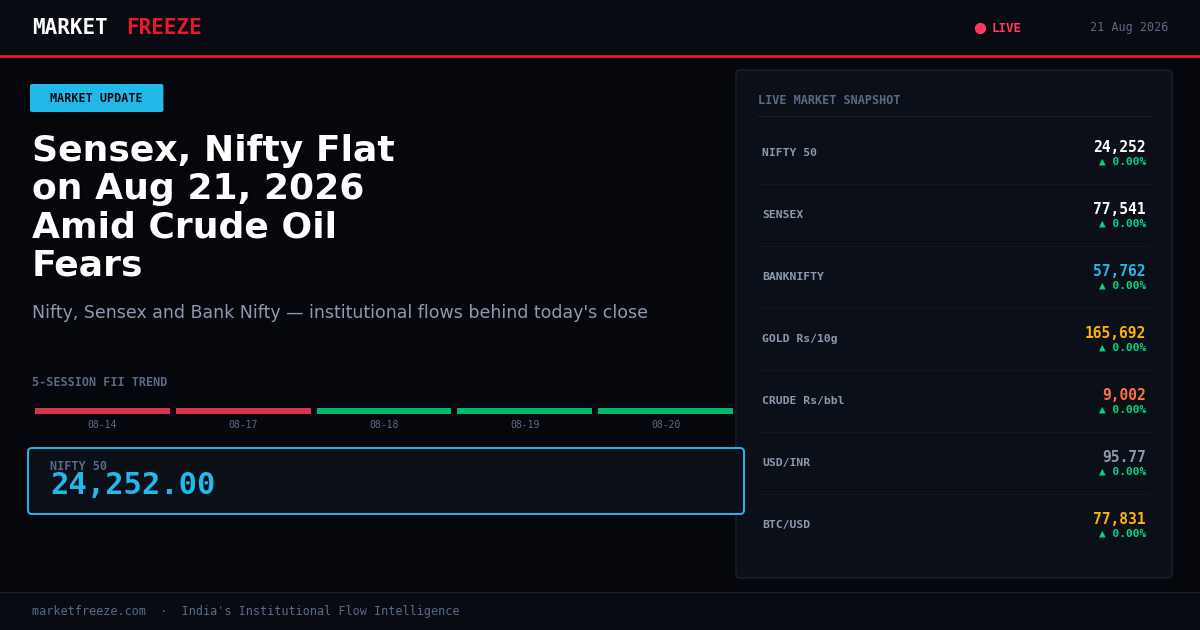
The Nifty 50 closed at 24,252.00, up 0.08%, while the Sensex ended flat at 77,541.00 on August 21, 2026, as elevated crude oil prices and geopolitical uncertainties kept investors on edge, with FIIs showing a net buy of ₹407.99 Cr and DIIs a net buy of ₹3,973.72 Cr.
FIIs Dial Back Buying as Crude Oil Spikes, DIIs Maintain Strong Support
Indian equities traded in a narrow range on Friday, August 21, 2026, with the Nifty 50 inching up 20.15 points to close at 24,252.00 and the Sensex adding a mere 3.11 points to settle at 77,541.00. This muted performance, despite positive contributions from banking heavyweights like HDFC Bank (adding 8.24 points to Nifty) and ICICI Bank (adding 5.74 points), was primarily driven by concerns over rising crude oil prices, which touched ₹9,002.00/bbl on MCX, and a general sense of caution stemming from weak global cues, including a significant fall in US markets and persistent inflation worries in the Eurozone bond markets.
Open a free demat account with
Upstox
or
Angel One
— zero brokerage on delivery trades.
Foreign Institutional Investors (FIIs) continued their net buying activity, albeit at a moderated pace, with a net inflow of ₹407.99 Cr. This contrasts with their more robust buying over the preceding two sessions, where net purchases stood at ₹1,651.53 Cr on both August 19th and 20th. The dip in FII buying intensity today, especially in the face of rising crude prices which typically signal inflationary pressures and potential interest rate hikes, suggests a degree of tactical caution. Conversely, Domestic Institutional Investors (DIIs) demonstrated unwavering confidence, recording a substantial net buy of ₹3,973.72 Cr, marking the third consecutive session of significant inflows exceeding ₹2,500 Cr. This strong DII support provided a crucial floor for the Indian benchmarks, preventing sharper declines amidst global headwinds.
Banking Stocks Shielded Nifty; IT Sector Under Pressure
The banking sector emerged as a key stabilizer for the Nifty 50 today. HDFC Bank’s positive contribution of 8.24 points and ICICI Bank’s 5.74 points highlight the resilience of large-cap banking counters. The Bank Nifty itself saw a healthy uptick of 0.46%, closing at 57,762.00. This sector strength is likely underpinned by strong DII participation, as these institutions often favor stable, large-cap financials during periods of market uncertainty. In contrast, the IT sector continued to face headwinds, with Infosys dragging the Nifty down by 7.19 points. Worries over US inflation and its potential impact on technology spending globally, coupled with a strong USD/INR (trading at Rs95.77, up 0.20%), are likely contributing to the subdued sentiment in IT stocks. This divergence between banking and IT clearly indicates a flow rotation, with DIIs bolstering financials while FIIs might be reassessing their exposure to rate-sensitive or export-oriented sectors like IT amidst a strengthening dollar and rising global yields.
Nifty’s Support and Resistance Levels Shaped by Recent Institutional Activity
Analyzing the recent flow data provides critical insights into potential support and resistance levels for the Nifty 50. The index closed at 24,252.00 today. Looking at the last three sessions, FIIs have been net buyers, injecting capital into the market. On August 20th, their net buy of ₹407.99 Cr, coupled with DIIs’ substantial ₹3,973.72 Cr purchase, suggests accumulation zones. The Nifty’s closing level of 24,231.85 on August 20th, where significant DII buying was observed, can be considered a near-term support. The robust buying from DIIs on August 18th and 19th, when they bought ₹2,579.31 Cr and ₹2,579.31 Cr respectively, alongside FII net buys of ₹1,651.53 Cr on both days, indicates strong underlying demand. The Nifty close of 24,154.90 on August 18th and 24,078.30 on August 19th points to crucial demand pockets. Therefore, the zone between 24,000 and 24,150 is likely to act as a strong support. On the upside, the psychological level of 24,300, which the index approached today, and the recent highs around 24,366.00 (seen on August 14th) could act as immediate resistance, especially if FII inflows do not pick up significantly.
Gold’s Surge Amidst Geopolitical Fears and Weakening Global Bonds
The current market environment is also marked by a significant spike in gold prices, with Gold MCX closing at ₹165,653.00/10g, up a notable 2.78% today. This surge in gold, often seen as a safe-haven asset, is directly linked to the elevated geopolitical uncertainties and the broader stress in global debt markets, as indicated by the Eurozone bond yields edging lower after a turbulent week. The rising crude oil prices (MCX at ₹9,002.00/bbl) also contribute to inflation fears, further bolstering demand for gold. While Indian equities traded flat, this strong performance in gold suggests that institutional investors are hedging their portfolios against potential macro-economic shocks. The correlation between rising gold prices and cautious institutional behavior (moderated FII buying) is evident. If crude oil prices continue to climb and geopolitical tensions escalate, gold could see further upside, potentially drawing capital away from riskier equity assets, impacting FII flows negatively.
Historical Parallel: Post-COVID Rally Correction Amidst Inflation Fears
A historical parallel can be drawn to late 2021 and early 2022, when markets experienced a strong rally followed by periods of consolidation and correction driven by rising inflation and impending interest rate hikes. During those phases, we observed a similar pattern of DIIs providing consistent support while FIIs became more selective, often reducing their net inflows during periods of heightened macro-economic uncertainty. For instance, in the week of August 14th to August 20th, 2026, we saw a shift from net outflows for FIIs (₹-2,535.10 Cr on Aug 17th) to net buying, albeit at lower volumes today. This mirrors the behavioral pattern of institutional investors in similar macro environments, where they tend to withdraw from riskier assets during periods of global economic stress and inflationary pressures. The current scenario, with rising crude and bond yield concerns, echoes these past dynamics, suggesting that sustained FII inflows will likely depend on the resolution of these macro-economic uncertainties.
Portfolio Framework: Banking and Gold as Havens
Given the current market dynamics – geopolitical risks, rising crude oil, and cautious FII sentiment – a prudent portfolio framework would involve overweighting defensive sectors and safe-haven assets. Specifically, investors could consider allocating a larger portion of their portfolio to banking stocks, particularly large-cap PSU and private banks exhibiting strong balance sheets and consistent DII backing. For instance, a target allocation of 25-30% to banking stocks could be considered, provided the Bank Nifty remains above its support level of 57,000. Simultaneously, a tactical allocation to gold, perhaps through gold ETFs or sovereign gold bonds, could provide a hedge. A target of 10-15% in gold, especially with MCX gold trading above ₹160,000/10g, could offer protection against inflation and geopolitical shocks. Conversely, a reduced exposure to rate-sensitive sectors like IT and high-growth, speculative stocks is advisable until FII flows rebound significantly and global inflation concerns subside.
What Changes This Outlook: Sustained FII Inflow Above ₹1,000 Cr Daily
The current market outlook, characterized by flat indices and divergent institutional flows, could shift significantly if Foreign Institutional Investors (FIIs) demonstrate a sustained commitment to Indian equities. A consistent daily net inflow of ₹1,000 Cr or more over a period of three to five trading sessions would signal renewed confidence and a greater acceptance of current valuations. Such a sustained inflow would likely coincide with a de-escalation of geopolitical tensions, a stabilization of crude oil prices below ₹8,000/bbl, and a softening of global inflation indicators. Without this substantial and consistent FII buying, the market may remain range-bound, with DIIs playing the role of the primary market support against global headwinds. A break above the 24,500 level on the Nifty, backed by such robust FII participation, would be a strong bullish signal.
Historical FII/DII Flow Data (Last 5 Sessions)
| Date | FII Net (Cr) | DII Net (Cr) | Nifty Close |
|---|---|---|---|
| 2026-08-14 | ₹-510.69 Cr | +₹4,353.09 Cr | 24,366.00 |
| 2026-08-17 | ₹-2,535.10 Cr | +₹5,101.46 Cr | 24,287.65 |
| 2026-08-18 | +₹1,651.53 Cr | +₹2,579.31 Cr | 24,154.90 |
| 2026-08-19 | +₹1,651.53 Cr | +₹2,579.31 Cr | 24,078.30 |
| 2026-08-20 | +₹407.99 Cr | +₹3,973.72 Cr | 24,231.85 |
Frequently Asked Questions
- Q: What did FII buy or sell on 20 August 2026?
A: FIIs were net buyers on 20 August 2026, with a net buy of ₹407.99 Cr. - Q: What did DII buy on 21 August 2026?
A: DIIs were net buyers on 21 August 2026, with a net buy of ₹3,973.72 Cr. - Q: Is FII buying or selling in August 2026?
A: In August 2026, FIIs have shown a mixed trend, with initial net outflows in the first half, followed by net buying in the latter half, indicating a cautious yet opportunistic approach.
Bottom Line
The Indian equity market closed largely flat on August 21, 2026, as global geopolitical concerns and rising crude oil prices weighed on investor sentiment, leading to a moderation in FII buying to ₹407.99 Cr. However, strong DII support, with a net buy of ₹3,973.72 Cr, provided a crucial cushion, particularly for the banking sector. The surge in gold prices to ₹165,653.00/10g reflects a growing preference for safe-haven assets amidst macro-economic uncertainties. A sustained increase in daily FII inflows above ₹1,000 Cr, coupled with a stabilization of crude oil prices, will be key to driving the Nifty 50 higher from its current trading range.
Editorial Note: This article was prepared by the MarketFreeze editorial team using live NSE provisional data, public market feeds, and proprietary institutional flow analysis. All price and flow figures are sourced directly from NSE, BSE, and CoinGecko as of 21 August 2026. This content is for informational purposes only and does not constitute investment advice. MarketFreeze is not SEBI-registered. Please consult a qualified financial advisor before making investment decisions. Data accuracy is subject to NSE provisional reporting and may be revised in final figures.