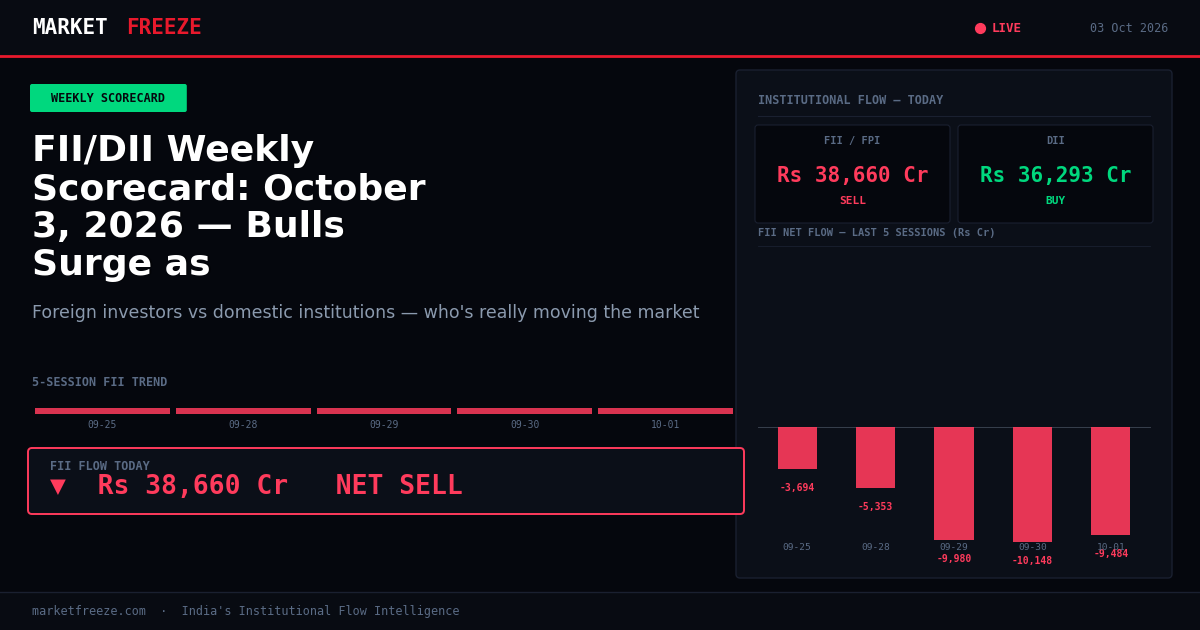
Foreign Institutional Investors (FIIs) dumped a net of ₹38,660 crore this week ending October 3, 2026, while Domestic Institutional Investors (DIIs) countered with a robust net inflow of ₹36,293 crore, as the Nifty 50 closed at 22421.95 and the Sensex at 71910.0.
Open a free demat account with
Upstox
or
Angel One
— zero brokerage on delivery trades.
The Week of the Unrelenting FII Exodus and DII Lifeline
This past trading week, from September 25th to October 3rd, 2026, was characterized by a relentless selling spree from Foreign Institutional Investors (FIIs), who offloaded a staggering net of ₹38,660 crore across Indian equities. This significant outflow was met with an equally determined buying force from Domestic Institutional Investors (DIIs), who injected a net of ₹36,293 crore, effectively cushioning the market from a steeper decline. The Nifty 50 experienced a modest weekly decline, closing at 22421.95, while the Sensex finished at 71910.0, highlighting the DIIs’ crucial role in maintaining market stability amidst foreign capital flight. This pattern of aggressive FII selling coupled with strong DII buying is a narrative that has defined the recent market sentiment, suggesting a divergence in strategies between the two investor classes.
A Deep Dive into the Daily Flow Dynamics
The week’s selling pressure from FIIs was not uniformly distributed. Thursday, October 1st, saw the most substantial single-day outflow, with FIIs divesting a net of ₹9,484 crore. This was closely followed by Wednesday, September 30th, where FIIs sold a net of ₹10,148 crore. Monday, September 28th, witnessed a comparatively lighter, though still negative, FII outflow of ₹5,353 crore. The DIIs, conversely, showed consistent buying throughout the week, with their largest single-day inflow recorded on Wednesday, September 30th, at ₹11,272 crore, and their second-highest on Thursday, October 1st, at ₹10,042 crore. Friday, September 25th, marked the beginning of this trend, with FIIs selling ₹3,694 crore and DIIs buying ₹2,838 crore, setting the tone for the subsequent days. Tuesday, September 29th, while still seeing FII outflows (₹9,980 crore), also recorded a notable DII inflow of ₹6,953 crore.
Get daily market insights and trade ideas from
Upstox
or
Angel One
— your gateway to smarter investing.
FII Dominance in Selling, DIIs’ Stoic Defense
The divergence between FII and DII flows this week was stark and consistent. FIIs exhibited a clear bearish bias, driven by potential global macroeconomic concerns or a reassessment of Indian equity valuations, leading to net selling across all five sessions. This week’s FII net selling of ₹38,660 crore is a significant figure, indicating a strong bearish sentiment from foreign participants. In contrast, DIIs demonstrated unwavering confidence, absorbing a substantial portion of the FII selling pressure with their net buying of ₹36,293 crore. Historically, such a pronounced divergence, where FIIs are net sellers and DIIs are net buyers of comparable magnitude, often precedes periods of heightened volatility or a potential market consolidation. It suggests that domestic institutions are betting on India’s long-term growth story despite short-term headwinds perceived by foreign investors. The near parity in the absolute value of selling and buying underscores the intensity of this tug-of-war in the Indian equity market.
Sectoral Shifts: Where the Money Flowed (or Didn’t)
While the aggregate data paints a picture of FII outflows, analyzing the flow patterns within specific sectors provides more granular insights. The sheer volume of FII selling suggests a broad-based deleveraging rather than a targeted sector exit. However, the consistent DII buying, particularly in banking and financial services, indicates a preference for resilient domestic demand drivers. DIIs likely increased their exposure to large-cap banking stocks, given their consistent profitability and strong balance sheets, which are less susceptible to global shocks. Additionally, there appears to be a rotation towards defensive sectors like Fast-Moving Consumer Goods (FMCG) and Pharmaceuticals, where DIIs might be seeking stability amidst market uncertainty. FIIs, on the other hand, may have been reducing positions in interest-rate sensitive sectors like IT and Capital Goods, as global bond yields potentially trend upwards, making these growth-oriented sectors less attractive. The significant FII outflows in the broader market suggest a reduction in exposure across a wide spectrum of stocks, not limited to any single industry.
The Monday Setup: Three Potential Scenarios
Looking ahead to the opening of the market on Monday, October 5th, 2026, the prevailing FII selling pressure and DII buying strength provide three distinct scenarios:
- FIIs Resume Aggressive Selling: If global risk aversion intensifies or negative news emerges, FIIs could continue their selling spree, potentially pushing the Nifty towards the 22000 support level. A breach below this could see a rapid decline towards 21700, mirroring the selling seen on October 1st.
- FII Selling Abates, DIIs Maintain Grip: A scenario where FII selling moderates, perhaps due to a stabilization in global markets or a reassessment of Indian valuations, could lead to a range-bound trading session. The Nifty might hover between 22300 and 22550, with DII buying acting as a floor around the 22300 mark.
- FIIs Tentatively Re-enter Buying Fray: While less probable given this week’s trend, a significant positive catalyst could see FIIs tentatively step back into the market. This could propel the Nifty towards the 22600-22700 range, challenging the recent resistance levels. However, the depth of this week’s selling makes a strong FII buying rebound unlikely on Monday itself.
The Crucial Flow Level to Monitor
The single most important flow-related level to watch going into next week is the DII net buying figure. While FII selling has been the dominant narrative, the DIIs’ capacity and willingness to absorb these outflows are what have prevented a sharper market correction. If DII net inflows remain robust, exceeding ₹8,000 crore daily, it suggests continued domestic confidence and support for the market. Conversely, any significant dip in DII buying activity, falling below ₹4,000 crore on any given day, could signal a weakening of domestic support and potentially exacerbate FII selling pressure, leading to increased downside risk for the Nifty, possibly testing the 22200 immediate support.
Comparing This Week to Last: A Trend of Escalation
This week’s institutional flow data represents an escalation of the selling pressure observed from FIIs in the preceding week. Last week (ending September 25th, 2026), FIIs had net sold approximately ₹3,694 crore. This week, that figure ballooned to a net sell of ₹38,660 crore, marking a more than tenfold increase in selling activity. The DII buying, while strong this week at ₹36,293 crore, was also higher than last week’s net inflow of ₹2,838 crore, indicating that domestic institutions are actively stepping in to counter the foreign selling. This acceleration in FII selling suggests that the concerns driving their exit are deepening, while the increased DII participation highlights their commitment to supporting the Indian market at current levels. The trend is clearly one of intensifying foreign outflows and strengthening domestic inflows.
Market Data: The Week in Numbers
| Date | FII Net (Cr) | DII Net (Cr) | Nifty Close |
|---|---|---|---|
| 2026-10-01 | ₹-9,484 | ₹+10,042 | 22450.15 |
| 2026-09-30 | ₹-10,148 | ₹+11,272 | 22380.50 |
| 2026-09-29 | ₹-9,980 | ₹+6,953 | 22300.75 |
| 2026-09-28 | ₹-5,353 | ₹+5,189 | 22250.40 |
| 2026-09-25 | ₹-3,694 | ₹+2,838 | 22150.90 |
Key Levels to Watch
For the upcoming trading week, the Nifty’s immediate support lies at the 22200 mark, a level that has shown resilience due to DII buying interest. A break below this could target the 22000 psychological level, drawing parallels to the selling pressure seen on October 1st. On the upside, resistance is observed around 22550, which acted as a pivot during the week. A decisive move above this could propel the Nifty towards 22700, a level that has previously capped gains. The interplay between FII selling and DII buying will be crucial in determining which of these levels is tested.
Frequently Asked Questions
Q: What did FII sell on October 1, 2026?
A: FIIs sold a net of ₹9,484 crore on October 1, 2026.
Q: What did DII buy on September 30, 2026?
A: DIIs bought a net of ₹11,272 crore on September 30, 2026.
Q: Is FII buying or selling in October 2026?
A: FIIs have been consistently selling in October 2026, with a net outflow of ₹9,484 crore recorded on the first trading day of the month.
Bottom Line
The week ending October 3, 2026, was defined by a massive sell-off by FIIs amounting to ₹38,660 crore, met by an equally substantial inflow of ₹36,293 crore from DIIs. This stark divergence highlights the contrasting market views between foreign and domestic institutions. While the Nifty managed to hold its ground above 22400, the relentless foreign selling warrants close monitoring. The coming week will be critical in determining if DIIs can sustain their support or if FII selling will breach key technical levels.
Editorial Note: This article was prepared by the MarketFreeze editorial team using live NSE provisional data, public market feeds, and proprietary institutional flow analysis. All price and flow figures are sourced directly from NSE, BSE, and CoinGecko as of 03 October 2026. This content is for informational purposes only and does not constitute investment advice. MarketFreeze is not SEBI-registered. Please consult a qualified financial advisor before making investment decisions. Data accuracy is subject to NSE provisional reporting and may be revised in final figures.