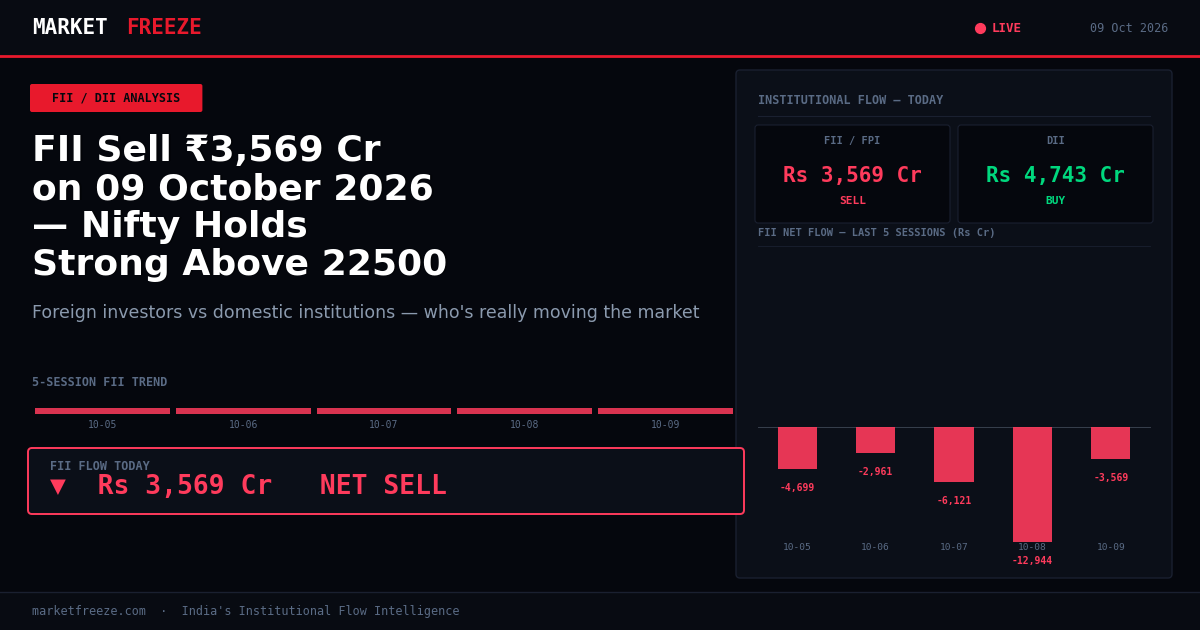
Parsing today’s institutional tape: Foreign portfolio investors (FPIs) offloaded a net of ₹3,568.90 Cr in Indian equities today, while domestic institutions (DIIs) countered with net purchases of ₹4,743.26 Cr.
FII Selling Abates but Remains Substantial
Today’s FPI net outflow of ₹3,568.90 Cr marks a significant reduction compared to yesterday’s ₹12,943.58 Cr sell-off. This indicates a de-escalation in selling pressure from foreign players. However, the gross buying figure of ₹10,373.99 Cr, juxtaposed against their selling, suggests a degree of opportunistic buying mixed with ongoing divestment. The DII net purchase of ₹4,743.26 Cr provided a critical buffer, absorbing a substantial portion of the FPI selling and preventing a sharper downside. This counter-balancing act by domestic funds is a key factor preventing further erosion in the indices.
Open a free demat account with
Upstox
or
Angel One
— zero brokerage on delivery trades.
Actionable Insight: While FII selling has eased, it has not ceased. Retail investors should monitor if the DII buying capacity can sustain against any renewed FPI outflows.
DIIs Step Up to Shore Up Markets
Domestic institutions were net buyers for the third consecutive session, with today’s purchase of ₹4,743.26 Cr being the second-highest in the last five sessions. This consistent buying from DIIs, particularly the significant ₹10,703.11 Cr on October 8th, highlights their commitment to accumulating Indian equities amidst FPI divestment. Their actions are directly responsible for the Nifty 50’s recovery to 22,520.45 today, a gain of 1.30%, and the Sensex’s rise to 72,472.00 (+1.23%). The Bank Nifty also saw a healthy uptick of 1.36%, closing at 55,257.00.
Actionable Insight: Given DII support, consider sectors where they have historically shown sustained interest, such as banking and select manufacturing stocks.
Historical Flow Context: Breaking an Eight-Week Losing Streak
The Nifty 50’s closing at 22,520.45 today officially breaks its eight-week losing streak, a significant event given the persistent selling pressure from FPIs. The table below illustrates the trend:
| Date | FII Net (Cr) | DII Net (Cr) | Nifty Close |
|---|---|---|---|
| 2026-10-05 | ₹-4,699.14 Cr | +₹5,181.62 Cr | 22,776.10 |
| 2026-10-06 | ₹-2,961.30 Cr | +₹5,088.92 Cr | 22,776.10 |
| 2026-10-07 | ₹-6,121.37 Cr | +₹4,596.57 Cr | 22,603.05 |
| 2026-10-08 | ₹-12,943.58 Cr | +₹10,703.11 Cr | 22,231.80 |
| 2026-10-09 | ₹-3,568.90 Cr | +₹4,743.26 Cr | 22,520.45 |
The sharp FPI outflow on October 8th was a critical juncture. Today’s reduced selling, coupled with DII buying, allowed the index to recoup losses and close above 22,500. This marks a potential inflection point, provided the underlying selling pressure doesn’t re-accelerate.
Actionable Insight: A sustained Nifty close above 22,500, supported by institutional flows, could signal a short-term bullish bias. However, watch for the 22,800 level as immediate resistance.
IT Sector Shows Resilience Amidst Earnings Anticipation
The Nifty IT index saw a gain of 3% today, a key driver of the market’s broader recovery. This aligns with reports of HCL Technologies’ shares rising 2.57% ahead of its Q2 FY27 results. While FPI selling has been broad-based, the resilience of IT stocks suggests selective accumulation or reduced FPI distribution in this segment. This runs counter to the broader narrative of FPIs reducing exposure across the board. The AI-driven growth narrative, as highlighted by Aswath Damodaran’s commentary on US stocks, may be providing a floor for Indian IT valuations, even as global yields rise.
Actionable Insight: Retail investors can consider building positions in fundamentally strong IT companies ahead of their earnings, especially those that have seen significant price corrections like HCL Tech, but be mindful of valuation multiples.
FMCG and Auto Stocks Lead Relief Rally
Beyond IT, FMCG and Auto sectors were also cited as leading the relief rally. This indicates broad-based buying interest across segments, absorbing some of the FPI selling. While specific flow data by sector is not available daily, the closing prices of indices and news reports suggest DIIs are actively deploying capital across these defensive and cyclical plays. The recovery in these sectors is critical for the overall index performance, especially if IT sees profit-taking post-results.
Actionable Insight: Focus on companies within FMCG and Auto that have strong domestic demand drivers and exhibit consistent DII accumulation patterns.
USD/INR Steady, Gold Edges Higher
The USD/INR pair closed marginally lower at Rs96.88, showing a slight depreciation in the rupee. This level of currency stability, despite significant FPI outflows, suggests robust underlying demand for INR or intervention from the Reserve Bank of India. Gold prices on MCX rose 1.25% to ₹151,945.00/10g, indicating a continued preference for safe-haven assets among some market participants. Crude oil prices, however, dipped 1.46% to ₹9,955.00/bbl, a positive sign for India’s import bill if sustained.
Actionable Insight: Monitor USD/INR for any sharp depreciation, which could signal renewed FPI outflows or increased import costs. Gold’s rise suggests ongoing global uncertainty which may impact risk assets.
Nifty Support and Resistance Levels
Based on today’s flow dynamics and index movement, the immediate support for the Nifty 50 is seen around the 22,350 mark. This level represents where DII buying stepped in to stem the prior day’s aggressive FPI selling. A breach below this could signal a retest of the 22,231.80 low seen yesterday. On the upside, resistance is building around 22,600, a level that saw selling pressure on October 7th. A decisive move above 22,700, potentially fueled by sustained DII accumulation and easing FPI outflows, would be required to challenge higher levels, possibly towards 22,850.
Actionable Insight: For traders, a break below 22,350 could signal a shorting opportunity, targeting 22,231.80, while a sustained move above 22,600 could initiate a long position targeting 22,850.
FAQ Section
What was the net FII sell figure today?
FIIs were net sellers of equities worth ₹3,568.90 Cr on October 9, 2026.
How much did DIIs buy in the last 5 sessions?
DIIs were net buyers for ₹5,181.62 Cr on Oct 5, ₹5,088.92 Cr on Oct 6, ₹4,596.57 Cr on Oct 7, ₹10,703.11 Cr on Oct 8, and ₹4,743.26 Cr on Oct 9.
Where did the Nifty 50 close today?
The Nifty 50 closed at 22,520.45 on October 9, 2026.
Sector Rotation and the DII Accumulation Strategy
The consistent buying from Domestic Institutional Investors (DIIs) is not merely a passive absorption of Foreign Portfolio Investor (FPI) selling; it points towards a strategic shift in sector allocation. The outperformance of the IT index, up by approximately 3% today, alongside the strength in FMCG and Auto, suggests a diversification of DII capital away from sectors experiencing significant FPI divestment. This could indicate a rotation towards defensives (FMCG) and cyclicals with strong domestic tailwinds (Auto), while IT benefits from global growth narratives and earnings anticipation. The fact that HCL Technologies’ stock saw a gain of over 2.5% ahead of its earnings is a prime example of this targeted accumulation. DIIs are likely leveraging FPI selling to acquire quality assets at more attractive valuations, anticipating a medium-term recovery.
A Glimpse into Past Market Reversals
The current scenario, where DIIs are providing a robust floor amidst FPI outflows, bears resemblance to market phases observed in late 2023. During that period, persistent FPI selling was effectively countered by domestic institutions, allowing the market to consolidate and eventually resume its upward trajectory. The Nifty 50’s ability to break an eight-week losing streak today, mirroring similar resilience shown in previous challenging months, underscores the growing influence and capacity of domestic capital. The key difference this time, however, might be the scale of global macroeconomic uncertainties, which could prolong FPI caution. The sustained buying of over ₹4,000 Cr by DIIs today, following a massive over ₹10,000 Cr purchase on October 8th, demonstrates a significant depth of conviction that could prove pivotal.
Retail Investor Positioning and Sentiment
While this article focuses on institutional flows, it’s crucial to consider the retail investor’s stance. With the market experiencing volatility and significant FPI outflows, retail participation often becomes a barometer of sentiment. The absence of major panic selling from retail segments, despite the market’s prior downturn, could be attributed to the DII support. Many retail investors tend to follow the lead of large domestic institutions. Today’s recovery, especially the Nifty’s close above 22,500, might embolden retail investors to increase their exposure, particularly in the sectors favored by DIIs. However, caution remains warranted, as retail participants are often the last to enter and the first to exit during sharp reversals, making them vulnerable to sudden shifts in institutional sentiment.
Crude Oil’s Decline: A Double-Edged Sword for Flows
The dip in crude oil prices to around ₹9,955.00 per barrel, while positive for India’s inflation outlook and import bill, can have complex implications for capital flows. Lower crude prices reduce the risk premium associated with emerging markets, potentially making them more attractive to foreign investors. If this trend continues, it could gradually ease the selling pressure from FPIs, especially if geopolitical tensions subside. The fact that gold prices edged higher to ₹151,945.00 per 10 grams, suggesting ongoing global risk aversion, creates a contrasting signal. This dichotomy means that while a lower oil price is fundamentally good, its impact on FPI flows might be gradual rather than immediate, especially with the lingering demand for safe-haven assets.
Bottom Line
Today’s session saw a significant moderation in FPI selling, with DIIs stepping up to absorb outflows and drive a relief rally across indices. The Nifty 50 broke its eight-week losing streak, supported by gains in IT, FMCG, and Auto sectors. While the selling pressure has eased, it has not entirely subsided, making sustained DII buying and the direction of FPI flows critical indicators for the coming sessions. Retail investors should focus on sectors demonstrating consistent domestic institutional support and monitor key index levels for confirmation of a sustained trend reversal.
Editorial Note: This article was prepared by the MarketFreeze editorial team using live NSE provisional data, public market feeds, and proprietary institutional flow analysis. All price and flow figures are sourced directly from NSE, BSE, and CoinGecko as of 09 October 2026. This content is for informational purposes only and does not constitute investment advice. MarketFreeze is not SEBI-registered. Please consult a qualified financial advisor before making investment decisions. Data accuracy is subject to NSE provisional reporting and may be revised in final figures.