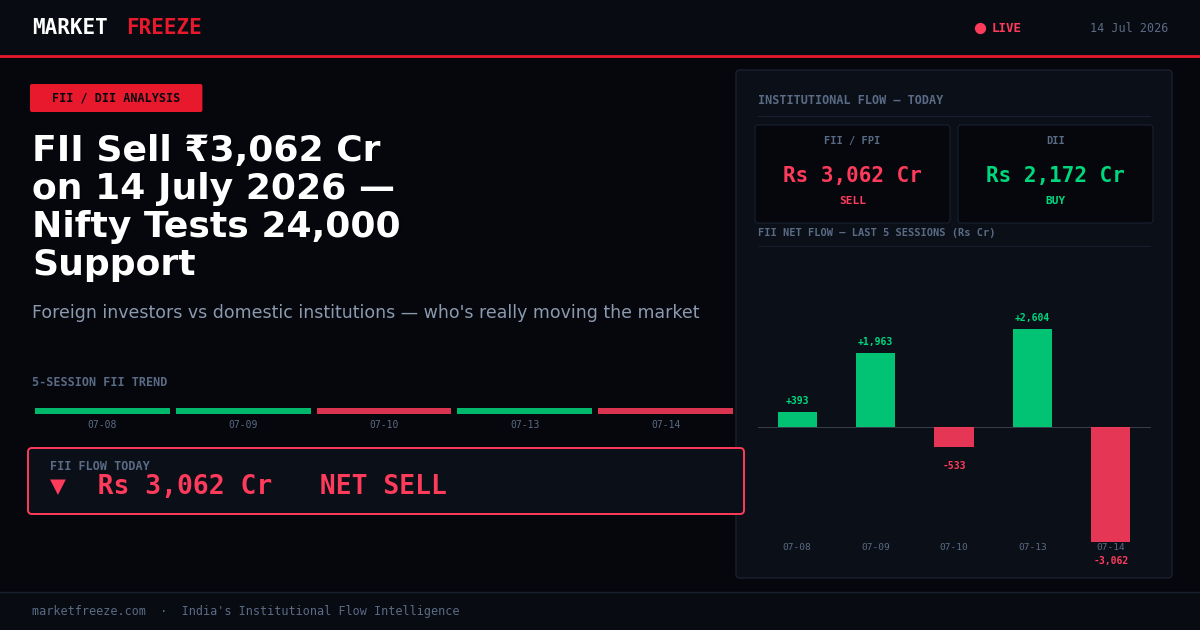
Institutional flow data released after market close shows Foreign Institutional Investors (FIIs) offloaded a substantial ₹3,062.27 Cr in Indian equities on July 14, 2026. This marks a significant reversal from the net buying of ₹2,603.72 Cr recorded on July 13. Domestic Institutional Investors (DIIs), however, continued their support, registering a net buy of ₹2,171.70 Cr today, slightly up from ₹2,019.68 Cr yesterday. The Nifty 50 closed at 24,083.60, down 0.53%, while the Sensex shed 0.63% to 77,129.00, indicating broad market weakness driven by external factors and the FII selling. This sharp FII outflow, coupled with a depreciating Rupee (USD/INR at ₹95.72, up 0.86%) and rising Crude MCX (₹8,131.00/bbl, up 1.98%), aligns with escalating US-Iran tensions which have pushed Brent crude prices higher, as reported by multiple financial news outlets.
Open a free demat account with
Upstox
or
Angel One
— zero brokerage on delivery trades.
FII Selling Dominates Amid Geopolitical Jitters and Weakening Rupee
The substantial FII sell-off of ₹3,062.27 Cr today is the primary driver of the day’s market decline. This outflow contrasts sharply with the net buying activity observed in the preceding two sessions, where FIIs deployed ₹2,603.72 Cr on July 13 and ₹1,962.80 Cr on July 9. The shift in FII stance suggests a renewed aversion to Indian equities, likely triggered by escalating geopolitical tensions in the Middle East. Reports indicate that fresh strikes between the US and Iran have intensified, leading to a surge in crude oil prices. The Rupee’s sharp depreciation past ₹95.72 against the US Dollar, reaching its weakest point since late May, exacerbates these concerns. For foreign investors, a weaker Rupee diminishes the value of their rupee-denominated investments when converted back to dollars, thus incentivizing selling. This outflow dynamic points towards potential weakness in sectors heavily reliant on foreign capital or those sensitive to currency fluctuations. The Nifty 50’s close at 24,083.60, below the 24,100 mark, reflects this institutional selling pressure.
DIIs Provide a Crucial Buffer as Foreign Flows Reverse
While FIIs were net sellers to the tune of ₹3,062.27 Cr, DIIs actively absorbed a significant portion of this selling pressure, buying ₹2,171.70 Cr worth of equities. This DII support has been a consistent feature over the last several sessions, with net purchases of ₹2,019.68 Cr on July 13 and ₹2,057.79 Cr on July 10. The sustained buying by domestic institutions, including mutual funds and insurance companies, has provided a crucial floor to the market, preventing a more severe decline. Their consistent deployment of capital, even as foreign investors pull back, indicates a different risk assessment or a focus on longer-term domestic growth drivers. The Banking Nifty, which experienced a notable decline of 1.23% today, often sees significant DII participation. While the overall market breadth remained bearish according to news reports, the DII buying suggests they are selectively accumulating positions, potentially in sectors that offer defensive characteristics or are less impacted by global headwinds. For retail investors, the persistent DII inflows highlight the importance of domestic capital in stabilizing the market during periods of foreign outflows.
Sectoral Implications: IT and Metals Show Resilience Amidst Broader Weakness
The directional flow of FII and DII capital provides insights into which sectors are gaining or losing favor. Today’s substantial FII selling of ₹3,062.27 Cr suggests that sectors typically favored by foreign capital, such as large-cap IT and select Consumer Staples, may have seen outflows. However, news reports also mention that IT and Metal sectors showed marginal gains, implying that while overall FII selling was high, there might have been pockets of selective buying or defensive positioning within these sectors. The Bank Nifty’s significant drop of 1.23% clearly indicates that financials are under pressure, likely impacted by the overall negative market sentiment and potentially higher interest rate expectations if global inflation concerns resurface due to crude oil price hikes. The Metal index, conversely, could be benefiting from a global demand outlook. China’s robust trade data, showing a 27% year-on-year increase in exports in June, suggests resilient global demand. This bodes well for export-oriented sectors like Metals, potentially attracting domestic buying even amidst FII selling. For retail investors, observing the relative strength of Metal stocks despite the broader market fall might offer trading opportunities, while caution is warranted in highly FII-dependent sectors like IT and financials.
Key Levels to Watch
Based on today’s trading activity and the significant FII selling, the Nifty 50 has breached key short-term support. The immediate support level to watch is the 24,000 mark. A sustained fall below this level, especially with continued FII selling, could open up downside towards 23,800. On the upside, resistance is now seen around the 24,250 level, where the index experienced selling pressure earlier in the session. A strong move above 24,350 would be required to signal a potential reversal of the bearish trend. The Bank Nifty’s sharp decline to 57,416.00 suggests immediate support at 57,000, with resistance seen at 57,750. For retail investors, monitoring the Nifty’s ability to hold the 24,000 level will be critical in assessing the immediate direction of the market.
Historical Flow Analysis: A Look at the Last Five Sessions
| Date | FII Net (Cr) | DII Net (Cr) | Nifty Close |
|---|---|---|---|
| 2026-07-08 | +₹393.19 Cr | ₹-383.43 Cr | 23,882.05 |
| 2026-07-09 | +₹1,962.80 Cr | +₹790.16 Cr | 23,962.80 |
| 2026-07-10 | ₹-532.86 Cr | +₹2,057.79 Cr | 24,206.90 |
| 2026-07-13 | +₹2,603.72 Cr | +₹2,019.68 Cr | 24,141.05 |
| 2026-07-14 | ₹-3,062.27 Cr | +₹2,171.70 Cr | 24,086.45 |
FAQ Section
Q: What did FII buy or sell on 14 July 2026?
A: FIIs were net sellers, offloading ₹3,062.27 Cr in Indian equities on July 14, 2026.
Q: What did DII buy on 14 July 2026?
A: DIIs were net buyers, deploying ₹2,171.70 Cr in Indian equities on July 14, 2026.
Q: Is FII buying or selling in July 2026?
A: In July 2026, FII activity has been mixed. After net buying in the early part of the month and on July 13, they turned into significant net sellers on July 14, offloading ₹3,062.27 Cr. The overall trend for July so far indicates a recent shift towards selling pressure from FIIs.
Bottom Line
Today’s session was dominated by a sharp reversal in FII flows, with a significant outflow of ₹3,062.27 Cr. This selling pressure, amplified by a depreciating Rupee and rising crude oil prices due to geopolitical tensions, dragged the Nifty 50 below the 24,100 mark. Domestic institutions, however, continued to provide strong support with net purchases of ₹2,171.70 Cr. While broad market sentiment turned negative, select sectors like Metals might find support from global demand cues, whereas Banking stocks faced considerable selling. Retail investors should closely track the Nifty’s movement around the 24,000 support level and observe if DII buying can sustain the market against FII outflows.
The broader market sentiment, as indicated by the Nifty 50’s retreat to 24,083.60, paints a cautious picture. Today’s substantial FII outflow of ₹3,062.27 Cr is a stark reminder of the volatility that foreign capital can introduce. For retail investors, this presents a dual challenge: navigating potential short-term downturns while identifying opportunities that domestic flows might be creating. The persistent buying by DIIs, who invested ₹2,171.70 Cr today, suggests a belief in the long-term growth trajectory of Indian equities, irrespective of global jitters. This is a crucial distinction for retail participants. Instead of reacting impulsively to FII sell-offs, a strategy focused on identifying fundamentally sound companies that DIIs are accumulating could prove more rewarding. This means looking beyond headline indices and delving into sector-specific performance and company fundamentals. The 0.53% drop in the Nifty indicates that over half a percent of its value was lost, underscoring the impact of today’s selling pressure.
Retail Investor Strategy: Navigating FII Volatility with DII Wisdom
The recent surge in FII selling, amounting to ₹3,062.27 Cr on July 14, 2026, necessitates a strategic re-evaluation for retail investors. The historical context of FII flows reveals a cyclical pattern; they are often the first to enter emerging markets during periods of stability and the first to exit when global risks escalate. Today’s outflows, contrasting sharply with their net purchases of ₹2,603.72 Cr just two days prior, exemplify this. Retail investors should adopt a strategy that leverages the stability provided by DIIs, who consistently bought ₹2,171.70 Cr. This involves looking for companies or sectors that DIIs are showing sustained interest in, as highlighted by their consistent net buying over the past few sessions. A deep dive into mutual fund portfolios, which are a significant component of DII activity, can reveal themes that domestic investors are betting on. Furthermore, focusing on companies with strong domestic demand drivers, robust balance sheets, and manageable debt levels can provide a buffer against currency depreciation, which saw the Rupee weaken by 0.86% to ₹95.72. The sentiment in the broader market, reflected by the Nifty’s fall, can create buying opportunities in quality stocks that are unfairly punished by indiscriminate selling. The percentage decline of 0.53% for the Nifty suggests that while significant, it wasn’t a catastrophic collapse, leaving room for selective accumulation.
Sector Rotation and Implications for Investment
The current market dynamics suggest a potential shift in sector preferences, driven by both global events and domestic institutional flows. The sharp rise in crude oil prices, linked to geopolitical tensions, impacts sectors that are energy-intensive or reliant on imported fuel. Conversely, sectors poised to benefit from a global recovery or strong domestic demand may see rotation. The Metal index, despite the overall market weakness, has shown resilience. News reports citing China’s strong trade figures, with exports up 27% year-on-year, indicate robust global demand for commodities. This could translate into continued strength for Indian metal companies, potentially attracting domestic capital. The Banking Nifty’s 1.23% decline, however, highlights a sector under pressure. This could be due to concerns about asset quality in a slowing global economy, or the impact of rising interest rates, should global inflation pressures intensify. IT stocks, historically a favourite of FIIs, might experience near-term headwinds due to outflows, but their long-term prospects remain tied to global digital transformation trends. Retail investors should monitor these inter-sectoral movements. A strategy of overweighting sectors with clear domestic demand catalysts or those benefiting from global commodity upcycles, while maintaining a cautious stance on highly FII-dependent sectors, might be prudent. The specific percentage drops in indices, like the 1.23% for the Banking Nifty, provide clear signals of sector-specific weakness or strength.
Historical FII Patterns: Context for Today’s Outflow
Understanding the historical context of FII flows provides valuable perspective to today’s substantial selling of ₹3,062.27 Cr. Over the past decade, FIIs have been a significant driver of Indian equity market performance, often leading rallies and exacerbating downturns. Their behavior is frequently correlated with global risk appetite and interest rate differentials. For instance, during periods of global uncertainty, such as the one potentially unfolding with escalated US-Iran tensions, FIIs tend to de-risk their portfolios. Looking at the past few sessions, their activity has been erratic: net buying of ₹2,603.72 Cr on July 13, followed by a significant sell-off. This whiplash indicates a market reacting sharply to external news. Historically, FII selling sprees, if sustained for multiple days, can lead to broader market corrections. However, the resilience shown by DIIs, who have been net buyers for many consecutive sessions, is a positive sign. Their continued investment, totaling ₹2,171.70 Cr today, suggests a structural shift in domestic savings allocation towards equities, providing a counter-balance to foreign flows. The percentage of daily trading volume attributed to FIIs can also be a key indicator; a high percentage of selling by FIIs on a significant volume day amplifies the impact.
Tomorrow’s Key Levels to Watch and Actionable Insight
As the market digests today’s developments, several technical levels will be critical for direction in the upcoming sessions. For the Nifty 50, the 24,000 mark now acts as a crucial psychological support. A sustained breach below this level, especially if accompanied by continued FII selling, could signal a move towards lower targets. Conversely, a strong rebound above the 24,250 resistance zone would indicate a potential short-term stabilization. For the Banking Nifty, the 57,000 level is the immediate support to monitor, with upside resistance seen around 57,750. The depreciating Rupee, currently at ₹95.72, and crude oil prices hovering around ₹8,131.00 per barrel, will remain key external factors. For retail investors, the actionable insight is to build a watchlist of high-quality companies that have demonstrated resilience during today’s sell-off, particularly those with strong DII backing. Focus on companies whose earnings are predominantly driven by domestic consumption or that are beneficiaries of global demand trends in sectors like metals, and consider initiating small, staggered positions as market sentiment stabilizes, rather than attempting to time the exact bottom.
Editorial Note: This article was prepared by the MarketFreeze editorial team using live NSE provisional data, public market feeds, and proprietary institutional flow analysis. All price and flow figures are sourced directly from NSE, BSE, and CoinGecko as of 14 July 2026. This content is for informational purposes only and does not constitute investment advice. MarketFreeze is not SEBI-registered. Please consult a qualified financial advisor before making investment decisions. Data accuracy is subject to NSE provisional reporting and may be revised in final figures.