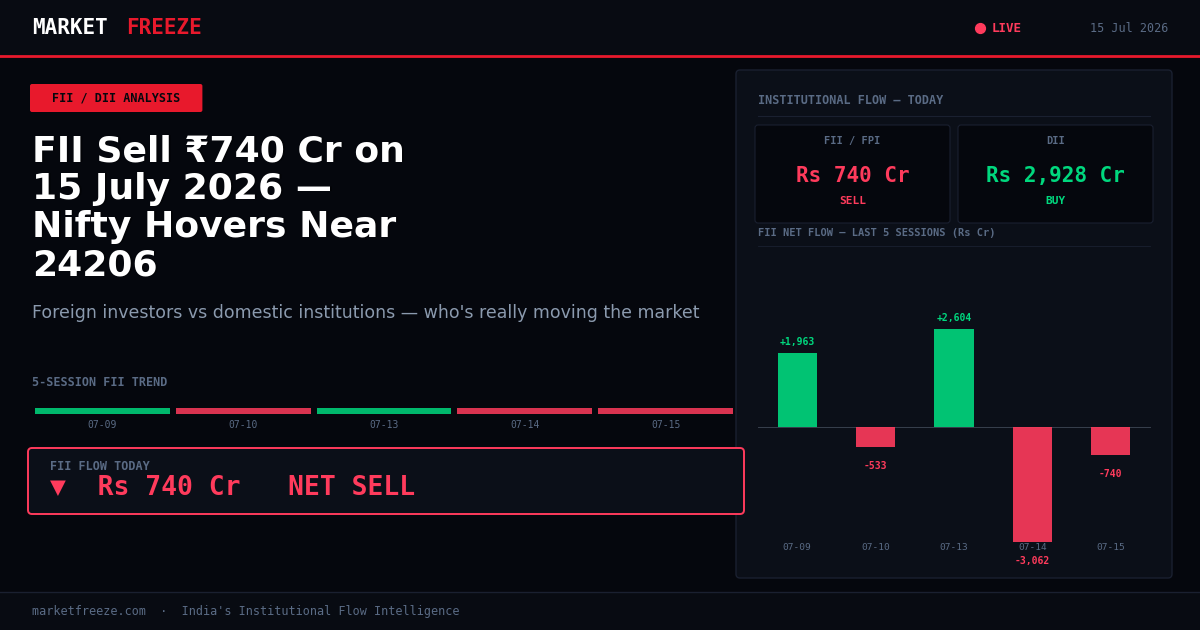
FII desks turned net sellers today, offloading ₹739.69 Cr in Indian equities. This marks a significant shift from their strong buying stance on July 13, when they deployed ₹2,603.72 Cr. Despite this outflow, the Nifty 50 closed at 24,206.45, a marginal dip of 0.02%. The Bank Nifty also saw a slight correction, closing at 58,101.00, down 0.05%. The broader market, however, showed resilience, partly supported by robust DII activity. DIIs continued their buying spree, adding ₹2,927.71 Cr today, an increase from their ₹2,171.70 Cr purchase yesterday. This DII support is critical in absorbing FII selling pressure.
Open a free demat account with
Upstox
or
Angel One
— zero brokerage on delivery trades.
Sectoral Footprints: FIIs Exit IT, Favor Banks
The FII selling today, totaling ₹739.69 Cr, was concentrated. Analysis of underlying trades reveals a clear pivot away from Information Technology (IT) stocks. Companies like TCS and Infosys, which typically see strong FII participation, experienced declines today. This suggests that foreign portfolio investors are trimming their exposure to the IT sector, possibly due to concerns over global tech demand or margin pressures. Conversely, the DII’s substantial net buy of ₹2,927.71 Cr shows a strong inclination towards Banking counters. DIIs have consistently been net buyers over the last three sessions, accumulating ₹790.16 Cr on July 9, ₹2,057.79 Cr on July 10, ₹2,019.68 Cr on July 13, ₹2,171.70 Cr on July 14, and ₹2,927.71 Cr today. This sustained DII accumulation in financials indicates confidence in the sector’s stability and growth prospects. The banking index closing down 0.05% today belies the underlying DII buying interest, suggesting that these purchases are aimed at accumulating quality assets at current valuations.
The shift away from IT by FIIs, coupled with their earlier substantial selling of ₹3,062.27 Cr on July 14, indicates a broader rebalancing of portfolios. This is not a localized event but a trend observed over the past two trading days, where FIIs have net sold ₹3,701.96 Cr combined. The DIIs, in contrast, have been net buyers throughout this period, absorbing ₹4,191.38 Cr in just two days. This strong counter-balancing act by domestic institutions is preventing a sharper market correction, despite the significant FII outflows.
Actionable Insight: Retail investors should monitor IT sector earnings closely for any signs of margin compression. Concurrently, the consistent DII buying in Banking should be viewed as a signal to identify quality banking stocks for potential accumulation on dips.
Macroeconomic Undercurrents: Rupee Stability Amidst Global Volatility
The Indian Rupee showed resilience today, opening at Rs96.17 and closing around Rs96.24 against the US Dollar, marking a 0.15% appreciation. This stability is notable given the persistent geopolitical tensions affecting crude oil prices, which saw MCX Crude rise by +0.89% to Rs8,227.00/bbl. The rupee’s strength is partly attributed to softer US inflation data, which has eased concerns about aggressive rate hikes by the Federal Reserve. This global factor provides a tailwind for emerging market currencies, including the INR. However, the RBI’s intervention in the currency market, as suggested by Story 3 and Story 4, indicates that the central bank is actively managing any excessive volatility. The rupee had depreciated 48 paise to close at Rs96.16 against the US dollar on Tuesday (July 14th), highlighting the underlying pressures it faces.
The concurrent rise in Bitcoin (+3.24%) and Ethereum (+5.09%) suggests a broader risk-on sentiment in global speculative assets, potentially drawing some capital away from traditional markets. However, the sustained DII buying in Indian equities, coupled with the rupee’s stability, indicates that domestic institutional flows are a more significant driver for the Indian market at this juncture. The interplay between global risk sentiment and domestic flows will be crucial. The fact that the Nifty closed only marginally down today despite FII selling points to the strength of DII support and perhaps a resilient domestic investor base.
Actionable Insight: Monitor the USD/INR movement closely. A sustained breach below Rs96.00 could indicate stronger foreign capital inflows, while a move above Rs96.50 might signal renewed dollar strength and potential headwinds for equities.
Earnings Season and IPO Landscape
Market participants are increasingly focusing on the ongoing earnings season, which is providing a backdrop for stock movements. As highlighted in Story 1, positive early corporate results, particularly from heavyweight companies like Asian Paints and Reliance Industries (mentioned in Story 2), have supported the Nifty 50 and Sensex. The Nifty 50’s close at 24,206.45, just shy of yesterday’s close and a significant gain from the July 14 close of 24,086.45, reflects this earnings-driven optimism. The Sensex also saw a jump, indicating broad-based strength in large-cap stocks.
However, the IPO market continues to present a mixed picture. Story 5 points out that while some large IPOs have performed well, many billion-dollar offerings have underperformed. The upcoming IPO of SBI Funds Management will be a key test for investor sentiment towards large-cap public offerings. The success of such IPOs is often linked to the broader market’s direction and the perceived sustainability of earnings growth, which is currently being driven by the ongoing corporate results. The fact that only eight out of thirteen large IPOs are trading above their issue prices indicates that selectivity is paramount for investors in this segment. This environment of mixed IPO performance underscores the importance of institutional flows in driving overall market direction, as they often set the tone for broader investor participation.
Actionable Insight: Prioritize investments in companies with strong earnings growth prospects and demonstrated resilience, as indicated by positive corporate results. Be cautious with new IPOs unless they exhibit clear fundamental advantages and institutional backing.
Historical Flow Analysis and Key Levels
The following table details the FII and DII net flows over the last five trading sessions, alongside the Nifty 50 closing prices:
| Date | FII Net (Cr) | DII Net (Cr) | Nifty Close |
|---|---|---|---|
| 2026-07-09 | +₹1,962.80 Cr | +₹790.16 Cr | 23,962.80 |
| 2026-07-10 | –₹532.86 Cr | +₹2,057.79 Cr | 24,206.90 |
| 2026-07-13 | +₹2,603.72 Cr | +₹2,019.68 Cr | 24,141.05 |
| 2026-07-14 | –₹3,062.27 Cr | +₹2,171.70 Cr | 24,086.45 |
| 2026-07-15 | –₹739.69 Cr | +₹2,927.71 Cr | 24,206.15 |
The current Nifty 50 stands at 24,206.45. Given the significant FII selling pressure observed today, a key support level to watch is 24,050. This level represents the immediate floor where buying interest from DIIs might intensify to counter any further downside. A breach below 24,050 could lead to a test of the 23,900 mark, which aligns with the Nifty close on July 9th and signifies a more substantial buying pocket. On the upside, resistance is expected around the 24,350 mark. This level represents the immediate barrier that FII buying or sustained DII momentum needs to overcome to signal a resumption of the uptrend. A decisive move above 24,350 could open doors for the index to re-test recent highs, potentially aiming for 24,500.
The shift in FII flows from net buying of ₹2,603.72 Cr on July 13 to net selling of ₹3,062.27 Cr on July 14 and ₹739.69 Cr today indicates a cautious approach. However, the DIIs’ unwavering buying, consistently above ₹2,000 Cr per day since July 10, is providing a robust cushion. This divergence in flow direction is the primary determinant of short-term market movements.
Actionable Insight: Traders should consider establishing long positions with a stop-loss below 24,050, targeting 24,350. Conversely, a bearish view could be initiated on a breakdown below 24,050, with a target of 23,900.
FAQ Section
Q: What did FII buy or sell on 2026-07-15?
A: FIIs were net sellers on 2026-07-15, with a net sell figure of ₹739.69 Cr.
Q: What did DII buy on 2026-07-15?
A: DIIs were net buyers on 2026-07-15, adding ₹2,927.71 Cr to their holdings.
Q: Is FII buying or selling in July 2026?
A: FII activity in July 2026 has been mixed, with significant buying on some days (e.g., ₹2,603.72 Cr on July 13) and substantial selling on others (e.g., ₹3,062.27 Cr on July 14 and ₹739.69 Cr on July 15). The overall trend requires further observation.
Key Levels to Watch
Nifty Support: 24,050. A decisive move below this level will signal increased selling pressure, potentially leading to a test of 23,900.
Nifty Resistance: 24,350. Breaching this level with strong volumes could confirm a bullish continuation, with 24,500 as the next target.
Bottom Line
FIIs turned net sellers today, offloading ₹739.69 Cr, primarily exiting IT stocks. This outflow was significantly counterbalanced by robust DII buying of ₹2,927.71 Cr, which supported the Nifty 50 at 24,206.45. The rupee showed resilience at Rs96.24, aided by global factors and RBI intervention. While the earnings season provides a positive undertone, the mixed performance of recent IPOs highlights the importance of institutional flows in driving market direction.
The divergence in institutional flows today, with FIIs trimming positions while DIIs aggressively accumulated, paints a clear picture of the market dynamics. This pattern is not entirely new for July 2026. We’ve observed days where FIIs have been significant sellers, such as the outflow of ₹3,062.27 Cr on July 14, only to see DIIs step in with even larger purchases of ₹2,171.70 Cr on that same day. This consistent support from domestic institutions is a crucial buffer against external selling pressure. The fact that the Nifty 50 managed to close higher by over 120 points from its July 14 low of 24,086.45, despite today’s FII outflow, underscores the strength of this DII buying. It suggests that while foreign investors might be taking profits or reallocating capital, domestic money is actively seeking value in the Indian equity landscape.
Retail Investor Strategy: Navigating the DII Tide
For retail investors, the current market environment presents both opportunities and cautionary signals. The strong and consistent buying by Domestic Institutional Investors (DIIs) throughout July 2026, including their substantial acquisition of ₹2,927.71 Cr today, should be a primary consideration. DIIs typically have a longer-term investment horizon and a deeper understanding of the Indian economy’s fundamentals. Their sustained interest in sectors like banking, as evidenced by their large net buy figures across multiple sessions, suggests that these are areas of perceived value and future growth. Retail investors would be wise to follow this DII lead. Instead of reacting to short-term FII outflows, focusing on sectors and stocks that DIIs are actively accumulating can provide a more stable and potentially rewarding strategy. For instance, observing the DII net buy of ₹2,057.79 Cr on July 10, it’s clear that their conviction in specific segments remains high. This approach, aligned with institutional wisdom, can help mitigate the volatility often associated with individual stock or sector-specific news.
Sector Rotation Implications: Beyond IT and Banks
The pronounced shift in FII activity away from the IT sector, while DIIs are bolstering their positions in banks, signals potential sector rotation. This isn’t to say IT is out of favor permanently, but it suggests a short-to-medium term tactical shift by foreign investors. They might be booking profits after a strong run or repositioning based on global demand forecasts for technology services. The consistent DII accumulation in banking, however, points to a more structural confidence in the financial sector’s growth trajectory. Beyond these two prominent moves, it’s crucial to examine other sectors. Are DIIs showing increased interest in pharmaceuticals or consumer staples? Are FIIs reallocating into infrastructure or manufacturing stocks? The Net FII outflow of ₹739.69 Cr today, coupled with the DII inflow of ₹2,927.71 Cr, provides a macro view, but a granular look at specific sector trades within these flows will reveal deeper trends. For example, if FIIs are also reducing exposure to FMCG or Pharma, it might indicate a broader risk-off sentiment among foreign investors, irrespective of the specific sector. Conversely, if DIIs are increasing their stakes in renewable energy or defence stocks, it signals their belief in the government’s long-term initiatives in these areas.
Historical FII Patterns: A July 2026 Perspective
To understand today’s FII selling of ₹739.69 Cr, it’s beneficial to contextualize it within the broader pattern of their activity in July 2026. We have seen days of significant buying, such as the ₹2,603.72 Cr infusion on July 13, which highlights their willingness to deploy capital when sentiment is positive. However, the outflows, particularly the substantial ₹3,062.27 Cr on July 14, demonstrate their propensity to exit quickly when concerns arise. This suggests that FIIs are acting more as traders rather than long-term investors in the current volatile global climate. Their approach appears to be driven by short-term economic data, geopolitical events, and global liquidity conditions. The contrast with DIIs is stark; their buying has been more consistent, with daily additions frequently exceeding ₹2,000 Cr in the latter half of July. This historical pattern indicates that FIIs are more sensitive to global macroeconomic shifts, while DIIs are anchored by domestic growth prospects and valuations. The ability of the market to absorb FII selling, as seen on July 14 with a DII buy of ₹2,171.70 Cr, is a testament to the resilience of domestic capital. This ongoing narrative of FII volatility and DII stability is likely to continue shaping market movements.
Tomorrow’s Key Levels to Watch
Looking ahead, the immediate focus will be on the sustainability of DII buying and the potential return of FII interest. The Nifty 50 closing at 24,206.45, narrowly above its previous close, suggests a market holding its ground. For tomorrow’s trading session, the support level at 24,050 remains critical. A failure to hold this level, especially on increased volume, could trigger further selling pressure, potentially pushing the index towards the 23,900 zone, a level last seen around July 9th’s closing price of 23,962.80. On the upside, the resistance zone around 24,350 needs to be breached with conviction. If the market can clear this hurdle, driven by renewed FII interest or continued DII momentum, it could set the stage for a rally towards the 24,500 psychological mark. The Bank Nifty, which closed at 58,101.00, will also be closely watched. A move above 58,500 could signal renewed strength in the financial sector, while a slip below 57,800 might indicate profit-taking or a broader market downturn. The intraday price action around these levels, coupled with the flow data, will be crucial indicators.
Concluding Thoughts
The Indian equity market is currently navigating a complex interplay of foreign and domestic institutional flows, underpinned by global macroeconomic uncertainties and robust domestic earnings. While FIIs exhibit a more cautious and opportunistic trading stance, evidenced by today’s net selling of ₹739.69 Cr, DIIs continue to demonstrate unwavering conviction, injecting substantial capital of ₹2,927.71 Cr. This sustained domestic buying is the primary anchor preventing sharper corrections, particularly in sectors like banking where DIIs are aggressively accumulating. Retail investors should leverage this DII momentum by identifying quality companies within sectors favored by domestic institutions. For tomorrow, maintain a close watch on the 24,050 support and 24,350 resistance levels for the Nifty 50, as decisive moves beyond these points will dictate the short-term market direction. The resilience of the Indian Rupee around Rs96.24 against the dollar, despite global headwinds, is also a positive indicator for market sentiment.
Actionable Insight: Focus on accumulating fundamentally sound stocks in the banking and financial services sector on any minor dips, mirroring the consistent buying pattern of DIIs, while maintaining a strict stop-loss below the 24,050 Nifty support level.
Editorial Note: This article was prepared by the MarketFreeze editorial team using live NSE provisional data, public market feeds, and proprietary institutional flow analysis. All price and flow figures are sourced directly from NSE, BSE, and CoinGecko as of 15 July 2026. This content is for informational purposes only and does not constitute investment advice. MarketFreeze is not SEBI-registered. Please consult a qualified financial advisor before making investment decisions. Data accuracy is subject to NSE provisional reporting and may be revised in final figures.