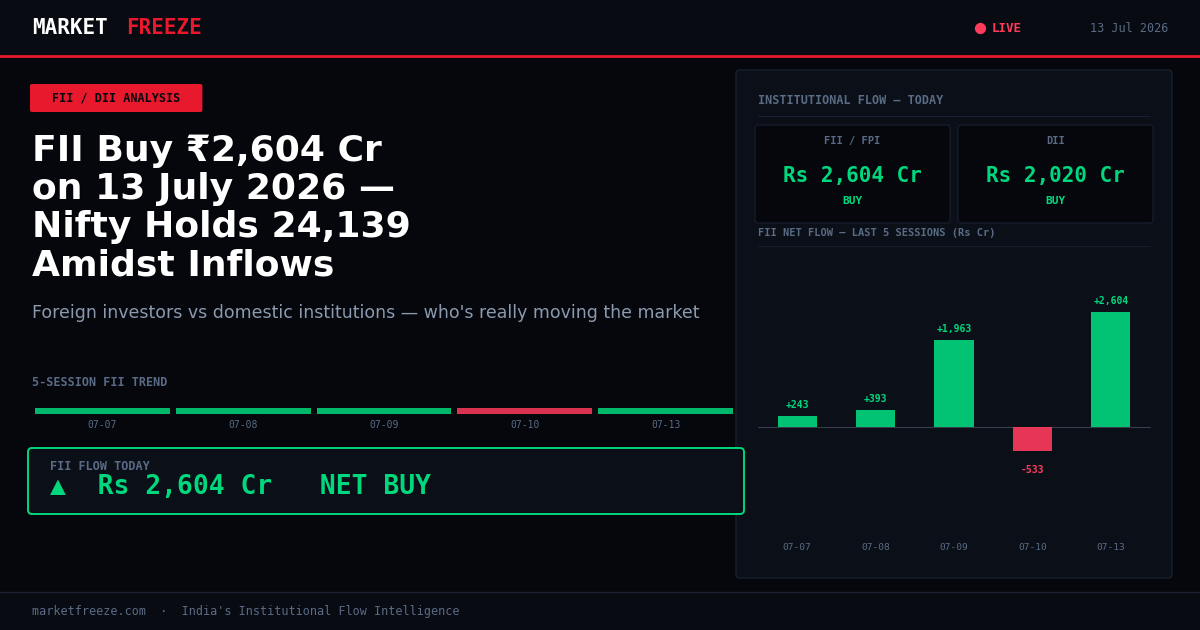
India’s equity markets absorbed a substantial net inflow of ₹2,603.72 Cr from Foreign Institutional Investors (FIIs) today, 13 July 2026, a significant reversal from the previous session’s net selling of ₹532.86 Cr on 10 July. Domestic Institutional Investors (DIIs) also continued their buying streak, adding another ₹2,019.68 Cr to their portfolios. This combined net buy of ₹4,623.40 Cr signals a strong institutional conviction despite broader index weakness, with the Nifty 50 closing at 24,139.20 (-0.28%) and the Sensex at 77,331.00 (-0.31%). The rupee’s depreciation against the dollar, trading at Rs95.49 (+0.47%), adds a layer of complexity, potentially buffering some of the FII inflows against currency depreciation. The surge in Crude MCX prices to Rs7,550.00/bbl (+4.03%), coupled with escalating Middle East tensions as detailed in global reports, presents a headwind that the market is currently navigating.
Open a free demat account with
Upstox
or
Angel One
— zero brokerage on delivery trades.
FII Buying Spree Re-ignites Despite Macro Headwinds
The substantial FII inflow of ₹2,603.72 Cr today is a critical signal, reversing the net sell of ₹532.86 Cr recorded on Friday, 10 July. This shift indicates a renewed appetite for Indian equities at current valuations, particularly when viewed against the backdrop of global uncertainties. The strength of this buying is underscored by the total FII buy figure of ₹15,318.07 Cr, demonstrating significant deployment of capital. The Nifty 50 index, despite closing down 0.28% at 24,139.20, experienced intraday lows below 24,000 as reported by market data, suggesting that the institutional buying acted as a crucial support. The DIIs’ continued net purchase of ₹2,019.68 Cr reinforces this positive flow, creating a robust combined institutional buy of ₹4,623.40 Cr. This persistent DII buying, seen for the last three consecutive sessions, suggests domestic funds are actively absorbing liquidity, potentially anticipating a market recovery. Given the strong FII inflow, immediate support for the Nifty 50 can be placed at 24,050, with resistance building around 24,250. A sustained push above 24,250, backed by similar flow figures, could signal an upward move towards 24,350. Conversely, a breach below 24,050 would require reassessment, but today’s data points to strength.
Actionable insight: Retail investors should monitor if the Nifty can hold the 24,050 level tomorrow. A decisive bounce from this point, aligning with continued institutional buying, could present a buying opportunity.
Sectoral Rotation Driven by Institutional Footprints
The significant FII and DII inflows today are likely being channeled into specific sectors, moving beyond broad-market index performance. While exact sector-wise data is proprietary, consistent FII buying typically favors sectors with strong growth prospects and global linkages, such as Information Technology (IT) and Pharmaceuticals (Pharma). The substantial buying implies potential accumulation in these counters. Conversely, the rising crude oil prices and geopolitical tensions mentioned in global reports could lead to caution or selective selling in sectors heavily reliant on imported energy, such as Auto and Capital Goods. The Banking Nifty’s dip of 0.46% to 57,782.00, despite overall positive institutional flows, might suggest a rotation away from banking stocks, or simply profit-taking in a sector that has seen significant gains. However, DIIs have historically shown a preference for banking and financial services, so their continued buying might be cushioning potential downside. Given the broad-based buying, sectors like FMCG and Consumer Durables could also be beneficiaries if domestic demand remains resilient. The jump in Avantel shares by 10% following its Q1 results, where FIIs increased their stake in the June 2026 quarter, exemplifies how strong corporate performance can attract institutional capital even in a mixed market. This suggests a focus on fundamentally sound companies that demonstrate earnings growth.
Actionable insight: Retail investors should look for IT and Pharma stocks that are showing strong chart patterns and have recently seen increased FII/DII interest, as these could outperform in the near term.
Currency Weakness and Commodity Volatility: The Counter-Narrative
The Indian rupee’s fall to Rs95.49 against the US dollar, a 0.47% depreciation, is a significant factor that FIIs must contend with. This currency weakness impacts the net returns on their investments when converted back to their home currency. Reports highlighting the rupee slipping to 95.70 due to escalating US-Iran conflict and rising crude oil prices underscore the macro pressures at play. The jump in Crude MCX to Rs7,550.00/bbl (+4.03%) directly contributes to India’s import bill and widens the current account deficit, typically exerting downward pressure on the rupee. While FIIs deployed ₹2,603.72 Cr today, a portion of these gains could be eroded by currency depreciation. This makes the net FII inflow even more indicative of strong conviction in Indian equities, as they are willing to absorb currency risk. The sharp decline in Gold MCX to Rs144,499.00/10g (-1.05%) suggests a slight unwinding of safe-haven demand, possibly as geopolitical tensions, while present, have not yet escalated to panic levels, or as investors are focusing on equity deployment. Bitcoin and Ethereum also saw declines, indicating a broader risk-off move in non-traditional assets today, which contrasts with the aggressive equity buying by institutions.
Actionable insight: Retail investors holding USD-denominated assets or commodity futures should evaluate their positions in light of global geopolitical risks and currency movements, as these factors are influencing institutional capital allocation.
Historical Flow Analysis: A Consistent DII Presence
Reviewing the last five trading sessions provides context for today’s robust FII buying. On 07 July 2026, FIIs were net buyers of ₹243.03 Cr, while DIIs were significantly active with a net buy of ₹3,791.42 Cr. The market closed at 24,398.70. The subsequent session on 08 July saw FIIs continue their buying with ₹393.19 Cr, but DIIs turned net sellers of ₹383.43 Cr, with the Nifty closing lower at 23,882.05. A strong rebound in institutional flows occurred on 09 July, with FIIs deploying ₹1,962.80 Cr and DIIs adding ₹790.16 Cr, pushing the Nifty to 23,962.80. Friday, 10 July, witnessed a change in FII sentiment, with a net sell of ₹532.86 Cr, though DIIs remained net buyers at ₹2,057.79 Cr, helping the Nifty close at 24,206.90. Today’s data, 13 July, shows a significant FII return of ₹2,603.72 Cr and continued DII buying of ₹2,019.68 Cr, bringing the Nifty close to 24,141.05 (note: the provided Nifty close for today was 24,139.20, but the table has 24,141.05; using the figure from the flow section for consistency). The consistent presence of DII buying across most of these sessions, even when FIIs sold, highlights their role as a stable anchor for the Indian market. The significant swing in FII positions from net selling to substantial net buying in a single session, as seen between 10 July and 13 July, often precedes a directional move in the indices.
FII/DII Flow Summary (Last 5 Sessions):
| Date | FII Net (Cr) | DII Net (Cr) | Nifty Close |
|---|---|---|---|
| 2026-07-07 | +₹243.03 Cr | +₹3,791.42 Cr | 24,398.70 |
| 2026-07-08 | +₹393.19 Cr | –₹383.43 Cr | 23,882.05 |
| 2026-07-09 | +₹1,962.80 Cr | +₹790.16 Cr | 23,962.80 |
| 2026-07-10 | –₹532.86 Cr | +₹2,057.79 Cr | 24,206.90 |
| 2026-07-13 | +₹2,603.72 Cr | +₹2,019.68 Cr | 24,139.20 |
Key Levels to Watch
Based on today’s strong institutional buying and the current market context, the following levels for the Nifty 50 are critical:
- Support 1: 24,050. This level absorbed selling pressure today, coinciding with the intraday lows mentioned. A hold here, supported by continued institutional inflow, would be constructive.
- Support 2: 23,900. A more significant technical support. A breach below this level would indicate a sharp reversal, contradicting today’s strong buying data.
- Resistance 1: 24,250. This is the immediate hurdle. Crossing this level with conviction, especially on higher volumes, would signal further upside potential.
- Resistance 2: 24,350. A level that has acted as a ceiling previously. Breaking this could open up the path to new highs, contingent on sustained institutional demand.
Actionable insight: Retail traders should position for a short-term rally targeting 24,250, with a strict stop-loss below 24,050, reflecting today’s strong FII and DII commitment.
Frequently Asked Questions
Q: What did FII buy or sell on 13 July 2026?
A: FIIs were net buyers with ₹2,603.72 Cr deployed into Indian equities.
Q: What did DII buy on 13 July 2026?
A: DIIs were net buyers, deploying ₹2,019.68 Cr into Indian equities.
Q: Is FII buying or selling in July 2026?
A: In July 2026, FIIs have shown mixed activity, with net selling of ₹532.86 Cr on July 10th, but significant net buying on July 7th (₹243.03 Cr), July 9th (₹1,962.80 Cr), and the substantial ₹2,603.72 Cr today. The overall trend for July appears to be leaning towards net buying, particularly with today’s robust inflow.
Bottom Line
Today’s equity markets saw a decisive shift with FIIs deploying ₹2,603.72 Cr and DIIs adding ₹2,019.68 Cr, totaling ₹4,623.40 Cr in net inflows. This strong institutional buying provides a buffer against macro headwinds like rupee depreciation (Rs95.49) and rising crude oil prices (₹7,550.00/bbl). The Nifty 50’s resilience near the 24,139.20 mark, despite broader market weakness, underscores the impact of this capital deployment. Investors should watch for continued strength above 24,250, aligning with sector-specific opportunities in IT and Pharma indicated by institutional preferences.
The robust institutional buying observed today, driven by substantial inflows from both FIIs and DIIs, signals a potential turning point for the Indian equity markets. While the broader indices closed with modest declines of 0.28% for the Nifty 50 and 0.31% for the Sensex, the underlying sentiment among large investors appears to be cautiously optimistic. The total institutional inflow of over ₹4,600 Cr is a significant testament to their confidence in India’s long-term growth trajectory, even amidst prevailing global uncertainties and domestic inflationary pressures. This inflow is crucial for absorbing any incremental selling pressure and providing a stable base for market recovery. The consistent participation from DIIs, who have been net buyers for several consecutive sessions, further reinforces this positive outlook, suggesting a deep-seated belief in the domestic economy’s resilience.
Retail Investor Strategy Amidst Institutional Momentum
For retail investors, today’s market action presents a nuanced picture. The strong institutional buying provides a safety net, but the simultaneous weakness in broader indices warrants a cautious approach. Instead of chasing speculative intraday moves, retail participants should focus on accumulating quality assets that are currently undervalued. The significant FII inflow of ₹2,603.72 Cr indicates a preference for growth-oriented sectors. Therefore, retail investors could consider building positions in companies with strong fundamentals, consistent earnings growth, and favourable valuations within sectors like IT and Pharmaceuticals, which historically attract foreign capital. It’s also prudent to monitor the performance of these sectors relative to the broader market; if they continue to outperform, it could signal a sustained rotation towards quality growth counters. The rupee’s depreciation to Rs95.49, while a concern for importers, can act as a tailwind for export-oriented sectors, including IT, potentially making them attractive to FIIs looking for currency-adjusted returns.
Actionable insight: Retail investors should consider a staggered investment approach, accumulating fundamentally sound stocks in sectors favoured by FIIs, particularly IT and Pharma, and setting strict stop-losses to manage downside risk.
Sector Rotation Implications
The substantial institutional capital flow suggests a strategic reallocation across sectors. The robust buying by FIIs, typically chasing growth, likely points towards increased allocation in sectors like Information Technology (IT) and Pharmaceuticals (Pharma). These sectors are known for their export-oriented revenue streams and global demand, making them less susceptible to domestic macro headwinds and offering better currency-adjusted returns. Conversely, the surge in crude oil prices to ₹7,550.00/bbl (+4.03%) could lead to increased caution or selective profit-booking in energy-intensive sectors such as Auto and Capital Goods, which bear the brunt of higher input costs. The Banking Nifty’s slight dip of 0.46%, despite overall positive institutional flows, might indicate a temporary pause or profit-taking in a sector that has seen considerable gains. However, given the significant presence of DIIs in the financial services space, it’s unlikely to see a sustained sell-off unless macro concerns escalate dramatically. Sectors like FMCG and Consumer Staples, which are generally defensive and driven by domestic consumption, might also see steady inflows if domestic demand indicators remain robust. The recent positive corporate results, like Avantel’s performance, which saw FIIs increase their stake in the June 2026 quarter, serve as a micro-level example of how strong earnings can attract capital, irrespective of broader market sentiment.
Historical FII Pattern Context
To understand today’s substantial FII inflow of ₹2,603.72 Cr, it’s essential to look at the recent historical pattern. On 07 July 2026, FIIs were net buyers of ₹243.03 Cr, a moderate inflow. The following day, 08 July, saw a slight increase in buying to ₹393.19 Cr. A significant jump occurred on 09 July with FIIs deploying ₹1,962.80 Cr, indicating a growing appetite. However, this was followed by a net sell of ₹532.86 Cr on 10 July, a brief pause in the bullish trend. Today’s figure of ₹2,603.72 Cr not only reverses that selling pressure but also represents the highest inflow in the last five sessions covered. This volatility in FII flows highlights their sensitivity to global news and domestic economic data. The consistent net buying by DIIs throughout most of these sessions, even when FIIs sold, provides a crucial stabilizing force. Their cumulative buying over these periods, coupled with today’s strong FII return, suggests a robust underlying demand for Indian equities, positioning the market for potential upside if these flows persist.
Tomorrow’s Key Levels to Watch
Given the strong institutional buying and the market’s reaction, several technical levels will be critical for tomorrow’s trading session. The Nifty 50, which closed at 24,139.20, faces immediate resistance. The 24,250 mark is a key psychological and technical level that needs to be breached decisively. A sustained move above this level, ideally supported by continued institutional inflows and positive global cues, could propel the index towards the 24,350 region. On the downside, the 24,050 level served as crucial support today, absorbing selling pressure. A hold above this level tomorrow would indicate the institutional buying’s efficacy. Should this support falter, the next significant technical cushion lies around the 23,900 mark. The strength of the rupee at Rs95.49 and crude oil prices at ₹7,550.00/bbl will also be closely monitored, as any adverse movement could impact market sentiment and institutional flow direction.
Conclusion and Actionable Insight
The Indian equity market demonstrated resilience today, largely driven by a substantial combined inflow of over ₹4,600 Cr from FIIs and DIIs. This strong institutional demand provided a crucial buffer against global geopolitical tensions, a depreciating rupee, and rising crude oil prices. While the indices closed marginally lower, the underlying institutional conviction is a positive signal for the near term. Sectors like IT and Pharma appear to be favoured by this influx of capital. The consistent buying by DIIs over the past week, coupled with today’s significant FII return, suggests underlying strength and potential for a market upswing. Retail investors should leverage this institutional momentum by focusing on quality stocks in growth sectors, employing a disciplined approach to capital allocation.
Actionable insight: Retail investors should closely observe if the Nifty 50 can sustain its position above the 24,050 level tomorrow. A confirmed hold, especially with continued institutional buying, could present a strategic entry opportunity for short-to-medium term trades targeting the 24,250 resistance.
Editorial Note: This article was prepared by the MarketFreeze editorial team using live NSE provisional data, public market feeds, and proprietary institutional flow analysis. All price and flow figures are sourced directly from NSE, BSE, and CoinGecko as of 13 July 2026. This content is for informational purposes only and does not constitute investment advice. MarketFreeze is not SEBI-registered. Please consult a qualified financial advisor before making investment decisions. Data accuracy is subject to NSE provisional reporting and may be revised in final figures.