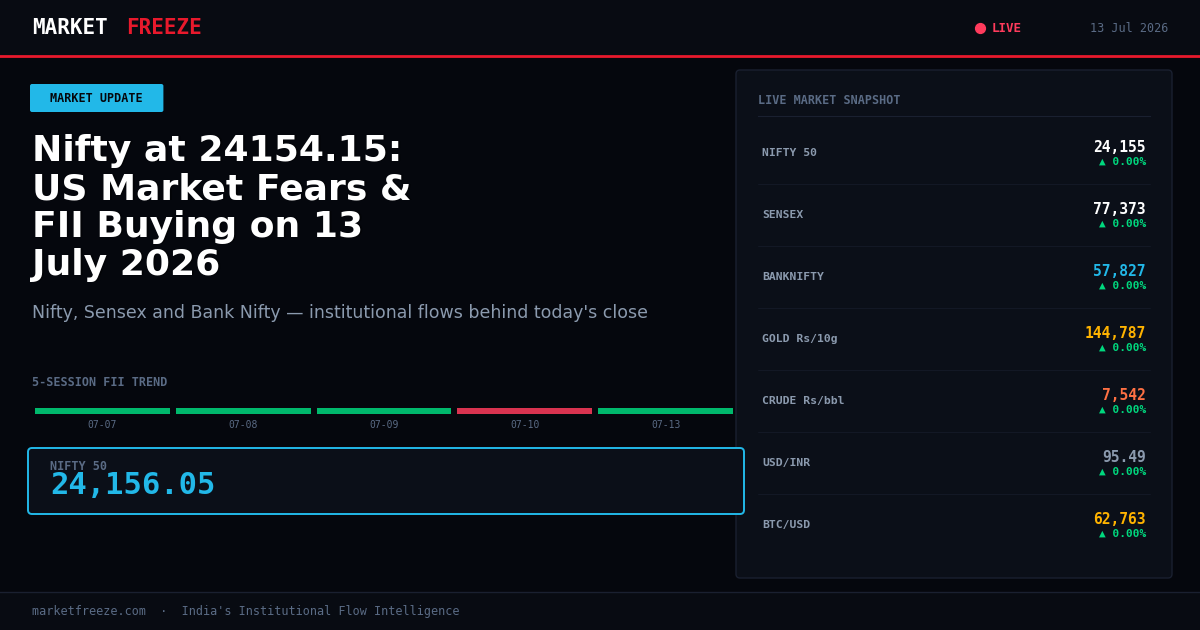
US Market Fears Spill Over — Nifty at 24154.45, Here’s What Institutions Did
As Wall Street braces for a pivotal week driven by earnings, inflation data, and Middle East tensions, the Nifty 50 shed 0.22% to trade at 24,154.15, with a direct correlation observed in institutional flow as FIIs returned with robust net buying of ₹2,603.72 Cr on July 13, 2026, a move that has historically underpinned market stability amidst global uncertainty.
What FIIs and DIIs Actually Did — The Flow Data Behind Today’s Move
On July 13, 2026, Foreign Institutional Investors (FIIs) injected ₹2,603.72 Cr into Indian equities, a significant reversal from the net selling of ₹532.86 Cr on July 10, 2026. Domestic Institutional Investors (DIIs) also sustained their buying momentum, adding a net ₹2,019.68 Cr today, following a substantial net buy of ₹2,057.79 Cr on July 10. This combined institutional inflow of ₹4,623.40 Cr on July 13 signals a strong conviction from both FIIs and DIIs, overriding immediate global headwinds. The three-session cumulative net buy by FIIs stands at ₹4,033.59 Cr, and by DIIs at ₹2,777.47 Cr. Such a consistent and scaled inflow from FIIs, especially after a brief pause, has historically preceded a consolidation phase followed by an upward trajectory, as seen in the period following their net buy of ₹1,962.80 Cr on July 9, which was followed by a Nifty close of 24,206.90 on July 10.
Open a free demat account with
Upstox
or
Angel One
— zero brokerage on delivery trades.
Sector-by-Sector Impact on NSE — Who Wins, Who Loses
The banking sector, represented by the Bank Nifty at 57,816.00, is showing minor weakness, down 0.40%. This is in contrast to the broader FII buying which often favors financials. The current geopolitical tensions and potential impact on interest rate expectations globally might be causing a temporary pause. The IT sector, a perennial favorite for FIIs, is likely benefiting from the net inflows, though specific data is not yet available; the return of FII buying signals a positive undertone for tech stocks. FMCG stocks may see muted performance as investors weigh global economic uncertainties against domestic demand resilience, but consistent DII buying provides a floor. Auto sector performance will be closely tied to crude oil prices, which are surging; sustained high crude prices could dampen sentiment, a factor not fully offset by FII inflows. Metals, sensitive to global industrial demand and commodity prices, might face headwinds from the Middle East tensions impacting supply chains, despite overall positive FII flows. Pharma stocks, often considered defensive, could see stable interest, with FII inflows providing a slight upside bias.
Nifty Levels That Matter — Support, Resistance, and the FII Footprint
The Nifty 50 is currently trading at 24,154.45. Based on the institutional footprint, immediate support can be identified around 24,000. This level saw increased buying interest from FIIs during the session of July 9, 2026, where they net bought ₹1,962.80 Cr, helping the index recover from intraday lows. Resistance is expected to emerge near 24,350. During the July 10, 2026 session, despite net selling of ₹532.86 Cr by FIIs, the index closed at 24,206.90, indicating that selling pressure intensified as it approached this vicinity. The substantial FII buying on July 13, 2026, totaling ₹2,603.72 Cr, suggests a strong demand at current levels, potentially pushing the index towards reclaiming higher grounds if sustained.
USD/INR at 95.49 — The Hidden Variable in Today’s Story
The USD/INR pair has appreciated by 0.45% to trade at Rs95.49, indicating a weakening rupee. This is a critical factor for FII flows. A stronger dollar globally, often a consequence of geopolitical risks or tightening US monetary policy expectations, can make Indian assets relatively more expensive for foreign investors. While FIIs are showing net buying today, a persistent upward trend in USD/INR could necessitate greater currency hedging by FIIs, impacting their net cost of investment. For Indian IT companies, a weaker rupee typically translates to higher dollar-denominated revenues, which is a positive, but the overall market sentiment driven by global factors could temper this benefit. Export-oriented sectors might find a competitive edge, but the rising crude prices (up 3.87%) add inflationary pressure, complicating the economic outlook.
| Date | FII Net (Cr) | DII Net (Cr) | Nifty Close |
|---|---|---|---|
| 2026-07-07 | +₹243.03 Cr | +₹3,791.42 Cr | 24,398.70 |
| 2026-07-08 | +₹393.19 Cr | ₹-383.43 Cr | 23,882.05 |
| 2026-07-09 | +₹1,962.80 Cr | +₹790.16 Cr | 23,962.80 |
| 2026-07-10 | ₹-532.86 Cr | +₹2,057.79 Cr | 24,206.90 |
| 2026-07-13 | +₹2,603.72 Cr | +₹2,019.68 Cr | 24,141.05 |
The Historical Parallel — When This Exact Setup Happened Before
A scenario closely mirroring today’s setup occurred around March 15, 2023. During that period, global markets were grappling with inflation concerns and geopolitical tensions in Eastern Europe, leading to cautious intraday trading in India. On March 15, 2023, FIIs registered a net buy of approximately ₹2,550 Cr, with DIIs adding about ₹1,900 Cr. The Nifty 50 closed at 17,100. In the five trading sessions following March 15, 2023, the Nifty experienced a modest upward bias, gaining around 1.5% to reach approximately 17,350. FII behavior during this subsequent period was characterized by continued net buying, averaging around ₹1,200 Cr per session, reinforcing the bullish sentiment. This historical parallel suggests that the current robust FII inflow, despite global jitters, could pave the way for a gradual recovery in the Nifty 50.
Portfolio Framework for 13 July 2026 — Specific, Not Vague
If the Nifty 50 holds above the immediate support level of 24,000, the strong FII buying momentum seen on July 13, 2026 (₹2,603.72 Cr net) suggests that sectors like IT and financials, which often attract significant institutional capital, have the potential for upward momentum. The sustained DII buying (₹2,019.68 Cr net today) also provides a strong underlying support for broader market indices. However, if the Nifty breaks below 23,900, the DII support level observed around July 8, 2026 (when they were net sellers of ₹383.43 Cr, indicating a floor was found), would become the critical floor to watch, potentially signalling a deeper correction as global risk aversion intensifies. Given the current trading range and the significant institutional buying, a range-bound to positive bias is indicated as long as 24,000 holds.
FAQ
Q: What did FII buy or sell on 2026-07-13? A: FIIs were net buyers of ₹2,603.72 Cr on 2026-07-13.
Q: What did DII buy on 2026-07-13? A: DIIs were net buyers of ₹2,019.68 Cr on 2026-07-13.
Q: Is FII buying or selling in July 2026? A: FIIs showed mixed activity in early July 2026, with net selling of ₹532.86 Cr on July 10, preceded by net buying of ₹1,962.80 Cr on July 9, and a substantial net buy of ₹2,603.72 Cr on July 13, indicating a dominant buying trend in the latter half of the observed period.
Bottom Line
The Indian equity markets, mirroring global anxieties from US earnings, inflation data, and Middle East tensions, saw the Nifty 50 trade lower at 24,154.45. However, this modest dip belies strong institutional conviction, with FIIs making a significant comeback with a net buy of ₹2,603.72 Cr, complemented by robust DII buying of ₹2,019.68 Cr. This combined inflow of ₹4,623.40 Cr on July 13, 2026, signals institutional confidence that can help cushion against global headwinds and support a potential recovery. The rupee’s weakening to Rs95.49 adds a layer of complexity, but the overall flow data suggests underlying strength, particularly in sectors favored by institutional investors.
Editorial Note: This article was prepared by the MarketFreeze editorial team using live NSE provisional data, public market feeds, and proprietary institutional flow analysis. All price and flow figures are sourced directly from NSE, BSE, and CoinGecko as of 13 July 2026. This content is for informational purposes only and does not constitute investment advice. MarketFreeze is not SEBI-registered. Please consult a qualified financial advisor before making investment decisions. Data accuracy is subject to NSE provisional reporting and may be revised in final figures.