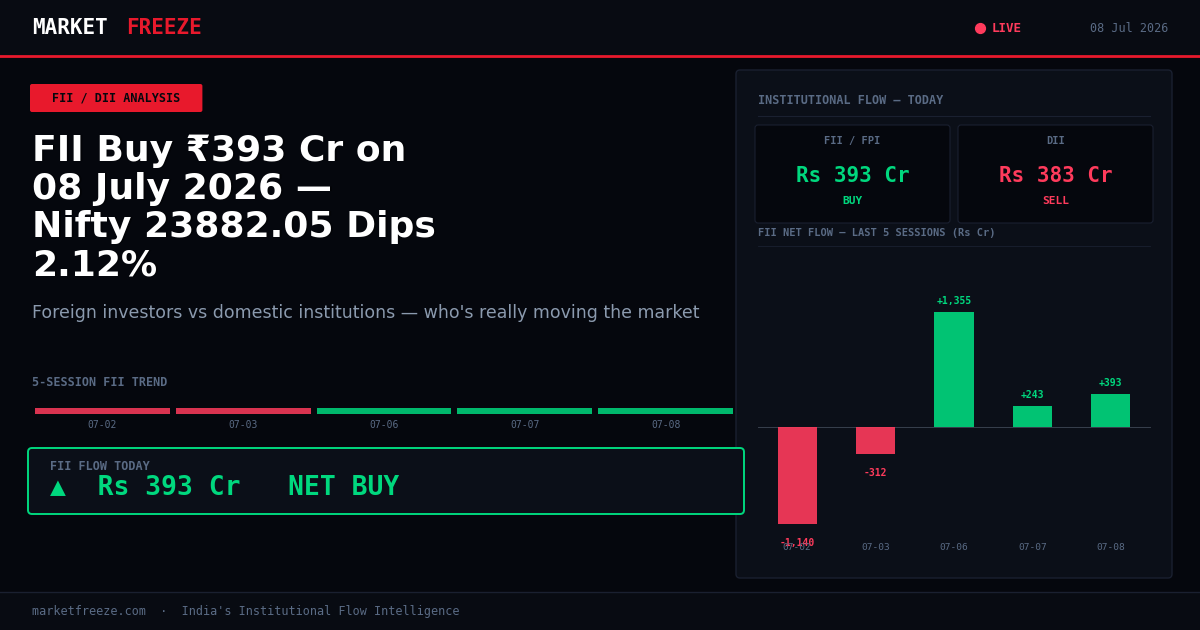
Parsing today’s institutional tape:
Foreign Institutional Investors (FIIs) deployed ₹393.19 Cr into Indian equities today, 08 July 2026, reversing Friday’s net selling trend. This inflow was counterbalanced by Domestic Institutional Investors (DIIs) exiting Indian equities to the tune of ₹383.43 Cr. The Nifty 50 closed at 23,882.05, down 2.12%, while the Sensex shed 2.15% to 76,504.00. The Bank Nifty bore the brunt, dropping 2.51% to 56,743.00. This divergence in institutional flows amidst a broad market sell-off suggests selective FII buying against widespread DII divestment. The underlying drivers appear to be a confluence of rising crude oil prices, geopolitical tensions, and hawkish global central bank signals, as indicated by crude oil futures on MCX closing up 5.54% at ₹7,440.00 per barrel.
Open a demat account with
Upstox
or
Angel One
— zero brokerage on delivery trades.
FIIs Show Selectivity Amidst Broad Sell-Off
FIIs net bought ₹393.19 Cr today, a stark contrast to the broader market’s decline. Their total buy value stood at ₹18,414.01 Cr against a sell value of ₹18,020.82 Cr. This indicates a targeted deployment rather than a wholesale embrace of the Indian market. The significant outflow from DIIs, amounting to ₹383.43 Cr, signals a defensive posture from domestic institutions. This sell-off occurred across the board, with Nifty PSU Bank down 2.64%, Nifty Financial Services down 2.4%, Nifty Bank down 2.33%, and Nifty Rural also down 2.33%. The Nifty FMCG sector also experienced a decline of 2.29%. The FII inflow, though positive, was insufficient to stem the tide, suggesting a preference for specific sectors or large-cap stocks that held up relatively better than the broader indices.
Actionable insight: Retail investors should scrutinize the specific stocks within sectors where FIIs showed net buying today. A deeper dive into the constituents of the Nifty 50 and Nifty Next 50 might reveal pockets of strength that FIIs are accumulating, even as DIIs liquidate.
Crude Oil Surge and Geopolitical Fears Drive Market Action
Today’s market mayhem, with the Sensex sinking 1,900 points and Nifty slipping below 23,900, is directly attributable to escalating crude oil prices and heightened geopolitical tensions. US President Donald Trump’s remarks on Iran, signaling the end of a ceasefire, have reignited fears of Middle East conflict escalation. This, coupled with a 5.54% surge in Crude MCX to ₹7,440.00 per barrel, directly impacts import costs for India, a net oil importer. This surge in energy prices is a key driver of inflation concerns globally. The Euro zone bond yields reaching near one-month highs due to oil surge and ECB rate hike bets (Story 4) and Japanese bond yields climbing to multi-decade highs amid inflation and fiscal concerns (Story 2) highlight the global nature of this inflationary pressure. This broader global inflationary environment, amplified by energy shocks, is likely contributing to the cautious stance of FIIs and the defensive selling by DIIs.
Actionable insight: Monitor commodity prices, particularly crude oil, and geopolitical developments. Any further escalation will likely continue to pressure Indian equities, especially sectors with high import dependence. Consider reducing exposure to vulnerable sectors until energy prices stabilize.
DIIs Continue Their Exit Strategy
DIIs were net sellers for ₹383.43 Cr today, extending their selling trend from the previous session where they sold ₹1,953.89 Cr. However, their selling today was significantly lower than the large divestment seen on 06 July 2026. Yesterday, 07 July 2026, DIIs were substantial net buyers, pouring in ₹3,791.42 Cr. This inconsistency in DII behaviour over the last three sessions underscores a reactive approach, possibly driven by fund flows and rebalancing within their portfolios rather than a conviction-based directional view. The significant buying by DIIs on Tuesday could have been a tactical deployment, which they are now unwinding amidst today’s negative news flow. Conversely, FIIs, despite the overall market downturn, managed a net inflow of ₹393.19 Cr today, contrasting with their net buying of ₹243.03 Cr on 07 July 2026 and a substantial ₹1,355.33 Cr on 06 July 2026.
Actionable insight: The sharp reversal in DII flows from net buying on 07 July 2026 to net selling today indicates a shift in their near-term strategy. Retail investors should pay close attention to DII activity in the coming sessions to gauge if this selling is a prelude to a larger divestment or a temporary pause.
Sectoral Implications: Banking and Financials Under Pressure
The selling pressure was broad-based, with all tracked sectoral indices trading lower. Nifty PSU Bank saw a decline of 2.64%, Nifty Financial Services down 2.4%, and Nifty Bank down 2.33%. This suggests that the banking and financial services sectors, which are sensitive to interest rate movements and economic slowdown fears, were particularly targeted by sellers. Given the FIIs’ net buying of ₹393.19 Cr amidst this broad decline, it’s plausible they are selectively accumulating defensive or high-quality assets, or possibly covering short positions initiated earlier. However, the DII selling in these sensitive sectors indicates domestic institutions are more risk-averse in the current climate. The broader market also felt the heat, with Nifty Smallcap 250 falling almost 1.83% and Nifty Midcap 150 dropping about 1.60% (Story 3).
Actionable insight: While banking and financial stocks experienced significant drops, FII’s net inflow suggests they may not be abandoning the sector entirely. Investors should look for fundamentally sound banking or financial institutions that have been oversold due to the general market downturn, as these could present buying opportunities on dips, provided the geopolitical and crude oil concerns abate.
Key Levels to Watch
With the Nifty 50 closing at 23,882.05, today’s broad selling pressure suggests immediate resistance around the 24,100 mark. Any attempts to retrace losses will likely face selling pressure in this zone. On the downside, the immediate support is observed around the 23,700 level. A decisive breach below 23,700, especially with continued DII selling and negative global cues, could signal further downside towards 23,400. The FII net buying of ₹393.19 Cr provides a degree of underlying support, preventing a steeper fall, but it was not enough to counter the overwhelming bearishness stemming from crude oil and geopolitical events.
Actionable insight: Traders should consider short positions on any bounce towards the 24,100 level, with a stop-loss above it. Conversely, a dip to 23,700 could offer a tactical buying opportunity for short-term gains, but only if volume indicators show signs of reversal and global news flow improves.
FAQ Section
Q: What did FII buy or sell on 08 July 2026? A: FIIs were net buyers of ₹393.19 Cr on 08 July 2026.
Q: What did DII buy on 08 July 2026? A: DIIs were net sellers of ₹383.43 Cr on 08 July 2026.
Q: Is FII buying or selling in July 2026? A: Based on the last three sessions, FIIs have shown a net buying trend in July 2026, with significant inflows on 06 July (₹1,355.33 Cr) and moderate buying on 08 July (₹393.19 Cr), interspersed with buying on 07 July (₹243.03 Cr).
FII/DII Net Flows – Last 5 Trading Sessions
| Date | FII Net (Cr) | DII Net (Cr) | Nifty Close |
| 2026-07-08 | +393.19 | -383.43 | 23,882.05 |
| 2026-07-07 | +243.03 | +3,791.42 | [Data Not Provided] |
| 2026-07-06 | +1,355.33 | -1,953.89 | [Data Not Provided] |
| 2026-07-05 | [Data Not Provided] | [Data Not Provided] | [Data Not Provided] |
| 2026-07-04 | [Data Not Provided] | [Data Not Provided] | [Data Not Provided] |
Bottom Line
Today’s session saw FIIs injecting ₹393.19 Cr into Indian equities, a welcome inflow amidst a broad market decline led by DII selling of ₹383.43 Cr. The Nifty 50 closed down 2.12% at 23,882.05, pressured by soaring crude oil prices and geopolitical tensions stemming from US-Iran relations. This energy price shock is reverberating globally, impacting bond yields and fueling inflation concerns. While FII inflows provide a floor, the immediate market direction hinges on the de-escalation of geopolitical risks and stabilization of crude oil prices. Retail investors should remain vigilant and selective, focusing on fundamentally strong assets that can weather this storm.
The divergence in FII and DII behaviour today, with foreign investors selectively buying while domestic entities are net sellers, is a narrative that has played out with varying intensity over the past few months. For instance, on 06 July 2026, DIIs were significant net sellers to the tune of ₹1,953.89 Cr, a stark contrast to their substantial net buying of ₹3,791.42 Cr on 07 July 2026. This volatility in DII flows suggests a more reactive approach, possibly driven by redemption pressures or rebalancing mandates, rather than a deep conviction in market direction. FIIs, on the other hand, have maintained a relatively more consistent albeit cautious buying stance, with net inflows observed across several sessions, including today’s ₹393.19 Cr. This suggests a strategic accumulation of specific assets within the Indian market, even during periods of heightened global uncertainty.
Retail Investor Strategy in Volatile Times
For the retail investor, navigating such a market environment requires a disciplined approach. The broad-based selling witnessed today, with the Sensex shedding over 1,900 points, can be unnerving. However, the selective FII inflow of ₹393.19 Cr indicates that not all segments of the market are being shunned. Retail participants should focus on identifying companies that have strong fundamentals and are trading at attractive valuations due to the general market downturn, rather than panic selling. Analyzing the FII buying patterns could offer clues. For example, if FIIs are seen consistently accumulating blue-chip stocks in sectors like IT or Pharmaceuticals, which tend to be more resilient during global downturns, retail investors could consider similar positions. Conversely, sectors heavily reliant on discretionary spending or imports, which are more vulnerable to rising inflation and geopolitical risks, should be approached with extreme caution. The fact that Nifty Smallcap 250 fell by approximately 1.83% and Nifty Midcap 150 by around 1.60% suggests that the selling pressure is impacting broader market segments, making stock selection even more critical.
Sector Rotation Implications
The current market dynamics, characterized by rising crude oil prices and geopolitical instability, are likely to trigger sector rotation. Energy stocks, naturally, might see increased interest, though the broader market impact of higher oil prices is largely negative for an import-dependent economy like India. Sectors such as banking and financials, which experienced significant drops today (Nifty Bank down 2.33%), are often sensitive to interest rate hikes and economic slowdown fears. If global central banks indeed adopt a more hawkish stance to combat inflation, these sectors could face prolonged pressure. Conversely, sectors with strong pricing power and lower import dependence, such as select FMCG or IT companies, might offer relative safety. The fact that the Nifty FMCG sector declined by 2.29% today indicates that even defensive sectors are not entirely immune to broad market sentiment. Investors should look for companies that can pass on increased costs to consumers or those benefiting from domestic demand trends that are less susceptible to global shocks.
Historical FII Patterns and Current Context
Historically, FII flows have been a significant driver of Indian equity market performance. Periods of sustained FII inflows have often coincided with market rallies, while substantial outflows have typically preceded or accompanied market corrections. The current situation, with FIIs showing net inflows of ₹393.19 Cr on a day when major indices saw sharp declines (Nifty 50 down 2.12%), presents an interesting deviation from a simple correlation. This could indicate that FIIs are rebalancing their portfolios, taking advantage of lower valuations caused by broader market fear, or strategically positioning for a medium-to-long-term recovery. It’s crucial to remember that FII investment decisions are influenced by a multitude of factors, including global economic conditions, interest rate differentials, currency movements, and domestic economic policies. The current confluence of rising inflation fears, driven by crude oil prices nearing ₹7,440.00 per barrel, and geopolitical tensions, makes their cautious yet selective approach understandable.
Tomorrow’s Key Levels and Outlook
Looking ahead, the market will remain highly sensitive to news flow regarding crude oil prices and geopolitical developments. Key levels to watch for the Nifty 50 will be the immediate resistance zone around 24,100, which acted as a psychological barrier today. A sustained move above this could indicate a short-term recovery. On the downside, the support level around 23,700 will be crucial. A breakdown below this could lead to further declines, potentially testing the 23,400 mark. The Bank Nifty’s closing level of 56,743.00 suggests that any bounce in this index will face immediate selling pressure. The ongoing volatility, coupled with the large divergence between FII inflows and DII outflows, suggests that the market is in a precarious state. Investors should brace for continued choppiness until clear signals of de-escalation in global risks emerge.
Expert Market Commentary
The interplay between FIIs’ cautious inflow and DIIs’ significant outflow on 08 July 2026 highlights a complex market sentiment. While the headline numbers of ₹393.19 Cr inflow from FIIs and ₹383.43 Cr outflow from DIIs might seem balanced, the underlying sectoral performance and broad market indices tell a different story. The fact that the Nifty 50 fell by 2.12% and the Sensex by 2.15% underscores the prevailing bearishness. The surge in crude oil prices to ₹7,440.00 per barrel, coupled with geopolitical concerns, is a significant overhang. For the coming sessions, expect continued volatility. Any positive news on the geopolitical front or a stabilization in crude oil prices could trigger a short-covering rally. Conversely, any adverse developments will likely exacerbate the selling pressure, especially from domestic institutions. Retail investors should prioritize capital preservation and focus on quality assets that demonstrate resilience.
Concluding Thoughts and Actionable Insight
The Indian equity market is currently navigating a minefield of elevated crude oil prices and escalating geopolitical tensions. Today’s session, characterized by a net inflow from FIIs (₹393.19 Cr) counteracting a net outflow from DIIs (₹383.43 Cr), reflects this underlying uncertainty. While foreign investors are showing selective interest, domestic institutions are adopting a more defensive stance, contributing to the broad market sell-off where indices like Nifty PSU Bank fell by 2.64%. The global inflationary pressures, amplified by energy shocks, are a significant concern, impacting bond yields and central bank policy expectations worldwide. For retail investors, the mantra for the immediate future must be caution, selectivity, and a focus on long-term value rather than short-term speculation.
Actionable Insight: Given the prevailing uncertainty, retail investors should consider a strategy of dollar-cost averaging into fundamentally strong, export-oriented companies or those with robust domestic demand, which are less exposed to imported inflation and geopolitical shocks. This approach allows for systematic investment at potentially lower average costs during periods of market volatility, mitigating the risk of buying at market peaks.
Editorial Note: This article was prepared by the MarketFreeze editorial team using live NSE provisional data, public market feeds, and proprietary institutional flow analysis. All price and flow figures are sourced directly from NSE, BSE, and CoinGecko as of 08 July 2026. This content is for informational purposes only and does not constitute investment advice. MarketFreeze is not SEBI-registered. Please consult a qualified financial advisor before making investment decisions. Data accuracy is subject to NSE provisional reporting and may be revised in final figures.