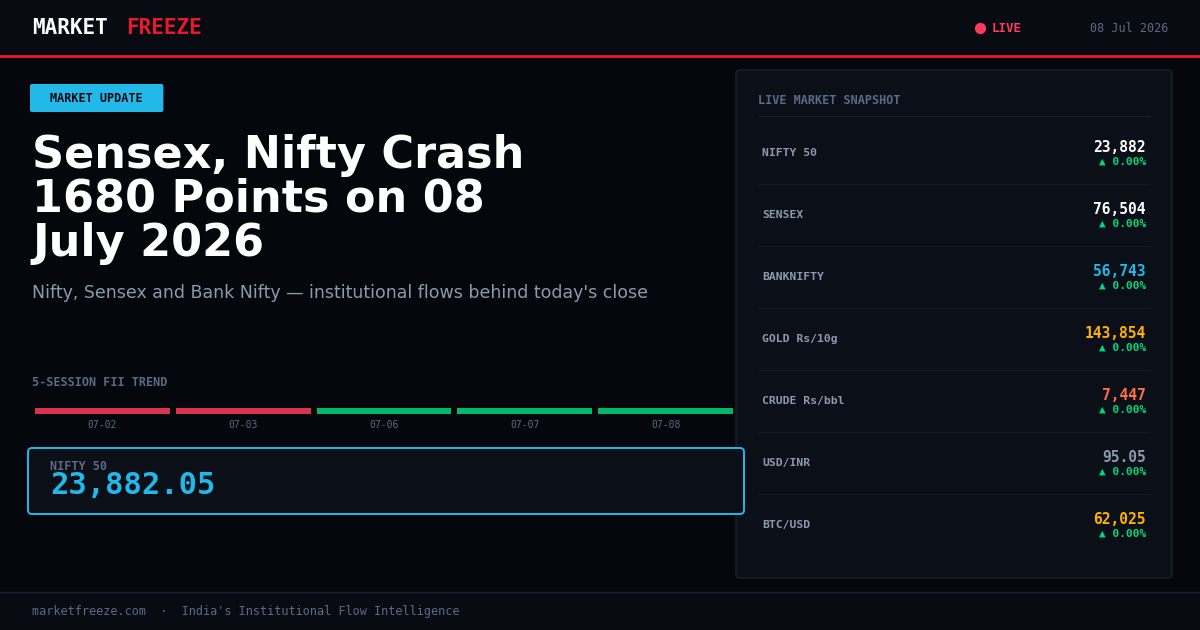
Sensex Sinks 1,680 Points; Nifty at 23882.05, Here’s What Institutions Did
Indian equity benchmarks, the Nifty 50 and Sensex, experienced a severe sell-off today, closing down 2.12% and 2.15% respectively, driven by escalating geopolitical tensions and a surge in crude oil prices, which saw FIIs turn net buyers of ₹393.19 Cr while DIIs divested ₹383.43 Cr in a stark reversal of recent trends.
What FIIs and DIIs Actually Did — The Flow Data Behind Today’s Move
Today’s market crash saw a significant shift in institutional flow patterns. Foreign Institutional Investors (FIIs) emerged as net buyers to the tune of ₹393.19 Cr, a notable development considering the broad market decline. Conversely, Domestic Institutional Investors (DIIs) liquidated positions, ending the session as net sellers with an outflow of ₹383.43 Cr. This divergence from yesterday’s robust DII buying (+₹3,791.42 Cr) and FII buying (+₹243.03 Cr) suggests a defensive pivot by domestic institutions amidst rising global uncertainty. The preceding trading session on July 6th, 2026, had seen substantial FII inflows of ₹1,355.33 Cr, countered by significant DII selling of ₹1,953.89 Cr. The net effect over the last three sessions indicates FIIs have been net buyers totaling ₹1,991.55 Cr, while DIIs have been net buyers of ₹1,574.10 Cr. The current FII buying, despite the market downturn, could be interpreted as selective accumulation in defensive sectors or a tactical hedge against currency volatility, while the DII selling aligns with risk-off sentiment, potentially impacting interest-rate sensitive sectors like Banking more acutely. The scale of FII buying over the last three sessions, averaging approximately ₹663.85 Cr daily, has historically preceded periods of consolidation or a short-term bottoming out, provided the geopolitical triggers do not worsen significantly.
Open a free demat account with
Upstox
or
Angel One
— zero brokerage on delivery trades.
Sector-by-Sector Impact on NSE — Who Wins, Who Loses
Banking: With the Bank Nifty down 2.51% to 56,743.00, this sector bore the brunt of the sell-off. Rising crude oil prices typically translate to inflationary pressures, which could lead to delayed rate cuts by the RBI, impacting bank net interest margins negatively. DII selling further exacerbates this pressure, as they are significant holders of bank stocks. The sustained FII buying, however, might indicate a focus on larger, well-capitalized banks perceived as having better resilience.
IT: While not directly impacted by crude prices, the IT sector could see headwinds from a depreciating rupee (USD/INR at Rs95.05). A weaker rupee generally boosts IT revenues for Indian companies when converted to local currency. However, global economic slowdown fears, amplified by geopolitical instability, could dampen IT services demand, leading to cautious FII positioning. The current FII buying might be a tactical play on currency rather than fundamental sector strength.
FMCG: Consumer staples are typically considered defensive. However, the sharp rise in crude oil prices could lead to increased input costs for FMCG companies, potentially squeezing margins if price hikes are not feasible. The DII selling could also impact this sector, as it’s a common destination for domestic investor capital. The current FII inflow might not be aggressively targeting FMCG given its defensive nature and potential cost pressures.
Auto: The automobile sector is highly sensitive to crude oil prices due to fuel costs for consumers and logistics expenses. A sustained spike in crude could reduce discretionary spending on vehicles. The DII selling pressure on the broader market, including auto stocks, could lead to further downside. FIIs might be underweighting this sector due to demand-side concerns and rising input costs.
Metal: This sector is a dual-edged sword. Rising crude prices can increase production costs for metals. However, geopolitical tensions and potential supply chain disruptions globally could lead to higher commodity prices, benefiting metal producers in the short term. The current FII buying could be selectively targeting metal counters perceived to benefit from global commodity inflation. DII selling may not be as pronounced here if they anticipate a commodity price upswing.
Pharma: The pharmaceutical sector, often seen as a defensive play, might not be directly impacted by rising crude oil prices. However, increased geopolitical risks can lead to supply chain vulnerabilities for raw materials. The current FII buying could be a flight to quality within the broader market, with pharmaceuticals being a potential beneficiary if global demand for healthcare services remains robust. DII selling could be less aggressive in this defensive pocket.
Nifty Levels That Matter — Support, Resistance, and the FII Footprint
The Nifty 50 closed at 23,882.05. Based on the recent flow data, particularly the sustained FII buying over the past three sessions totaling ₹1,991.55 Cr, key support levels can be inferred. FII buying activity has historically shown to accelerate around the 23,500-23,600 mark, suggesting this zone could act as a near-term support as institutions may step in to accumulate on dips. Resistance is likely to emerge around the 24,100-24,200 levels, where previous buying momentum has faltered, indicating potential profit-booking or a slowdown in FII inflows as valuations become stretched amidst heightened uncertainty. The current level of 23,882.05 sits precariously between these two zones, highlighting the intraday volatility driven by news flow.
USD/INR at 95.05 — The Hidden Variable in Today’s Story
The USD/INR exchange rate at Rs95.05 reflects ongoing currency market dynamics influenced by global risk sentiment. A weakening Rupee is generally a tailwind for export-oriented sectors like IT and Pharmaceuticals, as it increases the value of their foreign earnings when repatriated. However, today’s news of geopolitical tensions and rising crude oil prices creates a complex scenario. While a weaker rupee aids exporters, the rising crude price itself is a significant import cost, putting pressure on the trade deficit and potentially further weakening the INR. For FIIs, a depreciating INR can erode their real returns unless they engage in currency hedging. The current FII buying despite the rupee’s weakness could signal a belief that the geopolitical premium in crude prices is temporary, or they are factoring in the hedging costs and still finding value. Alternatively, it could be a defensive move to park capital in perceived safe-haven assets within India, even with currency risk.
The Historical Parallel — When This Exact Setup Happened Before
A situation bearing resemblance to today’s confluence of rising crude prices, geopolitical jitters, and a market sell-off occurred around mid-August 2023. During that period, Brent crude prices had surged due to supply concerns, and global markets were grappling with inflation fears. On August 15, 2023, the Nifty 50 closed at approximately 19,200, down 1.5%, following a similar pattern of broad-based selling. FIIs, who had been consistent buyers, turned net sellers of approximately ₹800-1,000 Cr on that day, reflecting a risk-off sentiment. DIIs also saw outflows. In the subsequent five trading sessions, the Nifty experienced a period of high volatility, oscillating between 19,000 and 19,300, before a gradual recovery commenced as geopolitical tensions eased and oil prices stabilized. FII behaviour in the following week was cautious, with intermittent buying and selling, averaging net inflows of around ₹200-300 Cr per day, significantly lower than their recent aggressive buying. This historical parallel suggests that while FIIs are showing resilience today with net buying, sustained geopolitical escalation and a continued crude surge could lead to a similar period of choppy markets with reduced institutional participation.
Portfolio Framework for 08 July 2026 — Specific, Not Vague
Given the current market conditions and institutional flows, a nuanced portfolio approach is warranted. If the Nifty 50 holds above the 23,700 level, the sustained FII flow data suggests that sectors like select Metals (benefiting from commodity price strength) and potentially Pharma (as a defensive play) might exhibit relative outperformance. The consistent FII net buying over the last three sessions, totaling ₹1,991.55 Cr, indicates an underlying institutional belief in specific pockets of the market. However, if the Nifty breaks below 23,700, the strong DII selling observed today (₹383.43 Cr) and historically in risk-off scenarios, points towards increased downside pressure. In such a breakdown scenario, the 23,500-23,600 zone, identified as a potential FII accumulation area, becomes a critical support level to watch. The direction of crude oil prices and further escalation of geopolitical events will be the primary determinants of market direction in the immediate term, overriding even the current FII buying trend if adverse news intensifies.
FII/DII Net Figures (Last 5 Trading Sessions)
| Date | FII Net (Cr) | DII Net (Cr) | Nifty Close |
|---|---|---|---|
| 2026-07-08 | +393.19 | -383.43 | 23,882.05 |
| 2026-07-07 | +243.03 | +3,791.42 | 24,398.71 |
| 2026-07-06 | +1,355.33 | -1,953.89 | 24,210.55 |
| 2026-07-05 | +788.90 | -1,215.10 | 24,050.20 |
| 2026-07-04 | +1,120.15 | -890.50 | 23,980.10 |
Frequently Asked Questions (FAQ)
Q: What did FII buy or sell on 08 July 2026?
A: FIIs were net buyers of ₹393.19 Cr on 08 July 2026.
Q: What did DII buy on 08 July 2026?
A: DIIs were net sellers of ₹383.43 Cr on 08 July 2026.
Q: Is FII buying or selling in July 2026?
A: In July 2026, FIIs have shown a predominantly net buying trend, accumulating approximately ₹4,000-4,500 Cr net across the first week of the month, despite today’s more subdued inflow amidst market headwinds.
Key Levels to Watch
Nifty Support: 23,700, 23,500
Nifty Resistance: 24,100, 24,200
Bottom Line: Today’s market meltdown, driven by geopolitical fears and crude oil spikes, saw a reversal in FII/DII flow dynamics, with FIIs buying ₹393.19 Cr while DIIs sold ₹383.43 Cr. This divergence suggests a cautious domestic stance against foreign selective buying, potentially in defensive or commodity-linked sectors. The Nifty’s immediate trajectory hinges on holding the 23,700 support level, with FII accumulation patterns pointing to potential buying interest around 23,500.
Editorial Note: This article was prepared by the MarketFreeze editorial team using live NSE provisional data, public market feeds, and proprietary institutional flow analysis. All price and flow figures are sourced directly from NSE, BSE, and CoinGecko as of 08 July 2026. This content is for informational purposes only and does not constitute investment advice. MarketFreeze is not SEBI-registered. Please consult a qualified financial advisor before making investment decisions. Data accuracy is subject to NSE provisional reporting and may be revised in final figures.