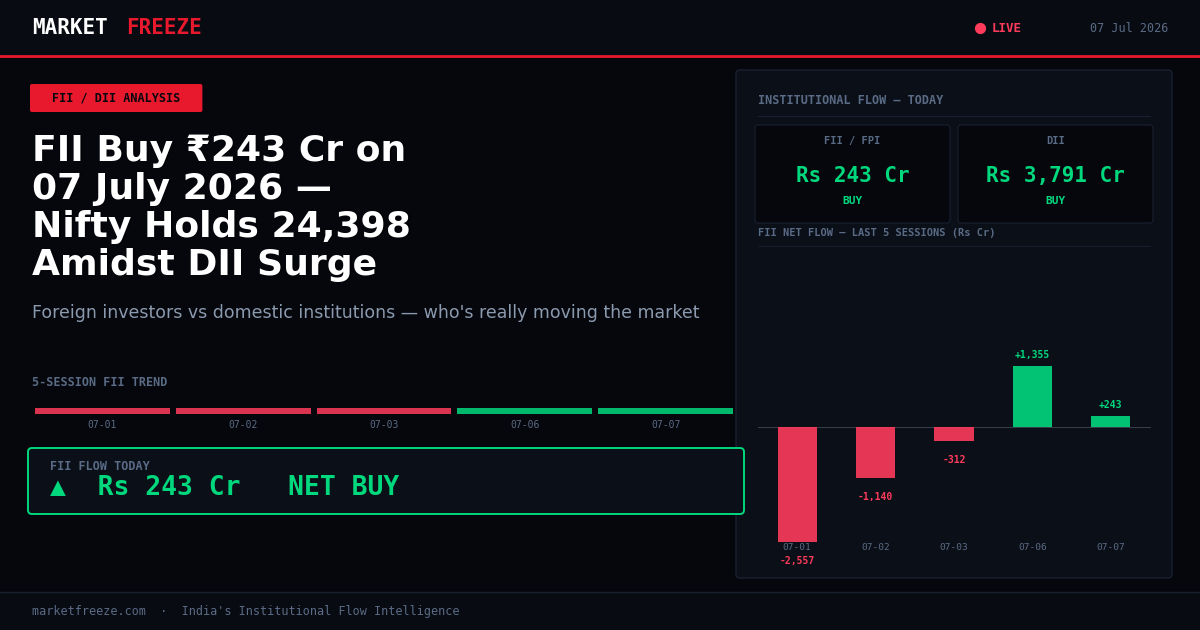
Institutional flow data released after market close shows DIIs deployed a significant ₹3,791.42 Cr into Indian equities today, providing substantial support against broader market declines. This strong domestic buying came as the Nifty 50 closed down 0.13% at 24,398.70 and the Sensex fell 0.13% to 78,181.00, snapping a four-day winning streak. FIIs also registered a net buy of ₹243.03 Cr, though their gross buy volume of ₹11,686.10 Cr was nearly offset by gross sales.
DII Dominance: Counterbalancing Sectoral Weakness
DIIs executed a net buy of ₹3,791.42 Cr on July 7, 2026. This aggressive domestic participation was critical given the overall market weakness observed during the weekly F&O expiry. Sectors like Nifty Defence, which fell 1.6%, Nifty Realty down 1.52%, and Nifty Metal slipping 1.12%, all saw declines. The robust DII buying indicates a continued belief in domestic growth stories, absorbing selling pressure across these specific segments. For retail investors, this DII action suggests that any dips in fundamentally strong domestic-oriented stocks might be met with buying interest.
The total DII buy volume for the day stood at ₹12,455.98 Cr, against sales of ₹8,664.56 Cr. This substantial net inflow from domestic institutions points to a strategic accumulation, particularly on a day when the Nifty Midcap 100 and Smallcap 100 indices dropped 0.30% and 0.55%, respectively. DIIs historically provide stability in broader market corrections, and today’s action confirms this pattern. Retail participants should observe DII concentration in mid and small-cap segments for potential sustained uptrends.
Open a free demat account with
Upstox
or
Angel One
— zero brokerage on delivery trades.
FIIs Maintain Minimal Positive Flow Amidst INR Strength
Foreign Institutional Investors recorded a net buy of ₹243.03 Cr today. This modest inflow contrasts with yesterday’s stronger buy figure of ₹1,355.33 Cr and follows a net sell of ₹311.82 Cr on July 3rd. While the headline number is positive, the gross FII buying of ₹11,686.10 Cr was closely matched by gross selling of ₹11,443.07 Cr. This indicates a selective deployment rather than broad-based accumulation. The strengthening of the USD/INR to Rs95.46, down 0.26% today, might have influenced FII decisions, making Indian assets marginally more expensive in dollar terms. Retail investors should monitor FII activity for specific sectors where gross buys significantly outweigh gross sells, indicating conviction.
The reduced net FII buying, despite a positive close, suggests that global factors, potentially including the UK bond market’s fiscal test for Andy Burnham, could be weighing on international fund allocation towards emerging markets. Even with a stronger Rupee, FIIs are not demonstrating aggressive buying in the current environment. This selective approach means that sectors like IT, which were noted to power the Nifty today, might be seeing focused FII interest, while others experience outflows. Retail traders should identify specific IT counters where FII accumulation is observed to align positions.
Sectoral Implications: Energy and Banking See Divergent Action
Today’s market saw Nifty Energy, Pharma, Media, PSU Bank, and Bank indices trading lower. Despite this, the substantial DII buying suggests underlying strength in some of these sectors, with domestic funds likely accumulating on dips. For instance, the Bank Nifty declined 0.16% to 58,201.00, yet DIIs continued their overall buying spree. This implies that DIIs might be finding value in the banking space after recent corrections. Retail investors holding banking stocks should consider DII support as a potential floor for further downside.
Conversely, the rise in Crude MCX by 1.11% to ₹6,949.00/bbl could put pressure on energy-importing sectors and potentially impact the profitability of certain industries. While Nifty Energy traded lower today, the DII net buying suggests a nuanced approach. It is possible DIIs are positioning for long-term trends despite immediate commodity price fluctuations. Retail participants should assess the impact of rising crude on specific energy and manufacturing stocks in their portfolio, while also factoring in DII accumulation.
Broader Market Indicators and Specific Stock Movements
The broader market breadth on BSE remained positive, with 4,158 stocks advancing against 1,516 declines and 2,444 unchanged. A notable 198 stocks hit 52-week highs, while 63 touched 52-week lows. This divergence indicates that while headline indices were down, significant pockets of strength exist. This aligns with the DII’s broad buying, suggesting that domestic funds are actively rotating into specific high-conviction stocks. Retail investors should not be swayed solely by index movements but analyze the performance of their individual holdings and the broader market’s underlying trends.
The news of Coal India OFS being fully subscribed also indicates demand for specific public sector undertakings. This, combined with the DII’s strong net inflow, suggests that specific value opportunities are being identified and capitalised upon by domestic funds. The crash of Trent by 12% despite IT stocks powering the Nifty highlights the stock-specific nature of today’s market. Retail investors should focus on individual stock fundamentals and avoid broad sector assumptions, especially in a market driven by selective institutional buying.
FII/DII Flow: Last 3 Sessions
| Date | FII Net (Cr) | DII Net (Cr) | Nifty Close |
|---|---|---|---|
| 2026-07-07 | ₹243.03 Cr (BUY) | ₹3,791.42 Cr (BUY) | 24,398.70 |
| 2026-07-06 | ₹1,355.33 Cr (BUY) | ₹1,953.89 Cr (SELL) | 24,430.35 (approx) |
| 2026-07-03 | ₹311.82 Cr (SELL) | ₹1,784.40 Cr (BUY) | 24,462.00 (approx) |
FAQ
Q: What did FII buy or sell on 2026-07-07?
A: FIIs were net buyers of ₹243.03 Cr on 2026-07-07, with gross purchases of ₹11,686.10 Cr and gross sales of ₹11,443.07 Cr.
Q: What did DII buy on 2026-07-07?
A: DIIs were net buyers of ₹3,791.42 Cr on 2026-07-07, with gross purchases of ₹12,455.98 Cr and gross sales of ₹8,664.56 Cr.
Q: Is FII buying or selling in July 2026?
A: In early July 2026, FII activity has been mixed. They were net sellers of ₹311.82 Cr on July 3rd, followed by net buys of ₹1,355.33 Cr on July 6th, and a smaller net buy of ₹243.03 Cr on July 7th. The trend indicates selective engagement rather than a consistent strong directional bias.
Key Levels to Watch
Given the Nifty 50 closing at 24,398.70 and the substantial DII buying today, immediate support levels are reinforced. The first support level for the Nifty can be seen around 24,000, a psychological mark where DIIs are likely to step in aggressively given their current buying trend. A breach below this could see the next support at 23,500, a level which would represent a roughly 3.6% correction from today’s close, and where sustained DII buying could again emerge.
On the upside, immediate resistance for the Nifty stands at 24,500, which would require FIIs to significantly increase their net buying. A sustained break above this could push the Nifty towards 24,800, representing a roughly 1.6% move from today’s close, where previous FII selling could resurface. Further strong resistance is anticipated at the 25,000 level, a significant psychological barrier that would need concerted FII and DII buying to overcome, indicating strong conviction in an upward trend. Retail investors should monitor FII participation when the Nifty approaches these resistance zones.
Bottom Line
Today’s market action was defined by robust DII buying of ₹3,791.42 Cr, which provided crucial support as both Nifty and Sensex snapped their four-day winning streaks, closing down 0.13% respectively. FIIs recorded a modest net buy of ₹243.03 Cr, indicating selective rather than broad-based foreign participation. The significant domestic accumulation, especially when sectors like Nifty Defence and Realty saw declines, suggests DIIs are finding value in specific segments. Retail investors should look for opportunities in areas where DIIs are showing strong conviction, particularly in mid and small-cap segments which also saw corrections today, while closely monitoring FII’s more cautious approach in the coming sessions.
Retail Investor Strategy: Aligning with DII Conviction
For the astute retail investor, today’s DII net buy of over ₹3,791 crore offers a crucial signal: domestic institutions are actively accumulating on dips. This strong domestic support, seen as the Nifty Midcap 100 dropped 0.30% and Smallcap 100 fell 0.55%, indicates that corrections in quality mid and small-cap stocks might present attractive entry points. Instead of panic selling during minor market downturns, retail participants could consider a staggered buying approach, focusing on fundamentally sound companies that align with India’s long-term growth story. The DII’s sustained buying, evidenced by their total buy volume of ₹12,455.98 crore, suggests a broader strategy of value hunting. Retail investors should research specific sectors and companies where DII presence has been consistently strong, potentially using this as a filter for their investment decisions. Observing the broader market breadth, with 4,158 stocks advancing on BSE, further reinforces the idea that opportunities abound beyond the headline indices.
Given the FIIs’ more cautious stance, registering a net buy of only ₹243.03 crore, retail investors should exercise discretion when chasing stocks solely based on short-term foreign inflows. While FIIs did show gross buying of ₹11,686.10 crore, their equally significant gross selling of ₹11,443.07 crore points to a highly selective approach. This selectivity implies that broad-based FII-driven rallies might be less likely in the immediate future. Therefore, aligning with DII-backed sectors and individual stocks, which currently demonstrate stronger conviction, could offer greater stability. Retail investors should also pay attention to the strengthening USD/INR to Rs95.46, as a stronger rupee can sometimes deter FIIs by making Indian assets more expensive in dollar terms. This dynamic further underscores the importance of domestic institutional flows in shaping market sentiment for local participants.
Sector Rotation Implications: Beyond Headline Declines
Despite Nifty Energy, Pharma, Media, PSU Bank, and Bank indices trading lower, the substantial DII net buy of over ₹3,791 crore suggests an active sector rotation is underway beneath the surface. While Nifty Defence fell 1.6% and Nifty Realty dropped 1.52%, DIIs’ willingness to absorb selling pressure indicates a potential re-rating or accumulation in specific pockets within these perceived weaker sectors. For instance, the Bank Nifty declined 0.16%, yet the overarching DII flow suggests domestic funds are accumulating banking stocks on dips, potentially anticipating future growth or improved asset quality. This implies that the decline in certain sectors might be viewed as a buying opportunity by long-term domestic investors, rather than a sign of fundamental weakness.
Conversely, while the Nifty IT sector showed resilience, with some IT stocks powering the Nifty, FIIs’ modest net buy of ₹243.03 crore overall means their participation might be highly concentrated in a few specific large-cap IT names. This selective FII interest, combined with their gross selling of ₹11,443.07 crore, suggests that the IT sector may not see uniform foreign buying across the board. Retail investors should avoid blanket assumptions about sector performance. Instead, they should delve into individual stock performance and institutional holding patterns to identify specific companies benefiting from strong DII conviction or targeted FII flows. The rise in Crude MCX to ₹6,949.00/bbl, for example, is a macro factor that could impact energy-dependent sectors, and DIIs’ sustained buying in a day where Nifty Energy traded lower could indicate a long-term bullish outlook despite short-term headwinds, offering a directional cue for patient investors.
Historical FII Pattern Context: A Nuanced View
Placing today’s FII net buy of ₹243.03 crore in historical context, it represents a continued pattern of selective engagement with Indian equities. This figure is significantly lower than their substantial buy of ₹1,355.33 crore just yesterday, and marks a rebound from the ₹311.82 crore net sell on July 3rd. Such fluctuating daily figures, where gross buys of ₹11,686.10 crore are nearly offset by gross sales, suggest FIIs are not currently committing to a strong, sustained directional play. This contrasts with periods of aggressive, broad-based FII buying that often precede major market rallies. The current FII behaviour aligns more with tactical adjustments and profit-booking in specific counters, rather than a significant increase in overall allocation to India. This cautious approach by foreign investors can be attributed to a confluence of global factors, including geopolitical uncertainties and central bank policies in developed economies, making them more discerning about capital deployment in emerging markets.
The relatively muted FII activity, particularly when the Nifty closed down 0.13%, underscores the critical role DIIs are playing in providing market stability. In previous periods of global uncertainty or capital outflows, FII selling often led to deeper market corrections. However, DIIs’ consistent net buying, exemplified by today’s ₹3,791.42 crore inflow and their total buy volume of ₹12,455.98 crore, has acted as a robust counterweight. This structural shift, where domestic liquidity is increasingly influential, fundamentally alters the market’s resilience. For retail investors, understanding this historical context is vital: while FII flows still matter for specific large-cap stocks and indices, the DII strength provides a more reliable underlying demand for the broader Indian market, especially in the mid and small-cap segments which dropped 0.30% and 0.55% respectively today.
Tomorrow’s Key Levels and Outlook
Looking ahead to tomorrow’s trading session, the Nifty 50, having closed at 24,398.70, will likely be influenced by the continuation of DII strength and any shifts in FII sentiment. Immediate support for the Nifty remains firm around the 24,200 mark, bolstered by today’s substantial DII buying. A sustained breach below this level could see the Nifty test 24,000, where the strong domestic liquidity could again provide a significant floor. The robust DII net buy of ₹3,791.42 crore suggests that any significant dip might be viewed as a buying opportunity by domestic institutions, limiting downside risk in the near term. Retail investors should monitor the cumulative DII buying in the opening hours for signs of continued strength, especially if global cues are negative.
On the upside, the Nifty faces immediate resistance at its previous high of 24,430.35, seen on July 6th. A sustained move above this level would necessitate a significant increase in FII buying, beyond today’s modest ₹243.03 crore net inflow, to generate strong momentum. The next resistance level is anticipated around 24,550, where profit-booking from both FIIs and short-term traders might emerge. A break above 24,550, backed by consistent FII participation, could pave the way for a test of 24,700. The mixed FII activity, with gross sales of ₹11,443.07 crore almost matching gross buys, indicates that overcoming these resistance levels will require a more concerted effort from foreign funds. The broader market breadth, with 198 stocks hitting 52-week highs today, suggests that stock-specific movements will continue to dominate, making it crucial for investors to focus on individual company fundamentals rather than just index levels.
Conclusion
Today’s market performance unequivocally highlighted the dominant role of Domestic Institutional Investors, whose substantial net buying of ₹3,791.42 crore proved instrumental in cushioning market declines and preventing a deeper correction. As FIIs continue their selective approach with a modest net buy of ₹243.03 crore, domestic liquidity remains the primary driver of stability and opportunity. Retail investors should leverage this insight by focusing on sectors and companies where DIIs are actively accumulating on dips, particularly in the mid and small-cap segments, as this strategy is likely to offer more resilient returns in the current market environment.
Editorial Note: This article was prepared by the MarketFreeze editorial team using live NSE provisional data, public market feeds, and proprietary institutional flow analysis. All price and flow figures are sourced directly from NSE, BSE, and CoinGecko as of 07 July 2026. This content is for informational purposes only and does not constitute investment advice. MarketFreeze is not SEBI-registered. Please consult a qualified financial advisor before making investment decisions. Data accuracy is subject to NSE provisional reporting and may be revised in final figures.