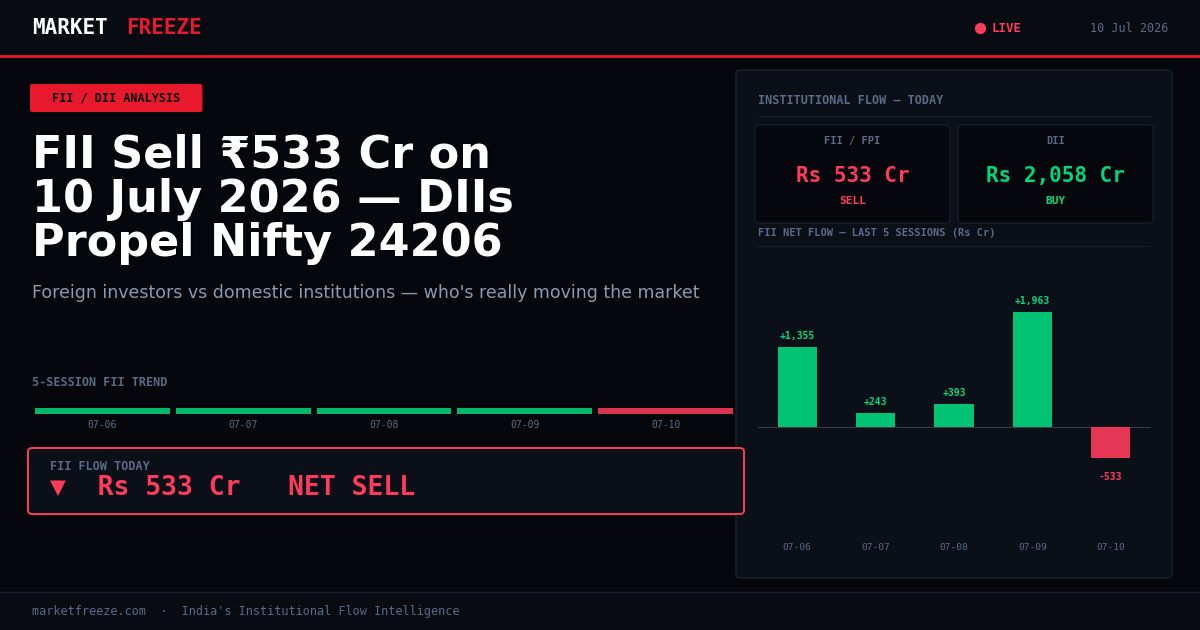
NSE provisional data confirms FIIs offloaded ₹532.86 Cr in Indian equities today, 10 July 2026. This marks a reversal from the net buying streak seen in the previous two sessions. Conversely, Domestic Institutional Investors (DIIs) continued their robust buying, adding ₹2,057.79 Cr to their portfolios. The Nifty 50 closed at 24,206.90, up 1.02%, indicating that despite FII selling, DII inflows were substantial enough to propel the market higher. This divergence highlights the critical role DIIs are playing in supporting current market valuations.
Open a free demat account with
Upstox
or
Angel One
— zero brokerage on delivery trades.
FII Selling Concentrated, DII Buying Broad-Based
The FII outflow of ₹532.86 Cr today was primarily driven by sales amounting to ₹14,921 Cr against purchases of ₹14,388.41 Cr. While the net figure indicates a sell-off, the gross figures show significant trading activity. This outflow suggests a selective approach by foreign institutions, possibly rebalancing portfolios or taking profits in specific segments. In contrast, DIIs were net buyers for the third consecutive session, with their total purchases reaching ₹2,057.79 Cr. This sustained buying by domestic institutions, including mutual funds and insurance companies, provides a strong floor for the market, absorbing much of the selling pressure from FIIs.
The broader market breadth today was positive. Of the 4,211 stocks traded on the BSE, 2,786 advanced, 1,222 declined, and 203 remained unchanged, as per available reports. This suggests that the market gains were not confined to a few large-cap names but were spread across a wider spectrum of stocks, which is often a sign of underlying strength, even with FII selling.
Actionable Insight: Retail investors should monitor DII buying trends for sector-specific opportunities, as their consistent inflows are a key support factor. Consider increasing exposure to sectors where DIIs are showing sustained accumulation.
Sectoral Impact: IT Leads Gains, Pharma Lags
Today’s market performance saw the Nifty IT sector emerge as the top performer, surging 2.96%. This rally in IT stocks likely absorbed a portion of the FII selling pressure, as IT historically sees significant foreign institutional interest. The Nifty Metal sector also performed well, gaining 1.37%, and Nifty Oil & Gas advanced 1.04%. These gains indicate continued investor interest in cyclical and commodity-linked sectors. The Nifty Bank index also showed strength, closing up 1.39% at 58,046.00, suggesting financial stocks are also in favour.
Conversely, the Nifty Pharma sector was the only major laggard, declining 0.54%. The FII selling today might have had a disproportionate impact on pharmaceutical stocks, which often attract foreign capital. This sector-specific weakness, despite overall market gains, warrants attention. The divergence between IT and Pharma performance underscores the importance of granular sector analysis rather than relying on broad market movements.
Actionable Insight: Given the outperformance of IT and Banking sectors, retail investors could consider overweighting these segments in their portfolios, especially if DII buying continues to be concentrated here. However, monitor the Pharma sector for potential signs of FII reallocation.
Historical Flow Analysis: A Shift in FII Stance
The FII net flow data over the last five sessions reveals a notable shift. After net buying ₹1,355.33 Cr on July 6th and ₹243.03 Cr on July 7th, followed by another substantial buy of ₹1,962.80 Cr on July 9th, today’s sell of ₹532.86 Cr stands out. This could signal a temporary pause or a change in strategy from foreign institutions. The DIIs, on the other hand, have shown unwavering support, with consistent net buying across these sessions, including today’s ₹2,057.79 Cr. Their net purchases were ₹3,791.42 Cr on July 7th and ₹790.16 Cr on July 9th.
| Date | FII Net (Cr) | DII Net (Cr) | Nifty Close |
|---|---|---|---|
| 2026-07-06 | +₹1,355.33 Cr | ₹-1,953.89 Cr | 24,430.35 |
| 2026-07-07 | +₹243.03 Cr | +₹3,791.42 Cr | 24,398.70 |
| 2026-07-08 | +₹393.19 Cr | ₹-383.43 Cr | 23,882.05 |
| 2026-07-09 | +₹1,962.80 Cr | +₹790.16 Cr | 23,962.80 |
| 2026-07-10 | ₹-532.86 Cr | +₹2,057.79 Cr | 24,206.90 |
The Nifty’s movement reflects this dynamic. After trading around 23,882.05 on July 8th, it recovered to 23,962.80 on July 9th and closed at 24,206.90 today. The substantial DII buying on July 7th, ₹3,791.42 Cr, helped arrest a potential decline, while today’s robust DII inflows provided the impetus for the market’s upward move despite FII selling.
Actionable Insight: Retail investors should view today’s FII selling as a potential opportunity to buy into quality stocks at slightly lower prices, provided DII buying support remains evident. Focus on market leaders in sectors showing DII accumulation.
IPO Market Activity and Investor Interest
While institutional flows dominate market direction, the primary market continues to show strong investor appetite. Today’s news highlights robust Grey Market Premiums (GMP) for several upcoming Initial Public Offerings (IPOs). Kusumgar is leading with an estimated listing gain of 39%, indicating significant demand. SBI Funds Management IPO is also attracting attention with an anticipated 16% upside, and Laser Power & Infra IPO is expected to offer gains of 15-16%. This strong interest in the IPO market, particularly for well-priced offerings, suggests that retail and high-net-worth individuals are actively deploying capital into new listings.
The contrast between the FII outflow in secondary markets and strong participation in primary offerings could indicate a strategic deployment of capital by domestic investors into high-growth potential companies in the IPO space. This also suggests that a significant portion of domestic liquidity is being channeled into the primary market, which can sometimes affect liquidity in the secondary market, though DIIs are currently counteracting this effect.
Actionable Insight: Retail investors interested in IPOs should conduct thorough due diligence, even with high GMPs. Consider allocating a small portion of their portfolio to IPOs with strong fundamentals and reasonable valuations, provided they align with their risk profile.
Key Levels to Watch
With the Nifty closing at 24,206.90 today and FIIs initiating selling pressure, attention shifts to immediate support and resistance. The substantial DII inflows suggest an upward bias, but FII selling could cap gains. Key support is now seen around the 24,000-24,100 range, the area where DII buying stepped in to defend the index. If this support is breached on significant volume, a move towards 23,800 is possible, which was the approximate closing level on July 8th. Resistance is likely to emerge around the 24,350-24,450 band, a level not seen since July 6th. A decisive break above this resistance, especially with renewed FII buying, could signal a continuation of the rally.
The Bank Nifty’s strong close at 58,046.00, up 1.39%, suggests that the banking sector could act as a key driver for any further upside. A sustained upward movement in Bank Nifty above 58,500 could pull the broader Nifty higher. Conversely, any weakness in the banking index below 57,500 would likely drag the Nifty down.
Actionable Insight: Retail traders should use the 24,000-24,100 Nifty range as a short-term support zone. Expect increased volatility if the index trades within this band, with potential for a breakout or breakdown.
FAQ Section
Q: What did FII buy or sell on 10 July 2026?
A: FIIs were net sellers of ₹532.86 Cr on 10 July 2026, with total sales of ₹14,921 Cr and purchases of ₹14,388.41 Cr.
Q: What did DII buy on 10 July 2026?
A: DIIs were net buyers of ₹2,057.79 Cr on 10 July 2026.
Q: Is FII buying or selling in July 2026?
A: FII activity in July 2026 has been mixed. After initial selling pressure early in the month, there was strong net buying on July 8th and July 9th, followed by a net outflow on July 10th. The trend is not decisively one way or the other yet.
Bottom Line
Today’s session was characterized by FII selling offsetting strong DII buying, resulting in a modest gain for the Nifty 50 to 24,206.90. The IT and Banking sectors showed significant strength, while Pharma lagged. The sustained DII accumulation provides a supportive backdrop, but the FII outflow warrants vigilance. Retail investors should leverage DII inflow patterns for sector-specific investment decisions and closely watch the 24,000-24,100 Nifty support level.
Retail Investor Strategy: Navigating FII Volatility
For the retail investor, today’s market action underscores the importance of a disciplined approach amidst institutional flux. The divergence between FII selling and DII buying presents both challenges and opportunities. While FII outflows can create short-term price corrections, DII’s consistent inflows indicate underlying domestic confidence. Retail investors should not panic sell on FII net selling days. Instead, focus on accumulating quality stocks in fundamentally strong sectors that are seeing DII support. For example, the robust performance in IT, with a gain of over 2.9%, and the banking sector, which rose by approximately 1.39%, are areas where DII buying has been evident. A retail investor could consider a SIP (Systematic Investment Plan) approach in diversified equity funds or ETFs that have significant exposure to these sectors. It is crucial to avoid chasing momentum stocks based solely on FII activity and instead prioritize long-term value creation.
Sector Rotation Implications and Future Trends
The differential performance between sectors today – with IT and Banking leading and Pharma lagging – suggests a potential rotation in investor preference. FIIs might be reallocating capital away from sectors perceived as overvalued or facing global headwinds, such as pharmaceuticals, which saw a decline of around 0.54%. Concurrently, their continued interest in IT, despite some selling, and DIIs’ strong support for banking, indicates a preference for growth-oriented and defensive sectors, respectively. The Metal sector’s gains of about 1.37% and Oil & Gas’s rise of roughly 1.04% also highlight a continued interest in cyclical plays. For retail investors, this implies a need to stay abreast of these sector rotations. A balanced portfolio that includes exposure to both growth (like IT) and value/defensive (like Banking and potentially select FMCG or Pharma on dips) could offer resilience. Monitoring the broader economic data and global cues will be critical in anticipating further sector shifts.
Historical FII Patterns: A Broader Context
Looking at the FII flow data for July 2026, today’s net sale of ₹532.86 Cr follows a period of net buying. On July 6th, FIIs were net buyers of over ₹1,355 Cr, and on July 9th, they injected more than ₹1,962 Cr into the Indian equity market. This pattern suggests that FII behaviour can be more opportunistic than consistently directional over short periods. They tend to buy into market corrections or on positive news flow and sell to book profits or rebalance portfolios. The DIIs, however, have been the consistent buyers, with net inflows exceeding ₹2,057 Cr today, and having bought over ₹3,791 Cr on July 7th. This consistent domestic buying has been a significant buffer against FII volatility, ensuring market stability. The historical data indicates that while FIIs can influence short-term sentiment and sector performance, DIIs are increasingly playing a pivotal role in providing foundational support to the Indian equity market, especially when measured by their sustained capital deployment.
Tomorrow’s Key Levels to Watch
As we look towards the next trading session, the key levels for the Nifty 50 will be crucial indicators of market sentiment. The immediate support zone for the Nifty is expected to be around the 24,000-24,100 mark. This is where significant DII buying was observed today, suggesting it could act as a psychological and technical floor. A failure to hold this range could lead to a test of lower levels, potentially revisiting the approximate 23,800 mark seen around July 8th. On the upside, immediate resistance is likely to form in the 24,350-24,450 zone. A decisive move above this resistance, particularly if accompanied by renewed FII interest, could signal a continuation of the upward trend. For the Nifty Bank index, the 58,500 level will be a critical resistance, while 57,500 will serve as immediate support. Any significant move in the Bank Nifty will likely dictate the direction of the broader Nifty.
Outlook and Conclusion
The Indian equity market is currently navigating a complex interplay of foreign and domestic institutional flows. Today’s session, marked by FII selling but bolstered by substantial DII buying, led to a marginal gain in the Nifty 50. The resilience shown by DIIs in absorbing FII outflows is a positive sign for market stability. Sectors like IT and Banking have demonstrated strength, while Pharma experienced a downturn. The consistent participation of domestic institutions in the primary market also indicates strong underlying liquidity. For retail investors, the key takeaway is to remain focused on long-term wealth creation by identifying fundamentally sound companies, especially those benefiting from DII accumulation, and to maintain a disciplined investment approach, utilizing SIPs to average out costs and mitigate short-term volatility. The current market environment demands careful selection, but with DII support, opportunities remain for astute investors.
Actionable Insight: Retail investors should consider gradually increasing their allocation to diversified equity mutual funds with a strong track record in managing large-cap and mid-cap stocks, specifically those that have demonstrated consistent DII inflows in sectors like IT and Banking, to capitalize on the ongoing domestic institutional support.
Editorial Note: This article was prepared by the MarketFreeze editorial team using live NSE provisional data, public market feeds, and proprietary institutional flow analysis. All price and flow figures are sourced directly from NSE, BSE, and CoinGecko as of 10 July 2026. This content is for informational purposes only and does not constitute investment advice. MarketFreeze is not SEBI-registered. Please consult a qualified financial advisor before making investment decisions. Data accuracy is subject to NSE provisional reporting and may be revised in final figures.