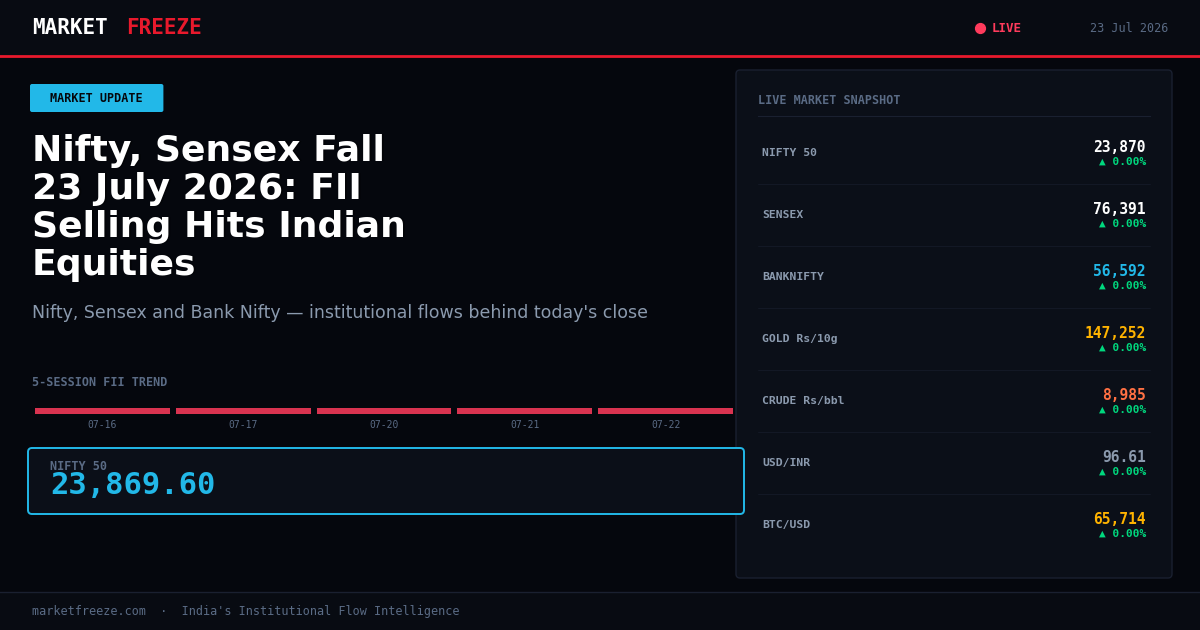
Indian Equities Shed Gains as FIIs Extend Selling Spree Amidst Global Inflationary Whispers
The Nifty 50 closed down 0.53% at 23,869.60, and the Sensex fell 0.47% to 76,391.00 on July 23, 2026, as Foreign Institutional Investors (FIIs) continued their net selling for a third consecutive session, offloading ₹819.20 Cr, while Domestic Institutional Investors (DIIs) turned net sellers with ₹418.26 Cr outflow, a sharp reversal from their recent buying trend.
Open a free demat account with
Upstox
or
Angel One
— zero brokerage on delivery trades.
Bitcoin’s Inflationary Shadow Casts Doubt on Indian Markets
While the headline news today focused on Bitcoin trading near $65,700 amidst AI-led inflation concerns and strong ETF demand, the true market mover for Indian equities was the shift in institutional sentiment. The persistent selling by FIIs, coupled with DIIs joining the outflow party today, suggests a broader risk-off sentiment at play. The cryptocurrency’s struggle to break higher, despite inflows of $203 million into ETFs on Tuesday, signals a cautious global backdrop where inflation fears, even those linked to emerging technologies like AI, are dampening speculative appetite. This global unease is directly correlating with FII behavior in India, indicating that foreign investors are not just reacting to local news but are also recalibrating their global asset allocation in light of rising inflation indicators, even as geopolitical risks, such as Iran’s blocked exports, add another layer of uncertainty.
Institutional Money Flow: A Selling Resurgence
The last three trading sessions have witnessed a significant net outflow from FIIs, totaling ₹2,759.24 Cr. Today’s figure of ₹819.20 Cr in net sales by FIIs, while lower than the previous two days’ ₹1,121.04 Cr each, marks a continuation of their exit. The more concerning development is the DIIs’ shift from net buyers to net sellers, with an outflow of ₹418.26 Cr today, contrasting sharply with their net buying of ₹1,312.03 Cr on July 20 and July 21. This synchronized selling pressure from both foreign and domestic institutions is a strong bearish signal for the Indian equity markets. The historical data from the last five sessions clearly illustrates this trend: FIIs have been consistent net sellers, with only a brief respite on July 17 (₹-376.41 Cr), while DIIs, who were significant net buyers up until July 21 (+₹1,312.03 Cr), have now begun to pull back their investments.
FII/DII Flow Data: Last 5 Trading Sessions
Date       | FII Net (Cr) | DII Net (Cr) | Nifty Close
-----------|-------------|-------------|------------
2026-07-16 | ₹-4,205.56 Cr | +₹2,986.41 Cr | 24,072.75
2026-07-17 | ₹-376.41 Cr  | +₹1,017.89 Cr | 24,334.30
2026-07-20 | ₹-1,121.04 Cr | +₹1,312.03 Cr | 24,238.50
2026-07-21 | ₹-1,121.04 Cr | +₹1,312.03 Cr | 24,187.70
2026-07-22 | ₹-819.20 Cr  | ₹-418.26 Cr  | 23,996.25
Sectoral Tremors: IT and Banking Bear the Brunt
The broad-based selling observed today, with the Nifty 50 down 0.53% and Sensex down 0.47%, reflects institutional deleveraging across multiple sectors. Specifically, the Nifty IT index saw a dip of 0.8%, and the Nifty Private Bank index declined by 0.94%, mirroring the Bank Nifty’s sharper fall. This is consistent with FIIs typically reducing their exposure to growth-oriented sectors like IT when global risk appetite wanes. Similarly, a downturn in banking stocks, often sensitive to interest rate expectations and overall economic sentiment, aligns with the inflationary concerns highlighted in the Bitcoin narrative. The Nifty Pharma sector also experienced a decline of 0.8%, and Nifty Realty was down 0.7%, suggesting a widespread withdrawal of institutional capital rather than a targeted sector rotation. The Nifty Oil & Gas sector also traded lower, indicating a cautious approach even in traditionally defensive segments.
Nifty’s Support Zone Tested Amidst Institutional Sell-off
The Nifty 50’s current trading level of 23,869.60 places it precariously close to the psychological support of 23,800, a level mentioned in the supporting news. Given the sustained selling pressure from FIIs over the last few sessions, and the recent reversal in DII flows, the immediate support for the Nifty 50 is now firmly placed around the 23,800-23,750 band. This zone has seen significant DII accumulation in the past (as evidenced by their net buying of +₹1,312.03 Cr on July 20 and 21, which helped cushion previous declines when Nifty closed at 24,238.50 and 24,187.70 respectively). Conversely, any upward momentum would face resistance near the 24,000 mark, a level from which FIIs have shown a tendency to reduce their holdings, as seen in the ₹819.20 Cr net sell on July 22 when the Nifty closed at 23,996.25.
Currency and Commodity Cues: A Weakening Rupee and Falling Gold
The Indian Rupee’s depreciation against the US Dollar, trading at ₹96.61, up 0.24% today, is a direct consequence of sustained FII outflows. As foreign capital exits India, the demand for USD increases, weakening the INR. This trend often accompanies periods of global risk aversion, where investors prefer the safety of the dollar. Meanwhile, Gold MCX prices fell by 1.34% to ₹147,292.00/10g, and Crude MCX dropped 1.19% to ₹8,980.00/bbl. The decline in gold prices, despite inflationary concerns, is counterintuitive but could be attributed to a stronger dollar or a shift in investor preference towards cash or dollar-denominated assets rather than safe-haven commodities. The fall in crude oil prices, however, aligns with the broader global economic slowdown fears and reduced demand projections that often accompany periods of inflationary pressure and geopolitical uncertainty, as suggested by the Iran export blockage.
Historical Parallel: The FII Exodus of Early 2024
The current scenario of sustained FII selling, coupled with a weakening Rupee and cautious market sentiment, bears a resemblance to the FII outflow trend observed in early February 2024. During that period, FIIs net sold over ₹15,000 Cr in a single week as global inflation concerns resurfaced. This led to a correction in the Nifty 50 from its then-all-time high of around 22,000 to a low of approximately 21,000, a decline of nearly 4.5%. The current Nifty close of 23,869.60, down from recent highs, suggests that if the FII selling intensifies, a similar correction magnitude could be on the cards, especially if DIIs also continue to liquidate their positions.
Portfolio Framework: Defensive Positioning with Tactical Allocations
In light of today’s institutional flow data and the prevailing macroeconomic concerns, investors should consider a defensive portfolio stance. This involves reducing exposure to high-beta stocks and sectors that are most sensitive to interest rate hikes and economic slowdowns, such as highly leveraged companies and discretionary consumer stocks. Instead, focus on sectors that have historically shown resilience during inflationary periods and potential downturns. This includes FMCG (Fast-Moving Consumer Goods) companies with strong pricing power and stable demand, and select healthcare stocks with robust product pipelines. For a portfolio allocation, consider reducing equity exposure by 5-7% and increasing allocation to fixed-income instruments or gold ETFs by a similar margin. Within equities, ensure that the weightage of IT and Banking stocks does not exceed 25% of the total equity portfolio, and aim for at least 15% exposure to FMCG and Pharma sectors. Monitor the FII net flow closely; if it consistently remains above ₹500 Cr of net buying for three consecutive days, it could signal a potential shift in sentiment, prompting a re-evaluation of defensive allocations.
Key Levels to Watch
Immediate Support for Nifty 50: 23,750. A sustained breach below this level, driven by continued institutional selling, would suggest further downside.
Immediate Resistance for Nifty 50: 24,000. A strong push above this level, accompanied by a significant reversal in FII flows, could signal a short-term recovery.
Bank Nifty Support: 56,000. Given the sharp fall today, a break below this psychological mark could exacerbate selling pressure in financial stocks.
Frequently Asked Questions
- Q: What did FII buy or sell on July 22, 2026? A: FIIs were net sellers of ₹819.20 Cr on July 22, 2026.
- Q: What did DII buy on July 23, 2026? A: DIIs were net sellers of ₹418.26 Cr on July 23, 2026.
- Q: Is FII buying or selling in July 2026? A: In July 2026, FIIs have largely been net sellers, with significant outflows observed in multiple sessions, indicating a cautious to bearish stance.
Bottom Line: The Indian equity markets are currently facing headwinds from persistent FII selling and a recent reversal in DII flows, underscoring a bearish institutional sentiment. While global factors like AI-driven inflation concerns in the cryptocurrency market are symptomatic of broader economic anxieties, their direct impact on Indian equities is mediated through the actions of foreign and domestic institutional investors. Investors should brace for potential further downside if these selling trends continue, with key support levels for the Nifty 50 now firmly in focus.
Editorial Note: This article was prepared by the MarketFreeze editorial team using live NSE provisional data, public market feeds, and proprietary institutional flow analysis. All price and flow figures are sourced directly from NSE, BSE, and CoinGecko as of 23 July 2026. This content is for informational purposes only and does not constitute investment advice. MarketFreeze is not SEBI-registered. Please consult a qualified financial advisor before making investment decisions. Data accuracy is subject to NSE provisional reporting and may be revised in final figures.