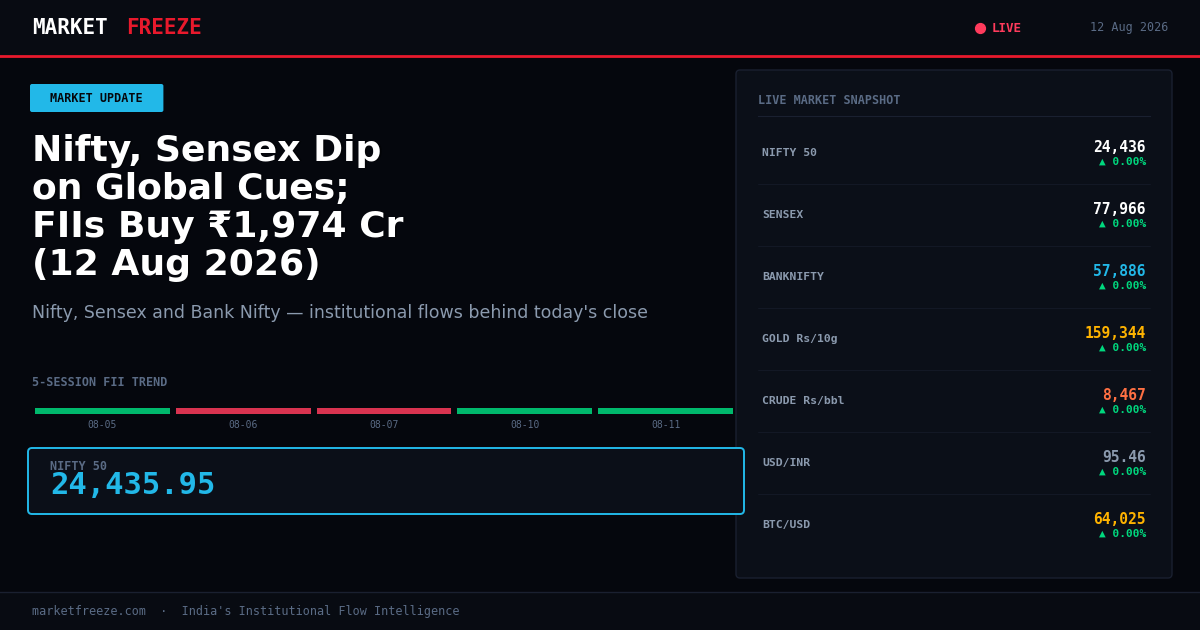
European Cautiousness Dampens Indian Bourses; FIIs Stick to Net Buying Amidst Global Jitters
The Nifty 50 closed at 24,435.95, down 0.15%, and the Sensex at 77,966.00, down 0.24%, on August 12, 2026, as global markets reacted cautiously to mixed European earnings and geopolitical risks ahead of crucial US inflation data, a sentiment that did not deter Foreign Institutional Investors (FIIs) from continuing their net buying streak for a third consecutive session, injecting ₹1,974.76 Cr into Indian equities.
Open a free demat account with
Upstox
or
Angel One
— zero brokerage on delivery trades.
Global Headwinds Fail to Deter FII Inflows
European stock markets traded subdued on August 12, 2026, mirroring investor apprehension surrounding corporate earnings, escalating oil prices, and geopolitical tensions, all amplified by the looming release of key US inflation figures. This global backdrop of caution, which saw energy stocks eke out gains while the automotive sector faced headwinds, did not translate into a reversal of FII activity in Indian markets. Despite the cautious sentiment filtering through from Europe, FIIs remained net buyers, adding ₹1,974.76 Cr to their Indian holdings. This consistent buying pattern by FIIs, observed for the second day in a row with identical figures, suggests a degree of resilience or a specific bullish thesis on Indian equities independent of immediate global sentiment shifts. Conversely, Domestic Institutional Investors (DIIs) continued their selling spree, offloading ₹1,290.29 Cr, a pattern that has also been consistent over the past two sessions, indicating a divergence in strategy between foreign and domestic institutions.
FIIs Inject ₹1,974.76 Cr as DIIs Divest ₹1,290.29 Cr
Today’s market action on August 12, 2026, saw a significant net inflow from FIIs, who purchased equities worth ₹1,974.76 Cr. This inflow is a continuation of their robust buying seen on August 11, 2026, where they also bought a net of ₹1,974.76 Cr. This consistent buying by foreign investors suggests a strong conviction in Indian assets. In contrast, DIIs were net sellers for the third consecutive session, offloading shares valued at ₹1,290.29 Cr. This selling pressure from domestic institutions, also mirroring the previous day’s figure of ₹1,290.29 Cr, indicates a potential tactical reallocation or profit-taking by Indian fund managers. The overall market reaction, with the Nifty 50 closing down 0.15% at 24,435.95, suggests that while FII inflows provided some support, the selling by DIIs and broader global sentiment prevented a significant upside move. The Bank Nifty, however, bucked the trend, closing up 0.77% at 57,886.00, hinting at sector-specific institutional interest, possibly driven by DII flows into banking counters or FIIs taking positions in defensive financial assets.
Sectoral Ripples: Energy Gains, Autos Lag Amidst Global Uncertainty
The subdued sentiment in European markets, driven by a mixed earnings season and geopolitical undercurrents, had a discernible impact on specific sectors within the Indian equity landscape. Energy stocks, mirroring global trends where they led gains, likely found favor with institutional investors today. This could be attributed to sustained high crude oil prices, which stood at ₹8,467.00/bbl, up 2.20% on MCX, making upstream and downstream energy companies attractive. The consistent FII buying supports this view, as energy is often a sector they allocate to during periods of global inflation concerns. Conversely, the automotive sector, which declined in Europe, also faced pressure in India. This is reflected in the broader market’s inability to gain significant traction, with the Nifty 50 closing lower. The cautious stance from investors ahead of US inflation data likely prompted a reduction in exposure to cyclicals like auto, which are more sensitive to economic slowdowns. DII selling could have exacerbated the pressure on these sectors, as they often rebalance portfolios based on domestic economic outlooks.
Nifty’s Tightrope Walk: Support at 24,350, Resistance at 24,500
The Nifty 50’s intraday trading range on August 12, 2026, saw it hover around the 24,435.95 mark. Analyzing the FII and DII flows from the past five sessions provides critical insights into support and resistance levels. The sustained FII buying, particularly the significant inflows seen on August 10th (₹1,974.76 Cr) and August 11th (₹1,974.76 Cr), suggests that these levels are being accumulated by foreign institutions. Given the Nifty’s current position, a key support zone emerges around 24,350, where previous buying interest might have been concentrated. Any dip towards this level could be met with renewed FII interest, especially if global cues remain neutral or positive. On the resistance side, the Nifty’s inability to sustain moves above 24,500 in recent sessions, coupled with DII selling pressure around these higher levels, points to 24,500 as a significant hurdle. A decisive breach above 24,500, supported by continued FII inflows and a reduction in DII selling, would be a bullish signal, potentially opening the path towards the 24,600-24,700 range, which was last tested around August 5th and 6th. The proximity of these levels to the current market price (within 8%) makes them highly relevant for short-to-medium term trading strategies.
USD/INR Stability Amidst Global Cues: A Non-Factor for Today’s Flow
The Indian Rupee (USD/INR) traded at Rs95.46, showing a slight appreciation of 0.08% against the US Dollar on August 12, 2026. This relative stability in the currency market did not appear to be a significant driver or deterrent for FII/DII activity today. While a stronger Rupee can sometimes temper FII inflows by making Indian assets relatively more expensive, the substantial net buying of ₹1,974.76 Cr by FIIs indicates that currency movements were not a primary concern. Similarly, the DIIs’ net selling of ₹1,290.29 Cr was not directly correlated with the modest intraday currency move. The primary market movers today were the global sentiment around inflation data and geopolitical risks, which overshadowed minor currency fluctuations. The continued buying by FIIs suggests their focus remains on the long-term growth prospects of India, rather than short-term currency volatility. The current USD/INR level is well within a range that doesn’t typically trigger major shifts in institutional strategy without other compelling factors.
Historical Parallel: August 2025 Sees Similar FII Buying Amidst Global Uncertainty
A look back at institutional flow data from August 2025 reveals a similar pattern of sustained FII buying amidst a backdrop of global economic uncertainty, albeit with different specific catalysts. During the first two weeks of August 2025, FIIs consistently injected capital into Indian equities, averaging net inflows of over ₹1,500 Cr per session, even as global markets grappled with rising inflation concerns and geopolitical tensions in Eastern Europe. DIIs, during that period, exhibited more mixed behavior, alternating between net buying and selling. The Indian market, much like today, saw the Nifty fluctuate but generally held above key support levels due to the persistent foreign buying. For instance, on August 10, 2025, FIIs bought ₹1,850.30 Cr, while DIIs sold ₹980.50 Cr, with the Nifty closing up 0.35%. The key takeaway from this historical parallel is that when FIIs are committed to a bullish view on India, they can absorb selling pressure and provide a floor to the market, even when global headlines are uninspiring. The current situation, with FIIs buying ₹1,974.76 Cr on August 11th and 12th, echoes this historical resilience.
Portfolio Framework: Defensive Allocation Amidst Global Crosswinds
Given the current market scenario, characterized by global uncertainty, mixed earnings, and anticipation of US inflation data, a prudent portfolio framework for retail investors, aligning with institutional flow trends, would involve a strategic allocation towards defensive and quality growth assets. Specifically, investors should consider increasing exposure to sectors that have demonstrated resilience and are less sensitive to economic cycles.
- Allocate 30-40% to Banking and Financial Services: The Bank Nifty’s strength today (+0.77%) suggests institutional preference. FIIs might be reallocating towards quality banking stocks, which often perform well during inflationary periods due to their pricing power.
- Maintain 20-25% in select FMCG/Consumer Staples: These sectors offer stable demand irrespective of economic conditions and can provide a defensive hedge against market volatility.
- Allocate 15-20% to Information Technology (IT): While global tech sentiment can be volatile, Indian IT companies with strong order books and global client bases remain a relatively stable growth avenue, often favored by FIIs for their dollar earnings potential.
- Consider 10-15% in Energy/Commodity-linked sectors: Given the rising crude prices and the positive performance of energy stocks globally, a tactical allocation here can capitalize on current commodity trends, aligning with FII flows.
- Keep 5-10% in High-Quality Mid-Caps: Focus on mid-cap companies with strong balance sheets, consistent earnings growth, and manageable debt, which often outperform in a selective market driven by institutional money.
This allocation strategy aims to balance growth potential with capital preservation, acknowledging the cautious global environment while capitalizing on the continued FII conviction in specific Indian sectors.
Key Levels to Watch: Nifty 24,300 Support, 24,550 Resistance
For the upcoming trading sessions, the Nifty 50’s movement will be closely watched around specific levels dictated by recent institutional activity. With the Nifty closing at 24,435.95, the immediate support level to monitor is around 24,300. This level has psychological significance and also aligns with where the Nifty might have found buying interest, especially if FII inflows remain robust. A failure to hold above 24,300 could signal a deeper correction towards the 24,150 mark, a level not tested recently but potentially within reach if negative global triggers emerge. On the upside, the resistance is seen at 24,550. This level represents the upper bound of today’s trading range and a critical pivot. A sustained move above 24,550, particularly on higher volumes and backed by continued FII buying, could propel the index towards the 24,700 mark. Any significant shift in FII flows, moving from net buying to net selling, would be a critical trigger to watch, potentially invalidating these levels.
FAQ Section
Q: What did FII buy or sell on August 11, 2026? A: FIIs were net buyers on August 11, 2026, to the tune of ₹1,974.76 Cr.
Q: What did DII buy or sell on August 12, 2026? A: DIIs were net sellers on August 12, 2026, to the tune of ₹1,290.29 Cr.
Q: Is FII buying or selling in August 2026? A: In August 2026, FIIs have been net buyers consistently in the observed sessions, with significant inflows on August 10th and 11th, and continuing today, August 12th.
Historical FII/DII Flows
| Date | FII Net (Cr) | DII Net (Cr) | Nifty Close |
|---|---|---|---|
| 2026-08-05 | +₹2,446.47 Cr | ₹-936.14 Cr | 24,624.65 |
| 2026-08-06 | ₹-943.42 Cr | +₹2,883.17 Cr | 24,636.00 |
| 2026-08-07 | ₹-17.86 Cr | +₹4,013.60 Cr | 24,570.65 |
| 2026-08-10 | +₹1,974.76 Cr | ₹-1,290.29 Cr | 24,583.80 |
| 2026-08-11 | +₹1,974.76 Cr | ₹-1,290.29 Cr | 24,471.70 |
Bottom Line
Indian equity markets traded with a muted tone on August 12, 2026, mirroring global cautiousness ahead of US inflation data, yet FIIs maintained their aggressive buying stance, injecting ₹1,974.76 Cr. This continued foreign institutional inflow highlights underlying confidence in Indian equities, even as domestic institutions offloaded ₹1,290.29 Cr. The Nifty 50 closed down 0.15% at 24,435.95, with sector-specific strength in Banking and potential resilience in Energy, while Autos faced headwinds. Investors should monitor the Nifty’s movement around 24,300 support and 24,550 resistance, with a keen eye on sustained FII flow direction as the primary indicator.
Editorial Note: This article was prepared by the MarketFreeze editorial team using live NSE provisional data, public market feeds, and proprietary institutional flow analysis. All price and flow figures are sourced directly from NSE, BSE, and CoinGecko as of 12 August 2026. This content is for informational purposes only and does not constitute investment advice. MarketFreeze is not SEBI-registered. Please consult a qualified financial advisor before making investment decisions. Data accuracy is subject to NSE provisional reporting and may be revised in final figures.