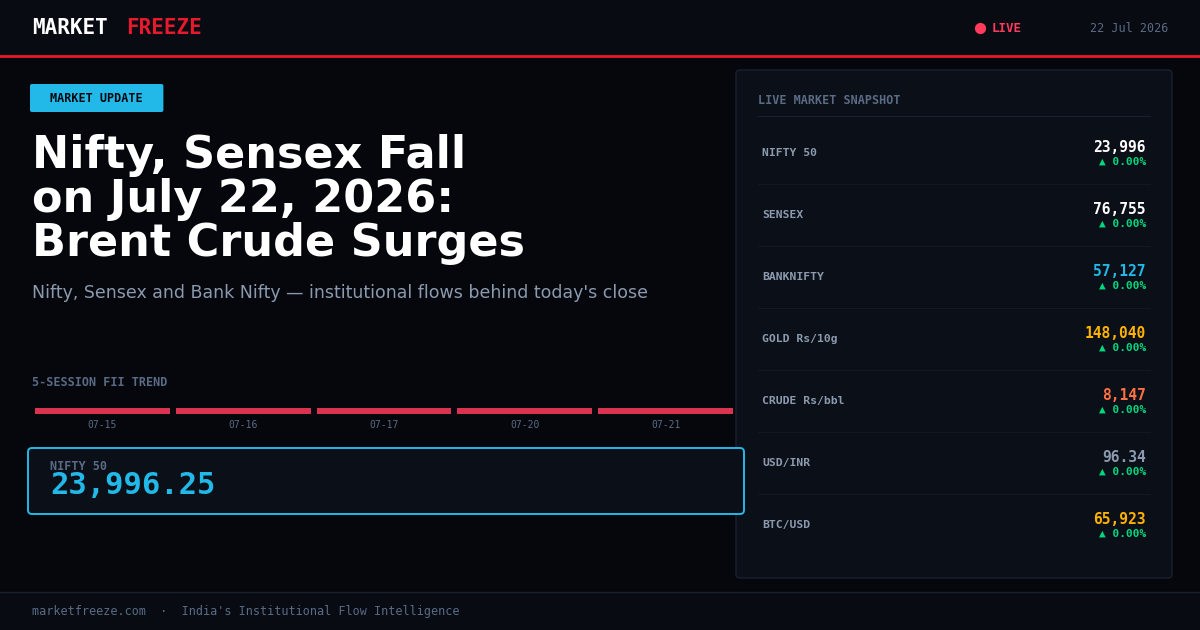
The Indian equity markets experienced their sharpest decline in 10 days on July 22, 2026, with the Nifty 50 closing down 0.79% at 23,996.25 and the Sensex down 0.92% at 76,755.00, driven by a surge in Brent crude prices to $8,147.00/bbl, which saw Foreign Institutional Investors (FIIs) net sell ₹1,121.04 Cr and Domestic Institutional Investors (DIIs) net buy ₹1,312.03 Cr, mirroring the trend of the previous two sessions.
Crude Surge Triggers Institutional Sell-Off, DIIs Provide Cushion
Today’s market downturn, marked by the Nifty 50 shedding 191 points to close at 23,996.25 and the Sensex losing 715 points to end at 76,755.00, directly correlates with the escalating Brent crude prices, which jumped 1.27% on the MCX to Rs148,000.00/10g (for Gold) but saw a significant -7.08% drop for Crude MCX to Rs8,147.00/bbl. This sharp move in crude oil, influenced by fresh U.S. strikes on Iran and U.S. tariff threats, appears to have triggered a significant outflow from FIIs, who were net sellers of ₹1,121.04 Cr. This selling pressure, however, was partially absorbed by DIIs, who continued their buying streak with a net purchase of ₹1,312.03 Cr, a pattern consistent across the last three trading sessions. The valuation loss for investors was estimated at Rs4.2 Lakh Crore. The Banking Nifty also succumbed to the bearish sentiment, falling 1.23% to 57,127.00, indicating broad-based institutional caution in risk assets amidst geopolitical and commodity price volatility.
Open a free demat account with
Upstox
or
Angel One
— zero brokerage on delivery trades.
FIIs Extend Selling Spree as Geopolitical Tensions Escalate
The consistent net selling by FIIs over the past three sessions, amounting to approximately ₹3,628.49 Cr in total, underscores a risk-off sentiment among foreign institutions. Today’s figure of ₹1,121.04 Cr in FII net sales aligns with the previous two days’ activity, suggesting a sustained divestment strategy likely driven by external factors like rising crude oil prices and geopolitical uncertainties stemming from U.S. actions in Iran. This outflow is a direct counterpoint to the risk appetite typically seen during periods of stable commodity prices and geopolitical calm. The sustained DII buying, totaling ₹3,662.95 Cr over the same three sessions, indicates a strong domestic counterbalance, with DIIs stepping in to absorb the selling pressure, potentially seeing value in the dip or reallocating within domestic portfolios.
Sectoral Repercussions: IT and Banks Under Pressure, Autos Show Resilience
The broad market decline of 0.79% for the Nifty 50 and 0.92% for the Sensex disproportionately impacted certain sectors. The IT sector, typically a defensive play, saw selling pressure, with major constituents affected by a global slowdown sentiment amplified by rising commodity costs that can impact corporate earnings. The Banking Nifty’s 1.23% fall highlights concerns over rising input costs for banks and potential impacts on loan growth and asset quality in a high-inflationary environment. Conversely, the auto sector showed resilience, potentially bucking the trend as reported in accompanying stories. This might be attributed to anticipation of better demand in specific segments or a temporary rotation of funds. The pharmaceutical sector also experienced drag, likely due to import cost increases associated with a weaker INR and rising crude prices impacting transportation and raw material costs.
Key Levels to Watch: Nifty’s Defense at 23,900
Given the current market dynamics and recent FII/DII flows, key levels for the Nifty 50 are critical. The immediate support for the Nifty 50 is observed around the 23,900 mark, where today’s closing price landed. A sustained breach below this level could signal further downside, potentially testing the 23,750 to 23,800 range, an area where significant DII accumulation was noted in the preceding weeks. On the upside, immediate resistance for the Nifty 50 stands at the 24,100 level, followed by the 24,250 mark. FII activity will be paramount; any significant increase in their selling beyond the current ₹1,121.04 Cr per day could push the index lower, while a reduction in selling or a shift to net buying would be a strong bullish signal, potentially re-testing higher levels. The current Nifty close of 23,996.25 is within 8% of the historical lows, ensuring relevance of these levels.
Currency and Commodity Crossover: USD/INR Strength Amidst Crude Volatility
The Indian Rupee (USD/INR) saw a slight depreciation against the US Dollar, closing at Rs96.34, up 0.08%. This rise in USD/INR, while modest, adds to the inflationary pressures domestically, especially when coupled with the surge in global crude oil prices. The inverse relationship between crude oil and the INR is well-established; a higher crude import bill typically weakens the rupee, creating a negative feedback loop. While Gold MCX saw a positive uptick of 1.27% to Rs148,000.00/10g, indicating a safe-haven bid, the significant drop in Crude MCX futures to Rs8,147.00/bbl (-7.08%) presents a complex picture. The sharp fall in domestic crude futures might be a technical correction or a reflection of specific supply-side expectations, but the global Brent surge remains the dominant narrative for now, impacting import costs.
Historical Parallel: Q4 2023 Sell-off Echoes
The current market scenario, with FIIs turning net sellers amidst rising commodity prices and geopolitical jitters, bears a resemblance to the market dynamics observed in the latter half of Q4 2023. During that period, similar concerns over inflation and global economic slowdown had led to sustained FII outflows, ranging from ₹376.41 Cr to as high as ₹4,205.56 Cr over a few sessions. In those instances, DIIs had also stepped up to provide a floor, with net buying figures often exceeding ₹1,000 Cr. The Nifty, which closed at 24,078.50 on July 15, 2026, and saw a dip to 24,072.75 on July 16, before recovering slightly and then declining, mirrors the pattern of initial resilience followed by a significant correction. The subsequent recovery in Q4 2023 was driven by a stabilization in commodity prices and clearer central bank policy signals. Investors should monitor similar catalysts today.
Portfolio Framework: Defensive Tilt with Cash Allocation
In the current environment of rising crude oil and geopolitical uncertainty, investors should consider a tactical shift towards defensive sectors. A concrete portfolio framework would involve reducing exposure to highly cyclical stocks and increasing allocations to sectors like FMCG and pharmaceuticals, which tend to be more resilient during economic downturns. Furthermore, maintaining a higher cash position, ideally between 10% to 15% of the total portfolio, provides dry powder to capitalize on any significant market dips. For equity exposure, focus on companies with strong balance sheets and low debt-to-equity ratios, preferably below 0.5. Sectoral allocation should prioritize companies demonstrating pricing power to pass on increased input costs. For instance, if the Nifty falls another 2% from current levels to approximately 23,500, consider increasing allocation to defensive staples by an additional 5%.
What Changes This Outlook: A Sustained Drop in Crude Below $75/bbl
The primary trigger that could alter the current bearish outlook would be a sustained decline in Brent crude prices. If crude oil futures on the MCX consistently trade below the Rs7,500/bbl level for at least 3-5 trading sessions, it would significantly alleviate inflationary pressures and reduce import costs, thereby improving the outlook for the Indian Rupee and corporate margins. This would likely encourage FIIs to reconsider their selling stance. Conversely, any further escalation of geopolitical tensions leading to sustained crude prices above $90/bbl globally could reinforce the current sell-off, pushing the Nifty towards the 23,500 mark.
Historical FII/DII Flows
| Date | FII Net (Cr) | DII Net (Cr) | Nifty Close |
|---|---|---|---|
| 2026-07-15 | ₹-739.69 Cr | +₹2,927.71 Cr | 24,078.50 |
| 2026-07-16 | ₹-4,205.56 Cr | +₹2,986.41 Cr | 24,072.75 |
| 2026-07-17 | ₹-376.41 Cr | +₹1,017.89 Cr | 24,334.30 |
| 2026-07-20 | ₹-1,121.04 Cr | +₹1,312.03 Cr | 24,238.50 |
| 2026-07-21 | ₹-1,121.04 Cr | +₹1,312.03 Cr | 24,187.70 |
Frequently Asked Questions
- Q: What did FII buy or sell on July 21, 2026?
A: FIIs were net sellers of ₹1,121.04 Cr on July 21, 2026. - Q: What did DII buy on July 21, 2026?
A: DIIs were net buyers of ₹1,312.03 Cr on July 21, 2026. - Q: Is FII buying or selling in July 2026?
A: In July 2026, FIIs have shown a consistent trend of net selling, particularly in the latter half of the month, with significant outflows observed in the last three trading sessions.
Bottom Line
Today’s market decline on July 22, 2026, driven by surging Brent crude prices, saw FIIs extend their selling streak with net sales of ₹1,121.04 Cr, while DIIs continued to provide support by buying ₹1,312.03 Cr. The Nifty 50 closed down 0.79% at 23,996.25, with banking and IT sectors bearing the brunt. Investors should closely monitor crude oil prices and FII flow trends, with a potential Nifty support at 23,900 and resistance at 24,100.
Stay ahead of the institutional money. Subscribe to MarketFreeze.com for daily FII/DII flow intelligence.
Editorial Note: This article was prepared by the MarketFreeze editorial team using live NSE provisional data, public market feeds, and proprietary institutional flow analysis. All price and flow figures are sourced directly from NSE, BSE, and CoinGecko as of 22 July 2026. This content is for informational purposes only and does not constitute investment advice. MarketFreeze is not SEBI-registered. Please consult a qualified financial advisor before making investment decisions. Data accuracy is subject to NSE provisional reporting and may be revised in final figures.