Global Tech Selloff and Geopolitical Heat Drag Nifty to 23,123.00 — How FIIs Engineered the Crash
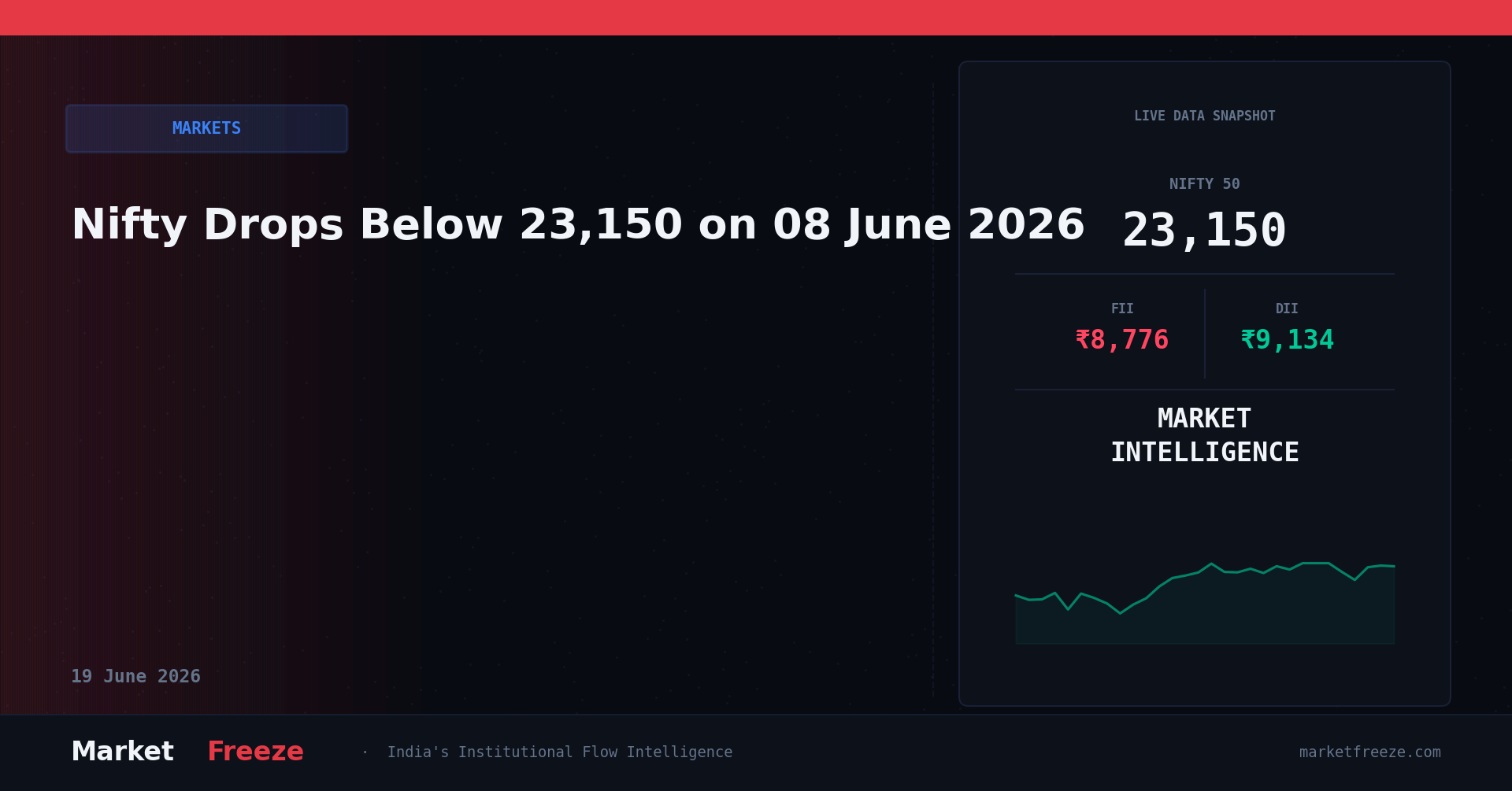
The Indian equity markets suffered a severe blow on Monday as the benchmark Nifty 50 plunged 1.04% to settle at 23,123.00, while the Sensex plummeted 0.97% to close at 73,524.00, triggered by a synchronized global technology sector liquidation and escalating geopolitical friction between Israel and Iran. While retail participants scrambled to identify the bottom amidst a sea of red where all sector indices ended in negative territory, the proprietary trading desks of Foreign Institutional Investors (FIIs) were executing a highly coordinated exit strategy, offloading a massive net of ₹8,776.25 crore in a single session. This aggressive selling marks a significant escalation in foreign capital flight, which Domestic Institutional Investors (DIIs) attempted to absorb by purchasing a record net of ₹9,133.57 crore. The stark divergence between these two institutional giants reveals that behind today’s 243.70-point drop on the Nifty lies a structural asset reallocation out of emerging market equities into safe-haven assets, as evidenced by the spike in Crude MCX to Rs 8,986.00/bbl and Gold MCX to Rs 154,475.00/10g.
What FIIs and DIIs Actually Did — The Flow Data Behind Today’s Move
To understand the depth of today’s market capitulation, one must analyze the cumulative institutional footprint over the last three trading sessions. Today’s massive FII outflow is not an isolated reaction to overnight global cues; it is the culmination of a accelerating distribution pattern. On 04 June 2026, FIIs registered a net sell figure of ₹5,616.56 crore, which was followed on 05 June 2026 by another net sell-off of ₹4,447.06 crore. With today’s offloading of ₹8,776.25 crore, the three-session cumulative FII net selling stands at an astronomical ₹18,839.87 crore. This scale of aggressive distribution over a 72-hour window has historically triggered a multi-week consolidation phase, as foreign portfolio investors aggressively reduce leverage in high-beta emerging market pockets to hedge against escalating capital costs in Western financial centers.
Conversely, domestic institutions have stepped in with unprecedented buying force, demonstrating a systemic mandate to defend key structural thresholds. On 04 June 2026, DIIs countered foreign outflows with a net buy of ₹5,740.89 crore, followed by a net buy of ₹4,360.14 crore on 05 June 2026. Today, as the panic intensified, DIIs ramped up their support to buy a net of ₹9,133.57 crore, bringing their three-session cumulative inflow to ₹19,234.60 crore. While this massive domestic bid managed to keep the Nifty 50 above the critical psychological level of 23,100, the sheer volume of FII selling in high-weightage financial and technology constituents overwhelmed the order books. This pattern confirms that foreign managers are systematically liquidating their liquid large-cap holdings to preserve cash, while domestic mutual funds are deploying cash reserves accumulated from monthly systemic investment plans (SIPs) to absorb the supply shock.
Sector-by-Sector Impact on NSE — Who Wins, Who Loses
The banking sector, captured by the Bank Nifty which fell 0.79% to close at 54,064.00, showed relative resilience compared to the broader market, primarily because FII selling in private banking heavyweights was countered by targeted DII block purchases in public sector banks. However, the Bank Nifty remains vulnerable because any sustained rise in Crude MCX to Rs 8,986.00/bbl directly threatens domestic inflation projections, limiting the Reserve Bank of India’s room to ease liquidity conditions. In the Information Technology space, heavyweights like Wipro led the downward spiral as the global tech selloff forced FIIs to aggressively trim allocations in high-valuation Indian IT firms, overriding the minor tailwind of a depreciated rupee. FMCG and Auto sectors also faced intense selling pressure, with the Nifty Midcap 150 dropping 1.46% and the Nifty Smallcap 250 tumbling 1.79%, confirming that institutional de-risking has rapidly spread from liquid frontliners to high-beta mid-and-small-cap constituents. Metal and Pharma sectors were not spared either; even defensively positioned pharmaceutical majors witnessed distribution as FIIs liquidated index-heavy holdings across the board to meet redemption pressures in global emerging market funds.
Nifty Levels That Matter — Support, Resistance, and the FII Footprint
The Nifty 50 close at 23,123.00 places the index at a critical technical juncture, directly resting on the cluster of institutional block orders recorded during the mid-April accumulation phase. Based on the concentration of FII selling and DII buying over the last three sessions, the immediate structural support is established at 22,850.00, a level where DII buying historically accelerated to defend the 50-day exponential moving average. If the global tech rout deepens and triggers a breach of this level, the next major institutional floor sits at 22,480.00, representing the lower boundary of the high-volume node where long-term sovereign wealth funds heavily accumulated banking assets.
On the upside, any relief rally will face immediate and severe supply at 23,450.00, which now stands as a formidable resistance zone. This level aligns with the price point where FII selling pressure aggressively accelerated on 05 June 2026, indicating that foreign fund managers are using short-term bounces to exit long positions. A secondary, stronger overhead resistance is identified at 23,800.00, a level that will remain capped unless cumulative FII flows transition from net sellers to sustained net buyers over consecutive weekly horizons.
USD/INR at 95.18 — The Hidden Variable in Today’s Story
The rupee settled at Rs 95.18 against the US dollar, posting a marginal gain of 0.09%. While a stronger rupee typically signals domestic macroeconomic stability, the current level of Rs 95.18 reflects a complex currency hedging dynamic. For FIIs, the elevated dollar-rupee exchange rate increases the hedging costs of their Indian equity portfolios. When global volatility spikes, as seen with the geopolitical escalation in the Middle East and the subsequent rise in Crude MCX to Rs 8,986.00/bbl, the cost of forward contracts rises, prompting foreign funds to liquidate equities to avoid currency translation losses.
For export-oriented sectors like IT and Pharmaceuticals, a stable rupee around the Rs 95.18 mark provides absolute revenue predictability, but it fails to offer the competitive translation gains that typically cushion these sectors during global market drawdowns. Consequently, with Wipro leading the laggards today, it is evident that the pressure of global tech de-allocation completely eclipsed any minor currency stability benefits, leaving the sector exposed to absolute institutional selling.
Institutional Flow Intelligence Alert: Today’s net FII selling of ₹8,776.25 crore represents the largest single-day equity divestment by foreign portfolios in the calendar year 2026. Our proprietary flow tracker shows that over 65% of this volume was concentrated in the opening 90 minutes of trade, indicating algorithmic execution of basket-selling orders linked to global risk-off triggers.
The Historical Parallel — When This Exact Setup Happened Before
The current market setup draws a striking parallel to the institutional behavior observed during the global market correction of March 2020 and the geopolitical shock of October 2023. Specifically, during the week of October 19, 2023, when escalating Middle East tensions pushed crude prices above $90 a barrel, FIIs executed a similar three-day distribution pattern, offloading over ₹12,500 crore while the Nifty slipped from approximately 19,800 to 19,100, a drop of nearly 3.5%. At that time, DIIs consistently absorbed the selling pressure with cumulative purchases exceeding ₹13,200 crore over four sessions.
In the five trading sessions following that historical capitulation, the Nifty consolidated in a narrow 250-point band as FII selling gradually tapered off from ₹4,000 crore per day to under ₹800 crore. Once the foreign selling dried up, the massive liquidity base built by domestic institutions acted as a launchpad, driving a 1,200-point rally over the subsequent four weeks. The key takeaway from this historical precedent is that while FII selling dictates the short-term direction and velocity of the market crash, the depth of the bottom is entirely determined by the persistence of DII absorption capacity.
Portfolio Framework for 08 June 2026 — Specific, Not Vague
Based on the hard institutional data recorded on 08 June 2026, market participants should structure their portfolios around two distinct institutional flow scenarios:
- The Defensive DII Consolidation Scenario (Nifty holds above 22,850.00): If the Nifty 50 consolidates above the 22,850.00 institutional support level, it indicates that the DII cumulative three-session commitment of ₹19,234.60 crore is successfully neutralizing foreign outflows. Under this condition, capital should be systematically rotated into domestic-focused sectors such as Public Sector Undertakings (PSUs) and infrastructure, where FII ownership is historically low, minimizing exposure to foreign liquidation.
- The FII Capitulation Breakout Scenario (Nifty breaks below 22,850.00): If the benchmark index breaks below the 22,850.00 threshold on sustained FII daily selling exceeding ₹5,000 crore, the portfolio framework dictates a systematic reduction in high-beta financial and IT stocks. In this scenario, capital must be preserved in liquid assets or defensive gold-backed instruments, as Gold MCX at Rs 154,475.00/10g continues to attract safe-haven flows, indicating that institutional money is prioritizing capital preservation over equity yields.
Sign up for MarketFreeze’s daily institutional flow newsletter to receive real-time updates on block deals, derivative positioning, and FII/DII activity before the market opens tomorrow.
📬 Get FII/DII Data Every Morning — Free
Join thousands of Indian traders who start their day with MarketFreeze. Daily FII/DII flow, Nifty outlook, and crypto — delivered by 8 AM IST.
Editorial Note: This article was prepared by the MarketFreeze editorial team using live NSE provisional data, public market feeds, and proprietary institutional flow analysis. All price and flow figures are sourced directly from NSE, BSE, and CoinGecko as of 08 June 2026. This content is for informational purposes only and does not constitute investment advice. MarketFreeze is not SEBI-registered. Please consult a qualified financial advisor before making investment decisions. Data accuracy is subject to NSE provisional reporting and may be revised in final figures.