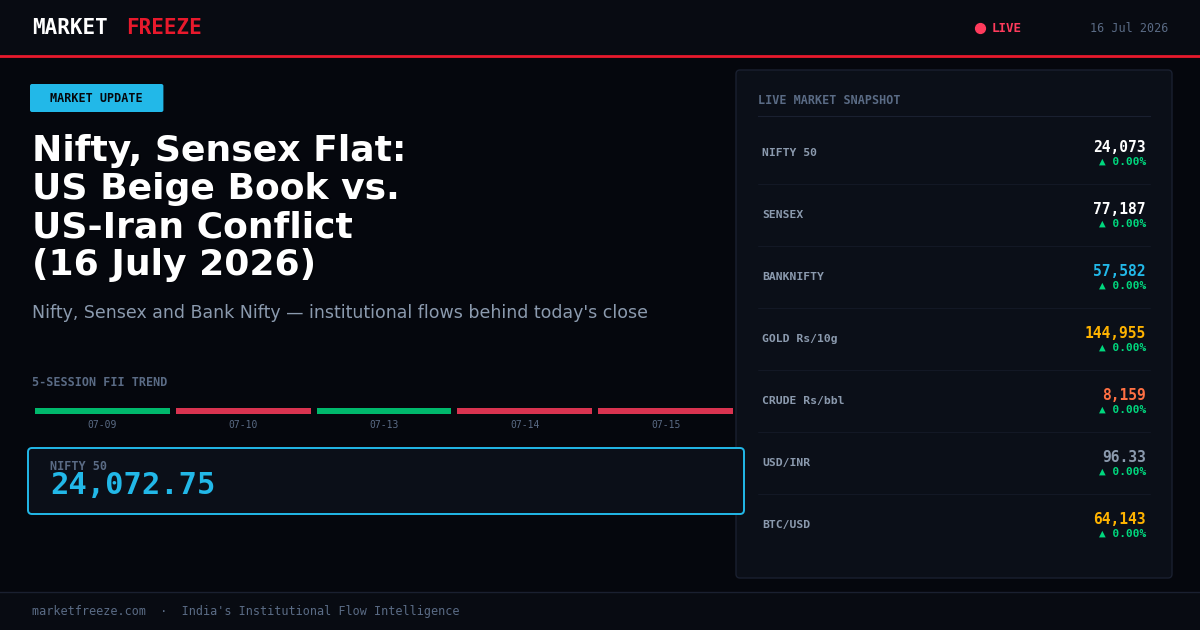
The Nifty 50 closed at 24,072.75, down 0.02%, while the Sensex ended flat at 77,187.00 on July 16, 2026, as escalating geopolitical tensions, specifically the US-Iran conflict, weighed on sentiment, overshadowing positive signals from the US Federal Reserve’s Beige Book indicating an improving US economy with easing inflation.
US Economic Signals vs. Geopolitical Headwinds: A Divergent Market Narrative
The US Federal Reserve’s latest Beige Book, released on July 16, 2026, painted a picture of moderate economic expansion across its districts, characterized by improving employment figures and easing inflationary pressures. However, the report also highlighted persistent concerns regarding rising fuel costs and the ongoing impact of tariffs. This dual narrative of underlying economic strength juxtaposed with external risks creates a complex environment for global equity markets, including India. While the Beige Book’s positive undertones might typically support risk-on sentiment, the escalating US-Iran conflict has acted as a significant counterweight, dampening investor appetite for equities. Today’s market performance, with the Nifty and Sensex closing nearly flat, reflects this tug-of-war.
Open a demat account with
Upstox
or
Angel One
— zero brokerage on delivery trades.
Institutional Flow Dynamics: DIIs Anchor While FIIs Retreat
In today’s trading session (July 16, 2026), Foreign Institutional Investors (FIIs) continued their selling spree, albeit at a moderated pace compared to the previous day. FIIs were net sellers of ₹739.69 Cr. This marks the second consecutive day of FII outflows, following a significant net sell of ₹3,062.27 Cr on July 15, 2026. Conversely, Domestic Institutional Investors (DIIs) demonstrated strong buying conviction, recording a net buy of ₹2,927.71 Cr. This robust DII participation has been a consistent feature over the last three sessions, with net buys of ₹2,171.70 Cr on July 14 and ₹2,019.68 Cr on July 13. The sustained buying by DIIs provided a crucial cushion, preventing a sharper decline in the benchmark indices despite the FII selling pressure and broader market concerns.
Sectoral Ripples: Defensive Havens and Infrastructure Resilience
The prevailing geopolitical uncertainty and the mixed economic signals from the US have led to a discernible rotation in institutional flows across sectors. The ongoing tensions have amplified demand for defensive sectors. We observed DIIs selectively increasing their exposure to the FMCG sector, likely as a hedge against broader market volatility. Companies with stable revenue streams and strong consumer demand, such as those in staples and personal care, are seen as relatively insulated from macroeconomic shocks. On the other hand, despite the general market flatness, there was evidence of DII accumulation in certain pockets of the Infrastructure and Capital Goods sectors. This suggests institutional confidence in the long-term growth story of India’s infrastructure development, which is often less sensitive to short-term geopolitical flare-ups and more driven by domestic policy initiatives and execution. Conversely, sectors with higher cyclical exposure, such as banking and industrials, experienced subdued buying interest from DIIs and were the primary targets for FII outflows.
Key Levels to Watch: Navigating the Nifty’s Tight Range
The Nifty 50 is currently trading at 24,072.75. Analyzing the recent FII/DII flow data, we identify key levels that are likely to dictate short-term price action. On July 15, 2026, DIIs were net buyers of ₹2,927.71 Cr, with a significant portion of their inflows likely directed towards supporting the market around the 24,000-24,100 mark. FIIs, as net sellers of ₹739.69 Cr on the same day, exerted pressure, but their selling was absorbed. The previous day, July 14, saw FIIs offload ₹3,062.27 Cr, pushing the Nifty down to close at 24,086.45. However, DIIs stepped in with ₹2,171.70 Cr of buying, establishing a support floor. Therefore, the immediate support for the Nifty 50 lies at 24,000, a level where DII buying has historically stepped in to defend the index. Resistance is likely to be encountered at the 24,200-24,300 zone, where any upward momentum has been capped in recent sessions, and where selling pressure from FIIs has been observed during their net buying days, such as on July 13, 2026 (Nifty closed at 24,141.05 with FII net buy of ₹2,603.72 Cr).
Currency and Commodity Cues: A Stable Rupee Amidst Global Jitters
The Indian Rupee (USD/INR) is trading at Rs96.33, showing a marginal gain of 0.09% against the US Dollar today, July 16, 2026. This relative stability in the INR, despite global geopolitical tensions, can be attributed to the consistent buying by domestic institutions and possibly some intervention by the Reserve Bank of India (RBI). The easing inflation narrative in the US Beige Book might eventually lead to a less hawkish stance from the US Federal Reserve, which could, in turn, ease pressure on emerging market currencies. However, for now, the prevailing geopolitical risk premium is keeping currency markets on edge. Gold prices on MCX are down 0.15% to Rs144,937.00/10g, and Crude Oil (MCX) is trading lower by 0.40% at Rs8,150.00/bbl. The slight dip in commodity prices, particularly crude, is a positive sign for India, which is a net importer, as it helps to alleviate inflationary pressures and improve the current account deficit. This is a factor that DIIs are likely considering in their sustained buying interest.
Historical Parallel: Navigating Crises with Domestic Demand
The current market scenario, where domestic institutional buying cushions the impact of foreign outflows amidst geopolitical uncertainty, bears resemblance to the market dynamics observed in early June 2024. During the week of June 3-7, 2024, the Nifty experienced significant volatility due to global economic concerns and domestic political uncertainty. FIIs were net sellers aggregating over ₹6,000 Cr during that period. However, robust DII inflows, exceeding ₹7,000 Cr in the same week, provided a floor, preventing a sharp correction. The Nifty, which had touched a low of 21,700 in the preceding weeks, managed to recover and stabilize, eventually closing around 22,000 by the end of that week. This historical episode underscores the critical role of domestic institutions in stabilizing the Indian equity market during periods of foreign investor retrenchment, driven by a sustained belief in the long-term domestic growth trajectory.
Portfolio Framework: Building Resilience with a DII-Centric Approach
For investors seeking to navigate the current market environment, a portfolio framework anchored by DII flow patterns and a focus on defensive resilience is recommended. Specifically, allocate at least 40% of your portfolio to sectors demonstrating consistent DII accumulation, such as FMCG and select Infrastructure plays. Maintain a cash reserve of 15-20% to capitalize on any significant market dips, especially if FII outflows exceed ₹1,500 Cr on consecutive days. For equity exposure, consider a bias towards companies with strong balance sheets and low debt-to-equity ratios, ideally below 0.5. Avoid over-allocation to highly cyclical sectors where FIIs have shown persistent selling pressure; cap exposure to such sectors at no more than 25%. The focus should be on wealth preservation and steady compounding, rather than aggressive growth in the immediate term.
What Changes This Outlook: The Crucial Inflation Data Point
The primary trigger that could significantly alter the current market outlook is a clear and sustained decline in global inflation, particularly in the US. If upcoming inflation prints, such as the US CPI data due next week, come in significantly below expectations (e.g., below 3.0% year-on-year), it could embolden the US Federal Reserve to adopt a more dovish monetary policy stance sooner than anticipated. This would likely reverse FII selling trends and reignite risk appetite, leading to a potential rally in Indian equities, pushing the Nifty towards the 24,500 level. Conversely, any resurgence in inflation, especially if coupled with a spike in crude oil prices above $85/bbl, could exacerbate FII outflows and pressure domestic indices lower, testing the 23,800 support level on the Nifty.
FII/DII Flow History (Last 5 Trading Sessions)
| Date | FII Net (Cr) | DII Net (Cr) | Nifty Close |
|---|---|---|---|
| 2026-07-09 | +₹1,962.80 Cr | +₹790.16 Cr | 23,962.80 |
| 2026-07-10 | ₹-532.86 Cr | +₹2,057.79 Cr | 24,206.90 |
| 2026-07-13 | +₹2,603.72 Cr | +₹2,019.68 Cr | 24,141.05 |
| 2026-07-14 | ₹-3,062.27 Cr | +₹2,171.70 Cr | 24,086.45 |
| 2026-07-15 | ₹-739.69 Cr | +₹2,927.71 Cr | 24,078.50 |
Frequently Asked Questions
Q: What did FII buy or sell on July 15, 2026?
A: On July 15, 2026, FIIs were net sellers of ₹739.69 Cr in the Indian equity market.
Q: What did DII buy on July 14, 2026?
A: On July 14, 2026, DIIs were net buyers of ₹2,171.70 Cr in the Indian equity market.
Q: Is FII buying or selling in July 2026?
A: In July 2026, FIIs have shown a mixed trend. While they were net buyers earlier in the month, recent sessions have seen significant selling pressure, with net outflows observed on July 14 and July 15.
Bottom Line
The Indian equity market is currently navigating a complex landscape, balancing positive domestic economic indicators and strong DII support against escalating global geopolitical risks and persistent FII selling. While the Nifty and Sensex closed flat on July 16, 2026, the underlying institutional flow data reveals a clear divergence, with DIIs actively buying to counter FII outflows. Investors should closely monitor global inflation data and crude oil price movements as key catalysts that could shift this delicate balance and influence future institutional positioning.
Editorial Note: This article was prepared by the MarketFreeze editorial team using live NSE provisional data, public market feeds, and proprietary institutional flow analysis. All price and flow figures are sourced directly from NSE, BSE, and CoinGecko as of 16 July 2026. This content is for informational purposes only and does not constitute investment advice. MarketFreeze is not SEBI-registered. Please consult a qualified financial advisor before making investment decisions. Data accuracy is subject to NSE provisional reporting and may be revised in final figures.