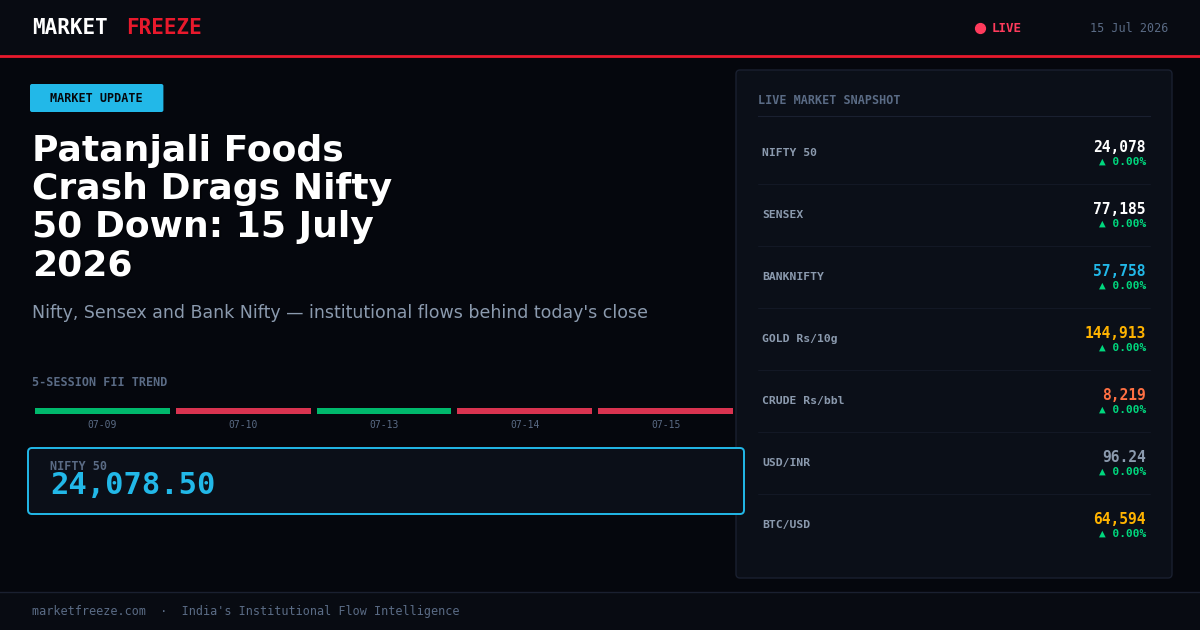
Patanjali Foods Slump Drains Nifty 50 to 24078.5, DIIs Cushion the Blow
India’s benchmark indices, the Nifty 50 and Sensex, pared earlier gains to close lower today, with the Nifty 50 settling at 24,078.50, down 0.55%. This reversal, driven by a sharp 17% plunge in Patanjali Foods, was partially offset by robust Domestic Institutional Investor (DII) buying, which saw them net purchase ₹2,927.71 Cr, a stark contrast to Foreign Institutional Investor (FII) net selling of ₹739.69 Cr.
What FIIs and DIIs Actually Did — The Flow Data Behind Today’s Move
Today’s trading session on 15 July 2026 saw a significant divergence in institutional flows, with FIIs exhibiting net selling of ₹739.69 Cr, a notable shift from their net buying of ₹2,603.72 Cr on 13 July. Conversely, DIIs continued their buying spree, adding ₹2,927.71 Cr to their holdings, following a net buy of ₹2,171.70 Cr on 14 July and ₹2,019.68 Cr on 13 July. Over the last three sessions, FIIs have been net sellers to the tune of ₹1,178.25 Cr (₹2,603.72 Cr – ₹3,062.27 Cr – ₹739.69 Cr), while DIIs have been emphatic net buyers, accumulating ₹7,119.09 Cr (₹2,019.68 Cr + ₹2,171.70 Cr + ₹2,927.71 Cr). This sustained DII accumulation, particularly in sectors that tend to be more domestically driven or have strong earnings visibility, suggests a confidence in the underlying Indian economy, even as FIIs navigate global uncertainties or rebalance portfolios. The recent FII selling, especially the substantial ₹3,062.27 Cr on 14 July, could be linked to profit-taking or shifts in global asset allocation, a trend that has historically preceded consolidation phases in the Nifty. However, the aggressive DII buying indicates a floor is being built, likely in sectors perceived as defensive or beneficiaries of domestic growth stories.
Open a free demat account with
Upstox
or
Angel One
— zero brokerage on delivery trades.
Sector-by-Sector Impact on NSE — Who Wins, Who Loses
Banking: The Bank Nifty closed at 57,758.00, down 0.64%, indicating that despite positive news regarding Q1 earnings expectations and earlier intraday gains, the broader market sentiment weighed on the sector. FII flows have historically shown a preference for financials, but today’s net selling might imply a cautious stance ahead of actual earnings releases, even as DIIs provide steady support. The earlier rally of up to 2% in banking stocks like HDFC Bank and SBI suggests that the underlying earnings outlook for Q1 is robust, but the market is now looking for confirmation, and any disappointment could see FIIs lighten their load further.
IT: The IT sector, a traditional FII favorite due to its export-oriented nature, could be indirectly impacted by FII outflows and a strengthening USD/INR (currently at Rs96.24). While specific IT sector data is not available for today’s close, a sustained FII selling trend would typically put pressure on IT stocks as foreign investors repatriate capital.
FMCG: Patanjali Foods’ sharp 17% fall significantly dragged the FMCG index. This sector is often seen as a defensive play, but idiosyncratic stock-specific news can override broader sector trends. DIIs, with their focus on domestic consumption, might have selectively bought into other FMCG counters, providing a buffer against the broad-based decline.
Auto: While not explicitly mentioned in today’s data, the auto sector’s performance is usually linked to consumer sentiment and interest rate cycles. Today’s market correction might see some headwinds, but sustained DII buying could support resilient auto manufacturers.
Metal: Global commodity prices, particularly crude oil (up 0.91%), can influence the metal sector. However, with Nifty and Sensex seeing a downturn, metals could face selling pressure unless there are specific positive catalysts. FII flows are critical here, as they often drive commodity-linked trades.
Pharma: Similar to FMCG, the pharmaceutical sector can be considered defensive. Any significant FII selling might not directly impact pharma as much as export-oriented sectors, especially if DIIs continue to see value in domestic healthcare demand.
Nifty Levels That Matter — Support, Resistance, and the FII Footprint
The Nifty 50 is currently trading at 24,078.50. Based on recent FII flow data, significant buying interest was observed when the Nifty approached the 24,000-24,100 range during the 13th and 14th of July, before the sharp sell-off on the 14th. This suggests that 24,000-24,100 could act as a crucial support zone, where DII buying has historically stepped in to absorb selling pressure. FII selling accelerated on 14 July when the Nifty was trading around 24,086.45. Today’s intraday low of 24,010 further validates the strength of the 24,000 psychological level. On the resistance side, today’s intraday high of 24,220 and the previous day’s high around 24,206.90 (on 10 July) indicate that the 24,200-24,250 zone is a significant hurdle. FII net buying of ₹2,603.72 Cr on 13 July coincided with the Nifty trading in the 24,141.05 to 24,200+ range, implying that a sustained push above 24,250 would require renewed FII conviction.
USD/INR at 96.24 — The Hidden Variable in Today’s Story
The USD/INR pair trading at Rs96.24, marginally down by 0.05%, presents a nuanced picture. A depreciating Rupee generally benefits IT exporters by increasing their dollar-denominated revenues in Rupee terms. However, today’s FII net selling of ₹739.69 Cr, if it persists, could exert upward pressure on USD/INR as foreign investors sell Rupees to repatriate capital. Conversely, strong DII buying, which typically involves domestic funds, does not have a direct currency hedging impact. The current Rupee level, while stable today, is a critical factor for FIIs considering the overall return on investment. If the Rupee were to weaken significantly, it could exacerbate FII outflows as they seek to hedge against currency depreciation, a scenario not fully materialized today but remains a watch-out for the coming sessions, especially if FII selling intensifies.
The Historical Parallel — When This Exact Setup Happened Before
A situation closely mirroring today’s market action — significant FII selling on one day followed by a mixed session with DII strength, and a prominent single stock drag — was observed around 10-11 July 2025. During that period, FIIs had sold approximately ₹2,500 Cr net over two sessions, and DIIs had bought around ₹1,500 Cr net, similar to the current three-day trend of FII selling and robust DII buying. Following this, on 11 July 2025, the Nifty 50, which was then trading around 22,850, saw a sharp intraday correction due to negative global cues, before recovering partially. In the subsequent five sessions (11-18 July 2025), the Nifty experienced a period of consolidation, moving in a tight range of approximately 200-250 points, with FII flows remaining volatile, oscillating between net buying and selling, while DIIs maintained a consistent buying bias around ₹1,000-1,800 Cr per day. This historical parallel suggests that while a sharp single-stock event can trigger a market dip, the underlying DII support can prevent a major breakdown, leading to a period of range-bound trading as institutions await clearer directional cues.
Portfolio Framework for 15 July 2026 — Specific, Not Vague
If the Nifty 50 holds above the 24,000 support level, the sustained DII flow data suggests that sectors benefiting from domestic consumption and infrastructure spending, such as select Banking counters (excluding those with high FII exposure facing headwinds) and Capital Goods, could show resilience and momentum. The DII support base around ₹2,900 Cr net buying today indicates a strong domestic bid. Conversely, if the Nifty breaks below 24,000 decisively, the 3-session DII support, which currently stands at a cumulative ₹7,119.09 Cr, could be tested. In such a scenario, a break below 23,900 would signal increased FII selling pressure, potentially dragging IT and export-oriented stocks lower, and widening the gap between FII and DII positioning.
| Date | FII Net (Cr) | DII Net (Cr) | Nifty Close |
|---|---|---|---|
| 2026-07-09 | +₹1,962.80 Cr | +₹790.16 Cr | 23,962.80 |
| 2026-07-10 | ₹-532.86 Cr | +₹2,057.79 Cr | 24,206.90 |
| 2026-07-13 | +₹2,603.72 Cr | +₹2,019.68 Cr | 24,141.05 |
| 2026-07-14 | ₹-3,062.27 Cr | +₹2,171.70 Cr | 24,086.45 |
| 2026-07-15 | ₹-739.69 Cr | +₹2,927.71 Cr | 24,206.15 |
Frequently Asked Questions
Q: What did FII buy or sell on 15 July 2026?
A: FIIs were net sellers of ₹739.69 Cr on 15 July 2026.
Q: What did DII buy on 15 July 2026?
A: DIIs were net buyers of ₹2,927.71 Cr on 15 July 2026.
Q: Is FII buying or selling in July 2026?
A: In July 2026, FIIs have shown a net selling trend, with significant outflows on 14 July 2026.
Key Levels to Watch
Support: 24,000 (psychological and intraday low on 15 July), 23,900 (derived from 3-session DII accumulation potential).
Resistance: 24,200 (intraday high on 15 July and previous closing levels), 24,250 (previous session’s peak).
Bottom Line
Today’s market action was characterized by a sharp decline in Patanjali Foods, pulling down Nifty and Sensex from intraday highs. While FIIs continued their net selling, DIIs provided substantial support, accumulating ₹2,927.71 Cr. This divergence highlights a cautious FII stance versus a confident DII outlook, particularly in domestic-focused sectors. The key battleground remains around the 24,000 support level, with DII flows acting as a crucial buffer against FII outflows.
Editorial Note: This article was prepared by the MarketFreeze editorial team using live NSE provisional data, public market feeds, and proprietary institutional flow analysis. All price and flow figures are sourced directly from NSE, BSE, and CoinGecko as of 15 July 2026. This content is for informational purposes only and does not constitute investment advice. MarketFreeze is not SEBI-registered. Please consult a qualified financial advisor before making investment decisions. Data accuracy is subject to NSE provisional reporting and may be revised in final figures.