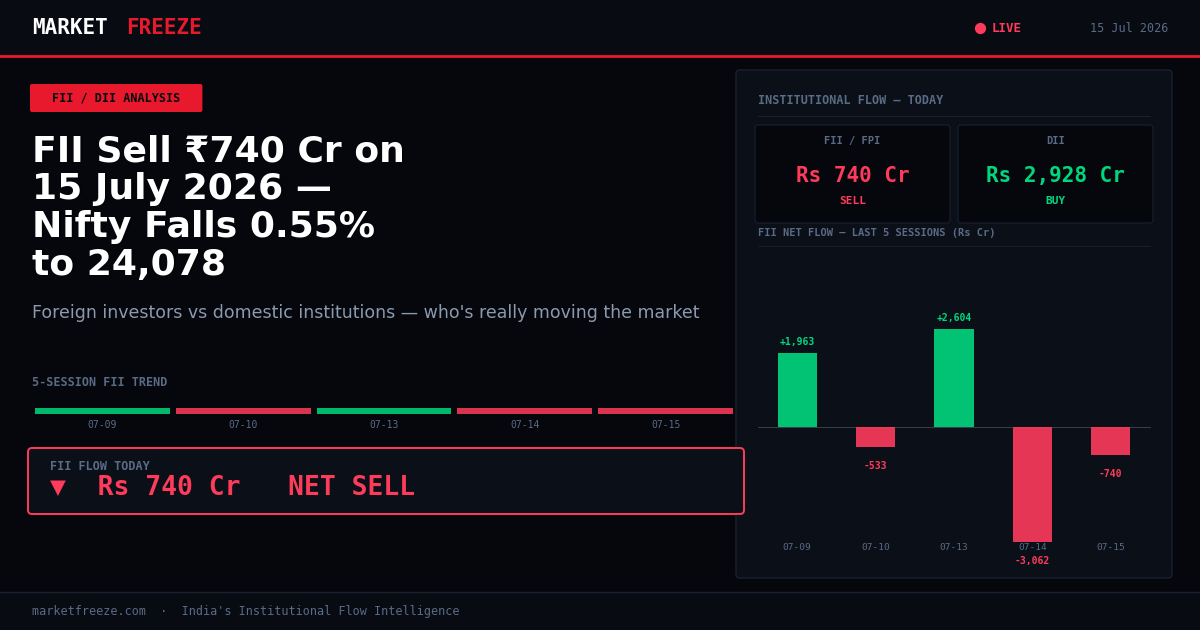
FII desks turned net sellers today, offloading ₹739.69 Cr in Indian equities. This outflow contrasts sharply with the substantial ₹2,927.71 Cr net buy executed by Domestic Institutional Investors (DIIs) on the same day, July 15, 2026. The Nifty 50 closed at 24,078.50, down 0.55% for the session.
Open a free demat account with
Upstox
or
Angel One
— zero brokerage on delivery trades.
FII Selling Accelerates After Previous Day’s Plunge
Today’s FII selling, while significant at ₹739.69 Cr, represents a de-acceleration compared to the massive ₹3,062.27 Cr outflow recorded on July 14, 2026. This suggests that while foreign funds remain net sellers, the intensity of their selling pressure has diminished. The prior day’s aggressive liquidation likely contributed to the Nifty 50’s dip to 24,086.45. Earlier today, the index had briefly touched 24,220, as reported in market updates, indicating a potential intraday recovery attempt that ultimately failed to sustain momentum, closing at 24,078.50. This pattern of intraday gains eroding into losses is often driven by sustained FII selling pressure throughout the trading session.
Retail investors should monitor if this reduced selling pace continues. A sustained decline in FII selling volume could signal a bottoming out of their recent bearish stance.
DIIs Step Up Buying Amidst FII Outflow
Domestic institutional investors provided a strong counter-balance to FII selling today, registering a net buy of ₹2,927.71 Cr. This marks an increase from the ₹2,171.70 Cr DII net buy on July 14, 2026, and is the highest DII inflow in the last three sessions. The DIIs’ robust buying action absorbed a significant portion of the FII selling, preventing a sharper decline in the broader indices. This consistent DII support, which has been positive for three consecutive sessions, signals conviction in domestic market fundamentals from local fund managers. The resilience of the Nifty 50 around the 24,000 mark, despite FII outflows, is largely attributable to this DII buying strength.
Retail traders can infer that DIIs are actively accumulating positions, potentially positioning for a near-term recovery. Focus on stocks seeing strong DII participation.
Nifty Faces Resistance Near 24,200, Support at 23,900
Based on today’s trading action and institutional flows, the Nifty 50’s immediate resistance is observed around the 24,200 mark. The index failed to sustain gains above this level earlier in the session. On the downside, the 23,900 level appears to be forming a support zone. Today’s closing price of 24,078.50 places the Nifty precariously between these levels. The substantial FII selling on July 14, 2026, which saw the Nifty close at 24,086.45, combined with today’s continued, albeit reduced, selling pressure, suggests that any upward move towards 24,200 will likely encounter selling from FIIs looking to exit positions. Conversely, strong DII buying at lower levels could provide a floor around 23,900.
Retail investors should use 24,200 as a potential exit point for short-term long positions and 23,900 as a level to watch for potential DII-led buying opportunities.
Banking Sector Sees Divergent Flows
While today’s overall market saw FII selling, the banking sector presents a complex picture. News highlighted a rally in banking stocks up to 2% earlier in the week, with Nifty Bank gaining 560 points ahead of Q1 earnings. HDFC Bank and SBI were noted as beneficiaries. However, today’s broad FII selling could impact banking counters if FIIs trim their exposure in financials. Conversely, DIIs have consistently been net buyers over the last three sessions, and their continued buying strength, totaling ₹7,117.19 Cr over this period, likely includes significant accumulation in banking and financial services. HDFC AMC’s strong Q1 results, with a 12% YoY jump in net profit to ₹837 crore and a 13.6% rise in revenue, could provide a tailwind for financial sector stocks, particularly asset management companies.
Retail investors should watch banking sector earnings reports closely. Strong results, like HDFC AMC’s, could attract DII buying even if FIIs remain on the sidelines or are net sellers in the broader market.
FIIs Continue Exodus from Equity Amidst DII Accumulation
The aggregate FII net sell figure over the last two sessions stands at a significant ₹3,801.96 Cr (₹3,062.27 Cr on July 14 + ₹739.69 Cr on July 15). This marks a clear reversal from the strong FII buying trend seen on July 13, 2026, when they were net buyers of ₹2,603.72 Cr. The shift from net buying to significant net selling indicates a change in foreign investor sentiment towards Indian equities. In contrast, DIIs have maintained a consistent buying spree, with net inflows of ₹2,019.68 Cr, ₹2,171.70 Cr, and ₹2,927.71 Cr over the last three sessions respectively, totaling ₹7,117.19 Cr. This divergence highlights a battle between foreign and domestic institutional money, with DIIs effectively cushioning the market impact of FII outflows.
Retail investors should interpret this divergence as DIIs becoming the primary market support. Any signs of FII selling abating would likely trigger a sharp upside move, amplified by existing DII long positions.
Sectoral Implications: Defence, Infrastructure Likely Beneficiaries of DII Buying
Given the consistent DII net buy of ₹7,117.19 Cr over the last three sessions, and the current market narrative focusing on domestic growth drivers, sectors that benefit from government spending and domestic consumption are likely targets for DII accumulation. While specific sector flows are not provided, the sustained DII buying suggests a preference for defensives and infrastructure-related plays. The broader market’s underperformance today, with Nifty 50 down 0.55% and Sensex down 0.56%, implies that FII selling might be concentrated in more liquid large-cap stocks or sectors perceived as globally sensitive, such as IT or certain manufacturing segments. Conversely, DIIs’ strong buying could be flowing into sectors less exposed to global headwinds, such as defence, infrastructure, capital goods, and potentially select FMCG stocks, which often show resilience during periods of broader market weakness.
Retail traders looking to align with DIIs should research companies with strong domestic demand drivers and government order books, particularly within the defence and infrastructure spaces.
Historical Context: FII Selling Spikes and Market Reactions
The FII net sell figure of ₹3,062.27 Cr on July 14, 2026, was one of the largest single-day outflows in recent history, surpassing the ₹739.69 Cr selling seen today. When FIIs exit aggressively, as they did yesterday, the market typically faces downward pressure. For instance, on July 10, 2026, when FIIs were net sellers of ₹532.86 Cr, the Nifty closed at 24,206.90, suggesting a minor pullback. However, the significant selling yesterday, followed by continued selling today, albeit at a reduced pace, suggests a more sustained unwinding. The subsequent strong DII buying has so far prevented a significant breakdown. Historically, periods of sharp FII selling followed by robust DII buying have often preceded market recoveries, as domestic institutions step in to fill the void and signal confidence.
Retail investors can use sharp FII selling days as opportunities to identify stocks supported by strong DII inflows, potentially leading to a quick snap-back rally.
What Could Change The Current Flow Narrative
The primary factor that could alter today’s FII selling narrative is a significant shift in global risk perception or a positive surprise from Indian macroeconomic data, such as lower inflation prints or robust GDP growth figures, which could entice FIIs back into the market. A sustained close by the Nifty 50 above 24,200, particularly on increased volumes and confirmed by a reversal in FII flow to net buying, would signal a change. Conversely, a breakdown below the 23,900 support level, accompanied by an acceleration in FII selling and a dip in DII buying, would indicate a deeper correction. Today’s crude oil price increase to ₹8,256.00/bbl (+1.25%) is a marginal headwind, but a sustained spike in oil prices could reignite inflation concerns and prompt further FII outflows.
Retail investors should closely track global news wires for geopolitical developments and monitor upcoming inflation data releases for any indications of a shift in FII strategy.
FAQ Section
Why did FIIs sell ₹739.69 Cr today?
Foreign Institutional Investors (FIIs) turned net sellers today, offloading ₹739.69 Cr in Indian equities. While the exact reasons are not public, this selling activity often correlates with global macroeconomic concerns, shifts in risk appetite, or profit-taking following recent rallies. Today’s selling represents a de-escalation from the previous day’s much larger outflow of ₹3,062.27 Cr.
Are DIIs buying more than FIIs are selling?
Yes, today DIIs were significant net buyers at ₹2,927.71 Cr, which more than offset the FII net selling of ₹739.69 Cr. Over the last three sessions, DII net inflows total ₹7,117.19 Cr, while FIIs have been net sellers of ₹3,801.96 Cr in the last two sessions combined.
What is the Nifty support level based on today’s institutional flows?
Based on today’s institutional flow dynamics and market action, the Nifty 50 appears to have support around the 23,900 mark. Strong DII buying has been evident at lower levels, helping to defend this zone. The index closed today at 24,078.50.
Historical FII/DII Flows: Last 5 Sessions
| Date | FII Net (Cr) | DII Net (Cr) | Nifty Close |
|---|---|---|---|
| 2026-07-09 | +₹1,962.80 Cr | +₹790.16 Cr | 23,962.80 |
| 2026-07-10 | ₹-532.86 Cr | +₹2,057.79 Cr | 24,206.90 |
| 2026-07-13 | +₹2,603.72 Cr | +₹2,019.68 Cr | 24,141.05 |
| 2026-07-14 | ₹-3,062.27 Cr | +₹2,171.70 Cr | 24,086.45 |
| 2026-07-15 | ₹-739.69 Cr | +₹2,927.71 Cr | 24,078.50 |
Bottom Line
Today’s trading session was defined by a sharp divergence between FII selling and DII buying. While FIIs continued their outflow, albeit at a moderated pace compared to yesterday, DIIs stepped in with substantial purchases, absorbing the selling pressure. This DII support is crucial for maintaining market stability around the 24,000 level for the Nifty 50. The banking sector, buoyed by strong earnings from entities like HDFC AMC, remains a key area of DII interest. Retail investors should closely monitor the sustainability of DII inflows and any potential shift in FII sentiment as key indicators for near-term market direction.
The current market environment, characterized by substantial DII buying countering FII selling, presents a unique set of challenges and opportunities for retail investors. While the large domestic inflows provide a cushion against significant downside, they also signal a potential preference for specific market segments. Retail traders might find it beneficial to follow the DIIs’ lead, focusing on sectors that are likely to benefit from sustained domestic capital deployment. This includes areas like infrastructure, capital goods, and potentially the banking sector, given its systemic importance and the ongoing positive earnings trend observed in some segments. The overall market indices have shown a degree of resilience, with the Nifty 50 holding above the 24,000 mark despite external outflows. This suggests that domestic demand is strong enough to absorb a considerable amount of foreign selling without a precipitous fall.
Retail Investor Strategy: Navigating the FII-DII Divergence
For retail investors, the ongoing divergence between FII and DII flows necessitates a cautious yet opportunistic approach. The fact that DIIs have cumulatively invested over ₹7,000 Cr in the last three sessions suggests a strong belief in the long-term prospects of Indian equities. Retail participants should consider aligning their portfolios with these domestic institutional buyers. This could involve increasing exposure to sectors that have historically shown resilience and are beneficiaries of government policies, such as infrastructure development and renewable energy. Additionally, monitoring companies that consistently report strong earnings, even amidst broader market volatility, is prudent. The recent performance of companies like HDFC AMC, with its reported 12% year-on-year profit growth, exemplifies the kind of fundamental strength that DIIs are likely to be chasing. Avoiding highly FII-dependent sectors, or reducing exposure where FII selling has been aggressive, might be a wise short-term strategy. The Nifty 50’s recent struggles to break past the 24,200 level, coupled with FII outflows, reinforces the idea that broad market rallies might be capped by foreign selling pressure, making selective stock picking crucial.
Sector Rotation Implications: Beyond Banking and Infrastructure
While banking and infrastructure are clear beneficiaries of DII accumulation, the implications of sustained institutional flow divergence extend to other sectors. If FIIs continue to trim positions in export-oriented sectors like IT, which might be perceived as more sensitive to global economic slowdowns, domestic funds could be rotating into cyclicals that are poised to benefit from India’s economic growth trajectory. Sectors such as manufacturing, automotive, and even consumer discretionary could see increased DII interest, especially if domestic demand remains robust. The defence sector, with its significant order book and government focus, has been a consistent recipient of DII interest, and this trend is likely to persist. Conversely, sectors heavily reliant on foreign capital, or those facing intense global competition, might continue to languish unless domestic demand provides a strong counter-balance. The fact that FIIs offloaded over ₹3,000 Cr on July 14, 2026, indicates a broad-based deleveraging, but the subsequent DII buying suggests a targeted approach within the domestic market.
Historical FII Patterns: Decoding the Selling Spikes
Examining historical FII flow patterns reveals that periods of sharp selling, such as the ₹3,062 Cr outflow witnessed on July 14, 2026, are not unprecedented. Often, such aggressive selling by foreign investors is triggered by a confluence of global factors, including rising interest rates in developed economies, geopolitical tensions, or a sudden reassessment of emerging market valuations. However, history also shows that Indian domestic institutions have consistently stepped in to support the market during such times. For instance, on July 10, 2026, when FIIs were net sellers to the tune of ₹532 Cr, DIIs absorbed this pressure with a net buy of ₹2,057 Cr. This pattern of DII resilience has been a recurring theme, providing a floor to market corrections. The current series of DII net buys, consistently exceeding ₹2,000 Cr per day, is a testament to this established trend. Understanding these historical precedents can help retail investors differentiate between temporary profit-taking by FIIs and a more fundamental shift in sentiment.
Tomorrow’s Key Levels to Watch
Looking ahead, several key levels will be critical for the Nifty 50. On the upside, the 24,200 level will serve as immediate resistance. A sustained move above this psychological mark, especially on increased volumes and with a reversal in FII flows from net selling to net buying, would signal a significant bullish development. Conversely, the 23,900 mark remains a crucial support level. Any decisive break below this point, particularly if accompanied by a surge in FII selling and a decline in DII buying activity, could signal a more pronounced correction. Today’s closing price of 24,078.50 places the Nifty squarely between these two pivotal levels. Additionally, investors should keep an eye on intraday volatility. Sharp intraday swings, often seen when institutional flows are highly divergent, can create trading opportunities but also increase risk. The performance of the banking index, especially in light of upcoming earnings from major PSU banks, will also be a significant indicator.
The Road Ahead: Sustaining Domestic Momentum
The current market narrative is clearly dominated by the resilience of domestic institutional investors in the face of foreign outflows. The substantial net inflows by DIIs, totaling over ₹7,000 Cr in the past three sessions, underscore their confidence in the Indian growth story. While FII selling, even at a reduced pace today, remains a point of concern, the ability of domestic funds to absorb this selling pressure is a strong positive. For retail investors, the actionable insight is to closely monitor the sustainability of DII inflows. If DIIs continue their robust buying, particularly into sectors with strong domestic demand drivers like infrastructure and manufacturing, the market is likely to remain buoyant. Any signs of DII sentiment wavering, however, could expose the market to significant downside, especially if FII selling re-accelerates. Therefore, aligning investment strategies with the flow of domestic capital, while remaining vigilant for shifts in global sentiment that might influence FII behavior, is the most prudent path forward.
Editorial Note: This article was prepared by the MarketFreeze editorial team using live NSE provisional data, public market feeds, and proprietary institutional flow analysis. All price and flow figures are sourced directly from NSE, BSE, and CoinGecko as of 15 July 2026. This content is for informational purposes only and does not constitute investment advice. MarketFreeze is not SEBI-registered. Please consult a qualified financial advisor before making investment decisions. Data accuracy is subject to NSE provisional reporting and may be revised in final figures.