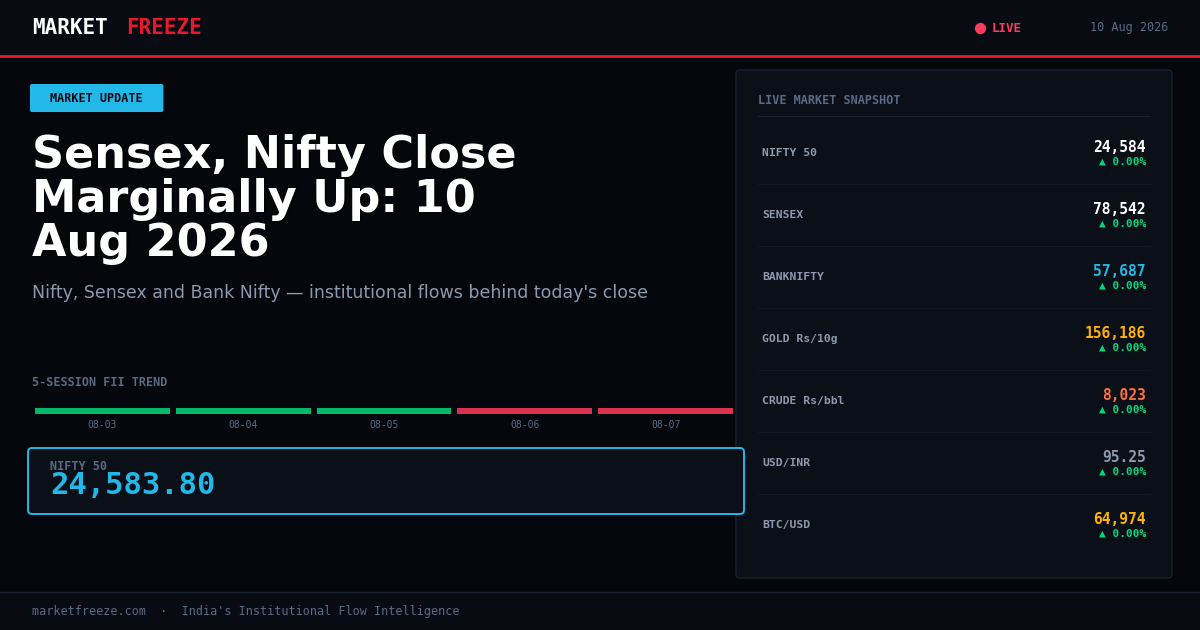
Nifty and Sensex Close Marginally Up Amidst Lackluster Trade; FIIs Exhibit Net Selling Pressure
The Indian equity markets, represented by the Nifty 50 and Sensex, concluded Monday’s trading session with marginal gains of 0.05% and 0.06% respectively, closing at 24,583.80 and 78,542.00, as a sense of range-bound trading prevailed. This subdued performance, despite positive Asian cues, was attributed to elevated US bond yields and ongoing geopolitical risks, which tempered investor enthusiasm. Crucially, Foreign Institutional Investors (FIIs) continued their net selling streak for the second consecutive session, offloading equities worth ₹17.86 Cr, while Domestic Institutional Investors (DIIs) provided robust support with a net buying of ₹4,013.60 Cr. This divergence in institutional flows, with DIIs absorbing FII selling pressure, was the defining characteristic of the day’s trading, as indicated by the live market data.
FIIs Continue Net Selling, DIIs Absorb Selling Pressure in Range-Bound Market
The trading session on August 10, 2026, saw a clear dichotomy in institutional investor behavior. FIIs, who have shown a mixed trend over the past few sessions, registered a net sell of ₹17.86 Cr. This follows a more significant net sell of ₹943.42 Cr on August 6th and a net buy of ₹2,446.47 Cr on August 5th. The consistent, albeit smaller, selling by FIIs today suggests a cautious approach or a tactical rebalancing of portfolios amidst global uncertainties. In stark contrast, DIIs demonstrated unwavering confidence, stepping in to net buy a substantial ₹4,013.60 Cr. This significant inflow from domestic institutions has been a consistent theme, with DIIs net buying ₹2,883.17 Cr on August 6th and ₹4,013.60 Cr on August 7th. The resilience shown by DIIs in absorbing FII outflows was instrumental in preventing any significant downside for the benchmark indices, keeping the Nifty 50 and Sensex in positive territory, albeit by narrow margins.
Open a free demat account with
Upstox
or
Angel One
— zero brokerage on delivery trades.
Sectoral Rotation Evident: Consumer Discretionary and Financials See Divergent Flows
The day’s trading exhibited clear signs of sectoral rotation, a trend that often accompanies periods of indecision in the broader market. While the overall indices ended marginally higher, specific sectors experienced significant swings. Consumer Discretionary stocks, notably Bajaj Finance and Titan, emerged as top gainers, contributing to the modest upward movement of the Sensex and Nifty. Bajaj Finance, a key financial services player, saw its share price appreciate, indicating renewed investor interest in the BFSI sector, likely driven by DII buying. Conversely, heavyweight stocks like SBI and Reliance Industries faced selling pressure, offsetting some of the gains. The news regarding Akums Drugs rallying 9% to a 52-week high on strong Q1 FY27 results (revenue up 13.9% YoY) highlights a potential shift towards mid-cap pharmaceutical and healthcare stocks, which often benefit from specific company performance rather than broad market sentiment. The subdued performance of Bank Nifty, which closed down 0.10% at 57,687.00, suggests that despite DII support, the broader banking sentiment might be tempered by concerns over asset quality or interest rate sensitivity, contrasting with the positive individual stock performance seen in Bajaj Finance.
Nifty 50 Navigates Near Historical Flow Support Levels
The Nifty 50’s closing at 24,583.80 places it within a crucial zone influenced by recent institutional activity. Analyzing the last five trading sessions, we observe a pattern where DII buying has consistently provided a floor, particularly when FIIs have exhibited selling pressure. On August 7th, when FIIs net sold ₹17.86 Cr, the Nifty closed at 24,570.65, very close to its current level. The significant DII buying of ₹4,013.60 Cr on that day cushioned the index. Similarly, on August 6th, despite FII net selling of ₹943.42 Cr, DIIs bought ₹2,883.17 Cr, supporting the Nifty to close at 24,636.00. The recent buying spree by DIIs, especially evident on August 5th and 7th, suggests that levels around 24,500-24,600 are being actively defended by domestic institutions. Any sustained FII selling below these levels could test the DII support. Conversely, a reversal in FII flows could propel the Nifty towards the 24,774.30 mark, the closing high observed on August 3rd, which was accompanied by strong net buying from both FIIs (₹277.48 Cr) and DIIs (₹2,260.37 Cr).
Gold Surges, Offering a Haven Amidst Geopolitical and Yield Concerns
While equity markets traded in a tight range, the precious metal segment showcased a different story. Gold on MCX surged by a notable 1.38% to close at ₹156,182.00 per 10 grams. This sharp uptick in gold prices is a clear indicator of investors seeking safe-haven assets in response to rising geopolitical tensions and the persistent concern over elevated US bond yields. The strength in gold often correlates with increased global uncertainty and a weaker US dollar, although the USD/INR pair saw a marginal dip of 0.02% to Rs95.25 today. The simultaneous rise in Crude MCX by 0.92% to Rs8,031.00 per barrel suggests that the geopolitical risks might be impacting energy supply concerns, further contributing to a cautious global economic outlook. This divergence between equities and gold underscores the prevailing risk-off sentiment that is influencing institutional allocation strategies, even as DIIs continue to back Indian equities.
Historical Parallel: August 2022 Saw Similar FII Outflows and DII Inflows
A historical parallel can be drawn to the trading patterns observed in August 2022, a period characterized by significant geopolitical overhangs and global interest rate hikes. During that time, Indian markets also witnessed periods of substantial FII outflows, often in the range of ₹1,000-₹2,000 Cr per session, countered by strong DII inflows. For instance, in the second week of August 2022, while FIIs were net sellers, DIIs consistently bought equities, providing a stabilizing force. This dynamic often led to range-bound trading in the Nifty and Sensex, with a gradual upward bias driven by domestic demand. The current scenario, with FIIs net selling ₹17.86 Cr today after a larger outflow on August 6th (₹943.42 Cr), and DIIs buying substantially (₹4,013.60 Cr), mirrors this historical trend. In 2022, such sustained DII buying eventually provided a foundation for market recovery once external headwinds subsided. This suggests that the current market structure, with DIIs as the primary support, could lead to a similar outcome if global sentiment improves.
Portfolio Framework: A Strategy for Divergent Institutional Flows
Given the current market scenario characterized by FII net selling and robust DII buying, a strategic portfolio adjustment is warranted. Investors should consider a defensive tilt within their equity portfolios, focusing on sectors that have demonstrated resilience or specific company-driven growth. For instance, allocating a portion of the portfolio to high-quality Consumer Staples and Pharmaceuticals, which typically outperform in uncertain times, would be prudent. Additionally, given Bajaj Finance’s strong performance and DII support for the financial sector, a selective approach to large-cap financials with strong balance sheets and consistent earnings growth could be considered. The current Nifty levels around 24,583.80, with support observed near 24,500 due to DII inflows, suggest that a 5-10% allocation to defensive sectors and 15-20% to well-managed financial services stocks could form a core holding. Conversely, reducing exposure to highly cyclical sectors that are more sensitive to global economic downturns would be advisable. The strategy should be to maintain liquidity and be prepared to re-enter growth-oriented sectors on clear signs of a shift in FII sentiment or a significant de-escalation of geopolitical risks.
Key Levels to Watch: 24,774.30 Resistance, 24,500 Support
The Nifty 50’s trajectory will be closely watched, with key levels dictated by institutional flow patterns. The immediate resistance for the Nifty lies around the 24,774.30 mark, the closing high recorded on August 3rd, when both FIIs and DIIs were in buying mode. A sustained move above this level, accompanied by a reversal in FII flows, could signal a breakout. On the downside, significant support is evident around the 24,500-24,550 range. This zone has seen considerable DII buying over the last few sessions, particularly on August 7th when the Nifty touched 24,570.65 amidst FII selling. A decisive breach below 24,500 would indicate that DII support might be waning or that FII selling is intensifying, potentially dragging the index towards lower support levels, though current flow data suggests this is less likely in the immediate term. The Bank Nifty’s support lies around its recent lows, with resistance around the 58,000 mark.
What Changes This Outlook: A Sustained FII Outflow Exceeding ₹500 Cr Daily
The current market outlook, underpinned by DII buying and marginal FII selling, could drastically change if FIIs were to initiate a sustained outflow exceeding ₹500 Cr on a daily basis for three consecutive sessions. Such a move would signal a significant shift in global investor sentiment towards Indian equities, potentially triggered by adverse macroeconomic data from the US, an escalation of geopolitical conflicts, or a sudden policy change. If this threshold is breached, it would indicate that the DII support may not be sufficient to counter aggressive FII selling, leading to a more pronounced correction in the Nifty and Sensex, potentially testing levels below 24,000. Conversely, if FIIs were to turn net buyers with inflows exceeding ₹1,000 Cr for multiple sessions, it would confirm a robust risk-on sentiment, likely propelling the markets to new highs, with the Nifty targeting levels above 25,000.
Frequently Asked Questions
Q: What did FII buy or sell on August 7, 2026?
A: On August 7, 2026, FIIs were net sellers, offloading equities worth ₹17.86 Cr.
Q: What did DII buy on August 10, 2026?
A: On August 10, 2026, DIIs were strong net buyers, purchasing equities worth ₹4,013.60 Cr.
Q: Is FII buying or selling in August 2026?
A: In August 2026, FIIs have shown a mixed trend so far, with net selling observed on August 6th (₹943.42 Cr) and August 10th (₹17.86 Cr), interspersed with significant net buying on August 5th (₹2,446.47 Cr). The overall trend for the month requires further observation, but recent sessions indicate a cautious approach with net selling.
Historical FII/DII Net Flows
| Date | FII Net (Cr) | DII Net (Cr) | Nifty Close |
|---|---|---|---|
| 2026-08-03 | +₹277.48 Cr | +₹2,260.37 Cr | 24,774.30 |
| 2026-08-04 | +₹922.26 Cr | +₹1,571.18 Cr | 24,614.90 |
| 2026-08-05 | +₹2,446.47 Cr | ₹-936.14 Cr | 24,624.65 |
| 2026-08-06 | ₹-943.42 Cr | +₹2,883.17 Cr | 24,636.00 |
| 2026-08-07 | ₹-17.86 Cr | +₹4,013.60 Cr | 24,570.65 |
Bottom Line: Indian equities closed marginally higher as DIIs continued their strong buying spree, absorbing FII selling pressure amidst global uncertainties. While Consumer Discretionary and specific mid-cap stocks showed promise, the broader market remained range-bound, reflecting investor caution. The sustained DII inflows are providing critical support to the Nifty around the 24,500 mark, making it a key level to watch for further direction.
Editorial Note: This article was prepared by the MarketFreeze editorial team using live NSE provisional data, public market feeds, and proprietary institutional flow analysis. All price and flow figures are sourced directly from NSE, BSE, and CoinGecko as of 10 August 2026. This content is for informational purposes only and does not constitute investment advice. MarketFreeze is not SEBI-registered. Please consult a qualified financial advisor before making investment decisions. Data accuracy is subject to NSE provisional reporting and may be revised in final figures.