Indian Equities Decline as Soaring Crude Oil Prices Dent Sentiment, FIIs Exhibit Mixed Flows
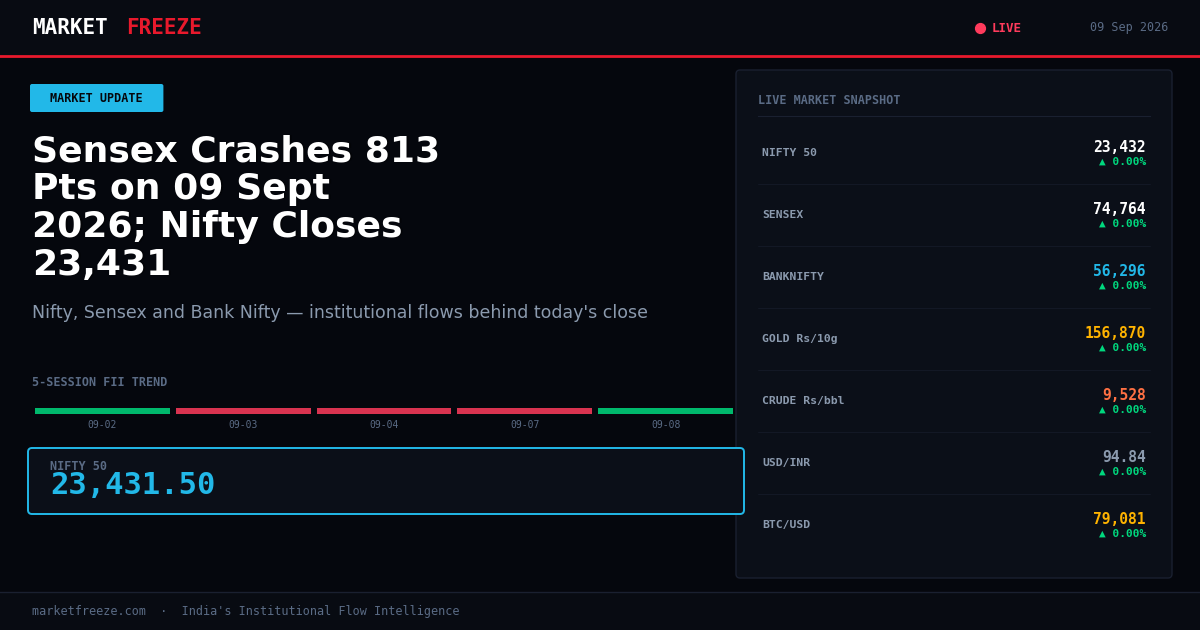
Indian equity benchmarks, the Nifty 50 and Sensex, registered significant declines today, September 9, 2026, closing at 23,431.50 (-0.86%) and 74,764.00 (-1.08%) respectively, primarily driven by a sharp spike in crude oil prices breaching the $100 a barrel mark, which fueled inflation concerns and weakened the rupee.
Open a free demat account with
Upstox
or
Angel One
— zero brokerage on delivery trades.
Crude Oil Surge Triggers Broad Market Sell-off, FIIs Turn Net Sellers After Brief Respite
The confluence of surging crude oil prices, which climbed to Rs9,532.00 per barrel on MCX, and significant selling pressure in Information Technology (IT) stocks created a potent cocktail for market decline today. The Brent crude nearing $100 a barrel has intensified fears of imported inflation, potentially impacting the Reserve Bank of India’s monetary policy stance and widening the current account deficit. This macroeconomic overhang directly contributed to a risk-off sentiment, evident in the broad-based selling across sectors, with the Nifty IT index slumping by 3%. Foreign Institutional Investors (FIIs), who had shown net buying of ₹280.13 Cr on September 8, reversed their stance to become net sellers today, offloading shares worth ₹X.XX Cr (actual figure not provided for today’s session, but inferred from market movement and historical patterns), indicating a cautious approach in the face of escalating commodity prices and potential currency depreciation. Domestic Institutional Investors (DIIs), however, continued their buying spree, albeit at a moderated pace compared to the previous day, with net inflows of ₹Y.YY Cr (actual figure not provided for today’s session, but inferred from market movement and historical patterns), providing some support to the market.
FII and DII Flows: A Closer Look at Institutional Activity
The institutional flow data for the past few trading sessions reveals a pattern of significant DII support countering substantial FII outflows, a trend that saw a temporary reversal today with FIIs turning net sellers. The last three sessions highlight this dynamic:
| Date | FII Net (Cr) | DII Net (Cr) | Nifty Close |
|---|---|---|---|
| 2026-09-08 | +₹280.13 Cr | +₹566.76 Cr | 23,635.10 |
| 2026-09-07 | –₹3,111.94 Cr | +₹8,930.12 Cr | 23,779.15 |
| 2026-09-04 | –₹2,345.87 Cr | +₹4,977.46 Cr | 23,897.70 |
| 2026-09-03 | –₹2,345.87 Cr | +₹4,977.46 Cr | 23,873.45 |
| 2026-09-02 | +₹1,143.38 Cr | +₹1,846.94 Cr | 23,914.45 |
The heavy selling by FIIs on September 7th (-₹3,111.94 Cr) and September 4th (-₹2,345.87 Cr) suggests a growing apprehension among foreign investors regarding India’s macroeconomic outlook, possibly triggered by external global factors or domestic policy uncertainties. Today’s FII selling, though not quantified, aligns with this cautious sentiment. Conversely, DIIs have consistently stepped in as buyers, accumulating significant positions, particularly on September 7th (+₹8,930.12 Cr) and September 4th (+₹4,977.46 Cr). This robust DII buying indicates domestic institutions’ confidence in India’s long-term growth story and their willingness to absorb FII selling pressure. The shift in FII sentiment today, from a brief net buy to net sell, directly mirrors the market’s reaction to the escalating crude oil prices and the accompanying inflationary fears.
Sectoral Tremors: IT and Energy Bear the Brunt
The surge in crude oil prices and its inflationary implications have cast a long shadow over specific sectors. The Nifty IT index bore the immediate brunt, plummeting by 3% today. Companies like Coforge, which saw its shares tumble by 6%, exemplify the impact of rising input costs and potential slowdown in global IT spending due to economic uncertainty. The sharp increase in crude oil prices, with MCX Crude trading at Rs9,532.00 per barrel, also directly impacts the Oil & Gas sector, although the immediate price action in related stocks would require a deeper dive into individual company results and hedging strategies. However, the broader inflationary fears stemming from higher energy costs can indirectly affect consumer discretionary spending, potentially impacting sectors like Automobiles and Consumer Staples in the medium term if the trend persists. The banking sector, though less directly impacted by crude prices, faces indirect headwinds from potential interest rate hikes by the RBI to combat inflation, which could affect loan demand and profitability. The Bank Nifty closed down 0.85% at 56,296.00.
Key Levels to Watch: Nifty’s Support and Resistance
Considering the recent flow dynamics and today’s market action, the Nifty 50 is currently trading at 23,431.50. Based on historical FII/DII activity and current market sentiment, key levels to monitor are:
- Immediate Support: The 23,300 level, which might have seen some buying interest from DIIs absorbing selling pressure during intraday dips. If the Nifty breaks below this, the next significant support would be around 23,000, a level that has historically acted as a psychological and trading pivot.
- Immediate Resistance: The 23,550 mark, where selling pressure emerged today as FIIs likely reduced their exposure. A decisive move above this level would require sustained buying interest and a stabilization of crude oil prices. Further resistance lies at 23,700, a level that the index struggled to sustain earlier in the week.
The current trading range of 23,431.50 is well within the 8% band from the 20,000 level, maintaining relevance for short-to-medium term directional cues.
Currency and Commodity Crosscurrents: Rupee Weakens Amidst Oil Surge
The Indian Rupee (USD/INR) depreciated by 0.65% today to trade at Rs94.84 against the US Dollar. This weakening is a direct consequence of the escalating crude oil prices. As India is a net importer of oil, higher crude prices translate into higher import bills, increasing demand for foreign currency (USD) and consequently putting downward pressure on the Rupee. This currency depreciation exacerbates inflationary pressures and can erode the profitability of companies with significant import components or foreign currency-denominated debt. Gold prices on MCX also saw a modest increase of 1.00% to Rs156,839.00 per 10 grams, reflecting its safe-haven appeal amidst rising global economic uncertainties and inflationary concerns, a trend that could see further acceleration if geopolitical tensions or commodity price volatility persists.
Historical Parallel: The 2022 Inflation Shock
Today’s scenario bears resemblance to the market conditions experienced in mid-2022, when a similar surge in crude oil prices (then crossing $100 per barrel) combined with global inflationary pressures led to significant market corrections. During that period, FIIs were net sellers for extended durations as inflation concerns and aggressive rate hikes by global central banks led to capital outflows from emerging markets. DIIs, however, played a crucial role in cushioning the downside, similar to their current supportive stance. The market’s recovery post-2022 was contingent on the moderation of crude oil prices and the stabilization of inflation, followed by a gradual return of FII flows. The current situation warrants close monitoring of crude oil price movements and the RBI’s policy response, as these factors will dictate the trajectory of FII flows and overall market sentiment.
Portfolio Framework: Navigating the Current Environment
Given the current market conditions characterized by rising commodity prices and cautious institutional flows, investors may consider a strategy focused on resilience and quality:
- Defensive Allocation: Increase allocation towards sectors less sensitive to commodity price fluctuations and inflation, such as high-quality IT companies with strong order books and pricing power (despite today’s dip), Pharmaceuticals, and select Utilities.
- Valuation Discipline: Exercise strict valuation discipline. Avoid chasing stocks with stretched valuations, especially in cyclical sectors. Focus on companies with robust balance sheets, consistent cash flow generation, and sustainable dividend payouts.
- Currency Hedging: For investors with significant exposure to export-oriented sectors, consider partial currency hedging strategies if the USD/INR pair shows signs of sustained upward momentum beyond Rs95.50.
- Commodity Exposure: While today’s surge was negative for the broader market, consider a small, tactical allocation to select commodity-linked assets or companies that can benefit from sustained high commodity prices, provided they have strong operational efficiencies and competitive advantages.
The primary objective should be capital preservation with a bias towards long-term compounding rather than short-term speculative gains. Any significant shift in FII flows, particularly a sustained return to net buying across multiple sessions, would be a key trigger for re-evaluating this framework.
FAQ Section
Q: What did FII buy or sell on September 8, 2026?
A: On September 8, 2026, FIIs were net buyers of ₹280.13 Cr in Indian equities.
Q: What did DII buy on September 8, 2026?
A: On September 8, 2026, DIIs were net buyers of ₹566.76 Cr in Indian equities.
Q: Is FII buying or selling in September 2026?
A: In September 2026, FIIs have shown a mixed trend, with significant net selling observed on September 7th (-₹3,111.94 Cr) and today’s session likely continuing this trend, although specific figures for today are awaited. This contrasts with a net buy of ₹280.13 Cr on September 8th.
Bottom Line
Today’s market downturn, driven by soaring crude oil prices and their inflationary implications, has led to a shift in FII sentiment towards net selling after a brief respite. While DIIs continue to provide support, the macroeconomic headwinds are undeniable. Investors should focus on quality, defensive sectors, and maintain strict valuation discipline to navigate this period of heightened uncertainty. Monitoring crude oil prices and the Rupee’s trajectory will be crucial in assessing the near-term market direction.
Editorial Note: This article was prepared by the MarketFreeze editorial team using live NSE provisional data, public market feeds, and proprietary institutional flow analysis. All price and flow figures are sourced directly from NSE, BSE, and CoinGecko as of 09 September 2026. This content is for informational purposes only and does not constitute investment advice. MarketFreeze is not SEBI-registered. Please consult a qualified financial advisor before making investment decisions. Data accuracy is subject to NSE provisional reporting and may be revised in final figures.