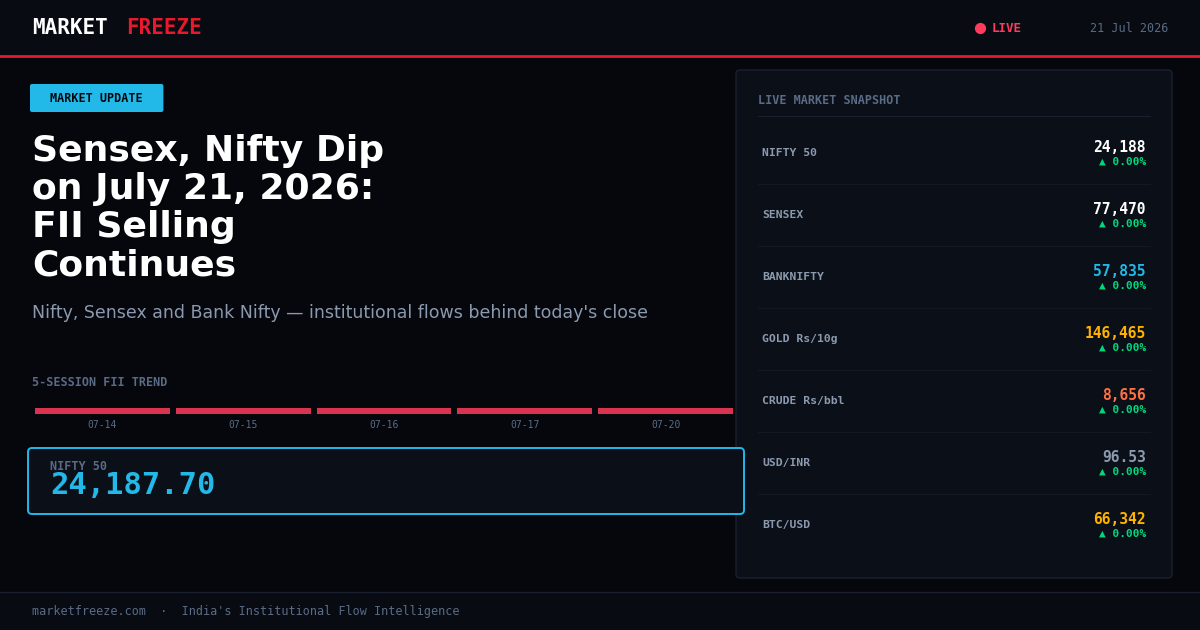
The Nifty 50 closed at 24,187.70, down 0.21%, and the Sensex at 77,470.00, down 0.31%, on July 21, 2026, as institutional investors showed a mixed flow pattern, with Foreign Institutional Investors (FIIs) continuing their net selling streak and Domestic Institutional Investors (DIIs) maintaining their net buying stance.
FIIs Extend Selling Spree as DIIs Step In Amidst Broad Market Dip
The Indian equity benchmarks, the Nifty 50 and Sensex, concluded Tuesday’s trading session in negative territory, with the Nifty 50 shedding 50.80 points to settle at 24,187.70 and the Sensex losing 238.41 points to close at 77,470.11. This broad market dip was accompanied by a continued net selling outflow from Foreign Institutional Investors (FIIs) amounting to ₹1,121.04 crore on July 20, 2026, the most recent available full-session data. Conversely, Domestic Institutional Investors (DIIs) provided a cushion, registering a net buying figure of ₹1,312.03 crore on the same day, indicating a divergence in institutional strategies. While the headline news points to a general market decline, the underlying institutional flow reveals a more nuanced picture where domestic capital is actively absorbing foreign outflows, particularly in sectors that faced selling pressure.
Open a free demat account with
Upstox
or
Angel One
— zero brokerage on delivery trades.
FIIs’ Persistent Redemptions Meet DII’s Robust Accumulation
Analyzing the institutional flow data over the last three sessions paints a clear picture of contrasting mandates. On July 20, 2026, FIIs divested net positions worth ₹1,121.04 crore, a continuation of their selling trend observed on July 17, 2026 (₹376.41 crore net sell), and a significant reduction from the larger outflow of ₹4,205.56 crore on July 16, 2026. This persistent selling pressure from foreign investors suggests a cautious global outlook or a rebalancing of their India exposure. However, DIIs have consistently countered this outflow. On July 20, they bought net positions to the tune of ₹1,312.03 crore, following ₹1,017.89 crore on July 17 and a substantial ₹2,986.41 crore on July 16. This sustained buying by DIIs, particularly evident in the increased quantum on July 16 despite FII outflows, indicates strong domestic conviction in Indian equities, absorbing foreign selling pressure and preventing a sharper market decline. The market’s ability to hold near the 24,100 level for Nifty, despite FII selling, is a testament to this DII support.
Sectoral Seesaw: IT and Banking Stocks Under Pressure, Energy Gains Traction
The broad market decline on July 21, 2026, was notably influenced by weakness in the Information Technology (IT) and Banking sectors. News reports and market observations suggest that IT stocks, which have been sensitive to global tech spending sentiment and currency fluctuations, faced renewed selling. Similarly, the Banking Nifty, which closed at 57,835.00, down 0.19%, indicated profit-taking or cautious positioning ahead of potential regulatory updates or interest rate expectations. Concurrently, the commodity markets showed strength, with Crude Oil futures on MCX trading at ₹8,657.00/bbl, up 0.52%, and Gold MCX reaching ₹146,472.00/10g, a significant jump of 1.54%. This strength in energy and precious metals often correlates with increased institutional interest in commodity-linked or inflation-hedging assets. While direct FII/DII data for specific sectors on July 21 is not yet fully aggregated, the sectorial performance aligns with a potential rotation out of rate-sensitive IT and BFSI into more tangible asset classes or sectors benefiting from commodity price appreciation. The sustained DII buying likely found opportunities in beaten-down mid-cap and small-cap stocks that were not explicitly highlighted in the broad index movements.
Key Levels to Watch: Nifty’s Resilience Hinges on 24,000 Support
Institutional flows provide critical insights into support and resistance levels. Observing the Nifty’s movement in relation to FII and DII flows over the past five sessions, we can infer key levels. On July 16, 2026, when FIIs sold heavily (₹4,205.56 crore), the Nifty closed at 24,072.75. Following this, on July 17, despite continued FII selling (₹376.41 crore), DIIs bought aggressively (₹1,017.89 crore), pushing the Nifty up to 24,334.30. This suggests that the 24,000-24,070 zone acted as a significant accumulation area for DIIs during heavy FII selling. On July 20, with FIIs selling ₹1,121.04 crore and DIIs buying ₹1,312.03 crore, the Nifty closed at 24,238.50, indicating that the 24,150-24,200 band is currently being defended by DIIs. Therefore, the immediate support for the Nifty 50 stands at 24,150, a level where DII buying has historically stepped in to absorb FII selling pressure. A sustained breach below 24,000 would indicate a shift in DII sentiment or an overwhelming increase in FII outflows, potentially targeting levels closer to 23,800, which was the Nifty close on July 14, 2026, following significant FII selling of ₹3,062.27 crore.
Currency and Commodity Crossover: Gold’s Surge and USD/INR Stability
The significant uptick in Gold MCX to ₹146,472.00/10g (+1.54%) on July 21, 2026, presents a notable crossover event with equity market movements. Typically, a strong rally in gold can signal risk aversion or inflationary expectations, which might lead FIIs to reduce their exposure to riskier assets like equities. The concurrent stability in USD/INR, trading at Rs96.53 (-0.05%), suggests that the Indian rupee is not significantly weakening against the dollar, which would normally attract FII selling. The fact that FIIs are net sellers despite a stable rupee and rising gold prices could indicate broader global macroeconomic concerns or a specific de-risking strategy by foreign funds. This divergence implies that DIIs are either capitalizing on specific Indian growth stories or see domestic valuations as more attractive than global alternatives, even amidst geopolitical or inflation-driven uncertainties reflected in gold prices. The sustained buying by DIIs, even as gold rallies and FIIs sell, is a key indicator of domestic institutional confidence potentially overriding global risk-off sentiment.
Historical Parallel: Navigating FII Outflows with DII Support
A historical parallel can be drawn from the trading sessions around mid-July 2026. For instance, on July 14, 2026, FIIs were net sellers of ₹3,062.27 crore, and the Nifty closed at 24,086.45. The subsequent sessions, particularly July 15 and July 16, saw continued FII selling, with the Nifty hovering around the 24,070-24,080 mark. However, DIIs consistently stepped in with robust buying, exceeding ₹2,171.70 crore on July 14 and ₹2,927.71 crore on July 15. This pattern of FII outflows being absorbed by DII inflows helped stabilize the market. The current scenario on July 20, 2026, with FII net selling of ₹1,121.04 crore and DII net buying of ₹1,312.03 crore, mirrors this historical resilience. The Nifty’s close at 24,238.50 on July 20 suggests that as long as DII buying remains strong and exceeds FII selling, the market can maintain a supportive footing, preventing sharp drawdowns despite negative headlines or global sentiment.
Portfolio Framework: Strategic Allocation in a Divergent Flow Environment
Given the current market dynamics of FII outflows and DII inflows, a strategic portfolio framework is essential. Investors should consider overweighting sectors where DIIs are showing consistent buying interest, potentially beyond large-cap IT and Banking, which are currently facing headwinds. Look for sectors that benefit from domestic demand or government initiatives. For instance, if DIIs are accumulating positions in infrastructure or manufacturing stocks, as suggested by the broad market’s resilience, a strategic allocation of 15-20% in these sectors could be considered. Conversely, while FIIs are net sellers, their previous significant holdings in large-cap IT and Pharma might see opportunistic buying by DIIs on dips. A portfolio could be structured with 40% in large-cap defensive sectors (like FMCG or Pharma, where DIIs might be rebalancing), 30% in cyclical sectors with strong domestic drivers (like Infrastructure, Industrials, or select BFSI names showing resilience), and 30% in high-quality mid-cap stocks that exhibit strong earnings growth and are likely beneficiaries of DII accumulation, provided they are trading at a P/E multiple not exceeding 25x their FY27 earnings estimates.
What Changes This Outlook: A sustained FII Net Buy above ₹500 Crore
The current market narrative is largely shaped by the persistent FII selling pressure being offset by DII buying. The critical trigger that could alter this outlook would be a sustained period of FII net buying. Specifically, if FIIs were to record a net buy figure exceeding ₹500 crore for two consecutive trading sessions, it would signal a significant shift in foreign investor sentiment. Such a development, coupled with continued DII inflows, would likely provide a strong upward impetus to the Nifty, potentially pushing it towards the 24,500 mark, which represents a significant resistance level tested earlier in the month. Conversely, if FII selling accelerates to levels seen on July 16 (above ₹4,000 crore) without commensurate DII support, the market could face a sharper correction, with the Nifty potentially testing the 23,800 support.
Historical FII/DII Flow Data (Last 5 Sessions)
| Date | FII Net (Cr) | DII Net (Cr) | Nifty Close |
|---|---|---|---|
| 2026-07-14 | ₹-3,062.27 Cr | +₹2,171.70 Cr | 24,086.45 |
| 2026-07-15 | ₹-739.69 Cr | +₹2,927.71 Cr | 24,078.50 |
| 2026-07-16 | ₹-4,205.56 Cr | +₹2,986.41 Cr | 24,072.75 |
| 2026-07-17 | ₹-376.41 Cr | +₹1,017.89 Cr | 24,334.30 |
| 2026-07-20 | ₹-1,121.04 Cr | +₹1,312.03 Cr | 24,238.50 |
Frequently Asked Questions
Q: What did FII buy or sell on July 20, 2026?
A: On July 20, 2026, FIIs were net sellers to the tune of ₹1,121.04 crore.
Q: What did DII buy on July 20, 2026?
A: On July 20, 2026, DIIs were net buyers of ₹1,312.03 crore.
Q: Is FII buying or selling in July 2026?
A: In July 2026, up to July 20, FIIs have predominantly been net sellers, with significant selling pressure observed on July 14 (₹3,062.27 crore) and July 16 (₹4,205.56 crore), although the quantum of selling has varied across sessions.
Bottom Line
The Indian equity markets experienced a marginal decline on July 21, 2026, with the Nifty 50 closing at 24,187.70 and the Sensex at 77,470.00. This broad-based weakness was characterized by continued net selling from FIIs totaling ₹1,121.04 crore on July 20, counterbalanced by robust net buying from DIIs amounting to ₹1,312.03 crore. Sectoral weakness was observed in IT and Banking, while commodities like Gold showed strength, highlighting a potential divergence in institutional asset preferences. The market’s resilience above the 24,000 mark for the Nifty is largely attributed to sustained DII support, suggesting domestic institutions are actively absorbing foreign outflows.
Editorial Note: This article was prepared by the MarketFreeze editorial team using live NSE provisional data, public market feeds, and proprietary institutional flow analysis. All price and flow figures are sourced directly from NSE, BSE, and CoinGecko as of 21 July 2026. This content is for informational purposes only and does not constitute investment advice. MarketFreeze is not SEBI-registered. Please consult a qualified financial advisor before making investment decisions. Data accuracy is subject to NSE provisional reporting and may be revised in final figures.