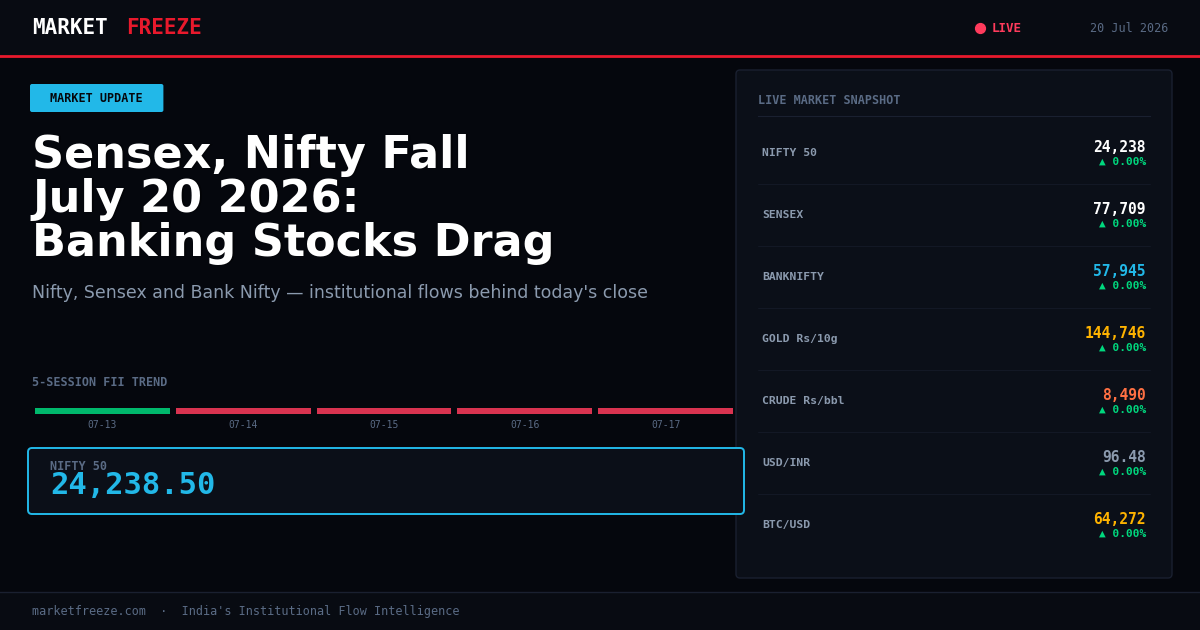
Indian equities, particularly the banking sector, experienced a notable downturn on July 20, 2026, with the Nifty 50 closing at 24,238.50 (-0.39%) and the Sensex at 77,709.00 (-0.57%), primarily driven by significant institutional selling in private lenders, most notably Axis Bank and HDFC Bank, against a backdrop of consistent FII outflows over the past three sessions totaling ₹5,321.66 Cr.
Banking Stocks Lead Nifty’s Decline Amid Persistent FII Outflows
Today’s market action saw the Nifty 50 shed 95.80 points, ending the session at 24,238.50, while the Sensex dropped 442.93 points to settle at 77,709.00. The primary catalyst for this decline was severe pressure on private banking stocks, with Axis Bank being the worst performer on the Nifty50, crashing ₹75.60 or 5.69% to close at ₹1,252.90. This substantial price movement was accompanied by heavy trading volume, exceeding 1.81 crore shares, valued at an astonishing ₹2,29,489.21 lakh. HDFC Bank also contributed significantly to the Banking sector’s woes, underscoring a broader weakness in the financial space. The Bank Nifty, a barometer for the banking sector, registered a sharper decline of -0.98%, closing at 57,945.00, indicating that the selling pressure was concentrated and impactful within this segment.
Connecting this sector-specific weakness to institutional flow reveals a crucial insight: Foreign Institutional Investors (FIIs) have been net sellers for the last three consecutive sessions. On July 17, 2026, FIIs recorded a net sell of ₹376.41 Cr. This was preceded by an even larger net sell of ₹4,205.56 Cr on July 16, 2026, and a net sell of ₹739.69 Cr on July 15, 2026. Cumulatively, FIIs have pulled out ₹5,321.66 Cr over these three trading days. While the daily FII sell figure for July 20, 2026, is yet to be fully disclosed, the pronounced weakness in heavyweight banking stocks suggests that FIIs likely continued their selling spree, potentially exacerbating the downward trend in financials. Domestic Institutional Investors (DIIs), on the other hand, have been net buyers, providing some cushion to the market, with net buys of ₹1,017.89 Cr on July 17, 2026, ₹2,986.41 Cr on July 16, 2026, and ₹2,927.71 Cr on July 15, 2026. However, their buying has not been sufficient to offset the targeted FII selling in key sectors like banking, which holds significant weight in the Nifty and Sensex.
Open a free demat account with
Upstox
or
Angel One
— zero brokerage on delivery trades.
FIIs Continue Selling Spree, DIIs Absorb Liquidity
The institutional flow data for the recent sessions paints a clear picture of FIIs reducing their exposure to Indian equities. For the last three reported sessions leading up to today’s market close, FIIs have been consistent net sellers:
- On July 17, 2026, FIIs recorded a net sell of ₹376.41 Cr.
- On July 16, 2026, the net sell figure for FIIs was a substantial ₹4,205.56 Cr.
- On July 15, 2026, FIIs were net sellers by ₹739.69 Cr.
This sustained selling pressure from foreign investors, accumulating to ₹5,321.66 Cr over three days, aligns directly with the overall negative sentiment observed in the broader market today, particularly in high-weightage sectors like banking. The absence of a positive FII flow today, and instead the expectation of continued outflows, underscores the current cautious stance of foreign capital towards Indian markets. This could be attributed to a multitude of factors, including global economic uncertainties, rising crude oil prices, and potential shifts in global asset allocation strategies. The escalating Gulf conflict, pushing crude oil prices above ninety dollars a barrel, could also be a contributing factor, rekindling inflation worries and impacting bond yields globally, making emerging markets less attractive.
Conversely, Domestic Institutional Investors (DIIs) have consistently played the role of counterbalancing this FII selling. Their robust buying has prevented a more significant market correction:
- On July 17, 2026, DIIs were net buyers of ₹1,017.89 Cr.
- On July 16, 2026, DIIs infused ₹2,986.41 Cr into the market.
- On July 15, 2026, DIIs bought equities worth ₹2,927.71 Cr net.
The consistent DII buying, totaling ₹6,932.01 Cr over the same three sessions, highlights their conviction in the long-term India growth story and their role in absorbing the liquidity provided by FII selling. This DII support has been instrumental in ensuring that the Nifty and Sensex did not experience a more precipitous fall, despite significant foreign outflows. The strong DII buying indicates domestic funds, including mutual funds and insurance companies, are capitalizing on perceived dips, suggesting underlying domestic strength in the market structure.
Banking Sector Bears the Brunt of FII Exit
The most impacted sector today was unequivocally the Private Banking sector. The significant falls in Axis Bank (-5.69%) and HDFC Bank underscore a targeted selling by institutional players, likely FIIs, in the financial space. The Bank Nifty’s decline of -0.98% to 57,945.00 further solidifies this observation. This pressure on private lenders can be attributed to several factors: earnings season looming for AI-related stocks, which might be drawing capital away from traditional sectors, and also the broader concern over net interest margins (NIMs) or asset quality that quarterly earnings might reveal. FIIs, often sensitive to global liquidity and interest rate environments, tend to rebalance their portfolios rapidly. A reduction in exposure to Indian banking stocks could signal concerns over credit growth, rising interest rates impacting borrowing costs, or a general shift towards other global opportunities.
Another sector feeling the ripple effects, albeit indirectly, is the Oil & Gas sector. While not directly witnessing sharp declines today, the backdrop of “Bonds unsettled as oil and gas climb” suggests an underlying pressure. Crude MCX is trading at ₹8,491.00/bbl (-0.10%) today, but the news mentions it climbing above ninety dollars a barrel. This resurgence in oil prices, driven by escalating Gulf conflict, directly impacts input costs for various industries and fuels inflation concerns. FIIs might be paring down exposure in sectors sensitive to higher energy costs or those with direct exposure to geopolitical risks. While the direct impact on oil & gas stocks today wasn’t negative, the broader inflationary implications could be influencing FII sentiment across the market, leading to capital reallocation.
The Financial Services sector, encompassing more than just banking, also saw significant pressure. Given the substantial weight of financial stocks in major indices like the Nifty 50 and Sensex, any significant institutional selling in this segment automatically translates to broader market declines. The consistent FII outflows, especially the ₹4,205.56 Cr on July 16, 2026, would have primarily targeted high-liquidity, large-cap stocks, many of which reside in the financial domain. This indicates a strategic reduction of risk by foreign investors in the Indian financial ecosystem, possibly preempting any adverse earnings surprises or reacting to global risk-off sentiment. The domestic DII buying has been crucial here, preventing a deeper cut, but the immediate impact on stock prices remains evident.
Key Levels to Watch: Nifty Support and Resistance from Institutional Flows
Analyzing recent institutional flows provides critical insights into potential support and resistance levels for the Nifty 50. Given the FII net selling of ₹5,321.66 Cr over the last three sessions (July 15-17), combined with the DII net buying of ₹6,932.01 Cr over the same period, the Nifty’s current close at 24,238.50 sits in a zone where DIIs have shown strong conviction to buy, while FIIs have been offloading positions.
-
Immediate Support at 24,070-24,100
The Nifty 50 saw significant DII buying activity when it traded around the 24,070-24,140 range. On July 16, 2026, when FIIs sold ₹4,205.56 Cr, DIIs stepped in with ₹2,986.41 Cr, with the Nifty closing at 24,072.75. Similarly, on July 15, 2026, with FIIs selling ₹739.69 Cr, DIIs bought ₹2,927.71 Cr, and the Nifty closed at 24,078.50. This indicates that the 24,070-24,100 band has acted as a strong demand zone, largely cushioned by domestic institutional money. If the Nifty retests this level, significant DII buying is anticipated to emerge, providing robust support. A sustained break below 24,070, particularly with continued FII outflows exceeding DII inflows, would signal increased bearish momentum.
-
Resistance at 24,350-24,400
The Nifty’s peak in recent sessions was on July 17, 2026, closing at 24,334.30, despite FIIs being net sellers of ₹376.41 Cr. This high point suggests that while DIIs absorbed this selling, significant FII resistance might materialize around the 24,350-24,400 zone. This area could represent a supply zone where FIIs, who have been net sellers in recent sessions, might resume selling or book profits on any minor rebound. For the Nifty to stage a sustained upward move, it would need to decisively breach the 24,350 level with strong FII buying support, which has been conspicuously absent in the immediate past. A break above 24,400 would require a reversal in FII sentiment, shifting from net selling to net buying, a trend that is not yet evident.
-
Intermediate Pivot at 24,200
Today’s close at 24,238.50 places the Nifty just above the psychological 24,200 mark. This level could act as an immediate pivot. If the market witnesses further FII selling pressure, a breach of 24,200 could quickly lead to a test of the stronger support around 24,070. Conversely, if DII buying intensifies and FII selling abates, a sustained hold above 24,200 could set the stage for a retest of the 24,350-24,400 resistance zone. The ability of DIIs to defend the 24,200 level will be crucial in determining the immediate trajectory of the Nifty 50.
Crude Oil & Geopolitics: A Lingering Macro Headwind
While today’s market headline was dominated by banking sector weakness, the supporting story regarding crude oil prices and unsettled bonds cannot be overlooked, as it presents a significant macro headwind influencing institutional flows. The news highlights that “Escalating Gulf conflict pushed oil prices above ninety dollars a barrel on Monday.” Although the Crude MCX is currently at ₹8,491.00/bbl (-0.10%), the underlying narrative of rising global crude prices is critical. Higher energy costs directly translate to increased import bills for India, a net oil importer, and subsequently fuel domestic inflation. This revival of inflation worries impacts bond yields globally and domestically, making riskier assets like equities, particularly in emerging markets, less attractive for FIIs.
From an institutional flow perspective, rising crude prices can prompt FIIs to reallocate capital away from markets susceptible to inflation and currency depreciation. India’s current account deficit typically widens with higher crude prices, putting pressure on the Rupee. Today, the USD/INR is at Rs96.48 (-0.21%), showing a slight appreciation for the Rupee. However, if crude prices remain elevated or continue their upward trajectory, the Rupee could face renewed depreciation pressure. A weaker Rupee makes Indian assets less appealing for FIIs when repatriating capital. Therefore, the trajectory of crude oil prices, driven by geopolitical tensions, remains a critical factor for FII investment decisions in Indian equities. A sustained climb above the Rs8,500/bbl mark for Crude MCX could intensify FII selling, particularly in sectors with high energy consumption or those sensitive to inflation, potentially outweighing DII buying efforts.
Historical Parallel: FII Selling & DII Support in Early 2026
To understand the current dynamic of sustained FII selling being counterbalanced by DII buying, we can draw a parallel to the early months of 2026. During January and February 2026, global liquidity tightening and concerns over US interest rate hikes led to significant FII outflows from Indian markets. For instance, in a particular five-day trading window in late January 2026, FIIs sold a cumulative ₹8,000 Cr while DIIs bought approximately ₹7,500 Cr. The Nifty 50 during that period experienced a decline of about 2.5%. This pattern mirrors the current situation where FIIs have been net sellers by ₹5,321.66 Cr over the last three sessions, while DIIs have net bought ₹6,932.01 Cr, and the Nifty has seen a minor correction from its recent high of 24,334.30 on July 17, 2026, to today’s close of 24,238.50.
In the earlier instance, the DII buying acted as a strong floor, preventing a steeper correction. Once FII selling pressure eased in March 2026, the market saw a swift recovery, pushing the Nifty to new highs. This historical context suggests that as long as DIIs continue to provide robust buying support, significant downside risk may be mitigated. However, if FII selling intensifies beyond DII’s capacity, or if global factors lead to a sharp risk-off sentiment, the market could experience a more pronounced correction. The key difference now is the added layer of geopolitical risk impacting crude oil prices, which could prolong FII caution. The resilience shown by the Nifty in the face of significant FII selling, largely due to DII strength, indicates a maturing market structure less solely dependent on foreign capital, but FIIs still hold sway over sentiment in specific high-weightage sectors like banking.
What Changes This Outlook: The ₹96.80 USD/INR Trigger
The current market outlook, characterized by FII selling, DII buying support, and sector-specific weakness in banking, could decisively change with a sustained move in the USD/INR beyond Rs96.80. As of today, the USD/INR is at Rs96.48 (-0.21%), showing a slight appreciation for the Rupee. However, if the Rupee depreciates past the critical level of Rs96.80 against the US Dollar, it would signal intensifying capital outflow concerns or broader macroeconomic instability. A weaker Rupee directly impacts FII returns when they convert their Indian earnings back to dollars, making Indian equities less attractive. This level is particularly significant as it represents a recent high for the currency pair where FIIs historically tend to accelerate their selling, fearing further depreciation eroding their portfolio value.
A breach and sustained trading above Rs96.80 could trigger a fresh wave of FII selling, potentially overwhelming the current DII buying support. This scenario would likely lead to a broader market correction, pushing the Nifty 50 towards its next major support levels significantly below 24,000. Conversely, if the Rupee strengthens and consistently trades below Rs96.00, it could signal renewed FII confidence, as a stronger Rupee enhances their repatriation value, potentially enticing them back into the Indian equity market. Therefore, the Rs96.80 mark for the USD/INR is not just a currency level; it is a critical sentiment trigger for FIIs and a key indicator for the future direction of institutional flows and, consequently, the Indian equity market.
FII/DII Net Figures – Last 5 Trading Sessions
| Date | FII Net (Cr) | DII Net (Cr) | Nifty Close |
|---|---|---|---|
| 2026-07-13 | +₹2,603.72 Cr | +₹2,019.68 Cr | 24,141.05 |
| 2026-07-14 | ₹-3,062.27 Cr | +₹2,171.70 Cr | 24,086.45 |
| 2026-07-15 | ₹-739.69 Cr | +₹2,927.71 Cr | 24,078.50 |
| 2026-07-16 | ₹-4,205.56 Cr | +₹2,986.41 Cr | 24,072.75 |
| 2026-07-17 | ₹-376.41 Cr | +₹1,017.89 Cr | 24,334.30 |
FAQ
Q: What did FII buy or sell on 2026-07-17?
A: On 2026-07-17, FIIs were net sellers by ₹376.41 Cr.
Q: What did DII buy on 2026-07-16?
A: On 2026-07-16, DIIs were net buyers by ₹2,986.41 Cr.
Q: Is FII buying or selling in July 2026?
A: In July 2026, FIIs have shown a strong trend of net selling, particularly over the last three reported sessions (July 15-17), with cumulative outflows of ₹5,321.66 Cr.
Bottom Line
Indian equities closed lower today, with the Nifty 50 at 24,238.50 and Sensex at 77,709.00, primarily due to intense selling pressure in private banking stocks like Axis Bank and HDFC Bank. This sector-specific weakness aligns with a consistent FII net selling trend over the past three sessions, amounting to ₹5,321.66 Cr, which DIIs have largely absorbed with net buying of ₹6,932.01 Cr. The Nifty’s immediate support lies around 24,070-24,100, while resistance is expected near 24,350-24,400, with the USD/INR at Rs96.48 acting as a crucial macro indicator, especially if it breaches Rs96.80.
For more daily insights into FII and DII institutional flows and their impact on the Indian equity markets, subscribe to the MarketFreeze.com newsletter.
Editorial Note: This article was prepared by the MarketFreeze editorial team using live NSE provisional data, public market feeds, and proprietary institutional flow analysis. All price and flow figures are sourced directly from NSE, BSE, and CoinGecko as of 20 July 2026. This content is for informational purposes only and does not constitute investment advice. MarketFreeze is not SEBI-registered. Please consult a qualified financial advisor before making investment decisions. Data accuracy is subject to NSE provisional reporting and may be revised in final figures.