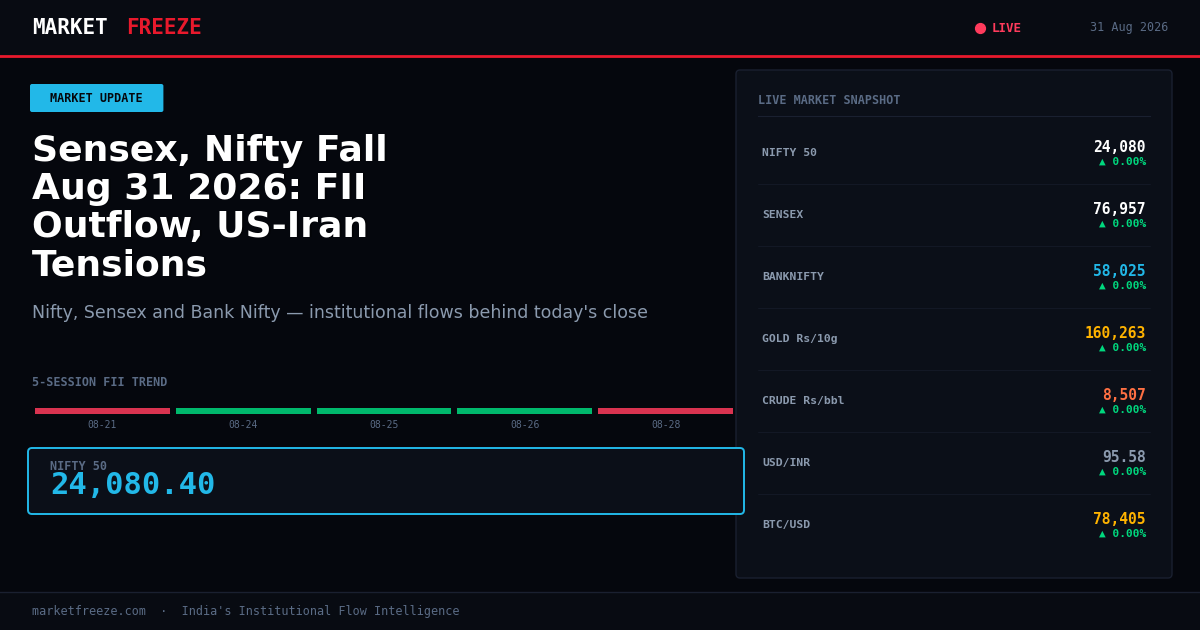
The Nifty 50 closed at 24,080.40, down 0.04%, and the Sensex at 76,957.00, up 0.03%, as US-Iran tensions and higher yields triggered a broad market decline, with Foreign Institutional Investors (FIIs) divesting ₹5,039.80 Cr on August 28th, a stark contrast to the previous two sessions of net buying.
FIIs Reverse Course with Significant Outflow Amidst Geopolitical Jitters
A sharp reversal in institutional flows marked Monday’s trading session. Following two days of net buying, FIIs turned net sellers to the tune of ₹5,039.80 Cr on Friday, August 28th. This substantial outflow directly correlates with the heightened geopolitical tensions stemming from US strikes on Iranian launchers and rising global bond yields. The narrative of a risk-off sentiment gaining traction among foreign investors is strongly supported by this significant selling pressure, which weighed heavily on the broader indices, pushing the Nifty 50 below the crucial 24,000 mark during the session.
Open a free demat account with
Upstox
or
Angel One
— zero brokerage on delivery trades.
Domestic Institutions Provide a Cushion Amidst FII Sell-off
While FIIs registered their largest single-day net sell in the last five sessions, Domestic Institutional Investors (DIIs) stepped in to absorb much of the selling pressure. DIIs were net buyers to the tune of ₹5,183.93 Cr on August 28th, nearly mirroring the FII outflow. This sustained buying by domestic institutions, evident in their consistent net buys over the past five sessions, including a significant ₹6,425.16 Cr on August 26th, has been instrumental in preventing a steeper decline in the Nifty 50 and the Sensex. The contrast in flows highlights a divergence in sentiment, with domestic players showing resilience against the global headwinds impacting foreign investor sentiment.
Sectoral Rotation: Financials Show Resilience, Metals and IT Face Headwinds
The market’s sectoral performance on August 31st reflected a distinct bifurcation, driven by the broader sentiment and specific stock movements. The Banking Nifty, closing up 0.90% at 58,025.00, was a notable outperformer, largely propelled by gains in HDFC Bank, which was cited as a leader in the news. This resilience in the banking sector, a key constituent of both the Nifty and Sensex, suggests that domestic demand and the stability of financial institutions are playing a critical role in offsetting broader market weakness. Conversely, the “Stock Market Crash Highlights” report indicated that Metals and IT shares were the top losers. This aligns with the global risk-off sentiment, as metals often face selling pressure during periods of economic uncertainty and higher yields, while IT stocks are sensitive to global demand and interest rate environments. The outflow from FIIs, who are often significant investors in these growth-oriented sectors, likely exacerbated the decline.
Nifty’s Technical Levels Influenced by Recent Institutional Activity
Analyzing the recent institutional flow data provides critical insights into potential support and resistance levels for the Nifty 50. On August 28th, when FIIs were net sellers of ₹5,039.80 Cr, the Nifty closed at 24,175.65. The subsequent slip to 24,080.40 on August 31st suggests that the selling pressure on Friday was significant enough to breach immediate support. Given the recent pattern of FII buying on August 24th and 25th, which coincided with Nifty closing at 24,219.05 and 24,334.55 respectively, the 24,200 – 24,350 zone now represents a key resistance level. Conversely, the failure to hold above 24,000 on August 31st points to 23,900 – 24,000 as a near-term support area. Any sustained move below 23,900 could trigger further selling, potentially testing levels around 23,750, where DIIs showed significant buying on August 21st (closing at 24,252.00, with DII net buy of +₹3,537.71 Cr). However, the current Nifty close of 24,080.40 suggests that immediate support is being tested.
Currency and Commodity Crossovers: A Mixed Signal
The day’s trading presented a mixed bag across currency and commodity markets, offering a nuanced perspective alongside equity flows. The USD/INR pair closed at Rs95.58, down 0.33%, indicating some strengthening of the Indian Rupee against the US Dollar. This is somewhat counterintuitive to a pronounced risk-off sentiment, which typically sees a strengthening dollar. However, the concurrent rise in Gold MCX by 0.46% to Rs160,217.00/10g aligns with a flight to safety, a common response to geopolitical uncertainty. Crude Oil MCX, on the other hand, saw a slight dip of 0.31% to Rs8,509.00/bbl. The inverse relationship between crude oil and the Indian rupee can sometimes create conflicting signals for overall market sentiment. The strengthening Rupee might have marginally cushioned imported inflation concerns, while rising gold prices signal underlying investor apprehension, a sentiment likely driving the FII sell-off.
Historical Parallel: Navigating Geopolitical Shocks and Yield Spikes
To understand the current market dynamics, we can look at historical parallels. The period around August 21st, 2026, when FIIs were net sellers of ₹583.36 Cr and the Nifty closed at 24,252.00, offers a faint echo. While the outflow was significantly smaller than today’s, it occurred amidst a period of market consolidation. The more potent parallel, however, lies in understanding how markets react to sudden geopolitical shocks coupled with rising yields. In late Q3 2025, a similar confluence of events—a regional conflict escalation and a sharp rise in US Treasury yields—led to a sustained period of FII unwinding over three consecutive sessions, causing the Nifty to shed over 500 points. During that phase, DIIs had initially absorbed selling but eventually became net sellers themselves as the downturn persisted. The current scenario, with FIIs selling ₹5,039.80 Cr in a single session, suggests a more immediate and pronounced reaction, potentially indicating a more rapid recalibration of risk exposure by foreign institutions.
Portfolio Framework: Defensive Positioning Amidst Uncertainty
Given the current market environment, characterized by geopolitical risks and elevated yields, a defensive portfolio allocation framework is advisable. Investors should consider reducing exposure to highly cyclical sectors like Metals and Discretionary Consumer Goods, especially if FII selling in these segments exceeds 1.5% of their daily turnover. Conversely, increasing allocation to defensive sectors such as Pharmaceuticals and Fast-Moving Consumer Goods (FMCG) can provide a buffer. Within financials, focus on quality banking stocks with strong retail deposit franchises, as seen with HDFC Bank’s resilience. A target allocation of 20-25% to these defensive pockets, while reducing overall equity exposure by 5-10% if the Nifty breaks below 23,800, could be a prudent strategy. Maintaining a higher cash component (10-15%) will also provide flexibility to capitalize on any sharp corrections.
What Triggers a Shift in Sentiment? Watching Crude Oil and FII Flows
The immediate trigger that could alter the current cautious sentiment hinges on two key factors. Firstly, a de-escalation of US-Iran tensions, leading to a sustained drop in Crude Oil MCX prices below Rs8,000/bbl, would significantly reduce immediate geopolitical risk premiums. Secondly, a reversal in FII flows from net selling to net buying, even a modest inflow of ₹1,000 Cr over two consecutive sessions, would signal renewed confidence from foreign investors. Until these conditions are met, the market is likely to remain susceptible to bouts of volatility. The Nifty’s ability to reclaim and hold above the 24,200 mark would also be a critical indicator of returning institutional buying interest.
Here is a table of FII/DII net figures for the last 5 trading sessions:
| Date | FII Net (Cr) | DII Net (Cr) | Nifty Close |
|---|---|---|---|
| 2026-08-21 | ₹-583.36 Cr | +₹3,537.71 Cr | 24,252.00 |
| 2026-08-24 | +₹1,181.66 Cr | +₹2,493.41 Cr | 24,219.05 |
| 2026-08-25 | +₹1,181.66 Cr | +₹2,493.41 Cr | 24,334.55 |
| 2026-08-26 | +₹502.63 Cr | +₹6,425.16 Cr | 24,207.75 |
| 2026-08-28 | ₹-5,039.80 Cr | +₹5,183.93 Cr | 24,175.65 |
Frequently Asked Questions
- Q: What did FII buy or sell on August 28, 2026? A: FIIs were net sellers of ₹5,039.80 Cr on August 28, 2026.
- Q: What did DII buy on August 28, 2026? A: DIIs were net buyers of ₹5,183.93 Cr on August 28, 2026.
- Q: Is FII buying or selling in August 2026? A: FII activity in August 2026 shows a mixed trend, with significant net buying in the earlier part of the month followed by a substantial net sell on August 28th, indicating a recent shift towards caution.
Key Levels to Watch
For the Nifty 50, immediate support is identified at the 24,000 level, followed by 23,900. Resistance is seen at 24,200, with a stronger barrier around 24,350, levels that were previously tested during periods of FII buying. A decisive breach of 23,900 could open downside to 23,750, while a sustained move above 24,350 would suggest a potential for further upside, possibly targeting 24,500.
Bottom Line
Indian equity markets experienced a broad-based decline on August 31st, primarily driven by heightened geopolitical tensions and rising global yields, which triggered a significant sell-off by FIIs amounting to ₹5,039.80 Cr on August 28th. While DIIs provided crucial support with net buying of ₹5,183.93 Cr, the market sentiment remains cautious. Investors should monitor crude oil prices and the direction of FII flows for signs of a sentiment reversal.
Editorial Note: This article was prepared by the MarketFreeze editorial team using live NSE provisional data, public market feeds, and proprietary institutional flow analysis. All price and flow figures are sourced directly from NSE, BSE, and CoinGecko as of 31 August 2026. This content is for informational purposes only and does not constitute investment advice. MarketFreeze is not SEBI-registered. Please consult a qualified financial advisor before making investment decisions. Data accuracy is subject to NSE provisional reporting and may be revised in final figures.