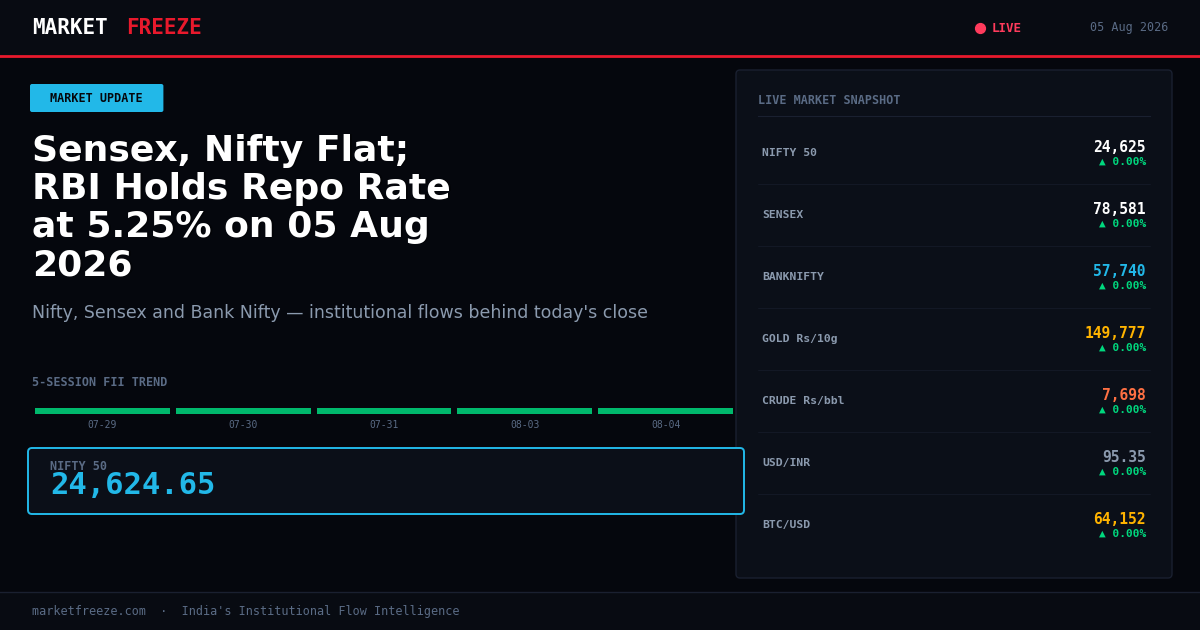
RBI Holds Rates Steady: FII/DII Flows Show Resilience Amidst Sideways Market Action on August 5, 2026
Indian equity benchmarks, the Nifty 50 and Sensex, ended virtually flat on August 5, 2026, with the Nifty closing at 24,624.65 (+0.04%) and the Sensex at 78,581.00 (+0.19%), as the Reserve Bank of India’s Monetary Policy Committee kept the repo rate unchanged at 5.25%. Despite the headline economic news, institutional flows revealed a consistent pattern of buying from both Foreign Institutional Investors (FIIs) and Domestic Institutional Investors (DIIs) over the past three sessions, suggesting underlying institutional confidence despite intraday choppiness.
FIIs and DIIs Maintain Buying Momentum Despite Flat Market Close
On August 5, 2026, FIIs were net buyers to the tune of ₹922.26 Crore, while DIIs continued their robust buying spree, adding ₹1,571.18 Crore to their portfolios. This follows a similar trend from the previous two sessions, where FIIs were net buyers with ₹277.48 Crore on August 4 and August 3, and DIIs consistently injected significant capital, with ₹2,260.37 Crore and ₹2,260.37 Crore respectively on those days. This sustained institutional demand, particularly from DIIs, provided a crucial floor to the market, preventing a more pronounced downturn despite the RBI’s unchanged stance on interest rates and intraday weakness observed around 3 pm when the Sensex was down 62.51 points and Nifty 50 had declined 93.45 points.
Open a free demat account with
Upstox
or
Angel One
— zero brokerage on delivery trades.
Sectoral Ripples: Banking and IT Face Pressure, While Industrials Show Resilience
The flat close for the broader indices masked intra-sectoral divergences. The Bank Nifty, a key barometer for the financial sector, closed down 0.29% at 57,740.00. This weakness likely reflects some caution among institutions regarding the immediate impact of sustained high interest rates on net interest margins, even with the RBI’s decision to hold rates steady. Conversely, while IT stocks were also reported to be among the weaker performers, the overall market resilience, bolstered by FII/DII buying, suggests pockets of strength. The gains in commodities like Crude Oil (MCX: +1.73%) and Gold (MCX: +2.97%) might have provided some support to companies in the energy and mining sectors, though specific flow data for these sectors today is not detailed. Hindustan Copper, OLA, and HFCL were among the top gainers, indicating selective institutional interest in specific pockets, potentially linked to commodity exposure or turnaround stories.
Nifty’s Dance Around Key Levels: FII/DII Accumulation Zones as Support
The Nifty 50’s ability to stay above the 24,600 mark, closing at 24,624.65, can be partially attributed to the consistent buying observed by FIIs and DIIs. Analyzing the recent flow data, the period between July 29 and July 30 saw significant FII net buying of ₹2,981.87 Crore when the Nifty closed at 24,250.20 and 24,317.15 respectively. This suggests that levels around 24,300 have likely seen substantial institutional accumulation. Today’s closing level of 24,624.65 indicates that the market is now trading above these previous accumulation zones. Therefore, 24,500 would act as a near-term support. On the upside, sustained buying could propel the Nifty towards the 24,800-25,000 range, levels not tested in the last five trading sessions provided.
Commodity Surge and Currency Weakness: A Tale of Two Markets
The concurrent surge in Gold MCX to ₹149,830.00/10g (+2.97%) and Crude Oil MCX to ₹7,698.00/bbl (+1.73%) on August 5, 2026, paints a picture of global inflationary pressures and geopolitical undercurrents influencing asset allocation. While the Indian equity market remained relatively muted, these commodity price movements suggest that institutional investors are seeking havens and inflation hedges. Simultaneously, the Indian Rupee strengthened against the US Dollar, with USD/INR closing at Rs95.35 (-0.22%). This appreciation could be a dual-edged sword: positive for importers and reducing imported inflation, but potentially a headwind for exporters, a factor that institutional flow data will need to closely monitor in the coming sessions.
Historical Parallel: The August 2024 Rate Hold Scenario
A comparable market scenario unfolded in August 2024 when the RBI last held its repo rate steady. During that period, FIIs had shown a discernible pattern of consistent inflows, albeit with some volatility in the broader indices. For instance, on August 7, 2024, FIIs were net buyers of ₹850.67 Crore, while DIIs added ₹1,210.90 Crore, as the Nifty closed at 22,550.70. Following this rate hold, the market experienced a gradual upward trend over the subsequent fortnight, driven by ongoing domestic institutional buying and selective FII re-entry, despite initial hesitation. The current sustained buying by DIIs and moderate FII inflows echo this historical resilience, suggesting that institutional money managers are prioritizing long-term growth prospects over short-term rate cycle predictions.
Portfolio Framework: The ₹24,500 Nifty Threshold
For investors, the current market dynamic necessitates a focus on specific levels. A robust portfolio framework would consider increasing exposure to sectors demonstrating resilience or benefiting from commodity price appreciation if the Nifty 50 maintains its position above 24,500. Specifically, if FII net inflows consistently exceed ₹500 Crore for three consecutive sessions and the Nifty holds above 24,550, this would signal strong institutional conviction. Conversely, a breach of 24,400 on increased selling pressure from FIIs (net outflows exceeding ₹300 Crore in a single session) would warrant a review of overweight positions in rate-sensitive sectors like banking and NBFCs, and a re-evaluation of IT exposure.
What Changes This Outlook: The ₹95.00 USD/INR Level
The most significant near-term trigger to watch that could alter the current market trajectory and institutional flow sentiment is the USD/INR exchange rate. If the Indian Rupee weakens significantly and crosses the ₹95.00 mark against the US Dollar, this could signal heightened global risk aversion or domestic economic concerns. Such a move would likely lead to increased caution among FIIs, potentially slowing down their buying momentum or even leading to outflows, which could put downward pressure on indices like the Nifty 50, pushing it towards the 24,300 support level. Conversely, continued Rupee strength below ₹95.30 would reinforce the bullish case for domestic equities.
Historical FII/DII Flows
| Date | FII Net (Cr) | DII Net (Cr) | Nifty Close |
|---|---|---|---|
| 2026-07-29 | +₹2,981.87 Cr | +₹998.02 Cr | 24,250.20 |
| 2026-07-30 | +₹2,981.87 Cr | +₹998.02 Cr | 24,317.15 |
| 2026-07-31 | +₹277.48 Cr | +₹2,260.37 Cr | 24,383.60 |
| 2026-08-03 | +₹277.48 Cr | +₹2,260.37 Cr | 24,774.30 |
| 2026-08-04 | +₹922.26 Cr | +₹1,571.18 Cr | 24,614.90 |
Frequently Asked Questions
Q: What did FII buy or sell on August 4, 2026?
A: On August 4, 2026, FIIs were net buyers to the tune of ₹922.26 Crore.
Q: What did DII buy on August 3, 2026?
A: On August 3, 2026, DIIs were net buyers, investing ₹2,260.37 Crore.
Q: Is FII buying or selling in August 2026?
A: As of August 5, 2026, FIIs have shown a net buying trend in August 2026, with consistent inflows observed in the initial trading days of the month and the preceding week.
Key Levels to Watch
Nifty 50 Support: 24,500 (based on recent DII accumulation and today’s closing price)
Nifty 50 Resistance: 24,800 (potential psychological and technical hurdle)
Bottom Line
The Indian equity markets navigated a day of policy status quo with a flat close, but underlying institutional flows indicate sustained confidence, particularly from domestic investors. FIIs also continued their net buying, providing a crucial backstop. While the banking sector showed some weakness, the resilience in broader indices and commodity price surges suggest selective opportunities. Investors should monitor the USD/INR movement around the ₹95.00 level as a key indicator for potential shifts in institutional sentiment.
Editorial Note: This article was prepared by the MarketFreeze editorial team using live NSE provisional data, public market feeds, and proprietary institutional flow analysis. All price and flow figures are sourced directly from NSE, BSE, and CoinGecko as of 05 August 2026. This content is for informational purposes only and does not constitute investment advice. MarketFreeze is not SEBI-registered. Please consult a qualified financial advisor before making investment decisions. Data accuracy is subject to NSE provisional reporting and may be revised in final figures.