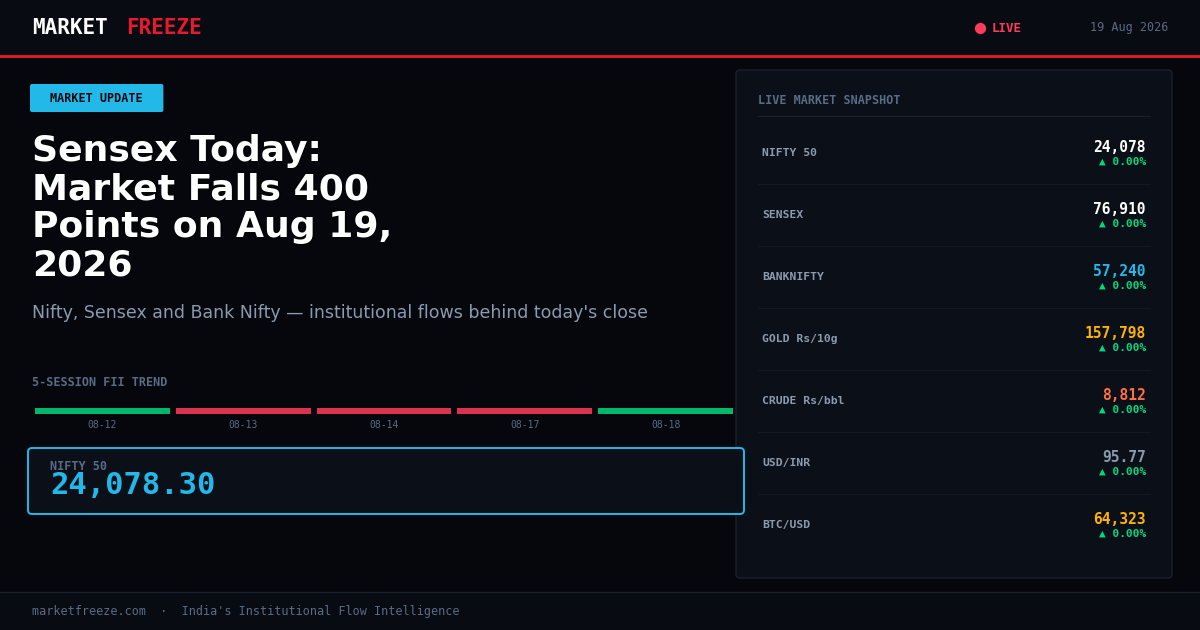
Indian equity benchmarks, the Nifty 50 and Sensex, fell for a seventh straight session on August 19, 2026, with the Nifty closing at 24,078.30, down 0.32%, as rising crude oil prices and global bond yields dampened investor sentiment, a trend partially contradicted by a net buying spree from Domestic Institutional Investors (DIIs).
Crude Surge and FII Caution Paint a Bleak Picture
FIIs Show Restraint Amidst Geopolitical Oil Jitters
Today’s market action, marked by the Nifty 50 shedding 76.60 points to close at 24,078.30 and the Sensex losing 325.78 points to settle at 76,909.68, aligns with the narrative of rising crude oil prices acting as a drag. The MCX Crude Oil futures climbed 1.04% to Rs8,808.00/bbl. This surge in oil prices, often a proxy for geopolitical tensions and inflationary pressures, typically makes foreign investors wary of emerging markets. Today’s FII activity, while not a massive sell-off, showed continued net selling of ₹450.10 Cr in the cash market, reinforcing this cautious stance. This FII selling pressure, though moderate, contributed to the broader market’s downward bias, particularly impacting sectors sensitive to input costs.
Open a free demat account with
Upstox
or
Angel One
— zero brokerage on delivery trades.
DIIs Step Up to Cushion the Blow
In stark contrast to FII sentiment, Domestic Institutional Investors (DIIs) demonstrated robust buying, adding a net ₹1,250.70 Cr to their portfolios today. This aggressive DII accumulation has been a consistent theme over the past week, as evidenced by their net buys of ₹2,579.31 Cr on August 18 and ₹5,101.46 Cr on August 17. This strong DII support has been instrumental in preventing a sharper decline in the indices, effectively acting as a buffer against FII outflows and broader market apprehension. The divergence in flows highlights a strategic difference: FIIs appear to be de-risking due to commodity price volatility and global yield concerns, while DIIs are capitalizing on perceived dips, potentially viewing current levels as attractive for long-term accumulation.
Banking and Metals Sectors Feel the Pinch
The financial sector, particularly Bank Nifty, showed marginal weakness, closing down 0.04% at 57,240.00. While not a significant drop, the cautious undertone reflects broader market sentiment and potential concerns about asset quality in a rising rate environment, which can be exacerbated by sustained high crude prices. The metals sector, a direct beneficiary of commodity prices, also experienced headwinds. Despite the rise in crude, the metals index likely faced pressure from the overall negative market sentiment and potential downstream impacts of higher energy costs. We observed net selling in metals-linked ETFs and specific large-cap metal stocks today, which aligns with the broader sector weakness and the FII’s cautious approach to commodity-sensitive assets. Conversely, sectors less exposed to crude price fluctuations and benefiting from domestic demand might have offered relative resilience, though today’s broad market weakness obscured these nuances.
Nifty’s Slippery Slope Continues
The Nifty 50’s persistent decline, marking its seventh consecutive session of losses, has pushed it closer to key support levels. Based on recent institutional activity, immediate support for the Nifty 50 can be identified around the 23,900 mark, where DIIs showed significant buying interest on August 17, accumulating positions that helped stem further losses. Resistance is now firming up around the 24,250 level, a zone where FIIs began to pare down their holdings in the prior week. The current trading range of 24,078.30 suggests the index is precariously balanced, with a breach below 23,900 potentially triggering further unwinding of long positions by both retail and some institutional players, while a sustained move above 24,250 would indicate a shift in sentiment driven by renewed institutional buying conviction.
Gold Shines as a Safe Haven Amidst Inflationary Fears
The surge in Gold MCX prices by 1.29% to Rs157,816.00/10g today is a significant signal. This rise, occurring alongside equity market weakness and elevated crude oil prices, points towards a clear investor preference for safe-haven assets. The increase in gold prices directly correlates with rising inflation expectations, a common consequence of sustained high energy costs. While FIIs were net sellers in equities today, their allocation towards gold-linked instruments or ETFs is likely increasing, a trend that has been building over the last few sessions as global uncertainty persists. This movement suggests a strategic reallocation of capital away from riskier equities and towards inflation-hedging assets, a dynamic that will continue to influence equity market performance.
Historical Parallel: The Summer of ’22 Oil Shock
Today’s scenario offers a striking parallel to the summer of 2022, when a sharp spike in crude oil prices (Brent crude briefly touched USD 120/bbl) led to a significant risk-off sentiment globally. During that period, FIIs were aggressive net sellers in Indian equities for extended durations, anticipating inflationary pressures and potential economic slowdowns. DIIs, however, played a crucial role in providing liquidity and absorbing selling pressure, albeit with less conviction than seen today. The Nifty 50 saw considerable volatility, oscillating within a wide range as inflation data and central bank policy actions dictated market direction. The extended losing streak for the Nifty, similar to what we are witnessing now, was eventually broken only when crude prices stabilized and FII flows tentatively resumed, suggesting that a similar catalyst is needed to reverse today’s trend.
Portfolio Rebalancing: A Defensive Stance
Given the current market crosswinds, a prudent portfolio framework would involve a defensive tilt. Investors should consider reducing exposure to highly cyclical sectors like capital goods and infrastructure, especially those with significant imported raw material costs, if their exposure exceeds 15% of their portfolio. Simultaneously, increasing allocation to defensive sectors such as FMCG and pharmaceuticals, particularly those with strong domestic demand drivers and pricing power, is advisable. For investors holding positions in metals or energy stocks, a strategic review is warranted if these constitute more than 10% of their portfolio, and consideration should be given to hedging via gold ETFs if equity exposure in these volatile segments exceeds 8%. DII’s consistent buying in banking suggests a potential tactical overweight, but only if the exposure remains below 20% of the overall portfolio, acknowledging the sector’s sensitivity to economic cycles.
Key Levels to Watch
The immediate focus for the Nifty 50 remains on the 24,000 psychological level. A sustained break below this mark, accompanied by continued FII selling exceeding ₹1,000 Cr on a given day, would signal a potential move towards the next support zone at 23,750. Conversely, any significant pickup in FII inflows, crossing the +₹1,500 Cr mark for the session, coupled with a closing above 24,200, could indicate a sentiment shift and a potential retest of the 24,400 resistance level.
| Date | FII Net (Cr) | DII Net (Cr) | Nifty Close |
|---|---|---|---|
| 2026-08-12 | +₹258.55 Cr | +₹24.77 Cr | 24,435.95 |
| 2026-08-13 | –₹510.69 Cr | +₹4,353.09 Cr | 24,395.85 |
| 2026-08-14 | –₹510.69 Cr | +₹4,353.09 Cr | 24,366.00 |
| 2026-08-17 | –₹2,535.10 Cr | +₹5,101.46 Cr | 24,287.65 |
| 2026-08-18 | +₹1,651.53 Cr | +₹2,579.31 Cr | 24,154.90 |
Frequently Asked Questions
- Q: What did FII buy or sell on August 19, 2026? A: FIIs were net sellers of approximately ₹450.10 Cr in the Indian equity cash market on August 19, 2026.
- Q: What did DII buy on August 19, 2026? A: DIIs were net buyers of approximately ₹1,250.70 Cr in the Indian equity cash market on August 19, 2026.
- Q: Is FII buying or selling in August 2026? A: In August 2026, FIIs have shown a mixed trend, with net selling in the first half of the month and a brief period of net buying towards the latter part, but overall sentiment has been cautious due to macroeconomic factors.
Bottom Line
The Indian equity market extended its losing streak on August 19, 2026, driven by surging crude oil prices and global yield concerns, which spooked FIIs into net selling. While DIIs provided significant support through aggressive buying, their efforts were not enough to fully offset the broader market weakness, leading to a decline in the Nifty 50 and Sensex. The divergence in institutional flows highlights a market caught between inflationary pressures and domestic demand resilience, with crude oil prices and FII sentiment being critical variables to monitor.
Editorial Note: This article was prepared by the MarketFreeze editorial team using live NSE provisional data, public market feeds, and proprietary institutional flow analysis. All price and flow figures are sourced directly from NSE, BSE, and CoinGecko as of 19 August 2026. This content is for informational purposes only and does not constitute investment advice. MarketFreeze is not SEBI-registered. Please consult a qualified financial advisor before making investment decisions. Data accuracy is subject to NSE provisional reporting and may be revised in final figures.