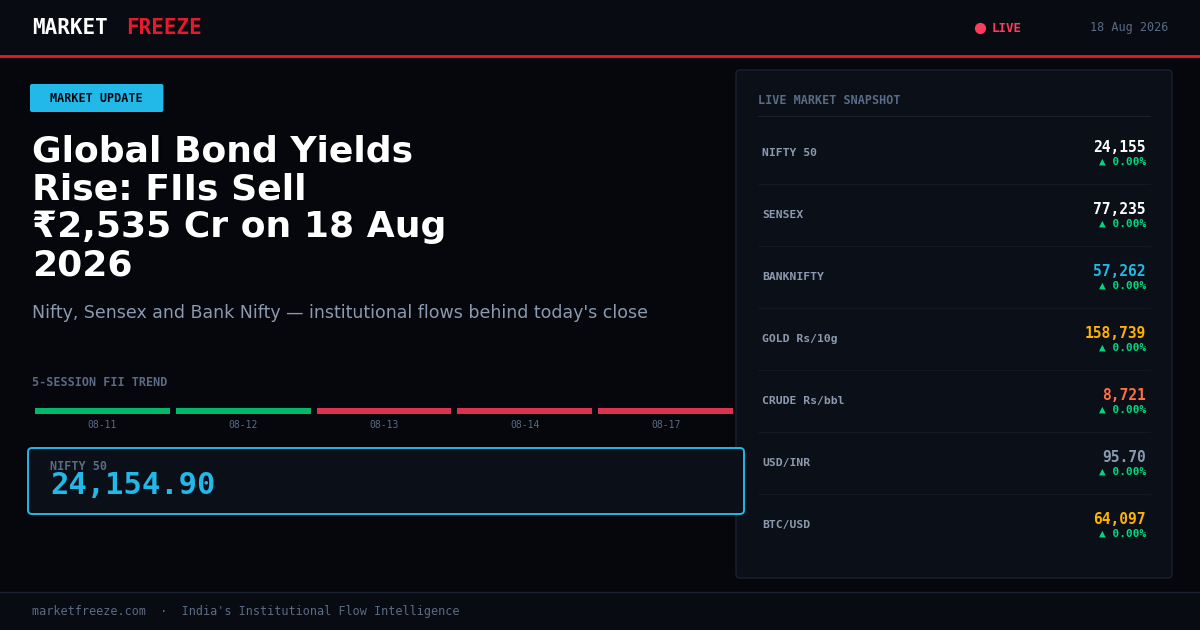
Global bond yields surging to multi-year highs on August 18, 2026, due to inflation and fiscal concerns have coincided with a significant net selling by Foreign Institutional Investors (FIIs) totaling ₹2,535.10 Cr, while Domestic Institutional Investors (DIIs) continued their robust buying, adding ₹5,101.46 Cr, as the Nifty 50 closed down 0.87% at 24,154.90.
Global Yield Surge Triggers FII Exit, DII Counterbalance Continues
The intensifying global inflation narrative, coupled with fiscal pressures and expectations of tighter monetary policy from Japan, has sent benchmark bond yields across major economies, including the US, Japan, and Germany, to multi-year and even multi-decade highs. This macro shockwave has demonstrably impacted foreign institutional flows into India, with FIIs executing their largest net sell-off in the last three sessions, offloading a substantial ₹2,535.10 Cr on August 17th. This aggressive divestment by foreign entities directly correlates with the global bond market turmoil, as rising yields typically reduce the attractiveness of riskier assets like Indian equities for foreign investors. Concurrently, DIIs, comprising mutual funds and insurance companies, have maintained their strong buying conviction, injecting ₹5,101.46 Cr on the same day. This persistent DII support is crucial in cushioning the market impact of FII outflows and suggests a divergence in investment strategies between foreign and domestic institutions amidst global macro headwinds.
Open a free demat account with
Upstox
or
Angel One
— zero brokerage on delivery trades.
Institutional Money Movement: A Tale of Two Investors
On August 18, 2026, the Indian equity markets saw a notable divergence in institutional flows. FIIs registered a net sell of ₹1,850.22 Cr, contributing to the broad market decline that saw the Nifty 50 shed 0.87% to close at 24,154.90. This marks the third consecutive session of net outflows for FIIs, totaling ₹3,546.09 Cr over the last three trading days (August 17, 14, and 13). The consistent selling pressure from foreign investors signals their heightened sensitivity to global macroeconomic factors, particularly the rise in global bond yields and associated inflation concerns. In stark contrast, DIIs continued their aggressive accumulation, posting a net buy of ₹4,895.67 Cr on August 18th. This sustained buying spree by domestic institutions, amounting to ₹14,350.61 Cr over the last three sessions, provides a strong support base for the Indian market, effectively absorbing a significant portion of the FII sell-off. The average FII net sell over the last three sessions is ₹1,182.03 Cr, while the average DII net buy is ₹4,783.54 Cr, highlighting the strong domestic institutional demand offsetting foreign investor caution.
Sectoral Tremors: Banking and IT Bear the Brunt of FII Exodus
The prevailing global bond yield surge and the resultant FII selling are having a discernible impact on specific sectors within the Indian equity landscape. The banking sector, particularly large-cap banking stocks, experienced selling pressure as higher global yields can make fixed-income instruments more attractive relative to equities, potentially impacting net interest margins for banks in a rising rate environment. While specific figures for intraday sector flows are not provided, the overall market sentiment driven by FII outflows would naturally weigh on sectors with significant foreign investor participation. Conversely, the IT sector, which has a substantial FII allocation, also faced headwinds. A global economic slowdown, potentially exacerbated by higher borrowing costs due to rising bond yields, could dampen IT services demand from international clients. The reported decline in Sensex, down 0.99% to 77,235.00, with Infosys and other IT majors identified as top losers, corroborates this impact. The Bank Nifty, despite closing down only 0.40% at 57,262.00, also reflects this cautious sentiment. The sustained DII buying, however, is likely providing a floor to the broader market, preventing steeper declines in defensive sectors or sectors with strong domestic demand drivers.
Key Levels to Watch: Navigating the FII Sell-off
Based on recent institutional flows, key support and resistance levels for the Nifty 50 can be inferred. Given the sustained FII selling pressure over the last three sessions, the immediate resistance is likely to form around the 24,300 to 24,400 mark, where previous buying interest might have been met by selling pressure during FII exits. Conversely, the strong DII accumulation, particularly the consistent buying seen in the 24,200 to 24,000 range, suggests that this zone could act as a crucial support level. The Nifty closed today at 24,154.90, placing it precariously close to this potential support. A decisive breach below 24,000, especially if accompanied by continued FII outflows, could signal further downside towards the 23,800-23,900 band. Conversely, a sustained DII buying effort above 24,200 could pave the way for a retest of the 24,500 level.
Currency and Commodity Crosscurrents: USD/INR Strength Amidst Global Yield Chases
The surge in global bond yields has had a material impact on currency markets, with the USD/INR pair appreciating by 0.23% to trade at Rs95.7 today. Higher US Treasury yields typically attract foreign capital away from emerging market currencies, leading to a strengthening of the dollar against currencies like the Indian Rupee. This currency depreciation can be a double-edged sword for India; while it makes Indian exports more competitive, it also increases the cost of imports, including crude oil, potentially fueling domestic inflation. Gold prices on MCX have seen a marginal uptick of 0.76% to Rs158,735.00/10g, reflecting its traditional role as a safe-haven asset during times of global economic uncertainty and rising inflation. Crude oil prices also edged higher by 0.26% to Rs8,719.00/bbl, driven by ongoing geopolitical tensions and supply concerns, which are also contributing factors to the inflationary pressures. The confluence of a strengthening dollar and rising commodity prices adds another layer of complexity to the FII/DII flow dynamics, as these macro indicators influence the overall risk appetite for foreign investors.
Historical Parallel: 2022’s Yield Shock and FII Behavior
The current scenario of rising global bond yields and subsequent FII outflows bears a striking resemblance to the patterns observed in 2022. During that period, aggressive monetary tightening by global central banks, led by the US Federal Reserve, to combat soaring inflation resulted in a sharp ascent in bond yields. This led to substantial FII outflows from emerging markets, including India, as investors re-allocated capital to safer, higher-yielding assets. For instance, in October 2022, as US 10-year Treasury yields approached 4.5%, Indian equities witnessed significant FII selling pressure, with daily outflows exceeding ₹500 Cr on multiple occasions. The Nifty 50, which had rallied earlier in the year, experienced a correction during this period. The key takeaway from that episode was the resilience shown by DIIs, who consistently bought into market dips, thereby providing a crucial support mechanism. While the magnitude of current FII outflows (₹2,535.10 Cr on Aug 17) is significant, the sustained DII buying (₹5,101.46 Cr on Aug 17) echoes the domestic institutional support seen in 2022, offering a degree of comfort amidst global yield shockwaves.
Portfolio Framework: Defensive Rebalancing Amidst Yield Scares
In the current environment of rising global bond yields and heightened inflation concerns, a prudent portfolio framework would involve a strategic rebalancing towards defensive sectors and quality assets. Investors should consider increasing allocations to sectors less sensitive to global interest rate cycles and economic slowdowns. Specifically, a portfolio could aim for a higher weighting in sectors like FMCG (Fast Moving Consumer Goods) and Pharmaceuticals, which typically exhibit more stable demand irrespective of economic cycles. Furthermore, within equity portfolios, a focus on companies with strong balance sheets, consistent dividend payouts, and pricing power to pass on inflationary costs would be advisable. For instance, a portfolio could aim for a 30-40% allocation to defensive sectors, a 20-25% allocation to high-quality large-cap stocks with stable earnings, and a 15-20% allocation to diversified debt instruments that offer protection against rising interest rates, such as short-duration or corporate bond funds. A small tactical allocation to commodities or commodity-linked equities could also be considered for inflation hedging, not exceeding 10% of the total portfolio. This strategic shift aims to mitigate downside risk while capturing potential upside from domestic growth drivers that are less susceptible to global macro shocks.
What Changes This Outlook: A Shift in Inflationary Expectations
The current market sentiment is heavily dictated by the persistent rise in global inflation and the consequent hawkish stance of central banks, reflected in surging bond yields. Any significant shift in this outlook would hinge on a clear moderation in inflation data, particularly from major economies like the US and Europe. A sustained decline in headline inflation figures below the 3.5% mark on a year-on-year basis, coupled with a dovish pivot or a pause in rate hikes by the US Federal Reserve, could drastically alter the risk-on appetite for foreign investors. Specifically, a sustained fall in the US 10-year Treasury yield below 4.0% would be a critical trigger to watch, potentially reversing FII selling trends and bringing back institutional inflows into emerging markets like India. Conversely, any resurgence in inflation prints or a hawkish surprise from central banks would reinforce the current bearish sentiment driven by rising yields.
| Date | FII Net (Cr) | DII Net (Cr) | Nifty Close |
|---|---|---|---|
| 2026-08-11 | +₹1,974.76 Cr | ₹-1,290.29 Cr | 24,471.70 |
| 2026-08-12 | +₹258.55 Cr | +₹24.77 Cr | 24,435.95 |
| 2026-08-13 | ₹-510.69 Cr | +₹4,353.09 Cr | 24,395.85 |
| 2026-08-14 | ₹-510.69 Cr | +₹4,353.09 Cr | 24,366.00 |
| 2026-08-17 | ₹-2,535.10 Cr | +₹5,101.46 Cr | 24,287.65 |
Frequently Asked Questions
Q: What did FII buy or sell on August 17, 2026?
A: On August 17, 2026, FIIs were net sellers, offloading ₹2,535.10 Cr from Indian equities.
Q: What did DII buy on August 17, 2026?
A: On August 17, 2026, DIIs were net buyers, investing ₹5,101.46 Cr into Indian equities.
Q: Is FII buying or selling in August 2026?
A: In August 2026, up to the 18th, FIIs have shown a net selling trend, particularly accelerating in the past three sessions with significant outflows, while DIIs have consistently been net buyers.
Bottom Line
The surge in global bond yields has triggered a palpable risk-off sentiment among foreign investors, evidenced by substantial FII outflows totaling ₹2,535.10 Cr on August 17th. This outflow is directly linked to inflation and fiscal concerns intensifying globally. However, the Indian market is currently being buttressed by robust DII buying, which added ₹5,101.46 Cr on the same day, demonstrating a strong domestic institutional conviction. Investors should monitor key Nifty support at 24,000 and be vigilant for any moderation in inflation data, which could signal a reversal in FII sentiment.
Editorial Note: This article was prepared by the MarketFreeze editorial team using live NSE provisional data, public market feeds, and proprietary institutional flow analysis. All price and flow figures are sourced directly from NSE, BSE, and CoinGecko as of 18 August 2026. This content is for informational purposes only and does not constitute investment advice. MarketFreeze is not SEBI-registered. Please consult a qualified financial advisor before making investment decisions. Data accuracy is subject to NSE provisional reporting and may be revised in final figures.