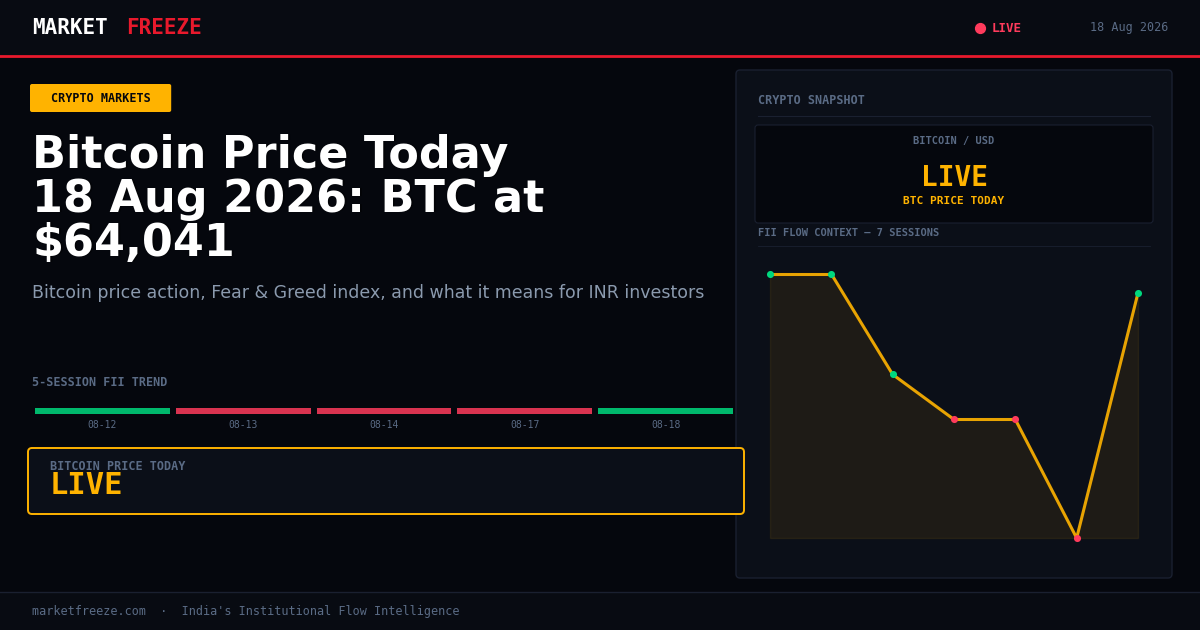
Bitcoin is trading at $64,039 USD, equivalent to ₹6,128,532 INR, marking a +0.97% change in the last 24 hours. This price action comes as crypto’s easy-money era faces scrutiny, with Global Settlement Network CEO Ryan Kirkley stating that inflated valuations and weak business models are driving a significant shakeout in the digital asset space.
Open a free demat account with
Upstox
or
Angel One
— zero brokerage on delivery trades.
Cryptocurrency shakeout echoes broader market concerns
The assertion by Global Settlement Network CEO Ryan Kirkley that crypto’s “easy-money era is ending” due to inflated valuations and weak business models resonates with traditional market observers. While specific to the digital asset space, this narrative of a market correction driven by unsustainable practices is a theme that has played out across various sectors. For Indian retail investors, this highlights the importance of fundamental analysis even in newer asset classes. The current Bitcoin price of $64,039 USD (₹6,128,532 INR) shows a slight uptick of +0.97%, but the underlying commentary suggests a cautious approach is warranted. This sentiment can indirectly influence broader market confidence, potentially impacting institutional flows into Indian equities.
USD/INR movements impacting INR-denominated crypto returns
The USD/INR exchange rate currently stands at ₹95.7. This level is crucial for Indian investors holding cryptocurrencies priced in USD. A strengthening INR (meaning it takes fewer rupees to buy one USD) would generally reduce the INR value of USD-denominated assets, while a weakening INR would have the opposite effect. Today, with Bitcoin showing a modest gain of +0.97% in USD terms, the stability or fluctuation of the USD/INR rate will determine the actual INR return for Indian investors. For instance, if the INR were to weaken significantly, it could amplify the positive INR returns from Bitcoin’s price appreciation. Conversely, a strong INR could mute these gains. The current stable exchange rate of ₹95.7 suggests that the primary driver of INR returns for Bitcoin holders today is the asset’s direct price movement in USD.
Ethereum’s technical upgrade presents new wallet challenges
Ethereum researchers are grappling with a significant technical hurdle: its next upgrade is set to break the long-standing ‘21,000 gas’ rule that wallets rely on. This change means that sending ETH to a brand-new address will incur a higher gas fee than sending to an existing one. Consequently, software applications built around the current flat fee structure may miscalculate transaction costs. This development, concerning Ethereum’s core infrastructure, could introduce temporary friction for users and developers. While Ether is currently trading at $1,895 USD (₹181,351 INR) with a slight dip of -0.08%, this upgrade could influence its adoption and usability in the short to medium term, potentially impacting its trading dynamics relative to Bitcoin. The ETH/BTC ratio currently stands at 0.0296, indicating that Bitcoin is holding steadier than Ethereum today.
Solana’s steady ascent amid broader digital asset recalibration
Solana is demonstrating resilience, trading at $76.07 USD (₹7,279 INR) and showing a healthy increase of +1.12% in the last 24 hours. This performance is noteworthy given the prevalent narrative of a crypto shakeout driven by unsustainable business models. Solana’s ability to post gains suggests that projects with robust underlying technology and clear utility can continue to attract investor interest. For Indian investors, Solana’s upward movement, coupled with Bitcoin’s modest gain, paints a picture of selective strength within the altcoin market. The fact that Cash App is expanding its crypto support to include assets like ether and solana via MoonPay, beyond just Bitcoin and USDC, indicates a growing mainstream acceptance and integration of these digital currencies. This broader adoption trend can provide a tailwind for assets like Solana.
Investor sentiment remains cautious, hinting at accumulation opportunities
The Fear & Greed index currently stands at 41/100, signaling a state of ‘Fear’ within the cryptocurrency market. Historically, readings within the 25-45 range have often marked accumulation zones. For instance, the March 2020 crash and the fourth quarter of 2022 both witnessed sustained institutional buying commence when the index hovered in this territory. This current ‘Fear’ reading, while indicating investor trepidation, could be interpreted by seasoned investors as a potential buying opportunity. For Indian retail investors, understanding this psychological indicator can be valuable. A sustained period of fear, coupled with positive underlying fundamentals for certain digital assets, could present a favorable entry point for strategic investments, mirroring past institutional behavior.
FIIs inject capital into Indian equities, a counterpoint to crypto caution
In a notable development for Indian equities, Foreign Institutional Investors (FIIs) have been net buyers to the tune of +₹1,651.53 Cr today. This inflow contrasts with the ‘Fear’ sentiment in the crypto market and suggests that institutional capital is still finding opportunities in Indian stocks. This positive FII flow can provide support to the Nifty, which closed at 24154.90. The sustained institutional buying in equities, even as crypto navigates a period of recalibration, indicates a divergence in perceived risk and reward across asset classes. For Indian investors, this highlights the importance of monitoring both domestic equity flows and global crypto trends to form a comprehensive investment strategy.
Crypto tax implications for Indian traders: A practical example
Understanding the tax implications of cryptocurrency transactions is vital for Indian investors. Let’s consider a scenario based on today’s Bitcoin price. If an investor were to sell 0.1 BTC, currently valued at approximately $6,403.90 USD or ₹612,853.20 INR, this profit would be subject to Indian crypto tax regulations. Assuming this sale represents a capital gain, it would be taxed at 30% plus applicable cess and surcharges, as per current Indian tax laws on virtual digital assets (VDAs). It is crucial for investors to maintain meticulous records of all buy and sell transactions, including dates and purchase costs, to accurately calculate gains and comply with tax obligations. The ongoing discussions around the crypto market’s future, as highlighted by the ‘easy-money era ending’ narrative, underscore the importance of long-term tax planning for crypto holdings.
Visa seeks new stablecoin partners amid evolving payment landscape
Visa’s strategic move to seek new stablecoin settlement partners following the sale of BVNK to Mastercard signals a dynamic evolution in the traditional finance and digital asset intersection. The request for proposal (RFP) specifically mentions the need to support a diverse range of stablecoins. This indicates that major payment networks are actively exploring and integrating digital currencies for cross-border settlements and other financial services. For Indian investors, this development is encouraging as it points towards greater institutional adoption and infrastructure development within the stablecoin ecosystem. While today’s crypto news has focused on a broader market shakeout, Visa’s proactive stance suggests that stablecoins, designed to maintain a fixed value, are seen as a reliable bridge between traditional fiat currencies and the digital asset world. This can indirectly bolster confidence in the overall digital asset market, even amidst volatility in assets like Bitcoin ($64,039 USD | ₹6,128,532 INR) and Ethereum ($1,895 USD | ₹181,351 INR).
Navigating the ‘Fear’ zone: A historical perspective on institutional buying
The current Fear & Greed index reading of 41/100, placing it in the ‘Fear’ territory, is a significant indicator for astute investors. The provided historical context is particularly compelling: readings between 25-45 have historically preceded periods of substantial institutional accumulation. Both the March 2020 market crash and the final quarter of 2022 saw significant FII and DII buying commence when the index was in this very range. This suggests that despite short-term anxieties, institutional players have demonstrated a strategic approach to deploying capital during such periods of apprehension. For Indian retail investors, this historical pattern offers a valuable lens through which to view current market conditions. It implies that the current ‘Fear’ sentiment, rather than being a signal to exit, could be an opportune moment to consider adding to positions in fundamentally sound assets, aligning with the actions of major market participants.
FII and DII Flow Dynamics: A 5-Day Snapshot
| Date | FII Net (Cr) | DII Net (Cr) | Nifty Close |
|---|---|---|---|
| 2026-08-12 | +₹258.55 Cr | +₹24.77 Cr | 24,435.95 |
| 2026-08-13 | ₹-510.69 Cr | +₹4,353.09 Cr | 24,395.85 |
| 2026-08-14 | ₹-510.69 Cr | +₹4,353.09 Cr | 24,366.00 |
| 2026-08-17 | ₹-2,535.10 Cr | +₹5,101.46 Cr | 24,287.65 |
| 2026-08-18 | +₹1,651.53 Cr | +₹2,579.31 Cr | 24,154.90 |
Key Levels to Watch for Nifty
Given today’s significant net buying by FIIs (+₹1,651.53 Cr) and DIIs (+₹2,579.31 Cr), despite a closing Nifty of 24154.90, the immediate support for the Nifty is seen around the 24000 mark. This level is expected to hold as long as institutional buying momentum continues. Resistance is likely to be encountered near the 24300-24400 levels, especially if there are any headwinds from global markets or a shift in FII/DII sentiment. The strong inflow today suggests an underlying bullish bias, but the market may take time to digest the previous days’ outflows and current price levels.
FAQ: Your Crypto Questions Answered
Q: What did FII buy or sell on 2026-08-17?
A: On 2026-08-17, FIIs were net sellers of Indian equities to the tune of ₹-2,535.10 Cr.
Q: What did DII buy on 2026-08-18?
A: On 2026-08-18, DIIs were net buyers of Indian equities, with a net inflow of +₹2,579.31 Cr.
Q: Is FII buying or selling in August 2026?
A: In August 2026, FII activity has been mixed, with significant selling observed earlier in the month, followed by a notable buying spree in the most recent sessions. The net position for the month requires a broader analysis of all trading days.
Bottom Line
The cryptocurrency market is undergoing a period of recalibration, with narratives around unsustainable business models gaining traction. However, select assets like Bitcoin ($64,039 USD | ₹6,128,532 INR) and Solana ($76.07 USD | ₹7,279 INR) are showing resilience. The current ‘Fear’ sentiment in the Fear & Greed index (41/100) aligns with historical accumulation zones, suggesting potential opportunities. Meanwhile, strong FII and DII inflows into Indian equities indicate continued institutional confidence in the domestic stock market, providing a counterbalance to the cautious sentiment in digital assets.
Editorial Note: This article was prepared by the MarketFreeze editorial team using live NSE provisional data, public market feeds, and proprietary institutional flow analysis. All price and flow figures are sourced directly from NSE, BSE, and CoinGecko as of 18 August 2026. This content is for informational purposes only and does not constitute investment advice. MarketFreeze is not SEBI-registered. Please consult a qualified financial advisor before making investment decisions. Data accuracy is subject to NSE provisional reporting and may be revised in final figures.