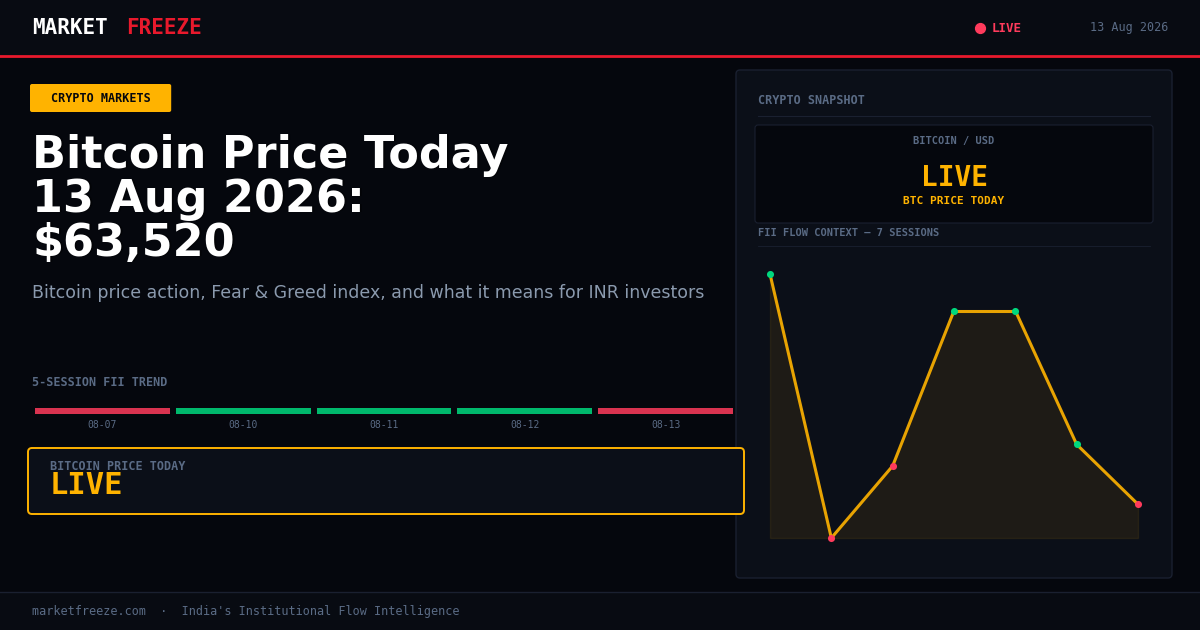
Bitcoin is trading at $63,558 USD or ₹6,064,068 INR, down 0.48% in the last 24 hours. This trading range, holding steady near the $64,000 USD mark, reflects a low volatility pattern in crypto markets following recent economic data. While Bitcoin and Ethereum see modest dips, altcoins like Monero and Hyperliquid are outperforming, signaling a potential rotation within the digital asset space. This underscores the importance of understanding specific asset performance rather than a blanket market view.
Open a free demat account with
Upstox
or
Angel One
— zero brokerage on delivery trades.
Indian Equities Navigate Sideways As FIIs Turn Net Sellers
The Indian equity market, as indicated by the Nifty at 24395.85, is experiencing a period of consolidation. Today, Foreign Institutional Investors (FIIs) were net sellers to the tune of ₹510.69 Cr. This comes after a mixed trend in the preceding sessions, where FIIs showed periods of buying, notably on August 10th and 11th with +₹1,974.76 Cr each day. However, Domestic Institutional Investors (DIIs) have consistently provided support, being strong net buyers in four of the last five sessions, including a significant +₹4,353.09 Cr today. This DII buying strength is crucial in cushioning the market from the outflow of foreign capital, a dynamic that retail investors must closely monitor.
Understanding the Impact of USD/INR on Crypto Returns for Indian Investors
The current USD/INR rate stands at ₹95.41. For Indian retail investors holding cryptocurrencies priced in USD, this exchange rate directly influences their INR returns. A strengthening INR (lower USD/INR) would reduce the INR value of their crypto holdings, even if the USD price remains stable. Conversely, a weakening INR (higher USD/INR) would boost INR returns. Today, with Bitcoin trading at $63,558 USD, the equivalent in INR is ₹6,064,068 INR. Any depreciation in the INR from this level would enhance the INR value of this holding, while an appreciation would diminish it. This currency aspect is a vital, often overlooked, layer of risk and reward for domestic crypto traders.
Ethereum’s Underperformance Relative to Bitcoin and Broader Altcoin Dynamics
Ethereum is currently priced at $1,887 USD or ₹180,038 INR, a decline of 0.92% over the past 24 hours. The ETH/BTC ratio stands at 0.0297, indicating that Bitcoin is outperforming Ethereum today. This divergence is noteworthy, as Ethereum often leads altcoin movements. Solana, another prominent altcoin, is down 0.52% to $76.01 USD or ₹7,252 INR. While specific altcoins like Monero and Hyperliquid are reportedly outperforming, as mentioned in market reports, the broader trend for major altcoins like Ethereum suggests a cautious sentiment, or at least a temporary shift in capital allocation favouring Bitcoin.
The “Fear & Greed” Indicator and its Historical Significance for Accumulation
The Crypto Fear & Greed Index is currently at 29/100, firmly in the “Fear” territory. Historically, readings within the 25-45 range have been significant for institutional investors. Both the March 2020 crash and the Q4 2022 period, marked by sustained fear readings in this band, preceded substantial institutional accumulation. This suggests that while current market sentiment is fearful, it could represent a strategic entry zone for astute investors looking to build positions in anticipation of future market recoveries. The current reading is not an outlier but aligns with historical patterns that have led to subsequent bull runs.
FII Capital Flows and Their Potential Ripple Effect on Crypto
The thesis connecting Foreign Institutional Investor (FII) flows to cryptocurrency markets is increasingly relevant for Indian retail investors. Today’s net outflow of ₹510.69 Cr from FIIs in Indian equities, coupled with DII inflows of +₹4,353.09 Cr, paints a picture of shifting institutional preferences. While FIIs are reducing their exposure to Indian stocks, it’s crucial to observe whether any of this capital eventually finds its way into alternative asset classes like cryptocurrencies, especially if these markets are perceived as offering uncorrelated returns or hedging properties against traditional market volatility. The consistent DII buying could be interpreted as a sign of domestic confidence, potentially providing a stable base for riskier assets.
Navigating Crypto Taxation: A Hypothetical Scenario with Today’s Prices
Let’s consider a hypothetical scenario for crypto taxation. Suppose an investor purchased Bitcoin at $40,000 USD (approximately ₹3,800,000 INR at a hypothetical exchange rate of ₹95/USD) and decides to sell a portion today when Bitcoin is at $63,558 USD (₹6,064,068 INR). The profit on this sale would be approximately $23,558 USD per Bitcoin, or ₹2,264,068 INR. Under Indian tax laws, such gains from virtual digital assets are taxed at a flat rate of 30%, plus applicable surcharges and cess. In this scenario, the tax liability on this single Bitcoin sale would be around 30% of ₹2,264,068 INR, which is approximately ₹679,220 INR. This highlights the significant tax implications of even a single profitable trade in the Indian crypto landscape.
Key Levels to Watch in Indian Equities Amidst FII Sell-Off
With the Nifty closing at 24395.85 and FIIs showing net selling pressure, key support levels for the Indian equity market are critical to monitor. Based on the recent price action and flow data, immediate support can be observed around the 24,300 mark. A breach below this could test the 24,000 psychological level, especially if FII selling intensifies. On the upside, resistance is likely to be encountered near the 24,500 level, followed by the 24,700 zone. DII buying strength will be paramount in defending these support levels. Any sustained FII outflows without corresponding DII inflows could lead to a downward trend, impacting broader investor sentiment.
Actionable Framework: Accumulating Crypto During Fearful Market Conditions
Given the Fear & Greed Index at 29/100, a strategic accumulation approach can be considered.
- Identify Core Holdings: Focus on fundamentally strong cryptocurrencies like Bitcoin ($63,558 USD | ₹6,064,068 INR) and Ethereum ($1,887 USD | ₹180,038 INR).
- Dollar-Cost Averaging (DCA): Implement a DCA strategy by investing a fixed INR amount at regular intervals (e.g., weekly or bi-weekly). This smooths out the average purchase price and reduces the risk of timing the market.
- Staggered Entries: If deploying a lump sum, consider breaking it into smaller tranches to be invested at different price points. For instance, allocating funds when Bitcoin drops below $63,000 USD (₹6,016,000 INR) and again if it tests $60,000 USD (₹5,724,000 INR).
- Rebalancing Altcoins: If exposure to altcoins like Solana ($76.01 USD | ₹7,252 INR) is desired, ensure it doesn’t exceed a predetermined percentage of the overall portfolio, and rebalance periodically to manage risk.
This framework leverages the current fear sentiment as a potential opportunity for long-term value accumulation.
Frequently Asked Questions for Indian Crypto Investors
Q: What did FII buy or sell on August 13, 2026?
A: FIIs were net sellers of ₹510.69 Cr in Indian equities on August 13, 2026.
Q: What did DII buy on August 13, 2026?
A: DIIs were net buyers of +₹4,353.09 Cr in Indian equities on August 13, 2026.
Q: Is FII buying or selling in August 2026?
A: FII activity in August 2026 has been mixed, with net selling observed on August 7th (₹-17.86 Cr) and August 13th (₹-510.69 Cr), contrasted by net buying on August 10th (+₹1,974.76 Cr) and August 11th (+₹1,974.76 Cr).
The current regulatory environment for Virtual Digital Assets (VDAs) in India, as reflected in the 30% taxation on profits, presents a significant consideration for investors. This flat rate applies regardless of the holding period, distinguishing it from capital gains tax on traditional assets where long-term gains are often taxed at lower rates. For instance, an investor realizing a profit of ₹2,264,068 INR on a single Bitcoin sale would incur a tax liability of approximately ₹679,220 INR. This necessitates careful tax planning and record-keeping for all VDA transactions, as any misstep could lead to substantial financial penalties. Understanding and adhering to these tax regulations is as crucial as understanding market dynamics for successful crypto investing in India.
Comparative Analysis: Bitcoin vs. Ethereum in the Current Market Cycle
Bitcoin ($63,558 USD | ₹6,064,068 INR) continues to act as the bellwether of the cryptocurrency market. Its relative stability, even with minor dips, is a testament to its established position. Ethereum ($1,887 USD | ₹180,038 INR), while also experiencing a slight downturn, shows a divergence in performance. The ETH/BTC ratio at 0.0297 suggests that Bitcoin is currently capturing more investor interest or capital, a trend that can shift rapidly. Historically, Ethereum has often led the charge in altcoin rallies, but in the current phase, the focus appears to be more on Bitcoin’s resilience and the emergence of specific altcoins that are demonstrating standalone strength, moving away from being solely dictated by Ethereum’s performance.
Global Macroeconomic Influences on Digital Assets
Beyond domestic equity flows and currency fluctuations, global macroeconomic factors play a pivotal role in shaping the digital asset landscape. Inflationary pressures, central bank monetary policies (particularly interest rate decisions by the US Federal Reserve), and geopolitical stability all contribute to investor sentiment towards risk assets. Cryptocurrencies, despite their decentralized nature, are not immune to these broader economic forces. For example, anticipation of interest rate hikes can lead to a flight from riskier assets, including crypto, as investors seek safer havens. Conversely, signs of economic recovery or dovish monetary policy can fuel risk appetite, potentially benefiting digital assets.
The Role of Stablecoins in Portfolio Management
In volatile crypto markets, stablecoins play a critical role for traders and investors looking to preserve capital or quickly redeploy funds. Assets like USDT (Tether) and USDC (USD Coin) aim to maintain a 1:1 peg with the US Dollar. For Indian investors, holding stablecoins can be a strategic maneuver to sidestep the direct impact of INR depreciation or appreciation on their portfolio, while still remaining within the crypto ecosystem. It allows for a ‘risk-off’ position within crypto without exiting to fiat, facilitating swift re-entry into other digital assets when opportunities arise. The ease of converting between cryptocurrencies and stablecoins, often at lower fees than traditional fiat on-ramps, adds to their utility.
Evaluating Altcoin Potential Beyond Bitcoin and Ethereum
While Bitcoin and Ethereum command significant attention, the altcoin market offers diverse opportunities, albeit with higher risk. The mention of Monero and Hyperliquid outperforming suggests that specific narratives or technological advancements are driving value in certain segments. For instance, privacy coins like Monero often see increased interest during periods of heightened regulatory scrutiny or when concerns about blockchain transparency are paramount. Similarly, newer platforms or layer-2 solutions like Hyperliquid might be attracting capital due to their innovative technology or perceived growth potential. Investors looking beyond the top two cryptos must conduct thorough due diligence, assessing project fundamentals, tokenomics, development teams, and community engagement.
Bottom Line
The Indian market is navigating a period of cautious trading, with FIIs exhibiting net selling pressure while DIIs continue to provide robust support. In the crypto space, Bitcoin is holding steady near $63,558 USD | ₹6,064,068 INR amidst low volatility, with a “Fear” reading on the Fear & Greed Index suggesting potential accumulation opportunities. Investors should remain cognizant of the USD/INR exchange rate’s impact on their INR-denominated crypto returns and consider disciplined strategies like DCA during these uncertain times.
Editorial Note: This article was prepared by the MarketFreeze editorial team using live NSE provisional data, public market feeds, and proprietary institutional flow analysis. All price and flow figures are sourced directly from NSE, BSE, and CoinGecko as of 13 August 2026. This content is for informational purposes only and does not constitute investment advice. MarketFreeze is not SEBI-registered. Please consult a qualified financial advisor before making investment decisions. Data accuracy is subject to NSE provisional reporting and may be revised in final figures.