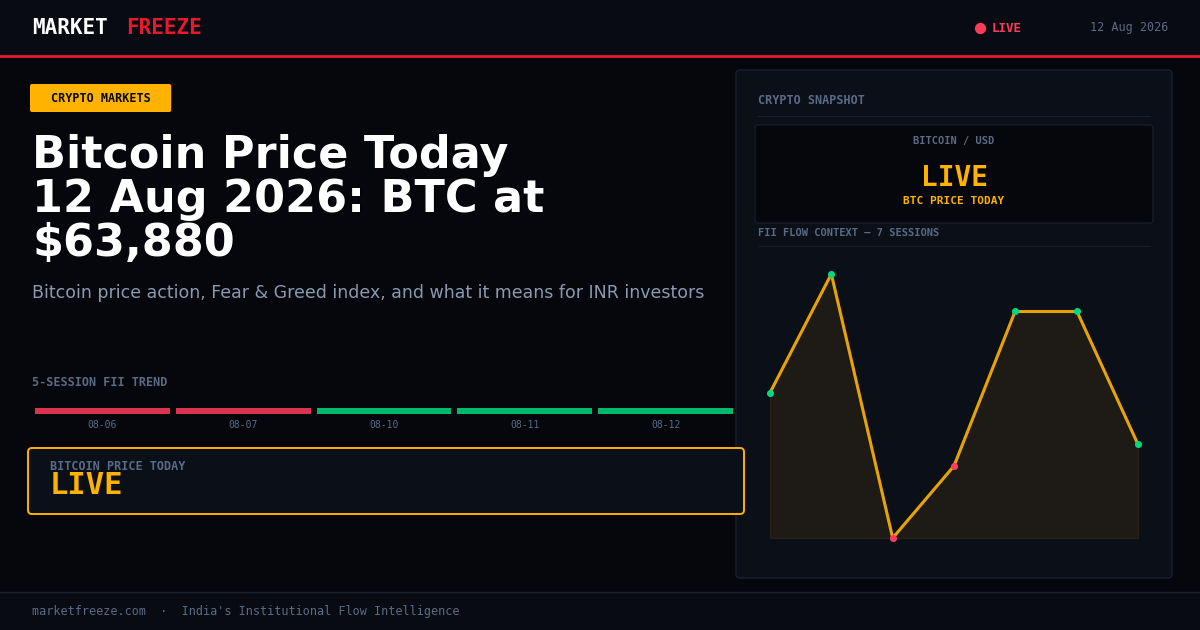
Bitcoin is trading at $63,894 USD, equivalent to ₹6,099,321 INR, as US CPI inflation matched expectations, slowing to 3.4% and providing a stable backdrop for risk assets.
Open a free demat account with
Upstox
or
Angel One
— zero brokerage on delivery trades.
US Inflation Data Supports Bitcoin Stability Near $64,000 Amidst Institutional Interest
The release of US Consumer Price Index (CPI) data, showing a slowdown to 3.4% as anticipated, has provided a steadying influence on Bitcoin. The flagship cryptocurrency is currently hovering near the $63,894 USD (₹6,099,321 INR) mark, a level that has seen resilience. This stability in inflation figures has also led to a decline in Treasury yields, a typically positive signal for digital assets. While Bitcoin showed a slight 24-hour dip of -0.45%, its ability to hold near key psychological levels in the face of global economic data underscores its growing integration within the broader financial landscape. This scenario echoes the sentiment from Anchorage Digital, which argues for a clear path to America’s payment systems for qualifying institutions, suggesting a move towards greater institutional adoption and a less fragmented financial ecosystem.
The INR Impact: How Currency Fluctuations Affect Indian Crypto Holdings
For Indian retail investors, the current USD/INR exchange rate of ₹95.46 plays a crucial role in determining the actual returns on their cryptocurrency investments. While Bitcoin has seen a minor correction of -0.45% in USD terms, the depreciating INR offers a slight buffer. For instance, if an investor holds Bitcoin denominated in USD, a weaker Rupee automatically increases the INR value of their holdings, even if the USD price remains stagnant or declines slightly. Conversely, a strengthening INR would amplify any USD-denominated losses. Today’s movement highlights the dual currency exposure Indian investors face: the global price action of cryptocurrencies in USD, and the local appreciation or depreciation of the INR against the dollar. A stable USD/INR at ₹95.46, combined with Bitcoin at $63,894 USD (₹6,099,321 INR), means that any gains or losses in the crypto market are immediately compounded or mitigated by the prevailing FX rate.
Ethereum’s Resilience and the ETH/BTC Dynamics
Ethereum is demonstrating notable strength, trading at $1,905 USD (₹181,851 INR), marking a +0.96% increase over the last 24 hours. This outperformance relative to Bitcoin is reflected in the ETH/BTC ratio, which currently stands at 0.0298. This indicates that while Bitcoin remains the dominant cryptocurrency, Ethereum is gaining ground. The ETH/BTC ratio is a key metric for institutional investors looking to gauge the relative attractiveness of the two largest digital assets. A rising ratio suggests stronger demand for ETH compared to BTC, often driven by developments in Ethereum’s ecosystem, such as upgrades or increased adoption of its smart contract capabilities. Today’s positive ETH/BTC movement, coupled with Ethereum’s individual price increase, suggests a potential rotation of capital into the second-largest cryptocurrency, or at least a stronger conviction in its future prospects relative to Bitcoin.
Solana Shows Upward Momentum in a Mixed Altcoin Landscape
Solana is exhibiting positive momentum, trading at $76.35 USD (₹7,288 INR), with a +0.61% gain in the past 24 hours. This performance places it in the green, mirroring Ethereum’s strength and suggesting a degree of optimism within the broader altcoin market, even as Bitcoin experiences a slight pullback. While specific news driving Solana today is not detailed in the provided context, its consistent performance in a generally cautious market environment indicates underlying strength or accumulation. For Indian investors, Solana at $76.35 USD (₹7,288 INR) represents an opportunity to gain exposure to a high-throughput blockchain that has been a focus for decentralized application development. The ability of altcoins like Solana to hold ground or advance when Bitcoin is consolidating is often a sign of a maturing crypto market, where diverse narratives and technological advancements can drive individual asset performance.
Navigating ‘Fear’ in the Crypto Market: Historical Opportunities Amidst Present Caution
The Fear & Greed Index currently stands at 27/100, firmly in the ‘Fear’ territory. Historically, readings in the 25-45 range have served as significant accumulation zones for astute institutional investors. The periods of the March 2020 crash and the fourth quarter of 2022 both witnessed sustained institutional buying commencing when the Fear & Greed index was within these cautionary levels. For Indian retail investors, this current ‘Fear’ reading, coupled with Bitcoin trading at $63,894 USD (₹6,099,321 INR), suggests that the market may be presenting an opportune moment to accumulate assets at potentially favorable prices. The historical data points to a pattern where extreme fear often precedes periods of significant recovery and growth, driven by institutional capital seeking value. Therefore, instead of being deterred by the ‘Fear’ sentiment, investors might consider it a signal for strategic entry points, especially if they align with their long-term investment horizons.
FII Flows: A Cautious Return to Indian Equities Amidst Global Crypto Stability
Foreign Institutional Investors (FIIs) were net buyers in Indian equities today, with an inflow of ₹259 Cr. This marks a welcome, albeit moderate, return of institutional capital into the Indian stock market. The Nifty closed at 24435.95, down slightly, indicating a day of consolidation rather than significant directional movement. While FII inflows are a positive sign for the Indian equity market, they do not directly correlate with crypto inflows on a day-to-day basis. However, a broader trend of FIIs deploying capital globally, including in emerging markets like India, can sometimes spill over into riskier assets like cryptocurrencies, especially when traditional markets are perceived as stable or undervalued. The current crypto environment, with Bitcoin holding at $63,894 USD (₹6,099,321 INR) and a ‘Fear’ sentiment prevailing, might not be a direct draw for FIIs looking for immediate returns, but sustained equity inflows could eventually correlate with increased allocations to alternative assets.
Crypto Tax Mechanics: Illustrating a Hypothetical Transaction
Let’s consider a hypothetical scenario for an Indian investor. Suppose an investor purchased 1 Bitcoin on January 15, 2024, for $40,000 USD (approximately ₹3,300,000 INR at the time) and decided to sell half of it (0.5 BTC) today, August 12, 2026, when Bitcoin is trading at $63,894 USD (₹6,099,321 INR). The sale of 0.5 BTC would yield $31,947 USD (₹3,049,660.5 INR). The original cost of this 0.5 BTC was $20,000 USD (₹1,650,000 INR). Therefore, the long-term capital gain would be $11,947 USD (₹1,399,660.5 INR). This gain would be subject to India’s crypto tax regulations, typically taxed at 30% plus applicable surcharges and cess. This example demonstrates how gains are calculated based on the difference between the sale price and the purchase price, irrespective of the current market sentiment or FII flows. It’s crucial for investors to maintain meticulous records of all transactions to accurately calculate their tax liabilities.
Key Levels to Watch: Nifty’s Support and Resistance in a Flow-Driven Market
With FIIs making a net purchase of ₹259 Cr today and DIIs also showing a modest net buy of ₹24.77 Cr, the immediate pressure on the Nifty may ease. The Nifty closed at 24435.95, indicating a key support level to watch. If buying pressure from domestic institutions continues and FII flows remain stable or increase, the Nifty could find immediate resistance around the 24,500-24,550 levels. Conversely, any significant outflows or a reversal in FII sentiment could see the index test support around 24,300-24,350. The current crypto market, with Bitcoin at $63,894 USD (₹6,099,321 INR), is not directly dictating Nifty’s movement, but a stable global risk environment, as suggested by the US inflation data, is conducive for Indian equities. Investors should monitor FII/DII flows closely as they often provide a leading indicator for short-term Nifty movements.
FAQ Section
Q: What did FII buy or sell on August 10, 2026?
A: On August 10, 2026, FIIs were net buyers with an inflow of +₹1,974.76 Cr.
Q: What did DII buy on August 12, 2026?
A: On August 12, 2026, DIIs were net buyers with an inflow of +₹24.77 Cr.
Q: Is FII buying or selling in August 2026?
A: In August 2026, FII flows have been mixed. After net outflows early in the month, they turned into net buyers on August 10th and 11th, and continued as net buyers on August 12th with +₹258.55 Cr.
Historical FII/DII Data
| Date | FII Net (Cr) | DII Net (Cr) | Nifty Close |
|---|---|---|---|
| 2026-08-06 | ₹-943.42 Cr | +₹2,883.17 Cr | 24,636.00 |
| 2026-08-07 | ₹-17.86 Cr | +₹4,013.60 Cr | 24,570.65 |
| 2026-08-10 | +₹1,974.76 Cr | ₹-1,290.29 Cr | 24,583.80 |
| 2026-08-11 | +₹1,974.76 Cr | ₹-1,290.29 Cr | 24,471.70 |
| 2026-08-12 | +₹258.55 Cr | +₹24.77 Cr | 24,435.95 |
Bottom Line
Today’s market action sees Bitcoin holding steady at $63,894 USD (₹6,099,321 INR) following benign US inflation data, while Ethereum and Solana show incremental gains. The prevailing ‘Fear’ in the crypto market, indicated by a Fear & Greed Index of 27/100, aligns with historical accumulation zones, suggesting potential opportunities for long-term investors. FIIs continue their cautious return to Indian equities with a net buy of ₹259 Cr, providing a stable backdrop for the Nifty at 24435.95. Indian investors must remain cognizant of the USD/INR rate at ₹95.46, which influences their actual rand returns on global crypto assets.
Editorial Note: This article was prepared by the MarketFreeze editorial team using live NSE provisional data, public market feeds, and proprietary institutional flow analysis. All price and flow figures are sourced directly from NSE, BSE, and CoinGecko as of 12 August 2026. This content is for informational purposes only and does not constitute investment advice. MarketFreeze is not SEBI-registered. Please consult a qualified financial advisor before making investment decisions. Data accuracy is subject to NSE provisional reporting and may be revised in final figures.