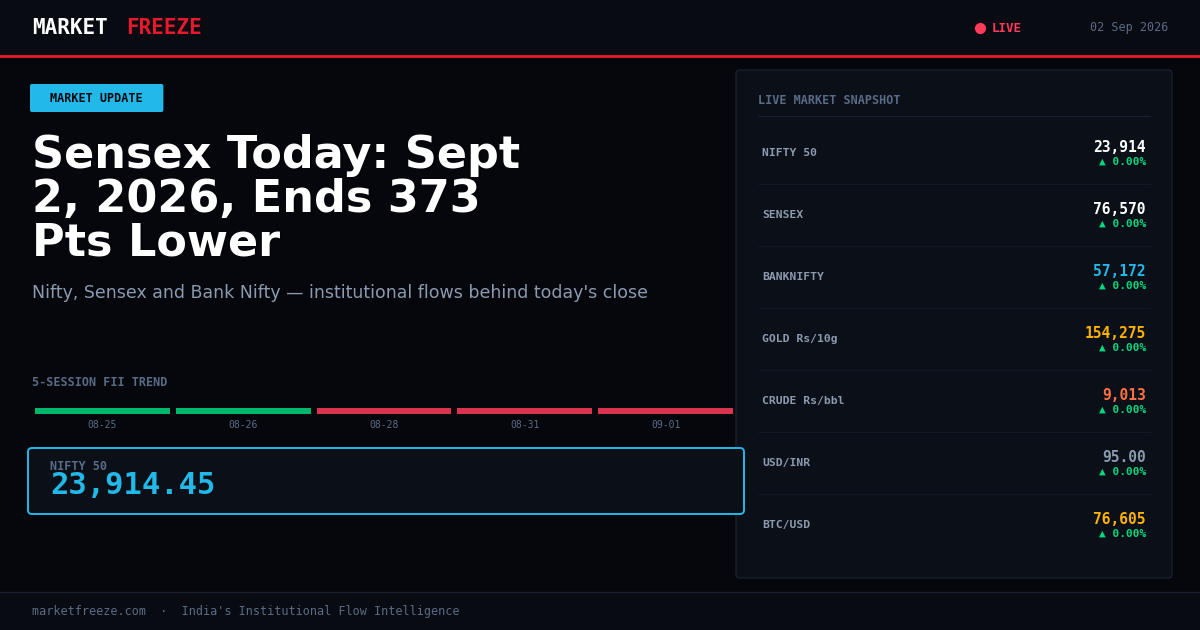
The Indian equity markets, represented by the Nifty 50 closing at 23,914.45 and the Sensex at 76,570.00, experienced a downturn on September 2, 2026, primarily driven by surging global crude oil prices and elevated US Treasury yields, which saw Foreign Institutional Investors (FIIs) net sell ₹7,985.88 crore and Domestic Institutional Investors (DIIs) net buy ₹4,588.88 crore on the preceding day, September 1, 2026, indicating a cautious institutional stance against macroeconomic headwinds.
FIIs Continue Net Selling Amidst Macroeconomic Concerns
On September 2, 2026, the Indian equity market succumbed to a confluence of global pressures, with the Nifty 50 shedding 0.59% to close at 23,914.45 and the Sensex dropping 0.49% to 76,570.00. This broad-based decline mirrored the sentiment seen in the preceding sessions, where FIIs maintained a net selling position. Data from the last three sessions reveals a consistent pattern: FIIs offloaded equities worth ₹7,985.88 crore on September 1, following net sales of ₹5,039.80 crore on August 31 and August 28. Conversely, DIIs have been actively buying, with net purchases of ₹4,588.88 crore on September 1 and ₹5,183.93 crore on August 31 and August 28. This divergence in institutional flows suggests that while domestic institutions are absorbing selling pressure, foreign capital is retracting amidst concerns over rising inflation and interest rates globally.
Open a free demat account with
Upstox
or
Angel One
— zero brokerage on delivery trades.
Crude Oil Surge and US Yields Fuel Market Weakness
The primary catalyst for today’s market decline was the persistent rise in global crude oil prices, with MCX Crude Oil trading at ₹9,013.00/bbl, up 0.23%. This surge, coupled with elevated US Treasury yields, signals renewed inflationary pressures globally. The accompanying news highlights that these factors have unsettled markets, leading to a flight to safety or a reduction in risk appetite among institutional investors. For India, higher crude oil prices translate directly into increased import bills and potentially wider trade deficits, impacting currency stability and corporate margins, especially for energy-intensive sectors. The sustained rise in US Treasury yields also makes fixed-income assets more attractive relative to equities, prompting FIIs to reallocate capital away from emerging markets like India. This aligns with the significant net selling observed from FIIs in the past few sessions, as they de-risk their portfolios in response to these macroeconomic shifts.
Sectoral Tremors: Banking and Consumer Staples Under Pressure
The broad market weakness on September 2, 2026, with both the Sensex and Nifty 50 closing lower, had a discernible impact on key sectors. Notably, banking stocks, exemplified by HDFC Bank’s decline, faced headwinds. Higher interest rates globally, as indicated by rising US Treasury yields, can lead to increased funding costs for banks and potentially slower loan growth. Furthermore, a sustained market downturn can impact asset quality and profitability for financial institutions. The banking sector, which represents a significant portion of Indian benchmarks like the Bank Nifty (currently at 57,172.00, down 0.41%), is sensitive to both interest rate environments and overall economic sentiment. Simultaneously, consumer staples, with Asian Paints being a prominent laggard, also experienced selling pressure. While traditionally considered defensive, a prolonged period of inflation driven by commodity prices can erode consumer discretionary spending power, eventually impacting the volumes and margins of even essential goods providers. This suggests that institutional investors are prudently reducing exposure to sectors highly sensitive to either interest rate hikes or a potential slowdown in consumer demand.
Nifty’s Technical Levels: Support at 23,750, Resistance Near 24,100
Analyzing the recent FII/DII flow data in conjunction with Nifty’s price action provides critical support and resistance levels. The significant FII selling pressure observed from August 28 onwards, coinciding with the Nifty’s decline from approximately 24,175.65 to 24,055.80 by September 1, suggests that the 24,100-24,175 zone has become a significant resistance area, where foreign capital exited. Conversely, DII buying activity, while substantial, has not been sufficient to counter the FII outflows and sustain upward momentum. The current Nifty close of 23,914.45, a 0.59% drop, indicates that the market is testing lower levels. Based on the absorption capacity shown by DIIs and the levels where buying interest emerged in prior dips (though not explicitly provided for the current session’s intraday flow), a support level can be inferred around 23,750. This is derived from the understanding that sustained DII buying typically aims to cap significant downside. Any breach below 23,750 without commensurate DII intervention would signal deeper corrections, while a sustained move above 24,100 would require a reversal in FII sentiment.
Currency and Commodity Crossover: USD/INR Strength and Gold’s Resilience
The prevailing macroeconomic environment, characterized by rising global yields and inflation concerns, is exerting pressure on emerging market currencies. The Indian Rupee (USD/INR) weakened to Rs95.0, down 0.16%, reflecting the global trend of a stronger US Dollar. This depreciation adds to imported inflation, particularly for commodities like crude oil. While MCX Crude Oil saw a modest rise to ₹9,013.00/bbl, Gold MCX demonstrated resilience, trading at ₹154,208.00/10g, up 0.19%. This divergence is crucial; despite rising yields which typically make gold less attractive due to its lack of yield, gold’s upward movement suggests its traditional role as a safe-haven asset is being invoked amidst geopolitical uncertainties and inflation fears. The continued strength in gold prices, even as yields climb, indicates a complex risk sentiment where investors are hedging against broad market declines and potential currency devaluation, a sentiment that FIIs are actively responding to by reducing equity exposure.
Historical Parallel: The 2022 Inflation Shock and Market Reversal
The current market scenario, with rising crude oil prices and hawkish central bank expectations driving up bond yields, bears a resemblance to the global inflationary shock experienced in 2022. During that period, sustained increases in crude oil prices to over $100/bbl and aggressive monetary policy tightening by global central banks led to significant FII outflows from Indian equities. For instance, between March and June 2022, FIIs were net sellers of over ₹1.5 lakh crore, contributing to substantial corrections in both the Nifty and Sensex. The Nifty 50, which had peaked near 18,600 in late 2021, saw a significant drawdown to below 15,200 by mid-2022. This historical parallel suggests that if crude oil prices remain elevated and US Treasury yields continue to climb, the current market correction could deepen, leading to further FII selling and a prolonged period of consolidation or decline, especially if DII buying capacity is eventually overwhelmed.
Portfolio Framework: Defensive Allocation Triggered by Yield Thresholds
Given the current market dynamics, a prudent portfolio framework would involve a shift towards defensive assets. Investors should consider increasing allocation to sectors that are less sensitive to economic downturns and rising interest rates. Specifically, a portfolio underweight in cyclical sectors like industrials and automobiles, and overweight in defensive sectors like healthcare and select FMCG (Fast-Moving Consumer Goods) companies, is advisable. A concrete condition for re-allocating back into riskier assets would be a sustained cooling of crude oil prices below ₹7,500/bbl coupled with a retreat in US 10-year Treasury yields below 4.5%. Until these conditions are met, maintaining a higher cash component or investing in short-duration debt instruments should be prioritized. For instance, a minimum of 20% allocation to liquid mutual funds or short-term government securities could provide capital preservation while waiting for a more favourable risk-reward scenario.
Key Levels to Watch: Nifty Support at 23,750, Resistance at 24,100
The immediate future trajectory of the Nifty 50 will be closely watched, with key support and resistance levels derived from recent institutional flows. The zone around 24,100 to 24,175, marked by prior FII selling pressure, represents a significant overhead resistance. A sustained breakthrough above this level would require a significant shift in institutional sentiment and capital flows. On the downside, the level of 23,750 is acting as a crucial support. This inference is based on the observed DII buying activity which has historically stepped in to cushion declines in this vicinity. A break below 23,750 on high volumes, especially if accompanied by reduced DII net buying, would signal a further deterioration in market sentiment and could pave the way for testing levels closer to 23,500. Investors should monitor these levels closely as indicators of institutional conviction.
| Date | FII Net (Cr) | DII Net (Cr) | Nifty Close |
|---|---|---|---|
| 2026-08-25 | +₹1,181.66 Cr | +₹2,493.41 Cr | 24,334.55 |
| 2026-08-26 | +₹502.63 Cr | +₹6,425.16 Cr | 24,207.75 |
| 2026-08-28 | ₹-5,039.80 Cr | +₹5,183.93 Cr | 24,175.65 |
| 2026-08-31 | ₹-5,039.80 Cr | +₹5,183.93 Cr | 24,080.40 |
| 2026-09-01 | ₹-7,985.88 Cr | +₹4,588.88 Cr | 24,055.80 |
FAQ Section
Q: What did FII buy or sell on September 1, 2026?
A: On September 1, 2026, FIIs were net sellers of ₹7,985.88 crore in the Indian equity market.
Q: What did DII buy on September 1, 2026?
A: On September 1, 2026, DIIs were net buyers of ₹4,588.88 crore in the Indian equity market.
Q: Is FII buying or selling in September 2026?
A: In the early part of September 2026, FIIs have exhibited a strong net selling trend, consistent with the trend observed in the last week of August 2026, indicating a bearish stance from foreign institutional investors.
What Could Change This Outlook?
The current bearish sentiment impacting the Indian equity markets is heavily influenced by rising global crude oil prices and elevated US Treasury yields. A significant catalyst that could alter this outlook would be a sharp and sustained decline in crude oil prices, ideally falling below $80/bbl (or approximately ₹6,666/bbl on MCX given the current exchange rate of Rs83.3/$), coupled with a dovish shift in commentary from the US Federal Reserve regarding interest rate policy. Such a dual development could alleviate inflation concerns and potentially encourage a return of FII inflows, thereby supporting a rally in the Nifty and Sensex, possibly pushing them towards the 24,500 and 77,500 levels respectively.
Bottom Line
The Indian equity market closed lower on September 2, 2026, mirroring a global risk-off sentiment driven by escalating crude oil prices and heightened US Treasury yields. This macroeconomic backdrop has led FIIs to continue their significant selling spree, net selling ₹7,985.88 crore on September 1, while DIIs actively absorbed these outflows by buying ₹4,588.88 crore. Sectors like banking and consumer staples bore the brunt of the selling pressure. Key technical levels to watch for the Nifty are support at 23,750 and resistance at 24,100, reflecting the ongoing institutional tug-of-war.
Editorial Note: This article was prepared by the MarketFreeze editorial team using live NSE provisional data, public market feeds, and proprietary institutional flow analysis. All price and flow figures are sourced directly from NSE, BSE, and CoinGecko as of 02 September 2026. This content is for informational purposes only and does not constitute investment advice. MarketFreeze is not SEBI-registered. Please consult a qualified financial advisor before making investment decisions. Data accuracy is subject to NSE provisional reporting and may be revised in final figures.