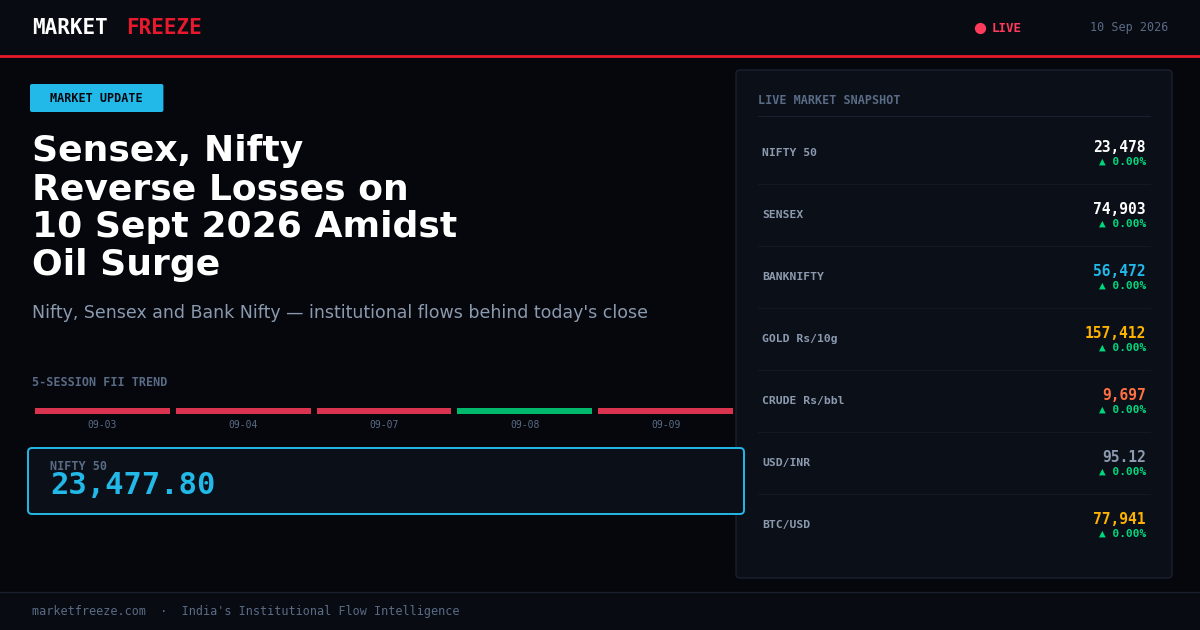
Market Snaps Three-Day Slide as FIIs Turn Cautious Sellers Amidst Soaring Crude
Indian equities, led by the Nifty 50 closing at 23,477.80, reversed earlier losses to end in the green on September 10, 2026, a move that saw Foreign Institutional Investors (FIIs) book marginal profits while Domestic Institutional Investors (DIIs) continued their robust buying spree.
Open a free demat account with
Upstox
or
Angel One
— zero brokerage on delivery trades.
FIIs Exhibit Caution as DIIs Power a Mid-Session Reversal
The market’s ability to recover from intraday lows, with the Nifty 50 gaining 46.30 points (0.20%) and the Sensex adding 138.00 points (0.19%), was largely supported by strong domestic institutional buying. Today’s trading session saw FIIs become net sellers, offloading equities worth ₹123.19 Cr. This marks a shift from their net buying of ₹280.13 Cr on September 8, and a stark contrast to their significant selling of ₹3,111.94 Cr on September 7. Conversely, DIIs continued their consistent accumulation, posting a net buy of ₹1,349.64 Cr, building on their impressive ₹566.76 Cr purchase on September 8 and a substantial ₹8,930.12 Cr on September 7. This divergence in flows suggests that while foreign investors are adopting a more cautious stance, likely reacting to rising crude oil prices and geopolitical concerns, domestic institutions are actively capitalizing on perceived dips.
Sectoral Resilience Driven by Banks and Infrastructure Amidst Oil Shock
The market’s resilience, particularly the upward swing in Power Grid and Axis Bank, which gained nearly 2% each, points towards a sector-specific strength that counteracted broader inflationary fears stemming from soaring crude oil prices. The Bank Nifty closed higher by 0.31% at 56,472.00, indicating sustained interest in the financial sector, likely driven by DII accumulation. UltraTech Cement and NTPC also registered gains, suggesting that select infrastructure and core sector stocks are holding firm. This performance in the face of crude oil prices breaching $9,699.00 per barrel on MCX, a level not seen since May, highlights a potential decoupling of certain sectors from immediate commodity price reactions. The Metals index, however, was noted to be dragging in early trading, as per supporting reports, indicating that commodity-linked sectors are more sensitive to these price surges.
Crude Oil Surge and Geopolitical Tensions Create a Divergent Flow Landscape
The confluence of rising crude oil prices, with Brent crude crossing the $102 per barrel mark for the first time since May, and ongoing geopolitical tensions, has created a complex backdrop for institutional flows. While the overall market managed a positive close, the shift in FII activity from net buying to net selling of ₹123.19 Cr today underscores their sensitivity to these macro-economic headwinds. The weakening INR, which depreciated by 0.64% to Rs95.12 against the USD, further exacerbates concerns for foreign investors regarding potential currency depreciation losses. This environment is likely contributing to a cautious approach from FIIs, even as DIIs continue to inject liquidity into the market.
Historical Parallel: DIIs’ Steadfastness Amidst FII Sell-offs
The current dynamic, where DIIs are consistently buying while FIIs show fluctuating or cautious behavior, is not entirely unprecedented. Looking at the historical data, particularly the sessions around September 7, 2026, we observed a massive FII net sell of ₹3,111.94 Cr, while DIIs stepped in with a substantial net buy of ₹8,930.12 Cr. This pattern of domestic institutions absorbing foreign selling is a recurring theme. Following the significant FII sell-off on September 7, the market saw a gradual recovery, with Nifty moving from 23,779.15 to 23,431.50 by September 9. Today’s reversal, despite FII net selling, mirrors this resilience, suggesting that strong domestic demand can indeed provide a floor for the market even in the face of foreign outflows, especially when select sectors exhibit strength.
FII/DII Flow Data: A 5-Session Snapshot
| Date | FII Net (Cr) | DII Net (Cr) | Nifty Close |
|---|---|---|---|
| 2026-09-03 | ₹-2,345.87 Cr | +₹4,977.46 Cr | 23,873.45 |
| 2026-09-04 | ₹-2,345.87 Cr | +₹4,977.46 Cr | 23,897.70 |
| 2026-09-07 | ₹-3,111.94 Cr | +₹8,930.12 Cr | 23,779.15 |
| 2026-09-08 | +₹280.13 Cr | +₹566.76 Cr | 23,635.10 |
| 2026-09-09 | ₹-123.19 Cr | +₹1,349.64 Cr | 23,431.50 |
Nifty’s Support and Resistance Levels Informed by Institutional Footprints
Analyzing the recent flow data provides crucial insights into potential support and resistance levels for the Nifty 50. On September 9, 2026, when the Nifty closed at 23,431.50, DIIs were net buyers of ₹1,349.64 Cr. This indicates buying interest at these lower levels, suggesting that 23,400 could act as an immediate support zone. Conversely, on September 8, FIIs turned net buyers with ₹280.13 Cr, and the Nifty closed at 23,635.10. Today’s intraday recovery from lower levels, despite FII net selling, indicates that the market found buyers around the 23,300-23,400 range. The resistance is likely to be tested around the 23,600-23,700 band, where earlier gains were seen and where FII buying was observed on September 8. A decisive move above 23,700 would require a sustained shift in FII sentiment or continued strong DII accumulation.
Currency and Commodity Crossover: INR Weakness and Oil’s Ascent
The Indian Rupee’s significant weakening by 0.64% to Rs95.12 against the US Dollar on September 10, 2026, is a critical takeaway that directly impacts institutional flow dynamics. For FIIs, a depreciating INR translates to potential capital erosion when repatriating their investments. This adds to the cautious sentiment already fueled by the surge in crude oil prices, with MCX Crude touching ₹9,699.00 per barrel. The interplay of these two factors—a weaker currency and higher energy costs—creates a challenging environment for foreign investors, reinforcing their tendency towards profit-booking or reduced allocation. Gold prices, trading at ₹157,415.00 per 10g, saw a modest uptick of 0.57%, indicating a safe-haven appeal, though not strong enough to divert significant institutional capital from equities.
Portfolio Framework: Navigating Volatility with Sectoral Selectivity
Given the current market confluence of rising oil prices, geopolitical uncertainties, and divergent FII/DII flows, a strategic portfolio approach is recommended. Investors should consider overweighting sectors with strong domestic demand drivers and pricing power. Specifically, the banking sector, which has seen consistent DII buying and closed higher today (Bank Nifty up 0.31%), remains a key focus. Infrastructure and capital goods, represented by gains in NTPC and Power Grid, also present opportunities, especially if government spending remains robust. Conversely, sectors heavily reliant on imported commodities or with significant export exposure to depreciating currency markets should be approached with caution. A portfolio adjustment strategy could involve increasing allocation to banking and infrastructure by 3-5% if Nifty remains above the 23,300 support level, while reducing exposure to import-heavy industrials by a similar margin if crude oil prices sustain above $100 per barrel.
What Triggers a Shift in Sentiment? Watch the FII Flow Reversal
The critical trigger for a sustained upward move in the Indian market will be a decisive reversal in FII net flows from selling to significant buying. While today’s market managed to close higher on DII strength, the FII net sell of ₹123.19 Cr indicates lingering caution. A sustained period of FII net buying exceeding ₹500 Cr per day, coupled with a stabilization or decline in crude oil prices below $9,500 per barrel, would signal a more confident institutional stance. Furthermore, a strengthening or stabilization of the INR around the Rs94.50 level against the USD would also be a key indicator of improved foreign investor sentiment.
| Date | FII Net (Cr) | DII Net (Cr) | Nifty Close |
|---|---|---|---|
| 2026-09-03 | ₹-2,345.87 Cr | +₹4,977.46 Cr | 23,873.45 |
| 2026-09-04 | ₹-2,345.87 Cr | +₹4,977.46 Cr | 23,897.70 |
| 2026-09-07 | ₹-3,111.94 Cr | +₹8,930.12 Cr | 23,779.15 |
| 2026-09-08 | +₹280.13 Cr | +₹566.76 Cr | 23,635.10 |
| 2026-09-09 | ₹-123.19 Cr | +₹1,349.64 Cr | 23,431.50 |
Frequently Asked Questions
- Q: What did FII buy or sell on 2026-09-09? A: FIIs were net sellers of ₹123.19 Cr on 2026-09-09.
- Q: What did DII buy on 2026-09-07? A: DIIs were net buyers of ₹8,930.12 Cr on 2026-09-07.
- Q: Is FII buying or selling in September 2026? A: In September 2026, FIIs have shown a mixed trend with significant selling on Sept 7 (₹3,111.94 Cr) and minor selling on Sept 9 (₹123.19 Cr), interspersed with net buying on Sept 8 (₹280.13 Cr).
Bottom Line
Indian markets demonstrated resilience today, closing higher despite escalating crude oil prices, primarily driven by robust domestic institutional buying. While FIIs turned net sellers, their cautious stance was absorbed by DIIs, indicating underlying strength in select sectors like banking and infrastructure. The prevailing macro headwinds, including a weakening INR and geopolitical tensions, suggest that FII sentiment will remain a key monitorable, with a sustained shift towards net buying being crucial for further market upside.
Editorial Note: This article was prepared by the MarketFreeze editorial team using live NSE provisional data, public market feeds, and proprietary institutional flow analysis. All price and flow figures are sourced directly from NSE, BSE, and CoinGecko as of 10 September 2026. This content is for informational purposes only and does not constitute investment advice. MarketFreeze is not SEBI-registered. Please consult a qualified financial advisor before making investment decisions. Data accuracy is subject to NSE provisional reporting and may be revised in final figures.