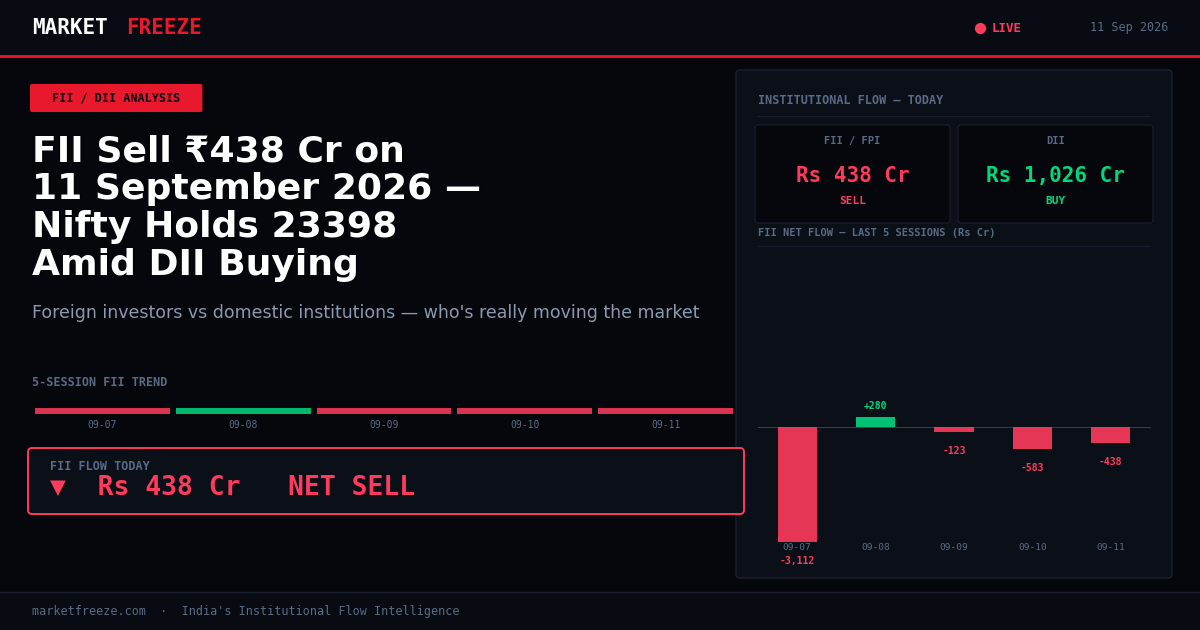
NSE provisional data confirms that on Friday, September 11, 2026, Foreign Institutional Investors (FIIs) offloaded a net of ₹438.24 Cr from Indian equities, while Domestic Institutional Investors (DIIs) injected a net of ₹1,025.85 Cr.
Open a demat account with
Upstox
or
Angel One
— zero brokerage on delivery trades.
FII Selling Continues for Third Straight Session
FIIs extended their selling streak to three consecutive trading days, marking a net outflow of ₹438.24 Cr today. This follows a net sell of ₹582.99 Cr on September 10th and ₹123.19 Cr on September 9th. The gross selling figure stood at ₹11,444.71 Cr, against a gross buying of ₹11,006.47 Cr. The total FII outflow over the last three sessions now stands at ₹1,144.42 Cr. This sustained selling pressure from FIIs suggests a lack of conviction in the current market trajectory, particularly given the macro headwinds discussed in global markets, such as elevated oil prices and inflation concerns ahead of US data, as noted in reports of European stocks moving cautiously.
The actionable insight for retail investors is to monitor the sustainability of this FII selling. If the trend persists into next week, it could signal increased downside risk for key indices.
DIIs Remain Strong Buyers, Cushioning Market Falls
Domestic Institutional Investors (DIIs) provided a crucial buffer to the market, reporting a net buy of ₹1,025.85 Cr today. This marks the third consecutive day of significant DII inflows, following net buys of ₹1,509.04 Cr on September 10th and ₹1,349.64 Cr on September 9th. Today’s DII buying was comprised of ₹10,030.79 Cr in purchases and ₹8,004.94 Cr in sales, indicating strong underlying buying interest. The sustained aggressive buying by DIIs, totaling ₹3,884.53 Cr over the last three sessions, directly counteracted the FII selling and played a role in the market’s intraday recovery, as suggested by reports highlighting buying in auto and financial stocks.
For retail traders, DII strength implies that domestic institutions see value at current price levels, offering a degree of support against foreign outflows.
Nifty 50 Retreats Below Key Support; Selling Pressure Emerges
The Nifty 50 index closed at 23,398.10, down 0.34% for the day. The intraday recovery seen, where the index bounced from lows, failed to hold, indicating that selling pressure intensified as the session progressed. Today’s FII net selling of ₹438.24 Cr, coupled with the broader market weakness in mid and smallcaps and rising volatility, suggests that the immediate support for the Nifty now lies around the 23,200 mark. Resistance is likely to be encountered near 23,600, a level that previously acted as a consolidation zone. The failure to hold above 23,500 today, especially with FIIs on the sell side, points to a challenging near-term outlook.
Retail investors should watch for a decisive close below 23,200 on the Nifty, which would confirm increased downside risk and potentially target levels closer to 22,900.
Sectoral Implications: Banking and IT in Focus Amidst Mixed Flows
While broad FII selling was observed, specific sector plays can be inferred. The consistent buying by DIIs, who often allocate heavily to large-cap financials, suggests continued accumulation in the Banking sector. Reports mentioning HDFC Bank as a top gainer on the Nifty support this. Conversely, the sustained FII outflows, if targeted towards defensive sectors, might indicate a rotation out of rate-sensitive or cyclical counters. Given the current global climate of rising yields and inflation concerns, as discussed by Aswath Damodaran, IT stocks, often seen as growth plays, could also be under pressure if FIIs pare down their holdings there. Metal and Realty stocks, which led losses today as per market wraps, were likely areas of FII exit, aligning with the rise in crude oil prices which impacts input costs for these sectors.
The takeaway for retail investors is to favor banking stocks supported by DII inflows and be wary of sectors showing signs of FII divestment, particularly those sensitive to commodity prices.
Crude Oil Volatility and its Impact on Market Direction
The significant decline in Crude MCX by 3.41% to ₹9,929.00/bbl today played a dual role. Initially, a surge in crude oil prices contributed to market declines, as reported in market wraps, pressuring sectors like aviation, logistics, and commodity-linked businesses. However, the subsequent fall in crude, as mentioned in recovery narratives, helped cushion the market’s fall. This sharp move in crude oil prices, a major import for India, directly influences inflation expectations and FII positioning. Today’s FII selling occurred despite the easing of crude prices later in the session, indicating that broader concerns, possibly related to global inflation or interest rate outlooks (as touched upon in discussions of European markets awaiting US inflation data), are outweighing the relief from falling oil.
Retail investors should monitor crude oil price movements closely; a sustained rise above ₹10,500/bbl could reignite inflationary fears and pressure Indian equities further, while a fall below ₹9,500/bbl might offer some relief.
USD/INR Strengthens: A Sign of FII Caution?
The Indian Rupee weakened against the US Dollar, with USD/INR closing at Rs95.51, a rise of 0.45%. This move is often correlated with FII outflows, as foreign investors may convert their Rupee holdings back to Dollars. The sustained selling by FIIs, amounting to ₹438.24 Cr today and ₹1,144.42 Cr over three days, aligns with this currency trend. A weaker Rupee can increase import costs and potentially fuel inflation, adding another layer of concern for the domestic economy. While DIIs are actively buying, the significant depreciation of the Rupee signals that foreign capital is not as robustly invested in India as it was previously, or that existing positions are being unwound.
For retail investors, a consistently weakening Rupee (moving towards Rs96.00) can be a negative indicator for equities, suggesting potential for continued FII outflows and inflationary pressures.
Historical Context: Sustained DII Buying Against FII Selling
The pattern of strong DII buying offsetting FII selling is not entirely new, but the magnitude of DII inflows over the past three sessions (₹3,884.53 Cr net) against FII outflows (₹1,144.42 Cr net) is noteworthy. Looking at the past five sessions:
| Date | FII Net (Cr) | DII Net (Cr) | Nifty Close |
|---|---|---|---|
| 2026-09-07 | ₹-3,111.94 Cr | +₹8,930.12 Cr | 23,779.15 |
| 2026-09-08 | +₹280.13 Cr | +₹566.76 Cr | 23,635.10 |
| 2026-09-09 | ₹-123.19 Cr | +₹1,349.64 Cr | 23,431.50 |
| 2026-09-10 | ₹-582.99 Cr | +₹1,509.04 Cr | 23,477.80 |
| 2026-09-11 | ₹-438.24 Cr | +₹1,025.85 Cr | 23,398.10 |
The period around September 7th also saw a significant divergence, with massive DII buying (₹8,930.12 Cr) against substantial FII selling (₹3,111.94 Cr), which preceded a Nifty decline from 23,779.15 to 23,431.50 over the next two sessions. Today’s pattern, while less extreme, shows a similar dynamic. The key difference is that crude prices and inflation concerns were more pronounced then, whereas today, the market reacted to both crude oil price swings and broader rate/inflation worries.
Retail traders should note that this divergence, while offering temporary support, has historically preceded declines when FII selling is persistent and macro conditions are uncertain.
What Would Shift This Flow Outlook?
The primary factor that could alter the current FII/DII flow dynamic would be a clear and sustained cooling of global inflation concerns, particularly evident in upcoming US inflation data. A significant dip in crude oil prices below the ₹9,500/bbl level for an extended period would also remove a key macro pressure point. For FIIs to return as net buyers, a sustained period of positive news flow regarding global interest rate stability and robust Indian corporate earnings exceeding expectations would be necessary. Any indication of the Reserve Bank of India intervening heavily to support the Rupee, beyond normal management, could also signal deeper underlying concerns that might deter FIIs.
Retail investors should position for potential upside if US inflation prints significantly lower than forecasts, suggesting the Fed might pause rate hikes sooner.
FAQ
Why did FIIs sell Indian stocks today?
FIIs sold a net of ₹438.24 Cr today, continuing a three-day selling trend. This could be driven by global inflation concerns, rising bond yields, and potentially a reassessment of Indian equity valuations in light of these macro factors, as suggested by broader market pressures.
How much did DIIs buy in the Indian market today?
DIIs were net buyers of ₹1,025.85 Cr in the Indian equity market today, providing significant support against FII selling.
What was the Nifty 50 closing value today?
The Nifty 50 index closed at 23,398.10 on September 11, 2026, down 0.34%.
Bottom Line
Friday’s trading session saw a clear divergence, with FIIs continuing their selling spree for the third consecutive day, offloading ₹438.24 Cr. This outflow was effectively absorbed by robust DII buying, which amounted to ₹1,025.85 Cr, indicating domestic institutional conviction at current levels. The Nifty 50 closed lower at 23,398.10, failing to hold intraday gains, amidst concerns over crude oil prices and global inflation data. The weakening Rupee to Rs95.51 further underscored the cautious stance of foreign capital. Retail investors should closely watch the sustainability of DII support against persistent FII outflows, with key Nifty levels to monitor being 23,200 for support and 23,600 for resistance.
Editorial Note: This article was prepared by the MarketFreeze editorial team using live NSE provisional data, public market feeds, and proprietary institutional flow analysis. All price and flow figures are sourced directly from NSE, BSE, and CoinGecko as of 11 September 2026. This content is for informational purposes only and does not constitute investment advice. MarketFreeze is not SEBI-registered. Please consult a qualified financial advisor before making investment decisions. Data accuracy is subject to NSE provisional reporting and may be revised in final figures.