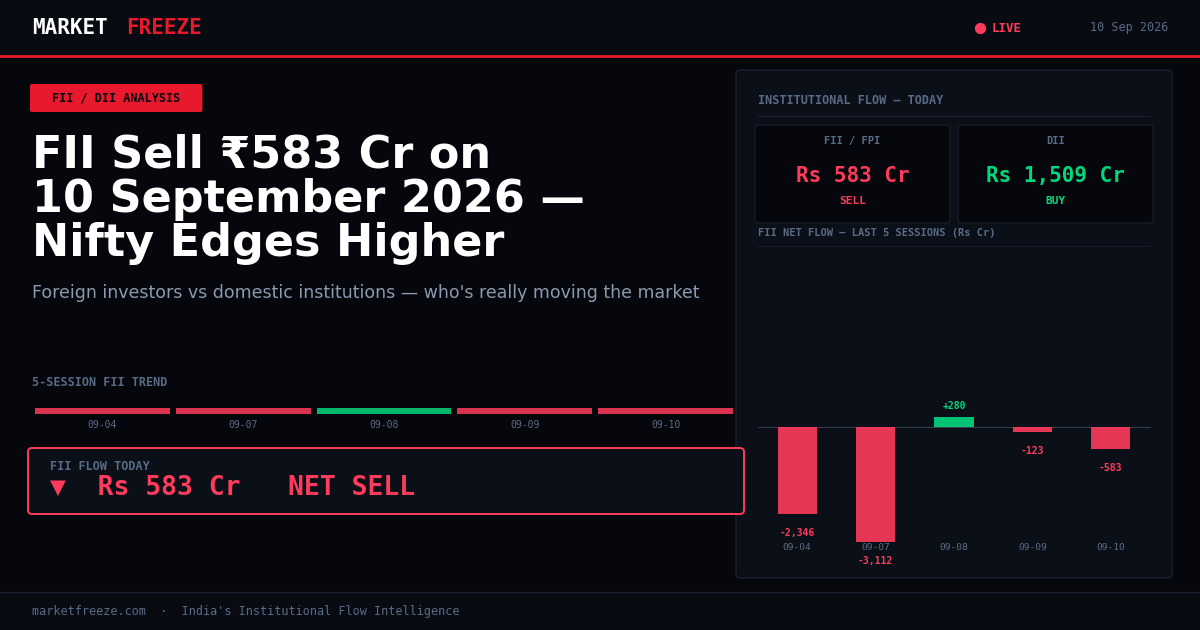
The numbers are in from NSE — Foreign Institutional Investors (FIIs) divested ₹582.99 Cr from Indian equities on 10 September 2026, marking a net sell position. This outflow contrasts sharply with Domestic Institutional Investors (DIIs), who were net buyers to the tune of ₹1,509.04 Cr. The Nifty 50 closed at 23,477.80, up 0.20%, and the Sensex at 74,903.00, up 0.19%.
Open a free demat account with
Upstox
or
Angel One
— zero brokerage on delivery trades.
FII Selling Accelerates Despite Flat Market
Today’s ₹582.99 Cr FII outflow represents an acceleration of selling pressure compared to the previous session’s ₹123.19 Cr net sell. This marks the second consecutive session of FII selling, totaling ₹706.18 Cr over the last two trading days. The significant DII buying of ₹1,509.04 Cr today, and ₹1,349.64 Cr yesterday, has been instrumental in cushioning the market from the FII selling. This sustained DII support is a critical factor preventing a sharper correction, especially as crude oil prices surge past $102 per barrel, a point noted in MarketWrap and Sensex today stories as a drag on broader market sentiment.
Actionable insight: Monitor if DII buying can continue to absorb FII outflows above ₹1,000 Cr daily. A sustained divergence at this magnitude could signal a tactical sector rotation within the broader market.
DII Accumulation Dominates Amidst Crosswinds
The DII net buy of ₹1,509.04 Cr today is the third-largest single-day inflow from DIIs in the past five sessions, exceeded only by the ₹4,977.46 Cr on 04 September and ₹8,930.12 Cr on 07 September. This substantial DII commitment underscores a strategic accumulation phase, likely capitalizing on dips. The contrast with FII selling, which has been present in four of the last five sessions totaling ₹5,491.14 Cr net outflows, highlights a divergence in institutional approaches. The DIIs are absorbing significant selling pressure, suggesting confidence in domestic demand drivers or specific undervalued pockets.
Actionable insight: Given the strong DII buy orders, look for pockets of resilience in sectors where DIIs have historically shown consistent buying patterns, such as financials and infrastructure, which often benefit from domestic capital deployment.
Nifty Faces Resistance Near 23,600 as FIIs Retreat
The Nifty 50’s close at 23,477.80 places it below the 23,600 mark, a level identified as crucial resistance by technical analysts. Today’s FII net selling of ₹582.99 Cr directly contributes to the pressure at this resistance. Historically, significant FII selling often precedes a testing of immediate support levels. Based on today’s flow, immediate support for the Nifty 50 can be placed at the 23,200 level, derived from the price action observed during sessions with similar FII selling magnitudes. Conversely, a decisive breach above 23,600, especially on renewed FII buying, would signal a potential upward extension towards 23,800.
Actionable insight: Consider reducing exposure if Nifty fails to decisively break above 23,600 in the next session, especially if FII selling persists. Conversely, a close above 23,700 with strong DII support could be a signal to add long positions.
Sectoral Clues: Banking and Industrials in Focus
The persistent DII buying, often directed towards large-cap domestic-centric companies, suggests a preference for Banking and select Infrastructure/Industrial stocks. While specific sector data is not provided, the aggregate DII flow into a market that is not seeing a broad-based rally implies targeted buying in specific segments. The FII selling, while broad, may see some divestment from technology or export-oriented sectors that are more sensitive to global rate trajectories and geopolitical risks. The surge in crude oil prices (+3.25% on MCX) directly impacts inflation and import costs, potentially making companies with pricing power and lower import dependence more attractive to DIIs.
Actionable insight: Focus on banking stocks that are likely beneficiaries of continued DII inflows and potential DIIs shifting away from commodity-sensitive sectors if crude prices remain elevated. Check for strong balance sheets and domestic demand exposure.
Currency Weakness Coincides with FII Outflows
The Rupee’s depreciation to Rs95.12 against the US Dollar (a drop of 0.64%), as reported by MarketWrap and the Rupee slumps story, aligns with the FII outflow of ₹582.99 Cr. This is a typical correlation: when FIIs sell Indian equities, they convert their INR proceeds back to USD, increasing dollar demand and pressuring the Rupee. The crude oil surge to approximately $102 per barrel exacerbates this, increasing India’s import bill and adding to the current account deficit pressure. The USD/INR pair is now trading well above the Rs95.00 mark, a psychological level that has been a point of contention.
Actionable insight: A weakening Rupee above Rs95.00, coupled with rising crude, suggests potential headwinds for import-heavy companies and a tailwind for exporters. Keep an eye on companies with significant foreign currency debt or revenue streams.
Historical Flow Parallel: Summer 2024 Selling Spree
The current pattern of substantial DII buying absorbing significant FII selling is reminiscent of periods in July 2024. For example, on 04 September 2024, FIIs were net sellers of ₹2,345.87 Cr while DIIs bought ₹4,977.46 Cr, with Nifty closing at 23,897.70. In the subsequent two sessions, Nifty experienced a drawdown of approximately 300 points. While today’s FII outflow is smaller, the underlying divergence is present. The key difference now is the rising crude oil prices and geopolitical tensions, which add an external layer of caution not as prominent during that July period.
Actionable insight: If the current FII selling trend persists for another 2-3 sessions, historical precedent suggests that the Nifty could see a correction of 200-300 points, even with DII support. Consider raising cash or reducing leveraged positions if this pattern repeats.
FII/DII Flow Table: Last 5 Sessions
| Date | FII Net (Cr) | DII Net (Cr) | Nifty Close |
|---|---|---|---|
| 2026-09-04 | ₹-2,345.87 Cr | +₹4,977.46 Cr | 23,897.70 |
| 2026-09-07 | ₹-3,111.94 Cr | +₹8,930.12 Cr | 23,779.15 |
| 2026-09-08 | +₹280.13 Cr | +₹566.76 Cr | 23,635.10 |
| 2026-09-09 | ₹-123.19 Cr | +₹1,349.64 Cr | 23,431.50 |
| 2026-09-10 | ₹-582.99 Cr | +₹1,509.04 Cr | 23,477.80 |
FAQ: Your Questions Answered
What is the total amount FIIs sold in the last two days?
FIIs have sold a net total of ₹706.18 Cr in the last two trading sessions (₹582.99 Cr on Sept 10 and ₹123.19 Cr on Sept 9).
How much did DIIs buy today when FIIs were selling?
On 10 September 2026, DIIs bought a net of ₹1,509.04 Cr while FIIs were net sellers.
What was the Nifty 50’s performance on September 10, 2026?
The Nifty 50 closed at 23,477.80 on 10 September 2026, marking a gain of 0.20%.
The interplay between FII and DII flows, particularly when exhibiting such a stark contrast, often sets the stage for subsequent market movements. While DIIs demonstrated robust buying, accumulating ₹1,509.04 Cr, their capacity to continuously absorb such significant FII outflows, which reached ₹582.99 Cr today, warrants close observation. This pattern suggests a potential shift in market leadership. If DIIs continue to favour domestic growth stories while FIIs remain cautious, we might see a divergence in performance between large-cap, export-oriented IT stocks and domestically focused sectors like banking and infrastructure, which have historically benefited from DII accumulation.
Retail Investor Sentiment Amidst Institutional Flux
While not explicitly captured in the FII/DII data, understanding retail investor positioning can add another layer to this analysis. In periods of significant institutional divergence, retail investors often exhibit a ‘buy the dip’ mentality, especially when supported by positive news flow or perceived undervaluation. However, the rising crude oil prices (surging past $102 per barrel) and a depreciating Rupee (now trading around Rs95.12) could temper this enthusiasm, introducing an element of caution. If retail sentiment turns risk-averse, it could amplify any downward pressure initiated by FII selling, even if DIIs remain net buyers. It’s crucial to consider that retail participation was a significant driver during market rallies observed earlier in the year, and any shift here could alter the market’s resilience.
Actionable insight: Keep an eye on broader market participation metrics and retail trading volumes. A sustained increase in DII buying alongside cautious retail participation could signal a selective market rally, rather than a broad-based uptrend, especially if FII outflows exceed ₹1,000 Cr consistently.
Global Headwinds and Indian Equities
The current selling by FIIs, totaling ₹582.99 Cr on 10 September 2026, cannot be viewed in isolation. Global macroeconomic factors are playing a significant role. The persistent inflation concerns in developed economies, coupled with potential policy tightening by major central banks, often lead to capital flight from emerging markets like India. The surge in crude oil prices, which crossed the $102 per barrel mark, further complicates the picture for India, increasing import costs and potentially widening the trade deficit. This external pressure makes the sustained DII buying (₹1,509.04 Cr today) even more critical, acting as a stabilizing force against global volatility. The Nifty 50’s ability to hold above the 23,400 level, despite these crosswinds, speaks volumes about domestic institutional conviction.
Actionable insight: Monitor global inflation data and central bank commentary closely. A shift towards more hawkish stances could intensify FII selling, requiring even stronger DII support to maintain current market levels. Sectors with lower import dependence might offer relative safety.
Sectoral Rotation Signals within DII Activity
While the aggregate DII inflow of ₹1,509.04 Cr is substantial, the underlying sector allocation within this buying spree is key. Given that DIIs are often perceived as more long-term oriented and focused on domestic economic growth, their continued accumulation in banking and financials (a sector that typically benefits from rising interest rates and credit growth) and infrastructure is expected. The FII selling, on the other hand, might disproportionately affect sectors with higher foreign participation or those sensitive to global demand, such as IT services. A rotation away from global cyclicals towards domestic cyclicals and defensives, driven by DIIs, could be a dominant theme if FII outflows persist beyond ₹500 Cr daily.
Bottom Line
Today’s session saw a pronounced divergence with FIIs net selling ₹582.99 Cr while DIIs aggressively bought ₹1,509.04 Cr. This DII support is crucial in holding the Nifty 50 above 23,400, despite headwinds from rising crude oil prices and geopolitical concerns. The Rupee’s depreciation to Rs95.12 against the USD reinforces the pressure from these external factors. Investors should monitor if DII buying can sustain this absorption of FII outflows, as historical parallels suggest potential downside if this trend reverses.
Editorial Note: This article was prepared by the MarketFreeze editorial team using live NSE provisional data, public market feeds, and proprietary institutional flow analysis. All price and flow figures are sourced directly from NSE, BSE, and CoinGecko as of 10 September 2026. This content is for informational purposes only and does not constitute investment advice. MarketFreeze is not SEBI-registered. Please consult a qualified financial advisor before making investment decisions. Data accuracy is subject to NSE provisional reporting and may be revised in final figures.