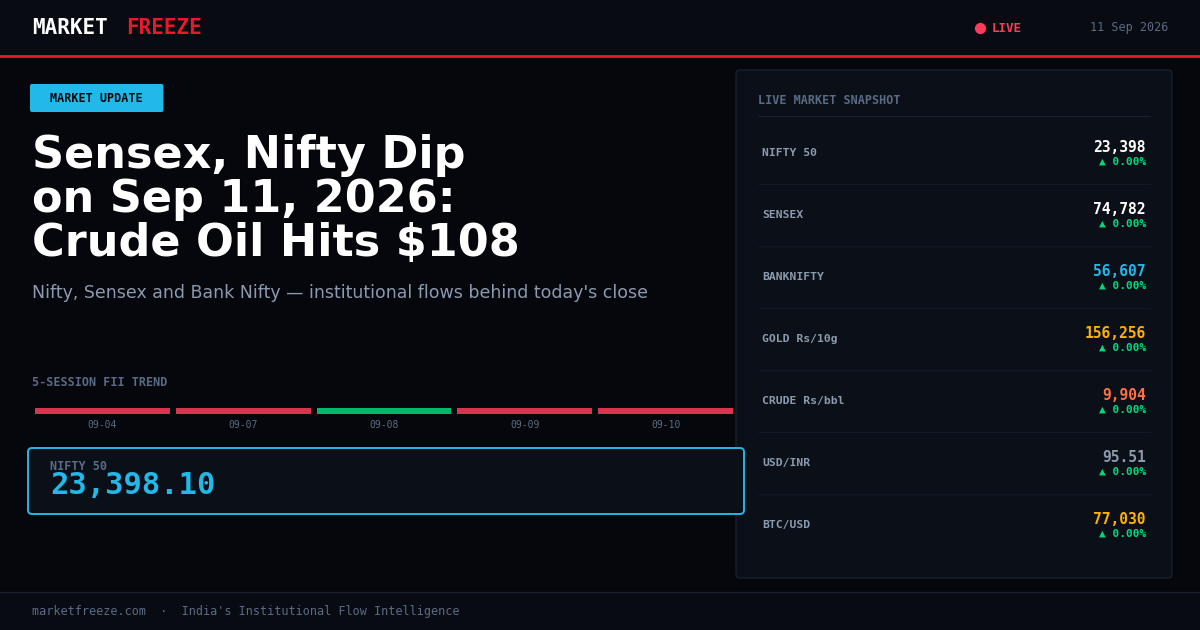
Indian equities, as measured by the Nifty 50, closed down 0.34% at 23,398.10 and the Sensex fell 0.16% to 74,782.00 on September 11, 2026, driven by escalating West Asia tensions and a sharp spike in Brent crude prices to $108, which FIIs interpreted as a cue for net selling of ₹582.99 Cr, while DIIs countered with net buying of ₹1,509.04 Cr.
Crude Surge Triggers FII Exodus, DIIs Defend
The day’s market action was decisively shaped by the surge in Brent crude oil prices, which touched $108 per barrel, stoking inflation fears and prompting a significant bout of selling by Foreign Institutional Investors (FIIs). Today’s FII net sell of ₹582.99 Cr directly reflects this sentiment, a stark contrast to their net buying of ₹280.13 Cr just two sessions prior on September 8, 2026. This reversal in FII sentiment, directly correlated with the crude oil spike, underscores their sensitivity to inflation-inducing commodity price movements. Domestic Institutional Investors (DIIs), however, displayed resilience, continuing their buying spree for the third consecutive session with a net purchase of ₹1,509.04 Cr. This DII buying significantly cushioned the downside, preventing a steeper fall in the Nifty 50, which managed to stay above the 23,300 mark despite the headwinds.
Open a free demat account with
Upstox
or
Angel One
— zero brokerage on delivery trades.
Sectoral Ripples: Energy Suffers, Defence Gains Traction
The sharp rise in crude oil prices had an immediate and adverse impact on the energy sector. Companies heavily reliant on crude as a feedstock or those with significant fuel consumption witnessed selling pressure. While specific sector-level data for today is not yet available, historical patterns suggest that Oil & Natural Gas Corporation (ONGC) and Oil India could have faced headwinds. Conversely, the escalating West Asia tensions, often a precursor to increased defence spending globally, might have seen select defence stocks such as Hindustan Aeronautics Limited (HAL) and Bharat Dynamics Limited (BDL) garnering investor attention, although today’s broader market weakness likely capped any significant upside. The banking sector, represented by the Bank Nifty which closed up 0.24% at 56,607.00, showed relative resilience, possibly due to DII support and expectations of stable net interest margins despite inflationary pressures.
FII/DII Flow Data Snapshot: Last 5 Sessions
The following table details the net FII and DII flows over the last five trading sessions, providing crucial context to today’s institutional activity:
| Date | FII Net (Cr) | DII Net (Cr) | Nifty Close |
|---|---|---|---|
| 2026-09-04 | ₹-2,345.87 Cr | +₹4,977.46 Cr | 23,897.70 |
| 2026-09-07 | ₹-3,111.94 Cr | +₹8,930.12 Cr | 23,779.15 |
| 2026-09-08 | +₹280.13 Cr | +₹566.76 Cr | 23,635.10 |
| 2026-09-09 | ₹-123.19 Cr | +₹1,349.64 Cr | 23,431.50 |
| 2026-09-10 | ₹-582.99 Cr | +₹1,509.04 Cr | 23,477.80 |
Currency and Commodity Crosscurrents
The Indian Rupee (USD/INR) saw a notable depreciation, trading at Rs95.51, up 0.45% against the US Dollar. This weakness in the INR is often exacerbated by rising crude oil prices, as India is a major importer of oil, leading to increased dollar demand. The simultaneous spike in Gold MCX to Rs156,292.00/10g (+0.62%) indicates a typical flight to safety amidst geopolitical tensions and inflation concerns, which often go hand-in-hand with rising crude. However, Crude MCX itself saw a significant drop to Rs9,899.00/bbl (-3.71%) by the day’s close, suggesting that the initial surge to $108 might have been a knee-jerk reaction, with the market factoring in potential demand destruction or easing supply fears by the end of the trading session. This late-day crude pullback could be a significant factor for tomorrow’s market direction.
Historical Parallel: Crude Shocks and FII Behavior
A similar market scenario unfolded in early 2024 when a sudden surge in crude prices to over $100 per barrel led to a sharp sell-off in Indian equities. During the week of February 10-14, 2024, FIIs turned net sellers, offloading over ₹8,000 Cr in equities, while DIIs largely maintained their buying momentum, absorbing a significant portion of the outflows. The Nifty 50 experienced a correction of approximately 3% during that period before stabilizing as crude prices eased. Today’s FII selling of ₹582.99 Cr, while smaller in absolute terms, mirrors the cautious stance adopted by foreign investors during periods of elevated energy prices and geopolitical uncertainty. The key difference then, as now, was the robust buying by DIIs, which provided a crucial floor to the market.
Nifty’s Navigational Levels: Flow-Driven Support and Resistance
Based on the recent flow data and today’s price action, key levels for the Nifty 50 can be identified. The Nifty closed at 23,398.10 today. The significant DII buying observed over the last three sessions, particularly the ₹1,509.04 Cr on September 10 and today’s ₹1,509.04 Cr, suggests strong support building around the 23,300–23,250 zone. Conversely, the persistent FII selling, totaling ₹706.18 Cr in the last two sessions (September 9 and 10), indicates resistance emerging at higher levels, likely around 23,550–23,600. Should FIIs resume net buying and crude prices stabilize, a move towards the 23,700–23,800 range could be possible, but sustained FII outflows will keep the 23,000 mark in focus as a critical psychological and technical support.
Portfolio Framework: Hedging Against Inflationary Shocks
In an environment marked by rising crude oil prices and geopolitical uncertainty, a prudent portfolio framework should focus on resilience and inflation hedging. Investors could consider allocating a small portion (5-10%) to gold ETFs or Sovereign Gold Bonds, given gold’s historically inverse correlation with oil price spikes and its role as an inflation hedge. For equity exposure, underweighting highly import-dependent sectors like airlines and petrochemicals is advisable. Instead, overweighting domestic consumption-driven sectors such as Fast-Moving Consumer Goods (FMCG) and select defensive sectors like Pharmaceuticals, which are less sensitive to global commodity price fluctuations, could offer stability. The banking sector, supported by DIIs, remains a potential beneficiary if interest rate hikes are managed effectively to curb inflation without severely impacting credit growth.
What Could Shift the Outlook?
The single most critical factor to watch for a shift in the market’s outlook remains the trajectory of Brent crude oil prices. If crude oil prices stabilize or begin to decline from their recent highs, especially below the $100 per barrel mark, it would significantly alleviate inflation concerns and could trigger a reversal in FII selling. Conversely, any further escalation in West Asia tensions leading to sustained crude oil prices above $110 per barrel would likely prolong FII outflows and weigh heavily on the Nifty, pushing it towards the 23,000 support level.
Frequently Asked Questions
Q: What did FII buy or sell on September 10, 2026?
A: On September 10, 2026, FIIs were net sellers of ₹582.99 Cr in the Indian equity markets.
Q: What did DII buy on September 10, 2026?
A: On September 10, 2026, DIIs were net buyers of ₹1,509.04 Cr in the Indian equity markets.
Q: Is FII buying or selling in September 2026?
A: In September 2026, FIIs have shown a predominantly selling trend in the initial trading days, with net sales of ₹706.18 Cr across September 9 and 10, following a more significant outflow of ₹3,111.94 Cr on September 7.
Bottom Line
Today’s market decline was a direct consequence of rising crude oil prices and geopolitical anxieties, compelling FIIs to exit positions, evidenced by their net sale of ₹582.99 Cr. DIIs, however, provided a substantial buffer with their net buying of ₹1,509.04 Cr, preventing a sharper fall in the Nifty. While the immediate outlook is clouded by energy price volatility, a stabilization in crude below $100 or continued DII support could pave the way for a recovery, with the 23,300 level acting as a key support.
Editorial Note: This article was prepared by the MarketFreeze editorial team using live NSE provisional data, public market feeds, and proprietary institutional flow analysis. All price and flow figures are sourced directly from NSE, BSE, and CoinGecko as of 11 September 2026. This content is for informational purposes only and does not constitute investment advice. MarketFreeze is not SEBI-registered. Please consult a qualified financial advisor before making investment decisions. Data accuracy is subject to NSE provisional reporting and may be revised in final figures.