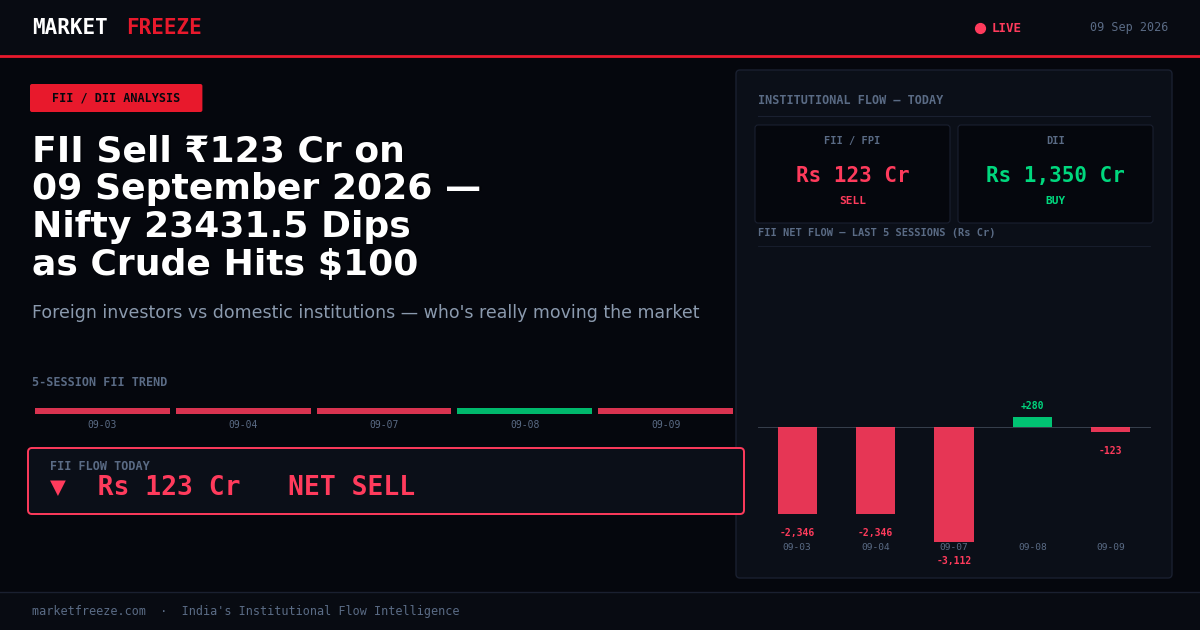
Foreign institutional investors offloaded ₹123.19 Cr from Indian equities today, marking a clear resumption of selling after yesterday’s modest net buy, while domestic institutional investors provided crucial counter-support by deploying ₹1,349.64 Cr into the market.
FII Selling Resumes: Crude Oil Crosses $100 Driving Outflows
Today’s FII net sell figure of ₹123.19 Cr represents a swift reversal from yesterday’s net buy of ₹280.13 Cr. This outflow contributed directly to the Nifty 50 declining 0.86% to close at 23,431.50 and the Sensex falling 1.08% to 74,764.00. The selling pressure aligns with broader market concerns stemming from Brent crude futures breaching the $100 a barrel mark for the first time since late July, as highlighted in today’s market reports. This rise in crude prices, now at Rs9,552.00/bbl on MCX, ignites inflation fears and impacts India’s current account deficit outlook. FIIs have been net sellers in three of the last five sessions, with significant outflows of ₹3,111.94 Cr on September 7th and ₹2,345.87 Cr on September 4th. The immediate implication for retail investors is a sustained bearish tilt from foreign players, necessitating vigilance regarding global commodity price movements.
DIIs Defend Against Foreign Selling: A Consistent Counter-Balance
Domestic institutional investors continued their robust buying streak, adding ₹1,349.64 Cr to Indian equities today. This marks DIIs as net buyers for the entire five-session period, with their lowest net buy in this period still being a substantial ₹566.76 Cr on September 8th. Their significant buying of ₹8,930.12 Cr on September 7th notably cushioned the impact of FII selling that day. The consistent DII support is a critical factor preventing steeper market declines, even as Nifty 50 broke down to 23,431.50. This ongoing DII participation suggests strong underlying domestic conviction in Indian assets, offering a potential floor to market corrections. For retail investors, DII buying provides a fundamental layer of support; however, it alone cannot fully offset sustained FII outflows, especially if global factors like crude oil prices continue to deteriorate.
Open a free demat account with
Upstox
or
Angel One
— zero brokerage on delivery trades.
Gross Turnover Reveals Lingering FII Activity Despite Net Sell
Today’s FII gross buy figure stood at ₹11,704.84 Cr, while their gross sell figure can be calculated as ₹11,828.03 Cr (₹11,704.84 Cr + ₹123.19 Cr). This indicates a substantial two-way flow totaling over ₹23,500 Cr, even with a relatively small net sell figure. The high gross turnover suggests that while FIIs were net sellers, they were actively rebalancing portfolios and not simply exiting en masse. This level of activity, despite the overall bearish sentiment driven by crude oil, implies tactical shifts rather than a complete capitulation. The specific sectors experiencing this two-way movement will dictate the immediate future of foreign positioning. Retail investors should view high gross turnover as a sign of continued engagement, not disinterest, though the net figure still points to caution.
Nifty Support Levels Test as IT Stocks Underperform
The Nifty 50 closed today at 23,431.50, a critical breakdown from its recent range. Given the FII selling, immediate support for Nifty 50 now sits around the 23,000-23,100 zone, derived from previous consolidation patterns. A breach below this could see the Nifty testing 22,500. Conversely, resistance is encountered at 23,600-23,700, a level it struggled to hold yesterday. Today’s market reports confirm that IT stocks led sectoral losses, aligning with FIIs typically trimming positions in growth-oriented sectors during periods of currency depreciation (USD/INR at Rs94.84) and rising inflation concerns. Metal stocks, however, showed relative strength today, potentially benefiting from inflationary hedges. Retail investors should monitor Nifty’s reaction to the 23,000 level, as sustained selling below this could indicate a deeper correction.
Currency and Commodity Crosswinds Intensify Market Pressure
The Indian Rupee depreciated significantly today, with USD/INR rising 0.64% to Rs94.84. This move is directly attributed to Brent crude futures surpassing $100 per barrel, as detailed in today’s news context. A weakening rupee typically makes Indian assets less attractive for FIIs on a repatriated earnings basis, exacerbating selling pressure. Concurrently, Gold MCX surged 1.07% to Rs156,938.00/10g, indicating a flight to safety asset amid global uncertainties and inflation worries. Crude MCX’s jump of 2.86% to Rs9,552.00/bbl is the primary catalyst for today’s market downturn and rupee depreciation. These interconnected movements in currency and commodities create a challenging environment for FII inflows. Retail investors should hedge against currency risks if holding international assets and consider inflation-resistant sectors.
FII/DII Net Flow: Last 5 Sessions
| Date | FII Net (Cr) | DII Net (Cr) | Nifty Close |
|---|---|---|---|
| 2026-09-03 | ₹-2,345.87 Cr | +₹4,977.46 Cr | 23,873.45 |
| 2026-09-04 | ₹-2,345.87 Cr | +₹4,977.46 Cr | 23,897.70 |
| 2026-09-07 | ₹-3,111.94 Cr | +₹8,930.12 Cr | 23,779.15 |
| 2026-09-08 | +₹280.13 Cr | +₹566.76 Cr | 23,635.10 |
| 2026-09-09 | ₹-123.19 Cr | +₹1,349.64 Cr | 23,431.50 |
Sectoral Implications: IT Under Pressure, Metals Gain Traction
Today’s FII selling, while not massive at ₹123.19 Cr, combined with the market’s overall decline suggests continued pressure on rate-sensitive and growth sectors. IT stocks were specifically mentioned in market reports as leading sectoral losses. This is a direct consequence of rising crude prices and the strengthening dollar (USD/INR at Rs94.84), which can increase operational costs for IT firms and diminish profit margins. Conversely, metal stocks showed resilience, often acting as a hedge against inflation. This divergence indicates FIIs are likely rotating out of perceived vulnerable sectors into those offering some protection against inflationary pressures. Retail investors should review their exposure to IT stocks and consider increasing allocation to sectors like metals or other inflation-resistant industries, assuming this trend persists.
What Would Shift This Outlook? Monitoring Key External Triggers
The current bearish outlook, driven by FII selling and rising crude oil prices, could shift with a few specific triggers. A sustained drop in Brent crude futures back below $95 a barrel would significantly alleviate inflation concerns and ease pressure on the rupee. Additionally, a clear reversal in FII flow, specifically a net buy figure exceeding ₹1,000 Cr for at least two consecutive sessions, would signal renewed foreign confidence. The Nifty 50 reclaiming and holding above 23,600 would also indicate a technical rebound. Investors should monitor upcoming inflation data from both India and the US, as well as any policy rate decisions from central banks, which could provide fresh directional cues. A significant shift in any of these external variables is required to alter the current FII selling pattern.
Retail Positioning Amidst Institutional Divergence
In scenarios where FIIs are net sellers and DIIs are strong net buyers, retail investors typically face conflicting signals. Today’s Nifty decline of 0.86% to 23,431.50 despite DII buying of ₹1,349.64 Cr highlights the dominance of foreign sentiment on headline indices. Small and mid-cap segments, where DII influence is often more pronounced, might show relative resilience compared to large-cap, FII-dominated stocks. The depreciation of the rupee to Rs94.84 and rising crude prices are macroeconomic factors that impact all segments. Retail investors often exhibit a lag in reacting to such institutional divergences, potentially buying into dips that DIIs are supporting, while FIIs are still exiting. Diversification across market capitalizations, with a focus on DII-backed stocks, could mitigate risks. It is crucial for retail investors to avoid herd mentality and base decisions on specific data, not broad market narratives.
FAQ
What did FIIs do with Indian stocks today, September 9, 2026?
Foreign institutional investors were net sellers of Indian equities today, offloading ₹123.19 Cr. Their gross purchases amounted to ₹11,704.84 Cr, while their gross sales totaled ₹11,828.03 Cr.
How much did domestic institutional investors (DIIs) invest in the market today?
Domestic institutional investors (DIIs) were net buyers, injecting ₹1,349.64 Cr into the Indian market on September 9, 2026, providing significant counter-balance to FII selling.
Why did the Nifty 50 fall to 23,431.50 today?
The Nifty 50 fell 0.86% to 23,431.50 today primarily due to FII selling and escalating concerns over crude oil prices, which crossed $100 a barrel. This triggered inflation fears and put pressure on the Indian Rupee, which depreciated to Rs94.84 against the US dollar.
Divergent Strategies: FIIs Trim Growth, DIIs Accumulate Value
The institutional flows today underscore a clear divergence in investment strategies. FIIs, with their net sell of ₹123.19 Cr, appear to be strategically de-risking from growth-oriented segments, particularly IT, which led sectoral losses. This behavior is consistent with global investors recalibrating portfolios in response to rising interest rates, a stronger dollar (USD/INR at Rs94.84), and inflationary pressures from crude oil prices nearing $100. Their high gross turnover, exceeding ₹23,500 Cr, suggests not a panicked exit, but a deliberate rotation out of sectors sensitive to global economic tightening and into more defensive or commodity-linked plays. DIIs, on the other hand, with their robust buying of ₹1,349.64 Cr, seem to be capitalizing on these dips, accumulating value in Indian equities. This domestic conviction likely stems from a longer-term view on India’s growth story, potentially focusing on sectors less impacted by immediate global headwinds or those poised for domestic demand recovery. The consistent DII support, evident in their net buying streak across the last five sessions with figures like ₹8,930.12 Cr on September 7th, highlights this fundamental difference in outlook.
Historical Precedent: Crude Shocks and FII Behavior
The current market dynamics, particularly the FII selling alongside Brent crude’s breach of $100, echo historical periods where commodity price spikes impacted institutional flows into emerging markets like India. Looking back at similar crude oil shocks, FIIs have often exhibited a pattern of reducing exposure to markets heavily reliant on oil imports, given the direct impact on current account deficits and inflation. While the net FII outflow today was ₹123.19 Cr, modest compared to the ₹3,111.94 Cr seen on September 7th, the psychological barrier of $100 for crude is a potent signal. This often triggers a reassessment of risk premiums. In past cycles, such inflationary environments led FIIs to favor developed markets or specific commodity-exporting economies, while DIIs provided resilience, acting as a crucial domestic anchor. The sustained DII buying of ₹1,349.64 Cr today, alongside the Nifty’s drop to 23,431.50, reinforces this pattern of domestic investors providing a buffer during periods of foreign skepticism.
Bond Market Implications and Future FII Trajectory
While today’s analysis focuses on equity flows, the rising crude oil prices and rupee depreciation to Rs94.84 have significant implications for India’s bond markets, which in turn influence FII equity decisions. Higher crude prices fuel inflation expectations, potentially leading to tighter monetary policy from the RBI. This could make Indian government bonds less attractive in the short term, leading to bond outflows by FIIs. When bond yields rise, the cost of capital for Indian companies also increases, impacting their valuations and making equity investments less appealing for FIIs. The interplay between these factors is critical. A sustained period of high crude oil and a depreciating rupee could push FIIs to demand a higher equity risk premium, leading to more aggressive selling than the ₹123.19 Cr witnessed today. Conversely, any signs of global disinflation or a moderation in crude prices could quickly reverse this sentiment, potentially bringing FIIs back, especially if DIIs continue to build a strong base with their consistent buying, exemplified by today’s ₹1,349.64 Cr infusion.
Bottom Line
FIIs resumed selling today with a net outflow of ₹123.19 Cr, significantly contributing to the Nifty 50’s 0.86% decline to 23,431.50. This move was primarily driven by Brent crude crossing $100 a barrel, intensifying inflation concerns and weakening the Rupee to Rs94.84. DIIs, however, provided crucial support with a net buy of ₹1,349.64 Cr, preventing a steeper market correction. The immediate outlook suggests continued pressure on growth sectors like IT, while metals may offer some hedge against inflation, urging retail investors to monitor crude price action and Nifty’s response to the 23,000 support level.
Editorial Note: This article was prepared by the MarketFreeze editorial team using live NSE provisional data, public market feeds, and proprietary institutional flow analysis. All price and flow figures are sourced directly from NSE, BSE, and CoinGecko as of 09 September 2026. This content is for informational purposes only and does not constitute investment advice. MarketFreeze is not SEBI-registered. Please consult a qualified financial advisor before making investment decisions. Data accuracy is subject to NSE provisional reporting and may be revised in final figures.