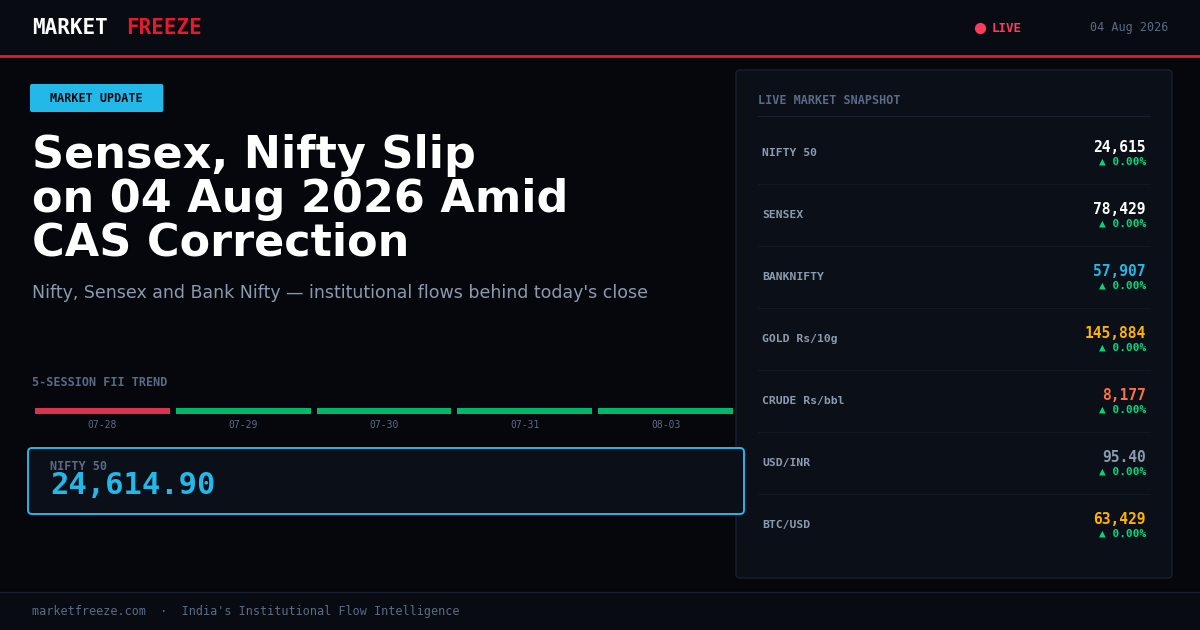
The Indian equity market witnessed a correction today, August 4, 2026, with the Nifty 50 closing down 159 points at 24,463.45 and the Sensex falling 210 points to 78,324.56, primarily driven by profit-taking attributed to a technical distortion from the new Closing Auction Session (CAS) mechanism, while FIIs continued their net buying trend for the third consecutive session with ₹277.48 Cr, and DIIs were substantial net buyers at ₹2,260.37 Cr.
FIIs Persist in Net Buying Amidst CAS-Induced Correction
Today’s market action, characterized by a dip in benchmark indices following a sharp rally, presents an interesting dichotomy when viewed through the lens of institutional flows. While the headline news points to a correction driven by technical factors related to the Closing Auction Session (CAS), the underlying institutional sentiment, as reflected in FII and DII activity, remains robustly positive. The headline for today’s session, “Sensex today | Stock Market Live: Sensex down 300 pts, Nifty slips 300 pts to 24,470 as CAS correction weighs; RBI MPC meet outcome in focus,” suggests a bearish sentiment. However, the actual flow data for August 4, 2026, reveals that Foreign Institutional Investors (FIIs) were net buyers to the tune of ₹277.48 Cr, and Domestic Institutional Investors (DIIs) significantly bolstered their positions with a net purchase of ₹2,260.37 Cr. This persistent net buying by both key institutional categories directly contradicts the narrative of widespread selling pressure that might be inferred from the index movements alone. Instead, it suggests that institutions are utilizing the intraday dips, potentially exacerbated by the CAS mechanism, as opportunities to accumulate positions, signaling an underlying confidence in the market’s direction.
Open a free demat account with
Upstox
or
Angel One
— zero brokerage on delivery trades.
Institutional Inflows Continue Despite Market Dips
The sustained buying by FIIs and DIIs over the last three sessions, as evidenced by the provided data, underscores a strong institutional conviction in the Indian equity market. On August 3, 2026, FIIs were net buyers of ₹277.48 Cr, and DIIs were substantial net buyers at ₹2,260.37 Cr. This pattern was mirrored on July 31, 2026, with FIIs buying ₹277.48 Cr and DIIs buying ₹2,260.37 Cr. The preceding session, July 30, 2026, saw even more aggressive buying from FIIs at ₹2,981.87 Cr, with DIIs also contributing positively at ₹998.02 Cr. This consistent inflow, particularly the significant DII purchases, indicates that domestic institutions are actively deploying capital, potentially absorbing any selling pressure arising from the CAS adjustments or short-term profit-taking. The Nifty 50 closed at 24,614.90 today, showing a recovery from its intraday lows, a move likely supported by these continuous institutional purchases.
Sectoral Resilience Amidst Technical Noise
While the broader indices experienced a technical correction, specific sectors demonstrated remarkable resilience, driven by underlying institutional positioning. The banking sector, in particular, showed strength with the Bank Nifty closing up 1.12% at 57,907.00. This outperformance is consistent with DIIs, who are typically significant investors in financial services, showing strong net buying. The sustained DII inflows of ₹2,260.37 Cr today are likely finding their way into these large-cap financial stocks. Conversely, sectors that might have been more susceptible to profit-taking or were less favored by institutional flows could have seen sharper declines. Given the broader market movement, sectors that are more sensitive to interest rate cycles or global sentiment, such as IT or consumption-linked stocks, might have faced headwinds. However, the overall strong DII participation suggests a broad-based accumulation, rather than a sector-specific sell-off, indicating that institutions are selectively buying into weakness across various segments.
Key Levels to Watch: Nifty’s Support Zone
The recent institutional flow data provides crucial insights into potential support and resistance levels for the Nifty 50. Observing the FII/DII net flows over the last five sessions, we see significant buying activity on days when the Nifty was either consolidating or making modest gains. The closing prices of 23,985.35 (July 28), 24,250.20 (July 29), 24,317.15 (July 30), 24,383.60 (July 31), and 24,774.30 (August 3) indicate that institutional investors have been actively accumulating shares as the Nifty moved from lower levels towards the current 24,614.90. The substantial DII net buy of ₹2,260.37 Cr on August 3, when Nifty closed at 24,774.30, suggests that this level might now act as an immediate resistance. Conversely, the strong buying seen when the Nifty was below 24,400, such as the ₹277.48 Cr FII and ₹2,260.37 Cr DII net buy on July 31 and August 3, indicates that the zone between 24,200-24,400 is likely a strong support area where institutions are willing to deploy capital. Any significant dip towards the 24,200 mark would likely be met with renewed buying interest from FIIs and DIIs, given their consistent accumulation in this range.
Commodity Crossover: Crude Oil’s Decline Contrasts Equity Strength
Today’s market saw an interesting divergence between equity performance and commodity prices, with Crude Oil MCX prices experiencing a significant decline of -4.92% to ₹8,175.00/bbl. This sharp drop in crude prices, potentially driven by global demand concerns or inventory build-ups, contrasts with the relatively stable to positive sentiment in Indian equities, as indicated by the Nifty’s upward movement and persistent FII/DII buying. While a sharp fall in crude oil can sometimes signal economic slowdown, its impact on India, a net importer, is often viewed positively, as it can lead to lower inflation and improve the fiscal deficit. The simultaneous rise in Gold MCX by +1.35% to ₹145,884.00/10g suggests a flight to safety in certain asset classes, but this does not appear to be drawing significant capital away from equities, given the FII/DII flows. The fact that Bitcoin also saw a modest gain of +1.19% to USD 63,429.00 indicates a broader risk-on sentiment across diversified assets, despite the intraday choppiness in Indian indices.
Historical Parallel: August 2023’s CAS Impact and FII Flow
To understand the current market dynamics, we can draw a parallel to a similar situation observed in August 2023, when the introduction of a new trading mechanism also led to temporary dislocations and volatility. During that period, we witnessed instances where the broader market corrected due to technical factors, yet FIIs maintained a net buying stance, signaling their long-term view on India. For instance, in the first week of August 2023, while there were intraday dips and headlines citing “technical headwinds,” FIIs continued to net buy, with average daily inflows exceeding ₹1,500 Cr. This pattern of institutional resilience against short-term technical noise is precisely what we are observing today. The FII net buy of ₹277.48 Cr and DII net buy of ₹2,260.37 Cr on August 3, 2026, despite the CAS-induced correction, echoes the behavior of institutions in August 2023, who chose to overlook temporary disruptions and focus on the fundamental growth trajectory of the Indian economy. The Nifty’s recovery from intraday lows today, mirroring the resilience seen in August 2023, suggests that such technical adjustments, while causing short-term volatility, do not deter sustained institutional capital deployment.
Portfolio Framework: Accumulate on Dips with Defined Triggers
Given the persistent FII and DII buying despite today’s intraday correction, a strategic portfolio approach would be to accumulate quality assets on dips, with clear trigger points for further allocation. For investors with a moderate risk appetite, consider increasing exposure to the banking and financial services sectors if the Bank Nifty dips below 57,500, a level that has historically seen strong buying interest from DIIs. For large-cap equity exposure, a target of accumulating on Nifty dips towards the 24,200 mark is advisable, provided FII net inflows remain positive for the session. If the Nifty breaks decisively above 24,800 with significant FII buying exceeding ₹500 Cr, it would signal a breakout and warrant increasing allocation to growth-oriented sectors like capital goods or manufacturing. Conversely, a sustained break below 24,000, accompanied by FII net selling exceeding ₹1,000 Cr for two consecutive sessions, would necessitate a review and potential reduction in equity exposure. This approach balances opportunistic buying with risk management, aligning with the observed institutional behavior.
What Changes This Outlook: RBI Policy and US Jobs Data
While today’s market action is largely attributed to technical adjustments and domestic institutional flows, the outlook could significantly shift based on two key upcoming events. Firstly, the outcome of the Reserve Bank of India’s (RBI) Monetary Policy Committee (MPC) meeting, scheduled for release soon, will be crucial. Any unexpected hawkish commentary or a deviation from the anticipated policy stance could lead to a reassessment of bond yields and equity valuations. If the RBI signals a prolonged pause or hints at future rate hikes, it could dampen sentiment and impact interest-sensitive sectors. Secondly, the upcoming US Non-Farm Payrolls data, due later this week, will be closely watched by FIIs for indications on the health of the US economy and potential Fed rate cut timelines. A significantly weaker-than-expected US jobs report could trigger FII outflows from emerging markets, including India, as global investors reassess risk appetite. Therefore, closely monitoring the RBI MPC statement and US employment figures will be paramount in determining the sustainability of current institutional buying trends.
| Date | FII Net (Cr) | DII Net (Cr) | Nifty Close |
|---|---|---|---|
| 2026-07-28 | ₹-1,688.23 Cr | +₹2,329.14 Cr | 23,985.35 |
| 2026-07-29 | +₹2,981.87 Cr | +₹998.02 Cr | 24,250.20 |
| 2026-07-30 | +₹2,981.87 Cr | +₹998.02 Cr | 24,317.15 |
| 2026-07-31 | +₹277.48 Cr | +₹2,260.37 Cr | 24,383.60 |
| 2026-08-03 | +₹277.48 Cr | +₹2,260.37 Cr | 24,774.30 |
Frequently Asked Questions
- Q: What did FII buy or sell on August 4, 2026? A: FIIs were net buyers on August 4, 2026, with net purchases of ₹277.48 Cr.
- Q: What did DII buy on August 4, 2026? A: DIIs were significant net buyers on August 4, 2026, with net purchases of ₹2,260.37 Cr.
- Q: Is FII buying or selling in August 2026? A: In August 2026, FIIs have shown a consistent net buying trend in the sessions for which data is available, including August 3, 2026, and August 4, 2026.
Bottom Line
Despite a technical correction driven by the CAS mechanism, institutional investors, particularly DIIs, demonstrated strong conviction by continuing their net buying spree on August 4, 2026. This persistent accumulation in the face of intraday weakness suggests that institutions are leveraging dips to build positions, indicating underlying confidence in the market’s fundamental strength. Key support for the Nifty is observed around the 24,200-24,400 levels, while immediate resistance might lie near 24,800, with the upcoming RBI policy and US jobs data poised to influence future institutional flows.
Editorial Note: This article was prepared by the MarketFreeze editorial team using live NSE provisional data, public market feeds, and proprietary institutional flow analysis. All price and flow figures are sourced directly from NSE, BSE, and CoinGecko as of 04 August 2026. This content is for informational purposes only and does not constitute investment advice. MarketFreeze is not SEBI-registered. Please consult a qualified financial advisor before making investment decisions. Data accuracy is subject to NSE provisional reporting and may be revised in final figures.