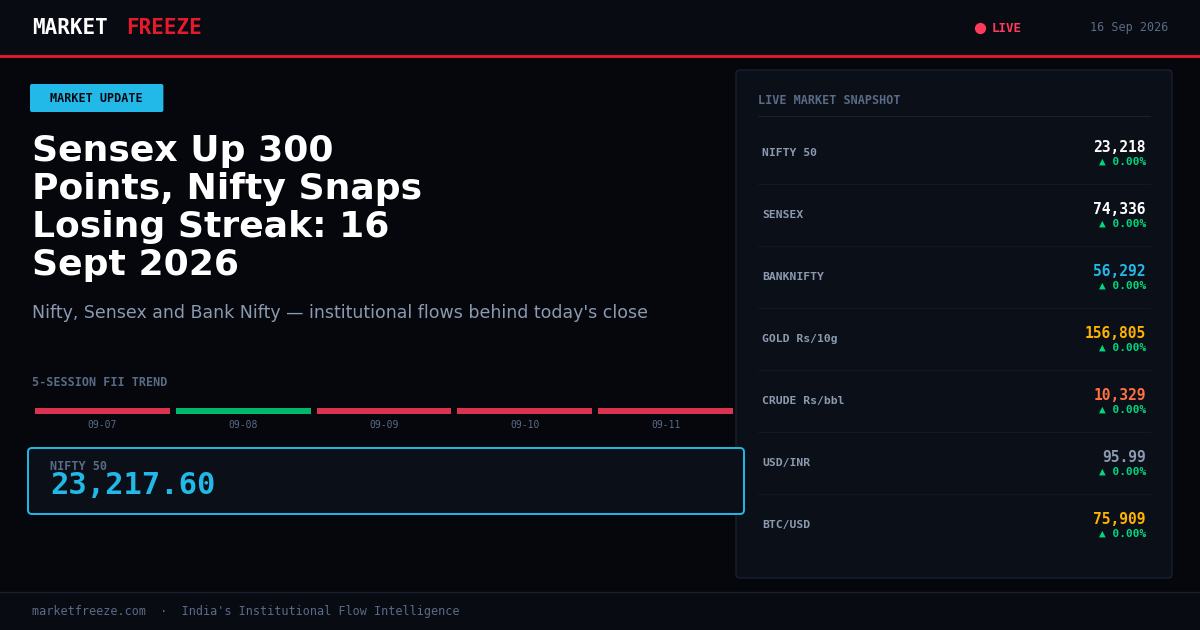
The Nifty 50 snapped its two-day losing streak to close at 23,217.60, up 0.43%, as Sensex rallied over 300 points, driven by institutional buying in metals and FMCG sectors, while IT stocks lagged ahead of the US Federal Reserve’s policy decision.
FIIs Continue Net Selling Amidst Pre-Fed Jitters; DIIs Extend Buying Spree
FII/DII Flow Dynamics: A Tale of Two Investors
Today’s market action, which saw the Nifty 50 climb to 23,217.60 and the Sensex gain 74,336.00, presents a nuanced picture of institutional behavior. While the headline suggests broad market strength, a closer look at the Foreign Institutional Investor (FII) and Domestic Institutional Investor (DII) flows reveals a divergence. FIIs continued their net selling trend, offloading Indian equities worth ₹930.90 Cr on September 11, 2026, and ₹582.99 Cr on September 10, 2026. This persistent outflow contrasts sharply with the robust buying activity from DIIs, who have been net buyers for at least the last three sessions, injecting ₹1,968.17 Cr on September 11, ₹1,509.04 Cr on September 10, and ₹1,349.64 Cr on September 9. This institutional dichotomy is crucial for understanding the market’s resilience and the underlying drivers of today’s uptick.
Open a free demat account with
Upstox
or
Angel One
— zero brokerage on delivery trades.
IT Sector Faces Headwinds as Global Yields Rise; Metals and FMCG Show Strength
The market narrative today was significantly influenced by sector-specific performance, with Information Technology (IT) stocks acting as a drag while Metals and Fast-Moving Consumer Goods (FMCG) sectors provided support. The rising US bond yields and escalating geopolitical tensions in West Asia, particularly crude oil prices hovering near $108 a barrel, typically pressure IT margins due to their global exposure and dependence on foreign currency revenues. This aligns with the observed weakness in IT counters. Conversely, the resilience in Metals and FMCG can be attributed to their defensive characteristics and potential to benefit from domestic demand or commodity price movements. The current FII selling pressure, often seen exiting growth-oriented sectors like IT during uncertain times, is being absorbed by DIIs, who are likely reallocating capital into these more stable or commodity-linked sectors.
Tata Group Stocks Tumble on Profit-Booking Post-IPO Buzz
The sharp correction in Tata Group stocks, with some falling up to 7%, underscores a significant event within the broader market. This downturn follows a speculative rally driven by IPO buzz, indicating a classic case of profit-booking by institutional investors who participated in the pre-IPO sentiment. While the exact quantum of FII/DII involvement in specific Tata Group stocks isn’t detailed, such large intra-group sell-offs can create ripple effects, particularly if these stocks are part of major indices or institutional portfolios. The FIIs’ net selling of ₹930.90 Cr on September 11 could have partially contributed to this profit-booking, especially if they were holding significant positions in these now-declining counters.
Nifty’s Resilience Tested: Support and Resistance Levels in Focus
The Nifty 50’s ability to reclaim the 23,200 mark today, despite headwinds, suggests underlying buying interest. Based on recent institutional flows, the 23,118.60 level (Nifty close on September 11) is emerging as a crucial support zone, as DIIs were seen absorbing selling pressure around this vicinity. On the upside, the 23,400-23,500 range could act as an immediate resistance, especially as the market awaits the US Federal Reserve’s policy decision, which could influence global liquidity and FII sentiment. The sustained DII buying at lower levels, coupled with FIIs stepping back on the way up, suggests a battleground around the current levels.
Currency and Commodity Crossover: USD/INR Weakness and Gold’s Shine
The Indian Rupee (USD/INR) continued its depreciation, trading at Rs95.99, up 0.11% against the dollar. This weakness in the INR, often a precursor to FII outflows as it impacts their realized returns, is occurring concurrently with a surge in Gold prices on MCX to Rs156,805.00/10g, up 1.18%. This inverse correlation is noteworthy. While FIIs are net sellers in equities, their capital might be seeking refuge in perceived safe-haven assets like gold, or they might be hedging their currency exposure. The continued rise in Gold, even as equities show some recovery, indicates investor caution and a preference for tangible assets amidst global uncertainty and anticipation of US monetary policy cues.
Historical Parallel: September 2024’s FII Exodus and DII Support
A historical parallel can be drawn to September 2024, when the Nifty 50 witnessed a significant drawdown. In the session of September 7, 2024, FIIs were massive net sellers to the tune of ₹3,111.94 Cr, while DIIs stepped in with substantial buying of ₹8,930.12 Cr, leading to a Nifty close of 23,779.15. This period was characterized by global macroeconomic concerns and significant selling pressure from foreign investors. The current situation, while not as extreme, mirrors the pattern of FII outflows being counterbalanced by DII inflows. The market’s ability to stabilize and even rally, as seen today, hinges on this DII support, much like in September 2024 when DIIs provided a floor.
Portfolio Framework: Strategic Allocation Amidst Divergent Flows
For investors, a strategic allocation framework is paramount. In a scenario where FIIs are net sellers (cumulative net sell of ₹1,513.89 Cr in the last three sessions) and DIIs are net buyers (cumulative net buy of ₹4,826.85 Cr in the last three sessions), consider reducing overweight positions in interest-rate sensitive sectors like IT and Capital Goods. Instead, overweight defensive sectors like FMCG and Pharmaceuticals, which typically perform better during periods of global uncertainty and INR depreciation. Additionally, allocate a portion to commodity-linked sectors like Metals, given their current outperformance. Maintain a cash reserve of at least 10% to capitalize on any sharp dips driven by external factors, especially pre-US Fed announcement.
What Changes This Outlook: Fed’s Stance on Inflation and Rate Trajectory
The single most critical trigger to watch that could alter today’s market narrative is the US Federal Reserve’s monetary policy decision. Any indication from the Fed of a more hawkish stance on inflation or a faster-than-expected pace of interest rate hikes could trigger a renewed wave of FII outflows and a sharper correction in equities. Conversely, a dovish tone or confirmation of the current rate trajectory would likely provide a significant boost to market sentiment and encourage FIIs to re-enter. Specifically, a Fed Funds Rate decision above 5.75% combined with hawkish forward guidance would be a negative signal. A pause or a signal of a terminal rate at current levels would be a positive catalyst.
Historical FII/DII Flows and Nifty Performance
| Date | FII Net (Cr) | DII Net (Cr) | Nifty Close |
|---|---|---|---|
| 2026-09-07 | ₹-3,111.94 Cr | +₹8,930.12 Cr | 23,779.15 |
| 2026-09-08 | +₹280.13 Cr | +₹566.76 Cr | 23,635.10 |
| 2026-09-09 | ₹-123.19 Cr | +₹1,349.64 Cr | 23,431.50 |
| 2026-09-10 | ₹-582.99 Cr | +₹1,509.04 Cr | 23,477.80 |
| 2026-09-11 | ₹-930.90 Cr | +₹1,968.17 Cr | 23,118.60 |
Frequently Asked Questions
Q: What did FII buy or sell on 2026-09-11?
A: FIIs were net sellers on September 11, 2026, to the tune of ₹930.90 Cr.
Q: What did DII buy on 2026-09-10?
A: DIIs were net buyers on September 10, 2026, to the tune of ₹1,509.04 Cr.
Q: Is FII buying or selling in September 2026?
A: In September 2026, FIIs have shown a consistent net selling trend, with a cumulative net sell of approximately ₹1,513.89 Cr in the first two weeks.
Key Levels to Watch
The Nifty 50’s immediate support lies around the 23,118.60 mark, where significant DII buying was observed. Resistance is anticipated in the 23,400-23,500 range, given the pre-Fed caution. A decisive breach above 23,500 on strong volumes could signal a shift in FII sentiment, while a fall below 23,000 would indicate sustained selling pressure.
Bottom Line
Today’s market resilience, marked by the Nifty 50 closing at 23,217.60, is primarily a testament to robust DII buying offsetting consistent FII outflows. While IT stocks faced pressure from rising global yields, the Metals and FMCG sectors provided a strong cushion. The upcoming US Federal Reserve policy decision remains the pivotal factor that could dictate the near-term direction and influence FII sentiment, potentially shifting the support and resistance levels observed today.
Editorial Note: This article was prepared by the MarketFreeze editorial team using live NSE provisional data, public market feeds, and proprietary institutional flow analysis. All price and flow figures are sourced directly from NSE, BSE, and CoinGecko as of 16 September 2026. This content is for informational purposes only and does not constitute investment advice. MarketFreeze is not SEBI-registered. Please consult a qualified financial advisor before making investment decisions. Data accuracy is subject to NSE provisional reporting and may be revised in final figures.