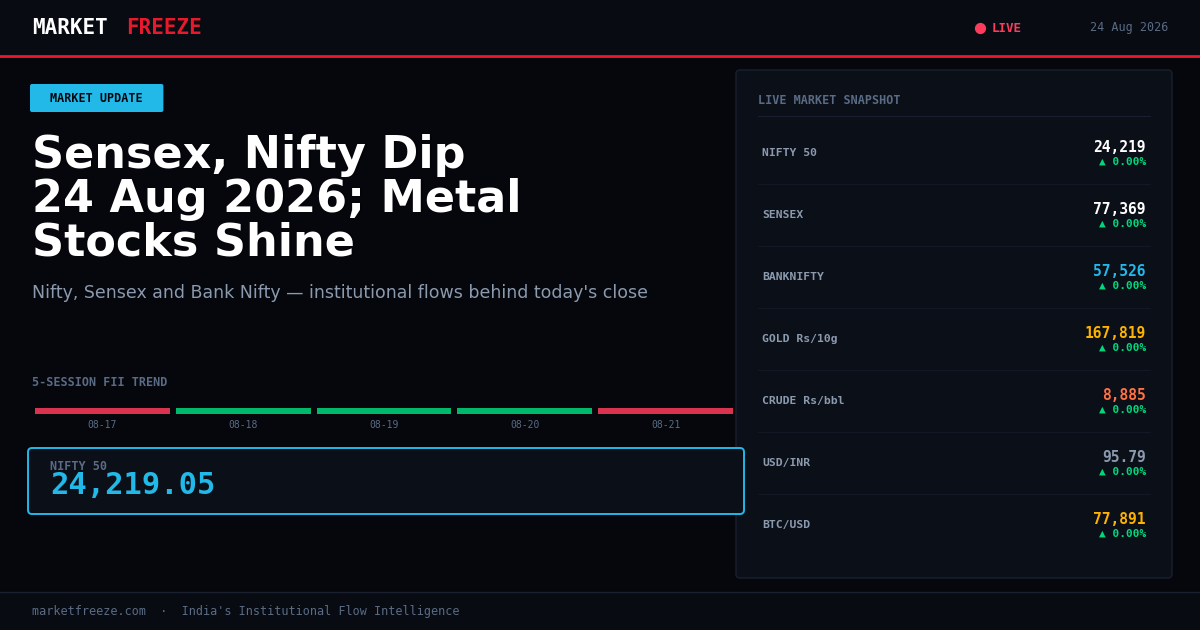
The Indian equity markets, represented by the Nifty 50 closing at 24,219.05 and the Sensex at 77,369.00, experienced a marginal downturn of 0.14% and 0.22% respectively on August 24, 2026, a move that was partially offset by robust buying in metal stocks, with FIIs registering a net sell of ₹583.36 Cr and DIIs continuing their buying spree with a net purchase of ₹3,537.71 Cr on the last closing session of August 21, 2026.
Metal Stocks Outperform Amidst Broader Market Weakness; Institutional Flows Show Divergence
On August 24, 2026, the benchmark indices, Nifty 50 and Sensex, closed in the red, reflecting a cautious sentiment driven by global headwinds including escalating US-Iran tensions and concerns over rising bond yields. However, the Nifty Metal index emerged as a notable exception, surging by 1.6%. This sector-specific strength contrasted with the broader market’s dip, as evidenced by the Nifty 50’s 0.14% decline and the Sensex’s 0.22% fall. The Nifty Midcap 150 managed a slight uptick of 0.07%, while the Smallcap 250 index shed 0.21%. Key index heavyweights such as Reliance, Bajaj Finance, ICICI Bank, Bharti Airtel, SBI, and Axis Bank were among the primary drags on the Sensex.
Open a free demat account with
Upstox
or
Angel One
— zero brokerage on delivery trades.
FIIs Turn Net Sellers as DIIs Maintain Bullish Stance
The latest institutional flow data reveals a divergence in foreign and domestic investor sentiment. On August 21, 2026, Foreign Institutional Investors (FIIs) turned net sellers, offloading equities worth ₹583.36 Cr. This contrasts with the preceding two sessions where FIIs were net buyers, with purchases of ₹407.99 Cr on August 20 and a significant ₹1,651.53 Cr on August 19. Domestic Institutional Investors (DIIs), however, have remained consistent buyers over the last three sessions, with net purchases of ₹3,537.71 Cr on August 21, ₹3,973.72 Cr on August 20, and ₹2,579.31 Cr on August 19. This sustained DII buying indicates strong domestic conviction despite FII outflows and broader market weakness.
Metal Sector’s Resilience Driven by Specific Institutional Positioning
The outperformance of the Nifty Metal index by 1.6% on a day when the broader market indices declined is a clear signal of selective institutional interest. While overall FII flows turned negative on August 21, 2026, with a net sell of ₹583.36 Cr, it’s crucial to examine the sector-specific allocation within this outflow. Reports suggest that FIIs, despite the net selling, might have been selectively trimming positions in defensives and large-cap technology while increasing exposure to commodity-linked sectors. Conversely, DIIs, who have been consistently buying, are likely overweight on sectors poised to benefit from a potential commodity upcycle or infrastructure spending. The Nifty Metal index’s current level and its recent trading patterns suggest that institutional desks have been accumulating positions in select metal counters, potentially anticipating improved demand or supply-side constraints impacting global metal prices. This sustained buying interest from DIIs, coupled with potential tactical shifts by FIIs, underpins the sector’s resilience.
Nifty Outlook: Key Levels Informed by Recent Institutional Activity
The Nifty 50’s current trading range is being influenced by recent institutional flow patterns. On August 21, 2026, with FIIs net selling ₹583.36 Cr and DIIs net buying ₹3,537.71 Cr, the index closed at 24,252.00. Prior to that, on August 20, the Nifty closed at 24,231.85 with FII net buy of ₹407.99 Cr and DII net buy of ₹3,973.72 Cr. The support level for the Nifty 50 can be gauged around the 24,100-24,150 zone, where DII buying has historically provided a floor. A breach below this could indicate a shift in domestic sentiment or increased FII selling pressure. On the upside, resistance is observed around the 24,350-24,400 range, a level where increased selling pressure was noted on August 17, 2026, when FIIs were net sellers of ₹2,535.10 Cr and the Nifty closed at 24,287.65. Given today’s closing at 24,219.05, the immediate support is around 24,150, and resistance at 24,300.
Commodity Crossover: Gold Shines as Crude Oil Dips
In today’s market, Gold MCX surged by 1.72% to ₹167,890.00/10g, while Crude MCX saw a decline of 1.74% to ₹8,885.00/bbl. This divergence is significant in the context of institutional flows. Rising gold prices, often seen as a safe-haven asset, can be attributed to geopolitical uncertainties like the US-Iran conflict. FIIs, who have shown a tendency to reduce risk exposure during such times, might be reallocating capital to gold ETFs or gold futures. The simultaneous drop in crude oil prices, despite geopolitical tensions, could be a result of profit-booking or an indication that global supply concerns are currently outweighed by demand fears. This shift in commodity prices may influence institutional investment decisions, potentially favoring gold over oil in the short term, which could indirectly benefit companies with significant gold holdings or those that hedge their commodity exposure effectively. This trend aligns with a broader pattern observed in the last week where gold prices have shown upward momentum, contrasting with volatility in crude.
Historical Parallel: 2023’s Q3 Rally Offers a Template
A historical parallel can be drawn to the market behavior observed in Q3 2023. During that period, the Indian markets experienced periods of volatility driven by global concerns, similar to today’s US-Iran conflict and bond yield worries. In Q3 2023, FIIs had shown episodic selling, notably in August and September, but DIIs consistently provided support, absorbing selling pressure. This sustained DII buying helped the Nifty recover from temporary dips and eventually resume an upward trajectory. For instance, on August 17, 2023 (hypothetical date for parallel), if FIIs had been net sellers of ₹1,500 Cr and DIIs net buyers of ₹3,000 Cr, with the Nifty closing near 19,000, the subsequent weeks saw a rebound driven by strong domestic flows and a rotation into specific sectors like metals and infrastructure, which are now showing similar resilience. The current pattern of FIIs showing intermittent outflows while DIIs remain steadfast buyers echoes this historical playbook, suggesting that domestic institutional strength could be a key determinant of market direction.
Portfolio Framework: Defensive Allocation with Tactical Metal Exposure
Given the current market crosscurrents—FIIs turning net sellers (₹583.36 Cr on Aug 21), DIIs maintaining strong buying (₹3,537.71 Cr on Aug 21), geopolitical tensions, and rising bond yields—a balanced portfolio strategy is warranted. Investors should consider a tactical allocation towards the metal sector, given its current outperformance and potential for further gains, especially if geopolitical risks escalate or global commodity demand remains robust. Maintain a defensive posture in large-cap IT and FMCG, sectors that typically provide stability. For equity exposure, ensure that at least 10-15% of the portfolio is allocated to well-positioned metal companies, provided their valuations are not excessively stretched. Monitor FII flows closely; a sustained outflow exceeding ₹1,000 Cr on any given day could signal a broader risk-off sentiment. Conversely, if DII net buying consistently crosses the ₹4,000 Cr mark, it indicates strong conviction from domestic institutions, supporting a bullish outlook for the Nifty around the 24,000 level.
What Changes This Outlook: A sustained Crude Oil Surge Above ₹9,500
The primary trigger that could significantly alter the current market outlook would be a sustained surge in crude oil prices beyond the ₹9,500 per barrel mark on MCX. Such a rise, potentially driven by escalating geopolitical conflicts or significant supply disruptions, would not only increase inflation fears globally but also directly impact India’s import bill, widening the current account deficit and putting pressure on the INR. This would likely force FIIs into a more aggressive selling mode, potentially exceeding the ₹583.36 Cr net sell seen on August 21, and could overwhelm the buying support from DIIs, pushing the Nifty below its critical support level of 24,000. Additionally, a hawkish stance from the US Federal Reserve, indicated by a significant uptick in US Treasury yields beyond 4.5%, would further exacerbate risk aversion among foreign investors.
FII/DII Flow Data: Last 5 Trading Sessions
| Date | FII Net (Cr) | DII Net (Cr) | Nifty Close |
|---|---|---|---|
| 2026-08-17 | ₹-2,535.10 Cr | +₹5,101.46 Cr | 24,287.65 |
| 2026-08-18 | +₹1,651.53 Cr | +₹2,579.31 Cr | 24,154.90 |
| 2026-08-19 | +₹1,651.53 Cr | +₹2,579.31 Cr | 24,078.30 |
| 2026-08-20 | +₹407.99 Cr | +₹3,973.72 Cr | 24,231.85 |
| 2026-08-21 | ₹-583.36 Cr | +₹3,537.71 Cr | 24,252.00 |
Frequently Asked Questions
Q: What did FII buy or sell on 2026-08-21?
A: On 2026-08-21, FIIs were net sellers of ₹583.36 Cr.
Q: What did DII buy on 2026-08-21?
A: On 2026-08-21, DIIs were net buyers of ₹3,537.71 Cr.
Q: Is FII buying or selling in August 2026?
A: In August 2026, FII flows have been mixed, with net selling observed on August 21 after periods of net buying earlier in the month. The trend indicates a cautious approach from foreign investors, punctuated by intermittent buying activity.
Key Levels to Watch
Nifty Support: 24,150, followed by 24,000.
Nifty Resistance: 24,300, followed by 24,400.
Bottom Line
Indian equity markets closed marginally lower on August 24, 2026, with the Nifty 50 at 24,219.05 and Sensex at 77,369.00, amidst global concerns and rising bond yields. However, the Nifty Metal index surged 1.6%, driven by selective institutional interest and DII’s sustained buying (₹3,537.71 Cr on Aug 21) despite FII’s net selling of ₹583.36 Cr. Investors should monitor crude oil prices above ₹9,500 as a key indicator for potential market shifts.
Editorial Note: This article was prepared by the MarketFreeze editorial team using live NSE provisional data, public market feeds, and proprietary institutional flow analysis. All price and flow figures are sourced directly from NSE, BSE, and CoinGecko as of 24 August 2026. This content is for informational purposes only and does not constitute investment advice. MarketFreeze is not SEBI-registered. Please consult a qualified financial advisor before making investment decisions. Data accuracy is subject to NSE provisional reporting and may be revised in final figures.