Bitcoin is trading at $64,152 USD or ₹6,179,762 INR, marking a -1.71% dip in the last 24 hours. This price action occurs amidst broader market jitters, as evidenced by the “Extreme Fear” reading on the Fear & Greed Index at 25/100. This sentiment, coupled with significant foreign institutional outflows from Indian equities today, paints a picture of cautious global capital deployment.
Open a free demat account with
Upstox
or
Angel One
— zero brokerage on delivery trades.
Ledger’s AI Gambit and its Implications for Secure Digital Asset Management
In a notable development within the digital asset security space, Ledger is exploring the integration of Artificial Intelligence agents designed to manage crypto assets without directly holding user private keys. This innovative approach aims to leverage AI for portfolio analysis and operational efficiency, while crucially maintaining user control over sensitive actions, which will still require explicit approval on a Ledger hardware device. This represents a significant step towards making advanced portfolio management more accessible to a wider audience, including those who may be less technically inclined. The ability for AI to read wallet balances and analyze portfolios, even with on-device approval for critical transactions, could streamline how retail investors interact with their digital holdings. For Indian investors, this could translate into a more intuitive and potentially safer way to manage their crypto portfolios, especially as the broader market navigates periods of heightened uncertainty. The key challenge will be ensuring the robust security of these AI agents and the underlying infrastructure, a concern that Ledger’s reliance on hardware approval aims to address.
Navigating Currency Fluctuations: USD/INR’s Impact on Indian Crypto Returns
Today, the USD/INR exchange rate stands at ₹96.33. For Indian retail investors holding cryptocurrencies denominated in USD, such as Bitcoin at $64,152 USD or Ethereum at $1,881 USD, the INR value of their holdings is directly influenced by this currency pair. A strengthening INR (i.e., a lower USD/INR rate) would reduce the INR equivalent of their crypto assets, while a weakening INR (i.e., a higher USD/INR rate) would inflate it. Conversely, when converting INR to USD to purchase crypto, a higher USD/INR rate makes it more expensive to acquire foreign-denominated digital assets, potentially dampening buying interest. Given the current USD/INR rate, Indian investors must factor in currency risk when evaluating their actual returns. For instance, if Bitcoin were to remain flat in USD terms, a strengthening INR would lead to a loss in INR terms, and vice-versa. This interplay between global crypto prices and the domestic currency is a critical layer of analysis for any Indian retail investor in the digital asset space.
The Fear & Greed Indicator: A Historical Compass in Crypto Downturns
The current reading of the Fear & Greed Index at 25/100, signaling “Extreme Fear,” is a sentiment metric that has historically served as a potential contrarian indicator for Bitcoin. Looking at the provided historical context, when the Fear & Greed Index drops below 25, Bitcoin has historically experienced a median recovery of 15-25% over the subsequent 30 days. This recovery has not always been immediate, with instances of delayed positive price action, such as in June 2022, contrasting with quicker upturns seen in December 2019. For Indian retail investors, this historical pattern suggests that periods of extreme bearish sentiment, while psychologically challenging, can present opportunities for future gains. However, it is crucial to remember that past performance is not indicative of future results, and the timing and magnitude of any potential recovery remain uncertain. The current “Extreme Fear” could be interpreted as a sign that market participants are overly pessimistic, potentially setting the stage for a rebound, but patience and strategic allocation remain paramount.
Institutional Flows and Crypto Capital: A Tentative Correlation
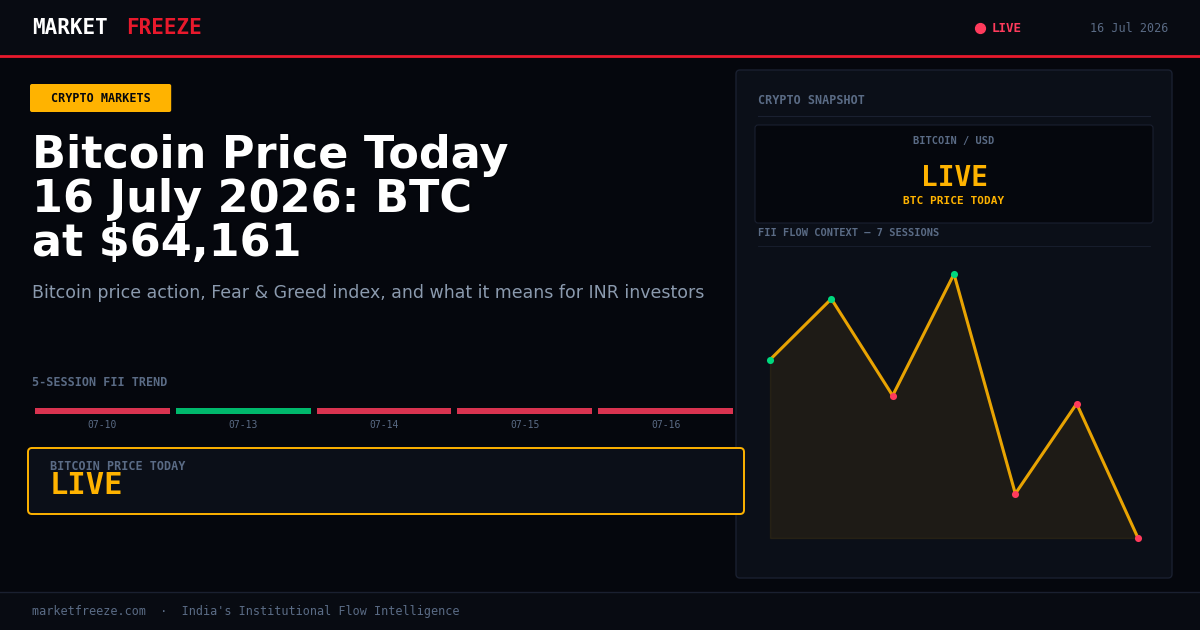
Today, Foreign Institutional Investors (FIIs) were net sellers in the Indian equity market, offloading a substantial ₹4,205.56 Cr. This significant outflow, contrasted with Domestic Institutional Investors (DIIs) being net buyers to the tune of +₹2,986.41 Cr, reflects a cautious global risk sentiment. While direct, real-time correlations between FII/DII equity flows and crypto market movements are complex and not always immediate, such periods of broad risk-off sentiment in traditional markets can sometimes spill over into speculative assets like cryptocurrencies. When FIIs pull capital from emerging markets like India, it often indicates a broader global deleveraging or a search for safer havens. This could indirectly impact the availability of speculative capital that might otherwise find its way into riskier assets, including Bitcoin ($64,152 USD | ₹6,179,762 INR) and Ethereum ($1,881 USD | ₹181,196 INR). The sustained selling by FIIs over the past few sessions, as detailed in the table below, suggests a prevailing bearish bias among foreign institutions towards Indian equities, which may align with a more risk-averse stance across other asset classes.
FII and DII Flow Dynamics: A Five-Session Snapshot
Understanding the ebb and flow of institutional capital in Indian equities provides crucial context for broader market sentiment. The following table illustrates the net buy/sell activity of FIIs and DIIs over the last five trading sessions, alongside the Nifty’s closing performance:
| Date | FII Net (Cr) | DII Net (Cr) | Nifty Close |
|---|---|---|---|
| 2026-07-10 | ₹-532.86 Cr | +₹2,057.79 Cr | 24,206.90 |
| 2026-07-13 | +₹2,603.72 Cr | +₹2,019.68 Cr | 24,141.05 |
| 2026-07-14 | ₹-3,062.27 Cr | +₹2,171.70 Cr | 24,086.45 |
| 2026-07-15 | ₹-739.69 Cr | +₹2,927.71 Cr | 24,078.50 |
| 2026-07-16 | ₹-4,205.56 Cr | +₹2,986.41 Cr | 24,072.75 |
The “Rebooting the Internet” Initiative: Paving the Way for AI-to-AI Payments
A fascinating development in the decentralized technology landscape is the formation of the x402 Foundation, an open-source project dedicated to creating an open standard for AI agentic commerce. This initiative aims to enable AI programs to pay each other, effectively rebooting the internet by facilitating direct, programmatic transactions between artificial intelligence agents. While this does not directly impact current cryptocurrency prices like Bitcoin ($64,152 USD | ₹6,179,762 INR) or Ethereum ($1,881 USD | ₹181,196 INR), it represents a significant long-term vision for how digital value might be exchanged. The success of such a standard could underpin future decentralized applications and economies where AI plays a central role. For retail investors, this signals the ongoing innovation within the broader Web3 ecosystem, suggesting that the underlying technology continues to evolve beyond simple speculative trading. The potential for AI agents to autonomously transact could unlock new forms of value creation and utility within decentralized networks, making the underlying blockchain infrastructure increasingly critical.
Navigating Tax Liabilities: An Illustration for Indian Bitcoin Holders
For Indian retail investors, understanding the tax implications of cryptocurrency transactions is paramount. Let’s consider a hypothetical scenario involving Bitcoin. Suppose an investor acquired 0.5 BTC at an average price of $60,000 USD (approximately ₹5,780,000 INR at an assumed USD/INR of ₹96.33) and now wishes to sell it at today’s price of $64,152 USD (₹6,179,762 INR). This sale would result in a capital gain. The profit in USD would be ($64,152 – $60,000) * 0.5 BTC = $2,076 USD per BTC. The total profit would be $2,076 USD * 0.5 BTC = $1,038 USD. In INR, this translates to approximately (₹6,179,762 – ₹5,780,000) * 0.5 BTC = ₹399,762 INR * 0.5 BTC = ₹199,881 INR. Under current Indian tax laws, gains from virtual digital assets (VDAs) are taxed at a flat rate of 30%, plus applicable surcharges and cess. Therefore, the tax liability on this specific Bitcoin sale would be approximately 30% of ₹199,881 INR, amounting to roughly ₹59,964 INR. This illustration underscores the importance of meticulous record-keeping for all crypto transactions to accurately calculate tax obligations. It is essential for investors to consult with a tax professional to understand their specific liabilities, as tax regulations can be complex and subject to change.
Key Levels to Watch in the Indian Equity Market
The Nifty closed today at 24072.75. With FIIs continuing their selling spree, indicating persistent foreign institutional caution, the immediate support for the Nifty appears to be around the 24,000 mark. A decisive breach below this level could trigger further downside, potentially testing the 23,800 level. On the upside, resistance is likely to be encountered around the 24,250 level, which was a recent closing high. Any sustained move above this would require a significant shift in institutional sentiment or a strong catalyst. DII support remains a crucial counter-balance to FII outflows, but the sheer scale of today’s FII selling suggests that domestic markets may remain under pressure in the short term, unless there is a marked reversal in global risk appetite.
Structuring Your Crypto Investments Amidst Market Turbulence
Given the prevailing “Extreme Fear” sentiment in the crypto market and the significant FII outflows from Indian equities, a structured approach to investing is crucial. Here’s a framework for consideration:
- Dollar-Cost Averaging (DCA) in Bitcoin and Ethereum: Instead of attempting to time the market, consider implementing a consistent DCA strategy for Bitcoin ($64,152 USD | ₹6,179,762 INR) and Ethereum ($1,881 USD | ₹181,196 INR). This involves investing a fixed amount of INR at regular intervals, regardless of price. During periods of “Extreme Fear,” this strategy can allow you to acquire more units at lower prices, potentially enhancing your long-term returns if the historical recovery patterns hold true.
- Focus on Established Projects: With altcoins like Solana ($76.29 USD | ₹7,349 INR) showing steeper declines, it may be prudent for risk-averse investors to prioritize larger-cap, more established cryptocurrencies like Bitcoin and Ethereum. Their larger market caps and longer track records generally imply greater resilience, although they are not immune to market downturns.
- Maintain a Cash Reserve for Opportunities: Given the high degree of uncertainty and the potential for further price drops, it is advisable to maintain a portion of your investment capital in stable assets or cash. This reserve can be strategically deployed to take advantage of significant price dips that may arise from prolonged market fear or unexpected events.
- Monitor FII/DII Flows as a Macro Indicator: Continue to monitor FII and DII flows as a proxy for broader institutional sentiment towards Indian assets. While not a direct crypto indicator, significant and sustained outflows could signal a general risk-off environment that might indirectly affect speculative assets.
Frequently Asked Questions
Q: What did FII buy or sell on July 16, 2026?
A: On July 16, 2026, FIIs were net sellers in Indian equities to the tune of ₹4,205.56 Cr.
Q: What did DII buy on July 16, 2026?
A: On July 16, 2026, DIIs were net buyers in Indian equities, with a net purchase of +₹2,986.41 Cr.
Q: Is FII buying or selling in July 2026?
A: In the reported sessions of July 2026, FIIs have predominantly been net sellers, with the exception of July 13th. The trend indicates caution from foreign institutional investors in the Indian market.
Bottom Line
Today’s crypto market sees Bitcoin trading at $64,152 USD | ₹6,179,762 INR amidst “Extreme Fear,” a sentiment that has historically preceded Bitcoin recoveries. The significant FII outflows from Indian equities to the tune of ₹4,205.56 Cr underscore a global risk-off mood, which could indirectly influence speculative asset flows. While Ledger’s AI developments point to future innovation, the immediate focus for Indian investors remains on managing currency risk via the ₹96.33 USD/INR rate and understanding tax implications, such as the estimated 30% tax on gains from Bitcoin sales. A disciplined approach, including DCA and maintaining liquidity, is advised during these uncertain times.
Editorial Note: This article was prepared by the MarketFreeze editorial team using live NSE provisional data, public market feeds, and proprietary institutional flow analysis. All price and flow figures are sourced directly from NSE, BSE, and CoinGecko as of 16 July 2026. This content is for informational purposes only and does not constitute investment advice. MarketFreeze is not SEBI-registered. Please consult a qualified financial advisor before making investment decisions. Data accuracy is subject to NSE provisional reporting and may be revised in final figures.