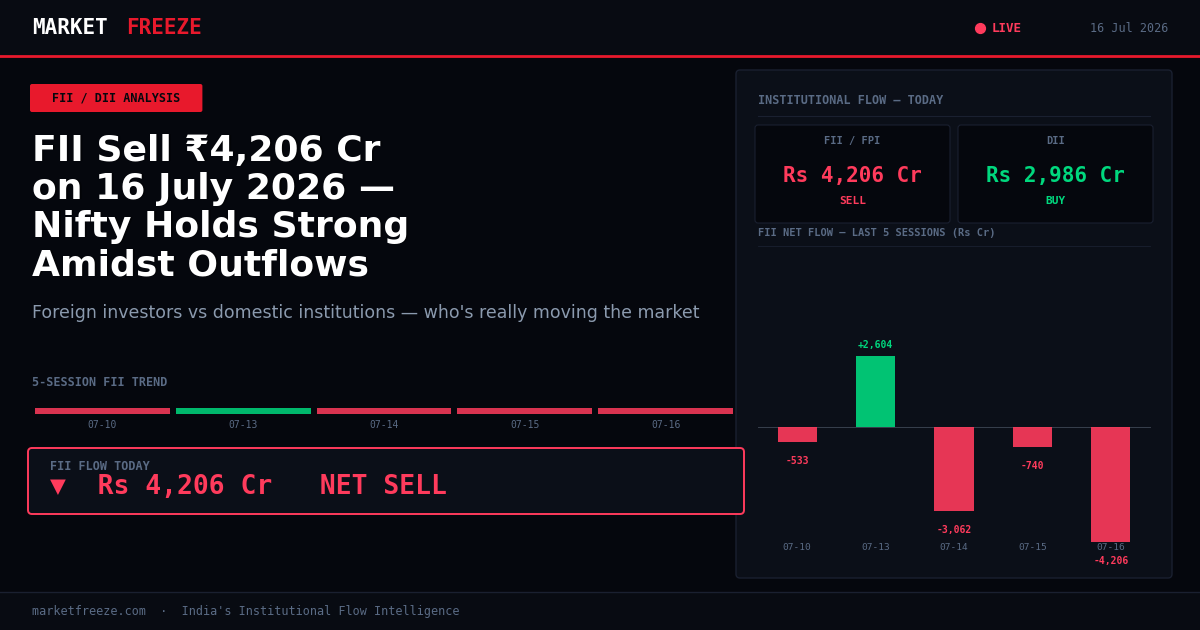
Foreign institutional investors offloaded ₹4,205.56 crore from Indian equities on July 16, 2026, marking their third consecutive session of significant net selling, while domestic institutional investors absorbed this pressure with a net buy of ₹2,986.41 crore.
FII Selling Intensifies: A Three-Day Outflow Streak
Today’s net FII selling figure of ₹4,205.56 crore is the largest single-day outflow observed in the last three sessions. This follows a net sell of ₹739.69 crore on July 15 and ₹3,062.27 crore on July 14. This acceleration in FII withdrawal points to a systemic reduction in exposure to Indian assets. The Nifty 50, despite this heavy foreign selling, registered only a marginal decline of -0.02%, closing at 24,072.75, primarily cushioned by persistent DII buying. This sustained DII support has been a consistent theme, with domestic institutions net buying for all three of these outflow sessions, indicating a strong counter-bid.
The total FII sell value for the day stood at ₹17,781.64 crore against a buy value of ₹13,576.08 crore. This wide divergence between gross buying and selling figures, with gross selling exceeding gross buying by over ₹4,200 crore, demonstrates conviction behind the FII exit. It is not merely profit-booking but a decisive reduction in positions. For retail investors, this means the primary upward momentum from foreign capital is absent, and Nifty’s ability to hold above 24,000 relies heavily on DII intervention.
Open a free demat account with
Upstox
or
Angel One
— zero brokerage on delivery trades.
DII Absorption Continues: The Domestic Buffer
Domestic institutional investors provided a critical buffer, injecting ₹2,986.41 crore into the market. This marks their highest net buying figure in the last three sessions, surpassing the ₹2,927.71 crore on July 15 and ₹2,171.70 crore on July 14. This consistent domestic buying has been instrumental in preventing a sharper correction in the Nifty 50. The Nifty’s marginal -0.02% decline, despite the significant foreign outflow, highlights the strength of local capital. This dynamic suggests that while FIIs are reducing exposure, domestic funds see value at current levels, maintaining a floor under the market.
The resilience of the Nifty 50 near the 24,072.75 mark, despite the aggregated ₹8,000 crore FII outflow over the past three days, directly stems from DII counter-buying. This sustained DII interest suggests that immediate support for the Nifty 50 could be observed around the 23,500-23,800 range, where domestic institutions consistently stepped in during previous FII selling periods. For retail investors, understanding this DII-led support is crucial for identifying potential accumulation zones.
Nifty 50 Holds Ground Amid Sectoral Divergence
The Nifty 50 closed effectively flat at 24,072.75, down a mere 5.75 points, as IT sector gains largely offset declines in financials. The Sensex also ended almost unchanged at 77,187.00. This neutrality at the index level masks significant internal churning. The Bank Nifty, for instance, declined by -0.30% to 57,582.00, indicating that FII selling likely concentrated in the financial sector, a traditional FII favorite. This aligns with the “IT gains offset financials drop” narrative from today’s market reports.
The strong performance in the IT sector, despite overall FII selling, suggests selective buying or reduced selling pressure in this segment. News of Tech Mahindra’s Q1 net profit soaring 28% YoY to ₹1,465 crore, with revenue up 18%, provides a fundamental driver for this IT resilience. Conversely, the underperformance of broader markets, with Nifty Midcap 100 dropping 0.41% and Nifty Smallcap 100 falling 0.10%, indicates a more widespread impact of FII selling beyond just the large-cap financial names. Retail investors should observe if IT strength can continue to defy the broader FII outflow trend, potentially using IT-focused ETFs as a defensive play.
Impact of Geopolitical Tensions on Market Breadth
Reports citing the “Iran-US conflict” and “escalating US-Iran conflict” as factors keeping optimism in check and weighing on sentiment provide context for the FII outflow. While the Nifty 50 and Sensex ended flat, the underperformance of mid and small-cap indices indicates that the broader market is more susceptible to these global uncertainties. The Nifty Midcap 100 dropping 0.41% and the Smallcap 100 falling 0.10% on a day where large-cap indices were stable confirms that foreign capital withdrawals are impacting market breadth. This flight to perceived safety, even within large caps (like IT vs. financials), is typical during geopolitical tensions.
The slight increase in Crude MCX by +0.94% to ₹8,260.00/bbl further underscores the geopolitical undertone. Rising crude prices directly impact India’s import bill and corporate margins, acting as a macroeconomic headwind. This increase in crude, coupled with the FII selling, suggests a cautious stance from foreign investors regarding broader economic stability. For retail investors, this implies a focus on defensive sectors less impacted by crude price volatility or global political events, and potentially reducing exposure to more cyclically sensitive mid and small-cap segments.
Currency and Gold: Divergent Signals
The USD/INR pair saw a minor appreciation of the Rupee, trading at ₹96.33, down -0.09%. This marginal strength in the Rupee, despite significant FII equity outflows, is noteworthy. Typically, FII selling places depreciatory pressure on the Rupee. The muted reaction suggests other capital flows or RBI intervention may be at play, or that the FII selling is somewhat anticipated and priced in. Gold MCX, often seen as a safe haven, declined by -0.49% to ₹144,446.00/10g. This simultaneous decline in gold and FII equity outflow is unusual, as gold usually appreciates during equity market uncertainty.
This divergence between FII equity selling and both Rupee strength and gold weakness suggests that the FII selling might be a rotation within asset classes or a repatriation of funds, rather than a broad flight to safety within India. The lack of a strong safe-haven bid in gold, coupled with the Rupee holding steady, indicates that domestic factors are mitigating the impact of FII actions. Retail investors should not interpret FII equity selling as a direct signal for a weaker Rupee or stronger gold, as other market forces are currently counteracting these typical correlations.
Historical Flow Comparison: Three Days of Sustained Outflow
Today’s FII net selling of ₹4,205.56 crore completes a three-day streak of significant outflows, totaling approximately ₹8,007.52 crore. This pattern of sustained FII withdrawal after a brief positive spell (₹2,603.72 crore on July 13) is a critical indicator. Prior to this, on July 10, FIIs were net sellers by ₹532.86 crore. The immediate context shows FIIs shifting from sporadic buying to a more consistent selling posture. This sustained pressure from foreign funds implies that the Nifty’s immediate upside potential is capped, with resistance forming around the 24,200-24,300 level, where previous FII buying had lifted the index.
Historically, prolonged FII selling phases have often led to broader market corrections, even if initially cushioned by DII buying. The current Nifty 50 level of 24,072.75, only slightly below its close on July 14 (24,086.45) and July 15 (24,078.50), demonstrates DIIs successfully absorbing the selling pressure around the 24,050-24,100 range. However, if FII selling intensifies beyond DII capacity, a break below 23,800 could trigger further downside. Retail investors should monitor the aggregate DII buying capacity against FII outflows to gauge the sustainability of current Nifty levels.
What Would Shift the Current Outlook?
The current outlook of FII selling being absorbed by DIIs would fundamentally shift if FIIs reverse their stance and return as significant net buyers, or if DII buying substantially weakens. A single FII net buy figure exceeding ₹5,000 crore, especially if sustained for two consecutive sessions, would signal a potential reversal in foreign capital flow. Similarly, if DII net buying dips below ₹1,000 crore while FII selling remains elevated, the market would lose its primary domestic support. Nifty 50 consistently holding above 24,100 for multiple sessions, accompanied by positive FII flow, would confirm renewed strength.
Another critical indicator would be a significant change in global risk factors, particularly a de-escalation of the US-Iran conflict, which currently weighs on market optimism. A clear resolution or reduction in geopolitical tensions could prompt FIIs to re-evaluate their positions in emerging markets like India. Conversely, any further deterioration in the geopolitical landscape, or a sharp spike in crude oil prices beyond ₹8,500/bbl, could intensify FII outflows and test the 23,500 level on the Nifty 50. Retail investors should use these specific flow figures and Nifty levels as actionable triggers for adjusting their exposure.
Last 5 Trading Sessions: FII/DII Activity and Nifty Close
| Date | FII Net (Cr) | DII Net (Cr) | Nifty Close |
|---|---|---|---|
| 2026-07-10 | ₹-532.86 Cr | +₹2,057.79 Cr | 24,206.90 |
| 2026-07-13 | +₹2,603.72 Cr | +₹2,019.68 Cr | 24,141.05 |
| 2026-07-14 | ₹-3,062.27 Cr | +₹2,171.70 Cr | 24,086.45 |
| 2026-07-15 | ₹-739.69 Cr | +₹2,927.71 Cr | 24,078.50 |
| 2026-07-16 | ₹-4,205.56 Cr | +₹2,986.41 Cr | 24,072.75 |
FAQ: Decoding Today’s Institutional Flows
-
How much did FIIs sell in Indian markets today?
Foreign Institutional Investors (FIIs) were net sellers of ₹4,205.56 crore in Indian equities on July 16, 2026, marking their largest single-day outflow in the last three sessions.
-
What impact did DII buying have on the Nifty 50 today?
Domestic Institutional Investors (DIIs) bought a net of ₹2,986.41 crore, helping to absorb FII selling pressure and limit the Nifty 50’s decline to just -0.02%, closing at 24,072.75.
-
Which sectors were affected by FII activity today?
FII selling likely concentrated in financials, contributing to the Bank Nifty’s -0.30% decline, while the IT sector showed resilience, potentially buoyed by strong Q1 results from companies like Tech Mahindra, which reported a 28% YoY net profit increase.
Bottom Line
FIIs continued their selling streak for a third consecutive session, offloading a substantial ₹4,205.56 crore, the highest outflow in this period. DIIs provided robust counter-support with a net buy of ₹2,986.41 crore, preventing a significant Nifty 50 correction, which closed flat at 24,072.75. This dynamic indicates domestic capital is currently the primary support for the Indian market, particularly as geopolitical tensions weigh on broader sentiment, impacting mid and small-cap indices more severely.
Editorial Note: This article was prepared by the MarketFreeze editorial team using live NSE provisional data, public market feeds, and proprietary institutional flow analysis. All price and flow figures are sourced directly from NSE, BSE, and CoinGecko as of 16 July 2026. This content is for informational purposes only and does not constitute investment advice. MarketFreeze is not SEBI-registered. Please consult a qualified financial advisor before making investment decisions. Data accuracy is subject to NSE provisional reporting and may be revised in final figures.