Indian Market Intelligence: 26 May 2026 – Global Optimism Meets Robust Domestic Flows
As of 26 May 2026, the Indian equity markets are navigating a dynamic environment, shaped by a confluence of evolving global macroeconomic factors and sustained domestic investor confidence. Today’s session underscores a critical interplay between external catalysts and strong internal market support, providing a nuanced picture for serious retail traders and investors.
A significant development influencing global financial sentiment is the news from the United States, indicating progress in Iran talks. This has led to a notable decline in US Treasury yields and softer oil prices, factors that carry substantial implications for inflation expectations, global liquidity, and, consequently, emerging markets like India. Understanding these intricate connections is essential for strategic market positioning.
Institutional Flow Analysis: FIIs and DIIs on 26 May 2026
Foreign Institutional Investors (FIIs) Activity
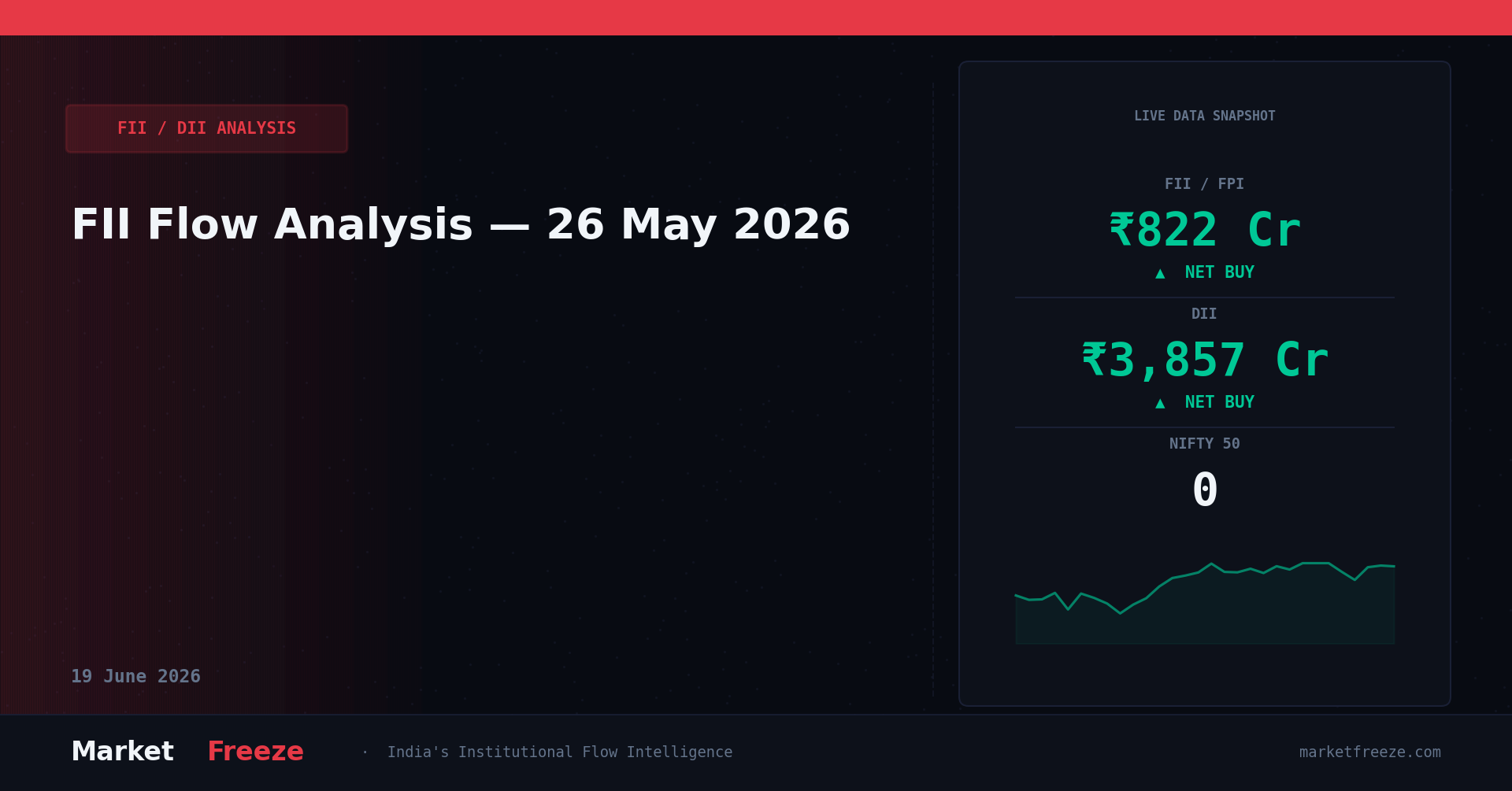
- Net Flow: ₹821.75 crore (BUY)
On 26 May 2026, Foreign Institutional Investors registered a net buy of ₹821.75 crore in the Indian equity markets. While this represents a positive inflow, its magnitude offers a specific insight. FII flows are often considered a critical barometer of global risk appetite and their perception of India’s growth prospects relative to other investment avenues worldwide. A net buying figure, even if modest, suggests a degree of confidence or tactical positioning, particularly when considered against the backdrop of global geopolitical and economic developments.
The pattern analysis for FII net buying of approximately ₹822 crore reveals a unique occurrence in recent market history: “Only 1 similar sessions in 90-day dataset — insufficient matches for reliable probability estimate.” This limitation is crucial for investors to acknowledge. It highlights the challenge of drawing definitive short-term predictive conclusions based solely on an isolated, statistically rare data point. Instead, a more prudent approach involves focusing on the broader trend of FII engagement, assessing how it aligns with macro narratives, and avoiding over-interpretation of singular, statistically anomalous events. FII activity is highly sensitive to factors such as global interest rate differentials, commodity price movements, geopolitical stability, and the relative attractiveness of Indian equities compared to other markets. A moderate positive flow today could be indicative of selective allocation, potentially targeting specific sectors or large-cap companies that offer defensive characteristics or clear growth visibility amidst global volatility. It remains imperative to monitor whether this positive trend sustains or if it represents merely a temporary fluctuation, especially in light of the evolving US bond market dynamics.
📊 Track institutional flows like FII/DII daily — and act on them with zero brokerage.
Domestic Institutional Investors (DIIs) Activity
- Net Flow: ₹3,856.88 crore (BUY)
In a notable contrast, Domestic Institutional Investors demonstrated robust buying interest on 26 May 2026, with a substantial net inflow of ₹3,856.88 crore. This significant figure underscores the sustained strength and unwavering confidence of domestic capital in the Indian market. DII buying typically encompasses investments from mutual funds, insurance companies, and pension funds, which collectively channel a substantial portion of household savings into equities. Their consistent and strong buying provides a crucial cushion against potential FII outflows and injects a vital element of stability into the market.
The sheer magnitude of DII buying today, which is nearly five times that of FII buying, powerfully reinforces the narrative of India’s structural growth story being increasingly supported by indigenous liquidity. This trend has been a defining characteristic of the Indian market in recent years, where local investors have consistently shown resilience, a long-term investment perspective, and a growing understanding of market dynamics. For retail investors, strong DII participation often signals underlying fundamental strength and a profound belief in the market’s long-term trajectory, thereby potentially reducing volatility during periods of external pressure or FII caution.
This sustained domestic demand suggests that any market dips or corrections primarily driven by global events are likely to be met with strong buying interest from DIIs, effectively providing a floor to the market. It also reflects a maturing domestic investor base that is increasingly sophisticated in deploying capital, moving away from traditional asset classes towards equities for long-term wealth creation. This domestic resilience is a cornerstone of the Indian market’s current stability and future potential.
Global Market Dynamics: US Bond Yields and Iran Talks
The top market story today, originating from the United States, carries profound implications for global financial markets, including India. The headline, “US Stock Market: Bond yields drop after Trump signals progress in Iran talks,” points to a critical shift in global risk perception and macroeconomic expectations.
Summary: “Treasury yields declined as optimism around a US-Iran agreement boosted demand for government bonds. Softer oil prices eased inflation concerns, reducing pres…”
The ramifications of this significant development are multi-faceted and warrant detailed consideration:
- Bond Yields and Equity Valuations: A noticeable drop in US Treasury yields makes fixed-income investments inherently less attractive relative to equities. Furthermore, lower bond yields reduce the discount rate commonly employed in equity valuation models, which theoretically increases the present value of future corporate earnings. This mechanism typically fosters a more favorable environment for equity markets globally, particularly benefiting growth-oriented stocks that derive a larger portion of their value from future cash flows.
- Inflation Expectations: The prospect of an agreement with Iran often signals an anticipated increase in global oil supply, which in turn leads to softer crude oil prices. Lower oil prices directly alleviate inflationary pressures, a significant positive for central banks worldwide. Reduced inflation concerns provide greater flexibility for central banks to adopt or maintain accommodative monetary policies, or at the very least, to slow down any ongoing monetary tightening cycles. This is a crucial factor for global economic stability.
- Global Liquidity: The combined effect of easing inflation concerns and the potential for less hawkish central bank stances can lead to an improvement in global liquidity conditions. Such an environment is generally highly beneficial for emerging markets like India, as it can encourage FIIs to allocate more capital to higher-growth economies, seeking better returns in a less restrictive global funding landscape.
- Risk Sentiment: Geopolitical de-escalation, exemplified by progress in high-stakes talks such as those with Iran, typically reduces global uncertainty and boosts overall risk appetite among investors. This positive shift can encourage a rotation of capital out of traditional safe-haven assets (like government bonds, leading to their yield drops) and into riskier assets, including equities in both developed and emerging markets.
For Indian markets, this global development is predominantly positive. Lower crude oil prices directly benefit India, a major net oil importer, by improving its current account deficit, reducing imported inflation, and easing pressure on the Rupee. The positive shift in global risk sentiment could also encourage greater FII participation, thereby complementing the already strong domestic institutional flows.
Cryptocurrency Market Snapshot: 26 May 2026
The cryptocurrency market on 26 May 2026 presents a picture of caution, offering a slight contrast to the generally positive sentiment emanating from the traditional financial markets due to the US-Iran news.
- Bitcoin: $76,796 (₹7,326,385) | 24h: -0.7%
- Ethereum: $2,096.86 (₹200,043) | 24h: -0.4%
- Solana: $84.58 (₹8,069.17) | 24h: -1.6%
All three major cryptocurrencies show slight negative movements over the last 24 hours. While these movements are not drastic, they do indicate a mild profit-taking or a cautious stance among crypto investors. This suggests that the broader risk-on sentiment from the US market news has not fully translated into the highly speculative crypto space, or perhaps that crypto markets are reacting to other internal dynamics, such as ongoing regulatory discussions, or simply undergoing a period of consolidation after previous rallies.
Crypto Fear & Greed Index
- Value: 34/100 — Fear
The Crypto Fear & Greed Index registering 34/100, firmly positioned in the “Fear” zone, further underscores the cautious sentiment prevalent in the digital asset space. This proprietary index measures overall market sentiment using a variety of factors, including volatility, market momentum and trading volume, social media sentiment, and Bitcoin dominance. A “Fear” reading indicates that investors are generally apprehensive, potentially due to recent price corrections, persistent regulatory uncertainties, or broader macroeconomic concerns specific to the crypto ecosystem.
The divergence between the somewhat positive traditional market cues (driven by US-Iran talks and falling bond yields) and the cautious crypto sentiment is particularly noteworthy. It suggests that while macro factors are improving for traditional financial assets, the crypto market might be operating under its own distinct set of concerns, which could include regulatory overhangs, persistent inflation worries for a segment of crypto investors, or simply a period of consolidation after previous speculative rallies. For investors, this indicates that while broader equity markets might find support from improving global liquidity and reduced geopolitical tensions, the more speculative end of the risk spectrum (such as cryptocurrencies) might still require careful monitoring for clear signs of a sustained recovery in sentiment.
Inter-market Analysis and Investor Implications for 26 May 2026
Synthesizing the various data points from 26 May 2026, a coherent picture emerges for serious retail traders and investors seeking to navigate the current market landscape:
- Positive Global Tailwinds: The decline in US bond yields and the easing of inflation concerns, largely attributed to potential progress in Iran talks, represent significant positive catalysts. These factors are conducive to a more benign global liquidity environment and a reduced cost of capital, which is generally favorable for equity markets worldwide, including India.
- Domestic Market Resilience: The substantial DII buying activity provides a robust domestic foundation for the Indian market. This suggests that local investors are actively capitalizing on any market dips and maintaining strong confidence in India’s long-term growth story. This sustained domestic support acts as a crucial buffer against potential global headwinds or intermittent FII profit-booking, lending stability to the market.
- FII Nuance: While FIIs registered a net buy today, the modest amount and the lack of a clear, statistically reliable pattern signal that foreign investors might still be adopting a selective or tactical approach. Their sustained positive participation will largely depend on the continued improvement in global risk sentiment and India’s relative economic performance compared to other emerging markets.
- Crypto as a Risk Barometer: The “Fear” sentiment prevalent in the crypto market, despite generally positive global macro news, suggests that the most speculative end of the risk spectrum remains under pressure. This could be interpreted as a leading indicator of lingering caution among a segment of global investors or specific challenges within the crypto space itself. It serves as a reminder that not all risk assets move in perfect lockstep, and different segments of the market can react to varying catalysts.
For retail investors, the current environment on 26 May 2026 suggests a nuanced approach. While global cues are turning more favorable, particularly concerning inflation and interest rate expectations, vigilance is still warranted. The strong domestic liquidity provides a robust support system for the Indian market. Investors might consider focusing on fundamentally strong companies that are poised to benefit from lower commodity prices and improved global liquidity, while also maintaining a diversified portfolio to mitigate against sector-specific or broader global risks.
Monitoring the trajectory of global bond yields, crude oil prices, and the broader geopolitical landscape will be critical in the coming weeks and months. The intricate interplay between these global factors and India’s inherent economic strengths will ultimately dictate the market’s direction. However, the sustained confidence demonstrated by DIIs remains a powerful testament to the underlying belief in India’s long-term growth narrative and its resilience in the face of external uncertainties.
📬 Get FII/DII Data Every Morning — Free
Join thousands of Indian traders who start their day with MarketFreeze. Daily FII/DII flow, Nifty outlook, and crypto — delivered by 8 AM IST.