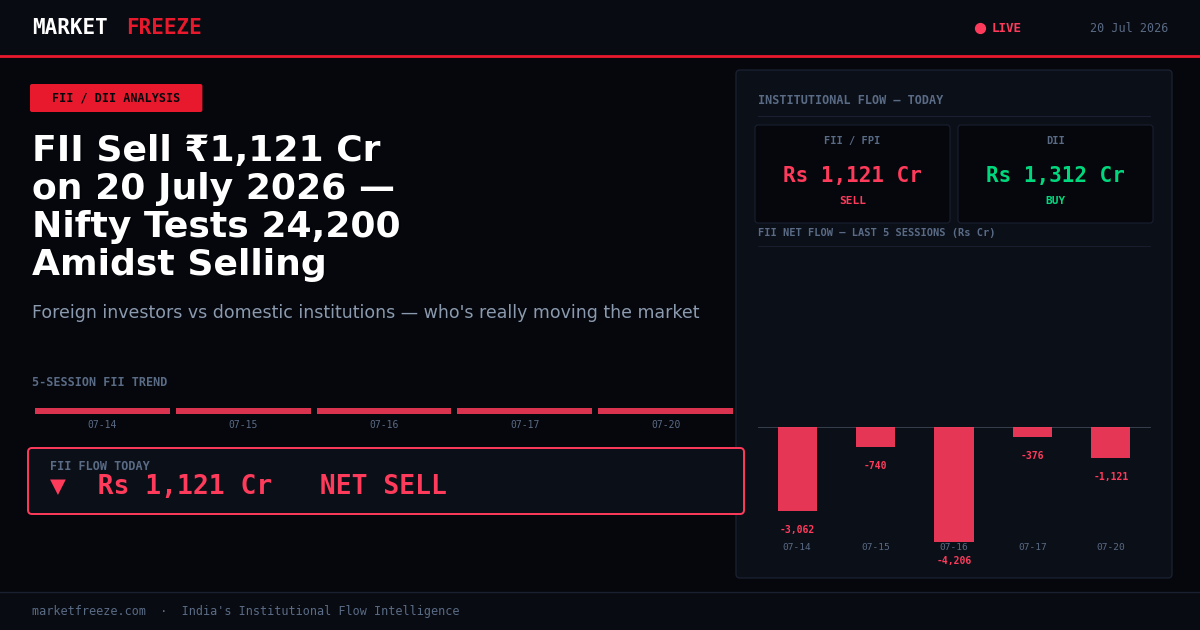
India’s equity markets absorbed ₹1,121.04 Cr in Foreign Institutional Investor (FII) selling and saw Domestic Institutional Investors (DIIs) inject ₹1,312.03 Cr today, 20 July 2026, as the Nifty 50 closed down 0.39% at 24,238.50 and the Sensex shed 0.57% to 77,709.00.
Open a free demat account with
Upstox
or
Angel One
— zero brokerage on delivery trades.
FII Selling Accelerates Despite DII Support
FIIs continued their selling streak, offloading a net of ₹1,121.04 Cr today. This outflow marks an acceleration from the ₹376.41 Cr net sale on 17 July 2026, though it falls short of the significant ₹4,205.56 Cr divestment recorded on 16 July 2026. The gross turnover in FII activity today was ₹13,312.67 Cr in buys and a higher figure in sells (actual sell figure not provided, but implied by net), suggesting a directional bias rather than high conviction across the board. Meanwhile, DIIs demonstrated strong buying conviction, stepping in with a net purchase of ₹1,312.03 Cr, exceeding their ₹1,017.89 Cr net buy on Friday and significantly bolstering the market against sharper declines.
The actionable insight: Retail investors should monitor if DII buying can consistently absorb FII selling pressure in the coming sessions. A sustained DII buy above ₹1,000 Cr while FIIs remain net sellers indicates domestic strength.
Nifty’s Defensive Stance and Support/Resistance Zones
The Nifty 50 closed at 24,238.50, down 0.39%. Today’s FII selling pressure suggests immediate resistance near the 24,400 mark, a level touched intraday. Conversely, the sustained DII buying and the FII outflow figure imply that the 24,100 level is currently acting as a crucial support zone. Any breach below 24,100 on increased FII selling would signal a potential downside target towards 23,800. Conversely, a push above 24,400, especially on reduced FII selling and increased DII buying, could open up the upside towards 24,600.
The actionable insight: Traders should consider building positions with a tighter stop-loss. A break below 24,100 could signal a short-term downtrend, while holding this level might offer a tactical entry point for counter-trend trades.
Banking Sector Dragged by Geopolitical Fears
Banking stocks were a key drag on the indices today, with the Bank Nifty closing down 0.98% at 57,945.00. This decline aligns with commentary referencing escalating Iran-US tensions and surging crude prices, which typically pressure banking margins and loan growth prospects. While specific FII/DII sector allocation data is not granular enough to pinpoint exact banking trades, the broad market selling by FIIs and the defensive buying by DIIs suggest a cautious approach towards rate-sensitive sectors like banking. Analysts cited in the news also highlighted banking stocks as major losers.
The actionable insight: Retail investors should view banking stocks with caution in the short term. Monitor the Bank Nifty’s ability to hold 57,500; a fall below this could signal further downside.
Real Estate Shows Resilience Amidst Broader Market Weakness
In contrast to the broader market’s performance, real estate developers, as exemplified by Sobha Ltd.’s strong Q1 results, are demonstrating resilience. Sobha reported a 50% year-on-year revenue rise and profit tripling to ₹50.8 crore. While this is a company-specific result, it suggests that the real estate sector might be less impacted by immediate geopolitical concerns and more by fundamental demand drivers. FIIs’ broad-based selling today doesn’t provide specific sector-level data, but DIIs’ consistent buying could be selectively favoring sectors with clear earnings visibility, potentially including real estate.
The actionable insight: Investors seeking defensive plays should investigate real estate companies with strong balance sheets and demonstrable earnings growth, looking for signs of DII accumulation.
USD/INR Weakness Aligns with Risk-Off Appetite
The Indian Rupee weakened to Rs96.48 against the US Dollar, down 0.21% today. This movement aligns with news reports indicating the Rupee hitting a two-month low and the RBI intervening by selling dollars. The persistent FII selling, coupled with global geopolitical anxieties (Iran-US tensions), typically leads to currency depreciation as foreign capital flows out. While Gold prices saw a marginal dip of 0.01% on MCX, Crude oil prices rose 0.49%, creating a mixed commodity environment. However, the dominant factor today appears to be the currency weakness driven by FII outflows.
The actionable insight: Retail investors should be aware that a weaker Rupee can increase import costs, potentially impacting inflation and corporate margins for companies reliant on imported raw materials or finished goods.
Historical Flow Context: A Familiar Pattern of FII Exit, DII Entry
Today’s flow pattern—significant FII selling juxtaposed with robust DII buying—is not unprecedented. On 16 July 2026, we observed a net FII sell of ₹4,205.56 Cr, met by a DII buy of ₹2,986.41 Cr. The Nifty closed at 24,072.75 that day. Following that large FII outflow, the Nifty saw a recovery in the subsequent two sessions, closing at 24,334.30 on 17 July and then at 24,238.50 today. This suggests DII support can indeed stabilize the market and lead to a rebound, provided FII selling doesn’t re-accelerate drastically.
The actionable insight: Past performance is not indicative of future results, but the observed pattern suggests that aggressive DII buying can cushion FII selling pressure and potentially set the stage for a market recovery if the selling intensity wanes.
Key Data Snapshot: FII/DII Flows Over the Last 5 Sessions
| Date | FII Net (Cr) | DII Net (Cr) | Nifty Close |
|---|---|---|---|
| 2026-07-14 | ₹-3,062.27 Cr | +₹2,171.70 Cr | 24,086.45 |
| 2026-07-15 | ₹-739.69 Cr | +₹2,927.71 Cr | 24,078.50 |
| 2026-07-16 | ₹-4,205.56 Cr | +₹2,986.41 Cr | 24,072.75 |
| 2026-07-17 | ₹-376.41 Cr | +₹1,017.89 Cr | 24,334.30 |
| 2026-07-20 | ₹-1,121.04 Cr | +₹1,312.03 Cr | 24,238.50 |
FAQ Section
What was the net FII sell today on 20 July 2026?
FIIs were net sellers of ₹1,121.04 Cr in the Indian equity markets today.
How much did DIIs buy today when FIIs were selling?
DIIs bought a net of ₹1,312.03 Cr today, providing a counter-balance to FII selling.
Where did the Nifty 50 close on 20 July 2026?
The Nifty 50 closed at 24,238.50 on 20 July 2026, down 0.39%.
Sector Rotation: A Shift Towards Value Amidst Uncertainty
The divergence in market performance today, with banks under pressure and real estate showing promise, hints at a potential sector rotation. As geopolitical uncertainties persist and crude prices hover around elevated levels, investors may be recalibrating their portfolios away from growth-oriented, high-beta sectors towards more defensive, value-oriented plays. The FIIs, known for their global macro views, might be trimming exposure to rate-sensitive sectors that could be impacted by prolonged inflationary pressures or slower economic growth. Conversely, DIIs, with their deeper understanding of domestic fundamentals, could be capitalizing on perceived undervaluation in sectors like real estate, which benefit from tangible demand and government support. The fact that the Nifty shed just 0.39% despite significant FII selling underscores this defensive positioning by domestic institutions.
The actionable insight: Retail investors should analyze the underlying drivers of sector performance beyond broad market sentiment. Look for sectors exhibiting strong earnings visibility and resilient demand, even in a challenging global environment, as these may be beneficiaries of sustained DII accumulation.
USD/INR Dynamics: A Window into Emerging Market Sentiment
The Rupee’s dip to Rs96.48 against the US Dollar is more than just a technical movement; it reflects a broader risk-off sentiment impacting emerging markets. When foreign investors pull capital from a market, as evidenced by the FII selling of over ₹1,121 Cr, the demand for the local currency weakens, leading to depreciation. The fact that the RBI had to intervene by selling dollars suggests a degree of discomfort with the pace of the Rupee’s decline. This currency weakness, in turn, can create a feedback loop, making Indian assets less attractive to foreign investors due to the potential for currency losses in addition to market volatility. The simultaneous rise in crude oil prices further exacerbates this, as India is a net importer of oil, increasing the import bill and putting additional pressure on the Rupee.
The actionable insight: Monitor the USD/INR cross rate closely. A sustained move above Rs96.50 could signal increased foreign capital outflows and heightened market volatility, potentially acting as a headwind for equity markets.
The Role of Retail Investors in a Volatile Environment
While FIIs and DIIs dominate the headline figures, the actions of retail investors often play a crucial role, especially during periods of heightened volatility. Today’s market saw the Nifty shed 0.39% and the Sensex 0.57%, indicating a cautious mood. In such scenarios, retail investors can either panic and sell, exacerbating the downturn, or step in to absorb some of the selling pressure, particularly in fundamentally sound stocks. Their participation, often characterized by a longer-term investment horizon, can provide a stabilizing influence. Given the strong DII buying, it’s plausible that some of this activity is aimed at providing liquidity and support, anticipating a rebound. The resilience shown by the market despite substantial FII outflows of over ₹1,121 Cr suggests that retail and domestic institutional buying is providing a floor.
The actionable insight: Retail investors should focus on their long-term financial goals and avoid making impulsive decisions based on short-term market fluctuations. Utilizing the DII buying patterns as an indicator of potential value can be a prudent strategy.
Bottom Line
Today’s trading session was characterized by significant FII selling of ₹1,121.04 Cr, a continuation of their recent outflow trend, which pulled the Nifty 50 down by 0.39% to 24,238.50. However, robust DII buying, amounting to ₹1,312.03 Cr, provided crucial support, preventing a steeper market decline. Geopolitical tensions and rising crude prices contributed to a cautious undertone, particularly impacting banking stocks. The Rupee also weakened to Rs96.48 as FII outflows persisted.
Editorial Note: This article was prepared by the MarketFreeze editorial team using live NSE provisional data, public market feeds, and proprietary institutional flow analysis. All price and flow figures are sourced directly from NSE, BSE, and CoinGecko as of 20 July 2026. This content is for informational purposes only and does not constitute investment advice. MarketFreeze is not SEBI-registered. Please consult a qualified financial advisor before making investment decisions. Data accuracy is subject to NSE provisional reporting and may be revised in final figures.