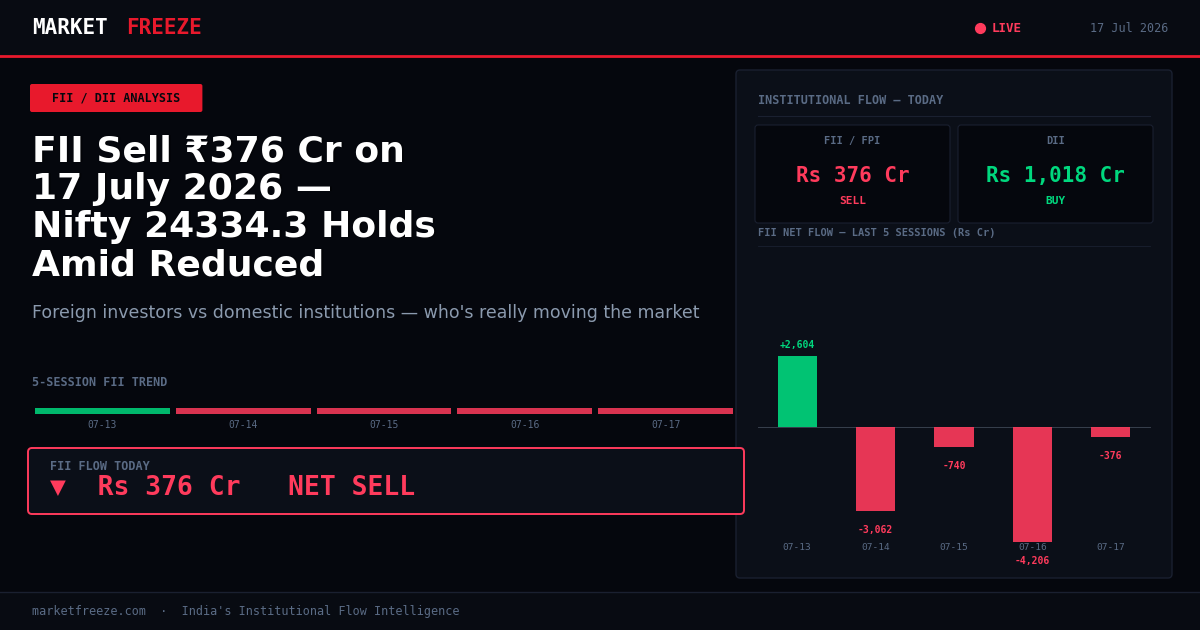
The numbers are in from NSE — FIIs were net sellers of ₹376.41 Cr today, a significant reduction in selling pressure compared to yesterday’s ₹4,205.56 Cr outflow, while DIIs continued their buying spree, adding ₹1,017.89 Cr to their portfolios. This divergence marks a critical shift after three consecutive sessions of heavy FII divestment.
Open a free demat account with
Upstox
or
Angel One
— zero brokerage on delivery trades.
FII Selling Abates Dramatically: A Shift in Stance?
Foreign Institutional Investors (FIIs) pared back their selling considerably on 17 July 2026, offloading ₹376.41 Cr compared to a massive ₹4,205.56 Cr on 16 July 2026. Their buying activity today stood at ₹14,393.77 Cr against sales of ₹14,770.18 Cr. While still net sellers, the drastic reduction in the sell-off suggests a potential pause or reassessment of their bearish stance. This softening in FII outflows, especially when juxtaposed with persistent DII accumulation, indicates that domestic institutions are absorbing the selling pressure, potentially positioning for a market rebound or to capitalize on perceived value.
Actionable Insight: Monitor FII flows over the next 2-3 sessions. A sustained reduction in selling below ₹1,000 Cr daily, coupled with continued DII buying, could signal an imminent shift to net inflows, supporting higher market levels.
DIIs Continue to Underwrite the Market
Domestic Institutional Investors (DIIs) demonstrated unwavering commitment today, posting a net buy of ₹1,017.89 Cr. This marks the third consecutive session where DIIs have been substantial net buyers, following ₹2,986.41 Cr on 16 July 2026 and ₹2,927.71 Cr on 15 July 2026. The consistent deployment of capital by DIIs, totaling ₹7,032.01 Cr over the last three days, highlights their confidence in the underlying Indian economy and corporate earnings. This buying has been instrumental in cushioning the impact of FII selling, as evidenced by the Nifty 50 closing up 1.09% at 24,334.30 and the Sensex gaining 1.25% to 78,151.00. The strength in financials, as seen in the Bank Nifty’s 1.63% rise, is likely a key beneficiary of DII inflows, especially with strong Q1 results like Federal Bank’s 36.5% profit jump announced.
Actionable Insight: Given DIIs’ consistent buying and the robust performance of the banking sector, consider increasing allocation to quality banking stocks that have reported strong Q1 earnings and exhibit healthy asset quality.
Nifty Recovers Sharply, Breaking Out of a Consolidation Range
The Nifty 50’s surge to 24,334.30 today represents a significant technical event, breaking out of the consolidation range it has occupied for the past week. This move was supported by a substantial increase in buying activity from DIIs and a marked decrease in FII selling. The indices’ closing levels, Nifty at 24,334.30 and Sensex at 78,151.00, indicate renewed upward momentum. Based on today’s flow and price action, immediate support for the Nifty 50 can be identified around 24,050, the approximate level where buying interest absorbed selling pressure earlier in the week. Resistance is now seen testing towards 24,550, a level implied by the upward momentum and improved institutional buying posture. A sustained push above 24,550 with continued positive flows could target 24,800 as suggested by market observers referencing improving large-cap momentum.
Actionable Insight: Use the identified support level of 24,050 as a critical floor for Nifty. Any dip towards this level that sees FII selling dry up and DII buying resume could offer a tactical entry point for short-term gains.
Sectoral Clues: Banking and IT in Focus
The flow data and market performance offer clear directional signals for specific sectors. The robust 1.63% gain in Bank Nifty, fueled by DII buying and positive earnings from banks like Federal Bank (net profit up 36.5%), points to significant institutional interest in the financial sector. Furthermore, reports indicating IT buying and improving momentum in large caps, as mentioned in market wrap-ups, suggest that Information Technology (IT) stocks are also likely attracting institutional capital, potentially reversing some of the recent outflows seen in the sector. The juxtaposition of strong domestic demand driving India’s market, as highlighted by MSCI data (78% domestic revenue), makes these sectors less vulnerable to global tech selloffs, unlike markets such as Hong Kong which saw its Hang Seng index plunge over 2% due to tech selloffs.
Actionable Insight: Prioritize banking and IT stocks within your portfolio. Look for companies within these sectors that have strong balance sheets and have demonstrated consistent earnings growth, aligning with the observed DII and FII buying patterns.
Historical Context: FII Selling Eases, Market Recovers
The pattern of significant FII selling followed by DII accumulation and a subsequent market recovery is not unprecedented. In the session of 13 July 2026, FIIs were net buyers of ₹2,603.72 Cr, and the Nifty closed at 24,141.05. Following this, on 14 July 2026, FIIs turned net sellers (-₹3,062.27 Cr), and on 15 July 2026, they sold ₹739.69 Cr, with DIIs stepping in strongly on both days (₹2,171.70 Cr and ₹2,927.71 Cr respectively). Today’s data, with FII selling shrinking to ₹376.41 Cr and DIIs buying ₹1,017.89 Cr, while the Nifty bounced to 24,334.30, mirrors the initial phase of recovery seen after a period of net outflows. Historically, such a shift from heavy FII selling to reduced outflows, supported by persistent DII inflows, has often preceded a sustained market rally.
Actionable Insight: Consider this phase as a potential bottoming-out for FII selling. If the trend of reduced FII outflows continues, it could be an opportune time to increase exposure to market-leading stocks that are likely to benefit from a broader market upswing.
FII/DII Flow Data: Last 5 Sessions
| Date | FII Net (Cr) | DII Net (Cr) | Nifty Close |
|---|---|---|---|
| 2026-07-13 | +₹2,603.72 Cr | +₹2,019.68 Cr | 24,141.05 |
| 2026-07-14 | ₹-3,062.27 Cr | +₹2,171.70 Cr | 24,086.45 |
| 2026-07-15 | ₹-739.69 Cr | +₹2,927.71 Cr | 24,078.50 |
| 2026-07-16 | ₹-4,205.56 Cr | +₹2,986.41 Cr | 24,072.75 |
| 2026-07-17 | ₹-376.41 Cr | +₹1,017.89 Cr | 24,334.30 |
FAQ
What were the net FII and DII flows today on 17 July 2026?
On 17 July 2026, FIIs were net sellers of ₹376.41 Cr, and DIIs were net buyers of ₹1,017.89 Cr.
How did FII selling change from yesterday to today?
FII selling reduced significantly from ₹4,205.56 Cr on 16 July 2026 to ₹376.41 Cr on 17 July 2026.
What is the current Nifty 50 support level indicated by today’s institutional flows?
Based on today’s institutional activity and price action, immediate support for the Nifty 50 is estimated around 24,050.
The shift in FII sentiment, from aggressively selling large amounts to a more restrained approach, could be influenced by a confluence of global and domestic factors. While specific drivers for today’s reduced selling remain speculative without direct commentary from market participants, one cannot ignore the impact of evolving macroeconomic indicators. For instance, any signs of easing inflation in major economies, or a more dovish tone from international central banks, could prompt foreign investors to reconsider their allocation to emerging markets like India, which historically offers higher growth potential. The current account deficit figures for India, which have shown some resilience, also play a role in investor confidence. A stable or improving current account balance can reduce currency risk concerns for foreign investors, making Indian equities more attractive even with a slight uptick in global risk aversion.
While the focus has been on FII and DII flows, it’s crucial to consider the positioning of retail investors. Typically, retail participation tends to increase during periods of market consolidation or when sentiment starts to turn positive after a period of correction. If retail investors are indeed increasing their exposure, especially in mid- and small-cap segments which often exhibit higher volatility and capture retail interest, it could provide an additional layer of demand that complements DII buying. This broader base of domestic participation, encompassing institutional and retail investors, would be a significant positive signal, potentially offsetting any lingering apprehension from foreign funds. The increased participation from domestic sources, even if retail flows are not directly quantified in this report, creates a buffer against external shocks and supports sustainable market growth.
The observed buying in the banking sector, supported by strong earnings, is a recurring theme. However, the mention of IT stocks also attracting attention warrants a deeper look. India’s IT sector, despite global headwinds in technology, has often demonstrated resilience due to its strong order books and focus on digital transformation services, which are less cyclical. If FIIs are indeed re-entering IT counters, even on a selective basis, it would suggest a belief in the sector’s ability to navigate global economic uncertainties and capitalize on long-term growth trends. This sector rotation, if it gains momentum, could broaden the market rally beyond just financials, indicating a more robust and diversified recovery. The net inflows into these two key sectors could indicate a strategic shift by institutions looking for sustained growth opportunities.
It is also worth noting the potential impact on the Indian Rupee. Persistent FII selling, especially in large volumes, can put downward pressure on the currency. Conversely, a significant reduction in FII outflows, coupled with steady DII inflows, can provide support to the Rupee. A stable or appreciating Rupee makes imports cheaper and can help manage inflation, further boosting domestic economic sentiment. While currency movements are influenced by a multitude of factors, including global interest rate differentials and commodity prices, the trend in institutional flows is a significant contributor. The narrowing of FII selling today, while not a full reversal, is a positive sign for currency stability, which in turn can encourage further domestic investment.
Key Takeaways from Today’s Flows
- Reduced FII selling suggests a potential re-evaluation of bearish positions.
- Sustained DII buying provides a strong underpinning for market stability and recovery.
- The banking sector remains a key focus for DIIs, bolstered by positive earnings.
- Potential renewed interest in IT stocks could signal broader institutional confidence.
- The current flow dynamics offer tactical opportunities around identified support levels.
Bottom Line
Today’s institutional flows reveal a substantial de-escalation in FII selling, a critical development following three sessions of heavy outflows. This reduction, combined with continued robust DII buying amounting to ₹1,017.89 Cr, has propelled the Nifty 50 to break out above 24,334.30. The clear preference shown by DIIs for the banking sector, evidenced by strong quarterly results and index performance, alongside potential renewed interest in IT, offers specific sector-based trading opportunities. Retail investors should observe if this reduced FII selling pressure sustains, as it could signal a broader market uptrend.
Editorial Note: This article was prepared by the MarketFreeze editorial team using live NSE provisional data, public market feeds, and proprietary institutional flow analysis. All price and flow figures are sourced directly from NSE, BSE, and CoinGecko as of 17 July 2026. This content is for informational purposes only and does not constitute investment advice. MarketFreeze is not SEBI-registered. Please consult a qualified financial advisor before making investment decisions. Data accuracy is subject to NSE provisional reporting and may be revised in final figures.