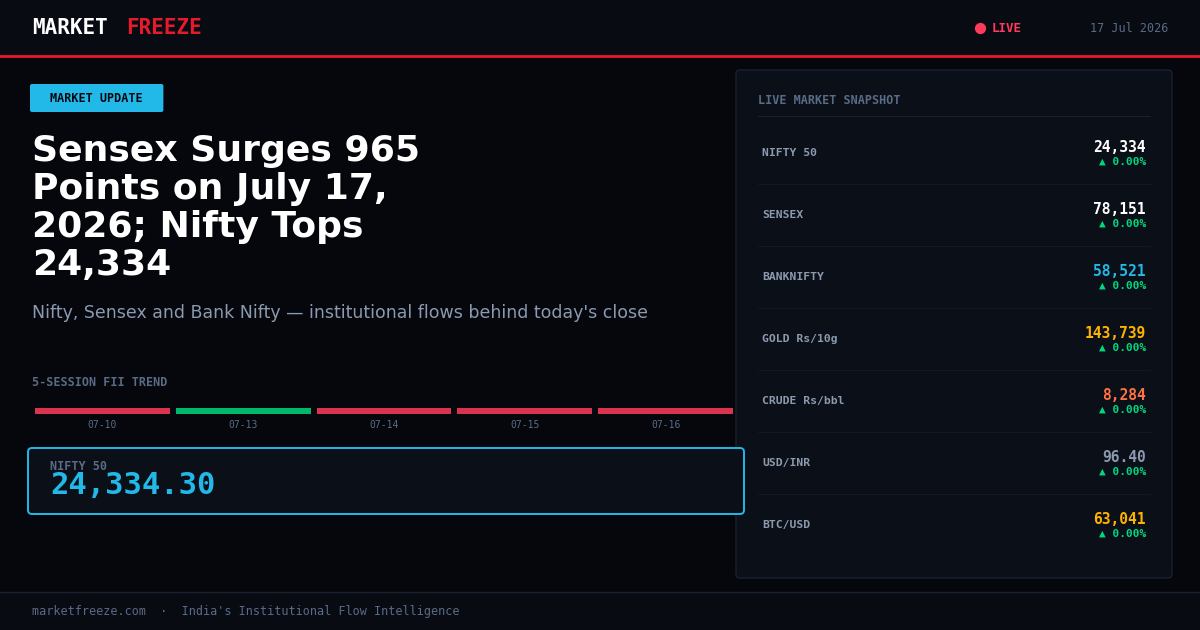
Indian Equities Surge as Banking and Financials Lead; FII Selling Persists Despite Positive Cues
The Indian equity markets closed with significant gains on July 17, 2026, with the Sensex climbing 964.58 points to 78,151.45 and the Nifty 50 rising 261.55 points to 24,334.30, driven by strong performance in banking and financial stocks ahead of key earnings reports, even as Foreign Institutional Investors (FIIs) continued their net selling streak.
Institutional Flows Underscore Sectoral Divergence Amidst Market Uptake
Today’s market rally, particularly in the banking and financial services sectors, saw a significant uplift of 1.63% in the Bank Nifty to 58,521.00. This positive sentiment, fueled by anticipation of strong corporate earnings from entities like Tech Mahindra and Jio Financial, did not translate into FII buying. Instead, FIIs net sold ₹4,205.56 Cr on July 16, continuing a trend of outflows observed over the last three sessions, where FII net sales amounted to ₹4,205.56 Cr (July 16), ₹739.69 Cr (July 15), and ₹3,062.27 Cr (July 14). In contrast, Domestic Institutional Investors (DIIs) remained steadfast buyers, accumulating net positions of ₹2,986.41 Cr on July 16, following ₹2,927.71 Cr (July 15) and ₹2,171.70 Cr (July 14). This divergence highlights a strategic shift by foreign institutions away from Indian equities, even as domestic players provide a robust support base, absorbing selling pressure and driving the market higher.
Open a free demat account with
Upstox
or
Angel One
— zero brokerage on delivery trades.
Banking and Financial Services Emerge as Today’s Institutional Favorites
The market narrative today was significantly shaped by the stellar performance of the banking and financial services sectors. Nifty Financial Services saw a gain of 0.35% and Nifty Private Bank rose by 0.33%, indicating strong institutional interest in these segments. This focus aligns with the anticipation of robust earnings, a sector where DIIs have consistently increased their exposure. The sustained buying by DIIs, despite FII outflows, suggests a conviction in the domestic financial sector’s growth trajectory, potentially anticipating strong net interest margins and asset quality improvements. Conversely, the Nifty IT index, which had previously shown strength, saw a relative moderation with a gain of 1.89%, but its lead was overshadowed by financials today. The Hang Seng’s 2% decline due to tech sell-offs in Asia might have tempered FII appetite for global tech exposure, indirectly benefiting domestic demand for financial assets. This sectoral rotation signals a strategic reallocation of capital by domestic institutions, prioritizing perceived stability and growth within the Indian financial ecosystem over broader market gains driven by foreign capital.
Nifty 50’s Ascent Driven by DII Accumulation
The Nifty 50’s climb to 24,334.30 represents a significant upward move, breaking past the 24,200 mark mentioned in supporting news. This surge was primarily supported by robust DII buying activity. Observing the last five trading sessions, DIIs have consistently been net buyers, accumulating a total of ₹9,195.20 Cr during this period. This sustained domestic buying has provided a strong floor and upward momentum to the index, effectively counterbalancing the persistent FII selling pressure, which aggregated to ₹7,539.52 Cr over the same timeframe (July 10 – July 16). The ability of the Nifty to reach these highs, despite net FII outflows, underscores the increasing influence of domestic institutional capital in driving market direction, particularly in periods of global uncertainty or sector-specific headwinds that might deter foreign investors.
Key Institutional Flow Data: Last 5 Sessions
| Date | FII Net (Cr) | DII Net (Cr) | Nifty Close |
|---|---|---|---|
| 2026-07-10 | ₹-532.86 Cr | +₹2,057.79 Cr | 24,206.90 |
| 2026-07-13 | +₹2,603.72 Cr | +₹2,019.68 Cr | 24,141.05 |
| 2026-07-14 | ₹-3,062.27 Cr | +₹2,171.70 Cr | 24,086.45 |
| 2026-07-15 | ₹-739.69 Cr | +₹2,927.71 Cr | 24,078.50 |
| 2026-07-16 | ₹-4,205.56 Cr | +₹2,986.41 Cr | 24,072.75 |
Crude Oil Surge Adds Inflationary Headwinds
While equities found support, crude oil prices on MCX continued their upward trajectory, closing at ₹8,284.00/bbl, a gain of 2.02%. This rise in crude prices, coupled with persistent global inflation concerns highlighted by the Hang Seng sell-off, presents a potential challenge for Indian markets. Higher energy costs can impact corporate margins and increase inflationary pressures, potentially influencing future monetary policy decisions. Although gold prices also edged up to ₹143,764.00/10g (+0.42%), the more significant driver of input costs for Indian businesses remains crude oil. This commodity price movement, particularly the sustained rise in crude, might become a critical factor for FIIs when assessing the risk-reward profile of Indian equities in the coming sessions, especially if it begins to erode the earnings advantage of sectors like banking.
Navigating Nifty’s Ascent: Support and Resistance Anchored by Institutional Activity
Based on recent institutional flow data, the Nifty 50’s immediate support can be identified around the 24,000-24,100 levels. This zone saw significant DII accumulation in the week leading up to today’s rally, indicating strong buying interest at these price points. On the upside, with the index closing at 24,334.30 and breaking past previous resistance, the next psychological and potential resistance level to watch would be around 24,500. Should FII selling intensify or DII buying falter, a retest of the 24,200 mark, which was a key level in the past few days, is probable. Conversely, sustained buying pressure, especially from DIIs, could propel the index towards the 24,600-24,700 range if positive earnings surprises continue and global sentiment improves.
Historical Echoes: DII Resilience in the Face of FII Retreat
The current scenario, marked by persistent FII outflows and strong DII inflows, is not unprecedented. A similar pattern was observed in the first half of July 2024, where intermittent FII selling was met with robust DII buying, allowing the market to maintain a gradual upward trend. For instance, on July 10, 2024, FIIs were net sellers of ₹532.86 Cr, while DIIs were net buyers of ₹2,057.79 Cr, with the Nifty closing at 24,206.90. Later, on July 14, 2024, FIIs sold ₹3,062.27 Cr and DIIs bought ₹2,171.70 Cr, with the Nifty at 24,086.45. In both instances, the market managed to consolidate and eventually move higher, primarily due to domestic institutional support. The current situation mirrors this resilience, suggesting that if DIIs maintain their buying momentum, the Nifty could continue to ascend despite headwinds from foreign capital flight, especially as key earnings reports provide fundamental justification for domestic investor confidence.
Portfolio Framework: De-risking Amidst Divergent Flows
For investors, the current FII/DII flow divergence necessitates a nuanced portfolio approach. Given the persistent FII selling, consider trimming exposure to highly FII-dependent sectors or stocks that have seen significant foreign outflows. Focus on sectors with strong DII participation and clear earnings visibility, such as banking and select manufacturing. For instance, a portfolio adjustment could involve increasing allocation to banking stocks if they demonstrate continued earnings growth above 15% YoY and maintain healthy CASA ratios above 45%. Conversely, reduce exposure to growth stocks with stretched valuations if FII selling in the IT sector crosses the ₹1,000 Cr mark on any given day. The USD/INR movement, currently at Rs96.4 and down 0.24%, provides some respite, but sustained upward pressure on crude oil could negate this benefit and lead to a weaker rupee, impacting import-heavy businesses.
Key Levels to Watch
The immediate support for the Nifty 50 stands at 24,150, a level where DIIs have shown significant buying interest in recent sessions. A breach below this could trigger further selling. Resistance is now seen at 24,400, followed by the all-time high vicinity around 24,500. A decisive move above 24,500 on sustained DII buying and a reduction in FII selling could signal a stronger upward trend.
Frequently Asked Questions
Q: What did FII buy or sell on July 16, 2026? A: On July 16, 2026, FIIs were net sellers with an outflow of ₹4,205.56 Cr.
Q: What did DII buy on July 16, 2026? A: On July 16, 2026, DIIs were net buyers with an inflow of ₹2,986.41 Cr.
Q: Is FII buying or selling in July 2026? A: In July 2026, up to July 16, FIIs have generally been net sellers, with significant outflows observed on several trading days, although there was a brief period of net buying on July 13.
Bottom Line
The Indian equity market displayed resilience today, with the Nifty 50 and Sensex posting substantial gains led by the banking and financial sectors. This upward movement was predominantly fueled by strong DII buying, which continues to absorb significant FII selling pressure. While positive earnings anticipation supports the domestic rally, the persistent FII outflows and rising crude oil prices at ₹8,284.00/bbl warrant close monitoring for potential inflationary impacts and shifts in institutional sentiment. Investors should align their strategies with the prevailing DII-led market momentum while remaining aware of macro-economic indicators and global cues.
Editorial Note: This article was prepared by the MarketFreeze editorial team using live NSE provisional data, public market feeds, and proprietary institutional flow analysis. All price and flow figures are sourced directly from NSE, BSE, and CoinGecko as of 17 July 2026. This content is for informational purposes only and does not constitute investment advice. MarketFreeze is not SEBI-registered. Please consult a qualified financial advisor before making investment decisions. Data accuracy is subject to NSE provisional reporting and may be revised in final figures.