Bitcoin is trading at $62,799 USD or ₹6,053,823 INR, down 2.12% in the last 24 hours, as a global selloff in chipmakers drags risk assets lower, pulling bitcoin back from recent highs. The AI frenzy is losing steam, leaving bitcoin less volatile than South Korean stocks, and this sector-wide weakness is also impacting the broader cryptocurrency market.
Open a free demat account with
Upstox
or
Angel One
— zero brokerage on delivery trades.
Global Chip Rout Fuels Crypto Selloff
The cryptocurrency market is experiencing a downturn, with Bitcoin ($62,799 USD | ₹6,053,823 INR) and Ethereum ($1,815 USD | ₹174,966 INR) both seeing declines. This follows a global selloff in semiconductor stocks, a trend exacerbated by the news that China’s Kimi AI model has outperformed established players like Claude and OpenAI in coding benchmarks. This development has sent shockwaves through the tech sector, with semiconductor equities experiencing significant drops. As crypto assets are often correlated with high-growth technology stocks, especially those tied to AI infrastructure, the weakness in chipmakers has directly translated into downward pressure on digital currencies. Solana ($73.75 USD | ₹7,109 INR) also reflects this broader risk-off sentiment, declining by 3.38% in the past 24 hours. The current “Fear & Greed” index at 27/100 signifies a strong presence of fear in the market, aligning with the selloff in technology and risk-sensitive assets.
The USD/INR Dynamics for Indian Crypto Investors
For Indian retail investors, the movement in the USD/INR exchange rate is a crucial factor influencing their actual returns in INR terms, irrespective of the USD-denominated price of cryptocurrencies. Today, the USD/INR stands at ₹96.4. This means that even if Bitcoin’s USD price remains stable, a strengthening INR (USD/INR falling) would reduce the INR value of an investor’s holdings, while a weakening INR (USD/INR rising) would boost it. Currently, with Bitcoin down 2.12% in USD terms, the INR depreciation to ₹96.4 offers a slight buffer, meaning the INR price of Bitcoin has fallen by less than its USD counterpart. Specifically, Bitcoin’s INR price has dropped by 2.12%, mirroring its USD performance due to the stable exchange rate. This highlights the importance of monitoring both global USD prices and local INR dynamics for a complete picture of portfolio performance.
Ethereum’s Relative Weakness Amidst Broader Market Decline
Ethereum ($1,815 USD | ₹174,966 INR) is currently underperforming Bitcoin, as indicated by the ETH/BTC ratio, which has fallen to 0.0289. This means Bitcoin is outperforming Ethereum by a noticeable margin today. Both major cryptocurrencies are experiencing declines, with Ethereum down 3.53% in the last 24 hours. This underperformance suggests that investors are rotating away from altcoins and towards Bitcoin, often seen as a safer haven within the crypto space during periods of heightened uncertainty or sector-specific downturns, like the current chip sector rout. The broader risk-off sentiment, amplified by the AI stock fatigue and global chip selloff, is likely contributing to this divergence, with capital flowing out of riskier altcoins like Ethereum and into the perceived relative safety of Bitcoin.
Navigating the Fearful Crypto Landscape
The “Fear & Greed” index is currently sitting at a low of 27/100, firmly in the “Fear” territory. Historically, readings within the 25-45 range have been significant for Indian equity markets, often marking accumulation zones where sustained institutional buying began. The examples of the March 2020 crash and the fourth quarter of 2022, both of which saw substantial institutional interest emerge when the index was in this zone, are pertinent. While this is a crypto-specific index, the underlying psychology of market participants can be a useful indicator. A reading of 27 suggests that many investors are currently acting out of fear, potentially capitulating on positions. For astute investors, this period of fear, coupled with dips in asset prices, could present an opportunity to accumulate assets at lower valuations, mirroring the historical institutional buying patterns observed in equity markets during similar fear-driven phases.
Institutional Flows and Their Crypto Implications
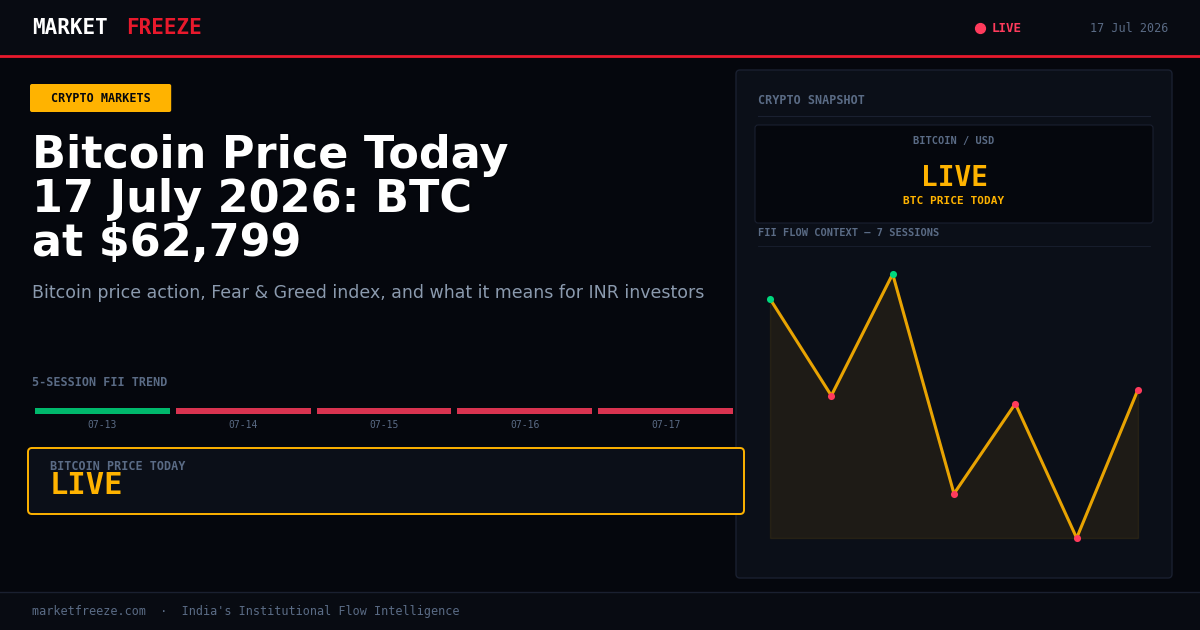
Foreign Institutional Investors (FIIs) were net sellers in Indian equities today, offloading ₹376.41 Cr. This follows a trend of FIIs being net sellers in four out of the last five trading sessions, with the exception being a significant buying spree on July 13th. Domestic Institutional Investors (DIIs), on the other hand, remained net buyers for the fifth consecutive session, injecting ₹1,017.89 Cr into the market today. The Nifty closed at 24334.30 today, showing a modest recovery from previous lows. While today’s FII outflow of ₹376.41 Cr is not as substantial as some previous days, it continues a pattern of caution. The thesis of FIIs reallocating capital from traditional markets to crypto is not strongly supported by today’s flows; in fact, the broader risk-off environment that is impacting equities, and thus FII sentiment, is simultaneously dragging down crypto prices. The correlation remains, with significant FII outflows from equities often coinciding with a broader deleveraging across risk assets, including cryptocurrencies.
Crypto Tax Mechanics: A Hypothetical Scenario
Let’s consider a hypothetical scenario for an Indian investor looking to sell Bitcoin today. Suppose an investor purchased 0.1 BTC on March 15, 2022, when the price was approximately $38,000 USD or ₹30,76,000 INR (assuming a USD/INR of ₹80.95 at the time). If they were to sell this 0.1 BTC today, July 17, 2026, at the current price of $62,799 USD or ₹6,053,823 INR, they would realize a significant capital gain. The total sale value would be ₹60,53,823 INR. The cost of acquisition was ₹30,76,000 INR, resulting in a taxable gain of ₹29,77,823 INR. Under current Indian crypto tax laws (as of the last known regulations), this gain would be taxed at 30% plus applicable cess and surcharge. This means the investor would owe approximately ₹9,72,827 INR in taxes on this single transaction, before any potential TDS implications on subsequent transactions.
Open a free demat account with
Upstox
or
Angel One
— zero brokerage on delivery trades.
Key Levels to Watch in Indian Equities
The Nifty closed at 24334.30 today, a slight rebound after recent declines. Given the ongoing FII selling pressure, albeit reduced today to ₹376.41 Cr, the 24,000 mark on the Nifty remains a critical psychological support level. A sustained break below this could signal further downside, potentially retesting the lows seen in the previous week. Immediate resistance is observed around the 24,500 level, where previous rallies have stalled. With DIIs continuing to provide a floor through consistent buying (+₹1,017.89 Cr today), a sharp breakdown might be mitigated. However, the overall trend of FII caution suggests that upside may be capped until global risk sentiment improves or FII flows turn decisively positive again.
Actionable Framework for Today’s Market Conditions
Given the current “Fear” reading (27/100) and the global tech selloff impacting crypto, here’s a framework for Indian investors:
- Assess Risk Tolerance: With fear prevalent, understand your personal comfort with potential further downside.
- Dollar-Cost Averaging (DCA) in Fear Zones: The historical context of 25-45 Fear & Greed readings marking accumulation zones suggests that periods like this, with prices down and fear high, can be opportune for systematic buying. Consider initiating or continuing DCA strategies in your preferred crypto assets, such as Bitcoin ($62,799 USD | ₹6,053,823 INR) and Ethereum ($1,815 USD | ₹174,966 INR).
- Monitor FII Flows: A significant increase in FII selling (e.g., exceeding ₹1,000 Cr net sellers) in Indian equities could indicate broader risk aversion that might impact crypto as well. Conversely, a shift to FII net buying could signal improving sentiment.
- Focus on Long-Term Holdings: With long-term holders selling at a loss, as indicated by some reports, it suggests potential capitulation. For investors with a long-term horizon, this could be a period to hold firm or even add to positions, anticipating a future recovery.
Historical FII/DII Flows and Nifty Performance
| Date | FII Net (Cr) | DII Net (Cr) | Nifty Close |
|---|---|---|---|
| 2026-07-13 | +₹2,603.72 Cr | +₹2,019.68 Cr | 24,141.05 |
| 2026-07-14 | ₹-3,062.27 Cr | +₹2,171.70 Cr | 24,086.45 |
| 2026-07-15 | ₹-739.69 Cr | +₹2,927.71 Cr | 24,078.50 |
| 2026-07-16 | ₹-4,205.56 Cr | +₹2,986.41 Cr | 24,072.75 |
| 2026-07-17 | ₹-376.41 Cr | +₹1,017.89 Cr | 24,334.30 |
Frequently Asked Questions
Q: What did FII buy or sell on July 17, 2026?
A: On July 17, 2026, FIIs were net sellers in Indian equities, with a net outflow of ₹376.41 Cr.
Q: What did DII buy on July 17, 2026?
A: On July 17, 2026, DIIs were net buyers in Indian equities, with a net inflow of ₹1,017.89 Cr.
Q: Is FII buying or selling in July 2026?
A: In July 2026, FIIs have largely been net sellers, with significant outflows recorded on most trading days, indicating a cautious stance towards Indian equities for the month so far.
Bottom Line
The cryptocurrency market is experiencing a downturn, mirroring weakness in global tech stocks driven by the semiconductor selloff and AI sector fatigue. Bitcoin is currently trading at $62,799 USD (₹6,053,823 INR) amidst widespread fear, as indicated by the low Fear & Greed index reading of 27/100. While FIIs continue to be net sellers in Indian equities, their outflows were moderated today, and DIIs remain consistent buyers. For Indian investors, the current fear-driven market conditions, coupled with the historical precedent of accumulation zones at similar Fear & Greed levels, presents a potential window for strategic, long-term accumulation via Dollar-Cost Averaging.
Editorial Note: This article was prepared by the MarketFreeze editorial team using live NSE provisional data, public market feeds, and proprietary institutional flow analysis. All price and flow figures are sourced directly from NSE, BSE, and CoinGecko as of 17 July 2026. This content is for informational purposes only and does not constitute investment advice. MarketFreeze is not SEBI-registered. Please consult a qualified financial advisor before making investment decisions. Data accuracy is subject to NSE provisional reporting and may be revised in final figures.