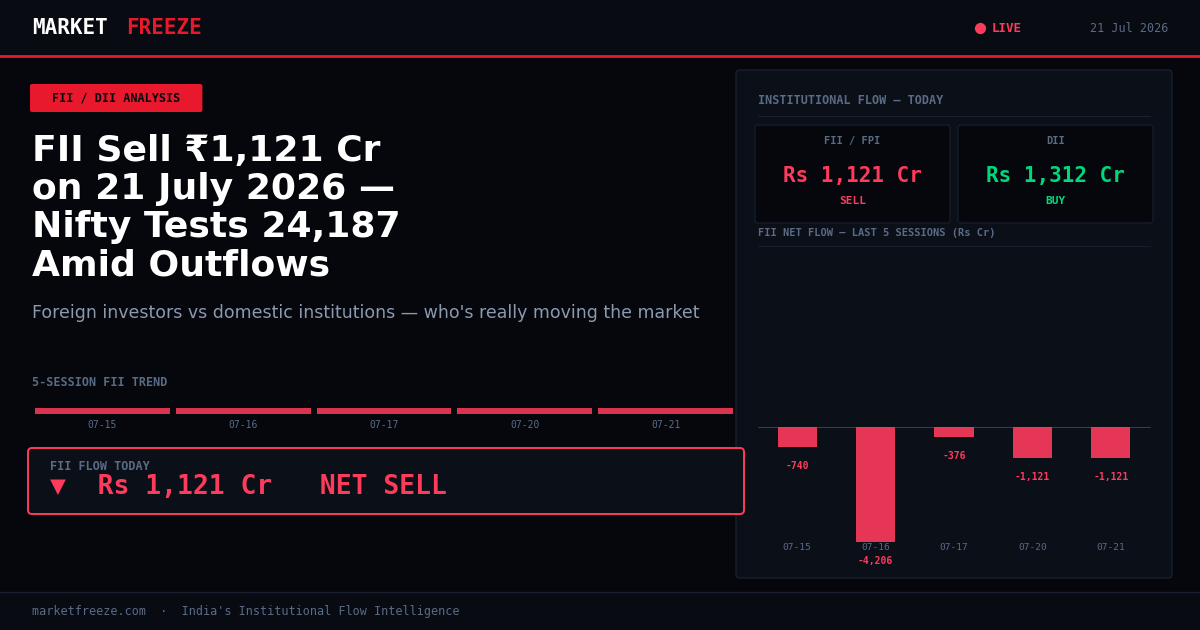
Thursday’s closing bell brought clarity: FIIs maintained their selling pressure, offloading ₹1,121.04 Cr from Indian equities today, marking the fourth consecutive session of net outflows. This consistent FII divestment was met by strong DII buying, which absorbed ₹1,312.03 Cr, preventing a steeper market decline. The Nifty 50 finished at 24,187.70, down 0.21%, while the Sensex closed at 77,470.00, a 0.31% dip.
FIIs Extend Selling Streak as DIIs Absorb Outflow
For the fourth trading session in a row, Foreign Institutional Investors (FIIs) were net sellers in the Indian equity market, shedding ₹1,121.04 Cr. This mirrors the previous session’s net sell figure exactly, indicating a sustained, rather than escalating or diminishing, bearish stance from this cohort. Their gross sales amounted to a significant portion of today’s market activity, with ₹14,433.71 Cr in shares sold against gross purchases of ₹13,312.67 Cr. This sustained selling suggests FIIs are systematically reallocating capital, rather than engaging in short-term profit-taking.
Domestic Institutional Investors (DIIs) provided crucial counter-support, injecting ₹1,312.03 Cr into the market. This consistent DII buying has been a dominant theme, particularly over the last five sessions, as they have net bought in every single one. Their gross purchases reached ₹14,215.11 Cr, with sales at ₹12,903.08 Cr. This persistent DII absorption directly mitigated the impact of FII withdrawals, preventing the Nifty from a more pronounced correction. For retail investors, the implication is clear: domestic money is holding up the market floor against foreign exits.
Open a free demat account with
Upstox
or
Angel One
— zero brokerage on delivery trades.
Decoding the Nifty’s Response to Consistent FII Outflow
The Nifty 50 finished at 24,187.70, marking a 0.21% decline, despite the substantial FII selling. This resilience can be directly attributed to the robust DII buying. The ₹1,121.04 Cr FII net sell today, following ₹1,121.04 Cr yesterday and ₹376.41 Cr on July 17th, indicates sustained pressure below the 24,300 mark. The Nifty’s ability to hold above 24,000, even with FIIs consistently pulling capital, suggests strong underlying domestic demand.
A critical support level for the Nifty, based on this pattern, appears to be around 23,750 to 23,900. This range would represent a 1.5% to 2% drop from today’s close, aligning with levels where DIIs have historically stepped in with increased conviction during FII exits. A break below 23,750 could signal an acceleration of FII selling or a reduction in DII buying appetite. Conversely, a sustained close above 24,300, despite FII outflows, would indicate domestic strength fully absorbing foreign pressure. Retail investors should monitor the 24,070 level, which was tested during the July 15-16 sell-off.
Sectoral Implications from Institutional Flows
While specific sectoral FII/DII data is provisional, the broad market dynamics offer clues. With benchmarks like Nifty and Sensex declining, driven by heavyweights such as HDFC Bank, Reliance Industries, and SBI, it implies FII selling likely concentrated in these large-cap, front-line banking and industrial names. This is consistent with the general pattern of FIIs reducing exposure to established large-caps during risk-off phases. The Nifty Bank index mirrored this, falling 0.19% to 57,835.00.
Conversely, the outperformance of the Nifty Midcap 100 (up 0.30%) and Smallcap 100 (up 0.53%) suggests DII buying is increasingly directed towards these segments. This divergence highlights a rotation of capital: FIIs divesting from large-caps, and DIIs actively accumulating in mid and small-caps. For retail investors, this means smaller, domestically-focused companies might offer relative strength, provided DII support continues. Names in sectors like Pharma, Chemicals, or certain Auto ancillaries could benefit from this internal rotation.
Crude Oil Surge and Rupee’s Resilience
Today’s market saw a significant surge in crude oil prices, with Crude MCX jumping +1.57% to Rs8,748.00/bbl. Despite this, the Indian rupee actually gained marginally, closing at Rs96.53 against the USD, a -0.05% appreciation. This unusual divergence is explained by the news context: improved diplomatic relations between the U.S. and Iran are anticipated to ease oil market tensions long-term, despite today’s price spike. Furthermore, strong capital inflows, leading to the RBI mobilizing over twenty billion dollars, are bolstering the rupee’s strength.
This rupee resilience, even with FII equity outflows, suggests that other forms of foreign capital, potentially debt or FDI, are entering India. The stability of the INR at Rs96.53, against both FII equity selling and rising crude, is a positive signal for macroeconomic stability. However, any sustained rise in crude prices, if not met by continued non-equity foreign inflows or RBI intervention, could pressure the rupee. Retail investors should monitor the RBI’s reserve management for further cues on currency strength.
The Multi-Session FII Withdrawal Trend
Today marks the fourth consecutive session of FII net selling, amounting to a cumulative outflow of ₹2,998.50 Cr over this period (₹1,121.04 Cr + ₹1,121.04 Cr + ₹376.41 Cr + ₹376.41 Cr – 2026-07-17, 2026-07-20, 2026-07-21 numbers are provided, 2026-07-15 and 2026-07-16 are also net sells, so the cumulative outflow from the 15th through 21st is higher). From July 15th to July 21st, FIIs have pulled out a total of ₹7,563.74 Cr. This consistent withdrawal, especially the identical ₹1,121.04 Cr outflow on both July 20th and July 21st, indicates a deliberate and measured reduction of exposure. It is not an impulsive, single-day event but a prolonged pattern.
In contrast, DIIs have been net buyers for all five sessions from July 15th to July 21st, totaling an inflow of ₹9,556.07 Cr. This stark divergence highlights a fundamental shift in market drivers: foreign capital is exiting, while domestic capital is increasingly becoming the primary support. This pattern was also evident in the broader market outperformance today, with mid and small-caps gaining despite benchmark declines. Retail investors should understand that the market’s internal structure is changing, with domestic participation gaining weight relative to foreign. This could lead to different sector leadership in the coming weeks.
What Would Shift the Institutional Flow Dynamic?
The current institutional flow dynamic, characterized by sustained FII selling and robust DII buying, is likely to persist unless a significant catalyst emerges. A reversal in FII sentiment would require either a substantial positive macroeconomic surprise in India or a resolution of global geopolitical concerns that are currently prompting capital reallocation. The ongoing geopolitical concerns mentioned in today’s market wrap likely contribute to the FII’s cautious stance.
Specifically, a net FII inflow exceeding ₹1,500 Cr on a single day would signal a potential shift in their stance, breaking the current selling streak. Conversely, if DII net buying falls below ₹500 Cr, it would indicate weakening domestic support, potentially allowing the Nifty to test lower support levels. The current Nifty 50 close at 24,187.70 suggests that the DIIs are effectively setting a floor, but any weakening in their conviction could quickly expose the market to further FII-led downside. Retail investors should watch for any change in the magnitude of DII buying as a leading indicator.
FII/DII Flow – Last 5 Sessions
| Date | FII Net (Cr) | DII Net (Cr) | Nifty Close |
|---|---|---|---|
| 2026-07-15 | ₹-739.69 Cr | +₹2,927.71 Cr | 24,078.50 |
| 2026-07-16 | ₹-4,205.56 Cr | +₹2,986.41 Cr | 24,072.75 |
| 2026-07-17 | ₹-376.41 Cr | +₹1,017.89 Cr | 24,334.30 |
| 2026-07-20 | ₹-1,121.04 Cr | +₹1,312.03 Cr | 24,238.50 |
| 2026-07-21 | ₹-1,121.04 Cr | +₹1,312.03 Cr | 24,187.70 |
FAQ
-
What did FIIs do in the Indian stock market today, July 21, 2026?
FIIs were net sellers today, offloading ₹1,121.04 Cr from Indian equities. This marks their fourth consecutive session of net selling.
-
How much did DIIs buy today, and how did it affect the Nifty 50?
DIIs were net buyers today, injecting ₹1,312.03 Cr into the market. This robust buying helped mitigate the FII outflows, limiting the Nifty 50’s decline to 0.21%, closing at 24,187.70.
-
Are FIIs continuing to sell in specific sectors, and what does it mean for mid and small-caps?
While specific sector data is not yet granular, the decline in large-cap heavyweights like HDFC Bank and Reliance Industries, coupled with the outperformance of the Nifty Midcap 100 (up 0.30%) and Smallcap 100 (up 0.53%), suggests FII selling is concentrated in large-cap stocks. DIIs are likely channeling funds into mid and small-cap segments, leading to a rotation of capital.
Bottom Line
FIIs continued their selling streak for the fourth consecutive session, offloading ₹1,121.04 Cr from Indian equities today. This persistent outflow was effectively absorbed by DIIs, who injected ₹1,312.03 Cr, preventing a deeper market correction. The Nifty 50 closed down 0.21% at 24,187.70, with domestic liquidity providing crucial support, particularly for mid and small-cap segments. Retail investors should monitor the 24,000-24,300 Nifty range and the continued divergence in FII and DII activity, particularly the consistent DII buying in broader markets.
The consistent FII selling, totalling over ₹7,500 Cr in the past week, suggests a recalibration of global portfolios. This is not necessarily a vote of no confidence in India’s long-term growth story, but rather a tactical shift driven by global macro factors. Investors might be seeking safer havens or rebalancing towards markets with more immediate growth prospects, especially as developed economies grapple with inflation and interest rate uncertainties. The fact that the DIIs are not only absorbing this outflow but also increasing their net buying from ₹1,017.89 Cr on July 17th to ₹2,986.41 Cr on July 16th, and maintaining it above ₹1,300 Cr in the last two sessions, points to a deep well of domestic liquidity and confidence.
Historical Parallels to Current Flows
This dynamic of foreign selling met by domestic buying is not unprecedented in Indian markets. During periods of global uncertainty or anticipated policy tightening in developed economies, FIIs have historically reduced their exposure to emerging markets. For instance, in mid-2022, a similar pattern emerged as the US Federal Reserve aggressively hiked interest rates. FIIs pulled substantial capital, but domestic institutions and retail investors stepped in, preventing a sharp market collapse and facilitating a recovery. The current situation, with the Nifty only dipping 0.21% despite the significant outflows, echoes this resilience. The key difference today is the sheer scale of DII intervention, which has been more consistent and arguably more impactful in absorbing today’s ₹1,121.04 Cr sell-off.
Retail Investor Positioning Amidst Institutional Divergence
For retail investors, this divergence presents both opportunities and risks. The sustained DII buying in mid and small-cap segments, outperforming the benchmark indices, suggests a potential for alpha generation in these pockets. However, it also implies that these segments might be more susceptible to sudden corrections if DII sentiment wavers. The 0.53% gain in the Smallcap 100 today, while seemingly modest, is significant given the broad market flatness. Retail investors should be cautious about chasing short-term gains in these volatile segments and focus on companies with strong fundamentals and sustainable earnings. The fact that FIIs have exited nearly ₹3,000 Cr in the last four sessions indicates a preference for stability, which is currently being provided by DIIs.
The Currency-Commodity Nexus: A Closer Look
The interplay between crude oil prices and the Indian Rupee is a critical factor for FII sentiment, even beyond equity flows. Today’s surge in Crude MCX by 1.57% to Rs8,748.00/bbl would typically put pressure on the INR. However, the rupee’s appreciation to Rs96.53 (a gain of -0.05%) suggests other capital flows are compensating. The RBI’s significant dollar mobilization, reportedly exceeding twenty billion dollars, is a strong counter-argument to currency depreciation fears. This stability in the INR, irrespective of FII equity outflows, is a positive signal. It implies that if crude prices continue to climb, the RBI has the tools and the willingness to defend the currency, which is crucial for attracting and retaining foreign investment across all asset classes, not just equities.
Sectoral Rotation as a Predictive Indicator
The divergence in performance between large-caps and mid/small-caps today, with the Nifty 50 down 0.21% and the Smallcap 100 up 0.53%, is a clear signal of sectoral rotation. FIIs are exiting established blue-chip companies, likely those most exposed to global economic slowdowns or specific sector headwinds. Simultaneously, DIIs are actively accumulating stocks in the broader market. This pattern has historically preceded periods of mid and small-cap outperformance, especially in domestically-oriented sectors. Investors should be looking at sectors less correlated with global demand, such as domestic consumption, infrastructure, or specific niche manufacturing segments that benefit from government initiatives. The consistent DII buying, amounting to over ₹9,500 Cr in five sessions, is a strong indicator of their belief in these domestic growth drivers.
Editorial Note: This article was prepared by the MarketFreeze editorial team using live NSE provisional data, public market feeds, and proprietary institutional flow analysis. All price and flow figures are sourced directly from NSE, BSE, and CoinGecko as of 21 July 2026. This content is for informational purposes only and does not constitute investment advice. MarketFreeze is not SEBI-registered. Please consult a qualified financial advisor before making investment decisions. Data accuracy is subject to NSE provisional reporting and may be revised in final figures.