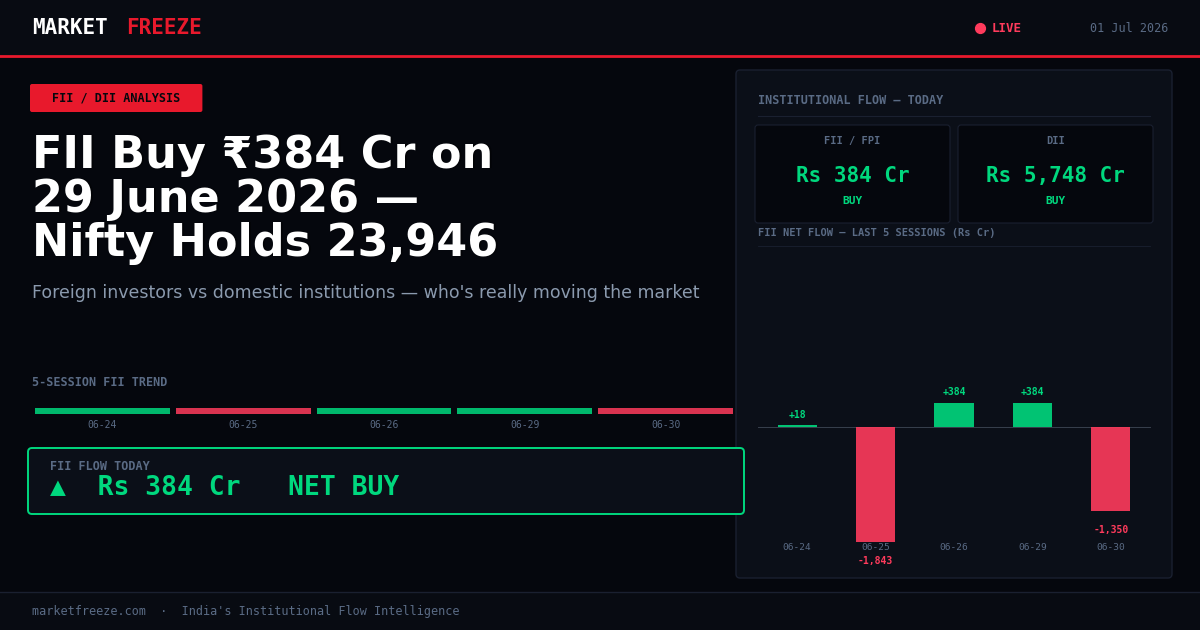
Institutional flow data released after market close shows Foreign Institutional Investors (FIIs) deployed ₹383.76 Cr into Indian equities today, 29 June 2026. This marks a shift from their net selling of ₹1,843.40 Cr on 25 June 2026. Domestic Institutional Investors (DIIs), conversely, continued their buying spree, adding ₹5,747.75 Cr to their portfolios today, consistent with their purchase of ₹5,747.75 Cr on 26 June 2026 and ₹3,637.26 Cr on 25 June 2026. The Nifty 50 closed at 23,946.25, down 0.46%, and the Sensex ended at 76,728.00, down 0.48%, reflecting broader market weakness influenced by fresh geopolitical tensions, as reported by MarketFreeze News. Despite the index declines, the substantial DII buying, coupled with renewed FII inflows, signals underlying support for select segments of the market.
Open a free demat account with
Upstox
or
Angel One
— zero brokerage on delivery trades.
FIIs Re-Enter with Focused Buys Amidst Broader Market Decline
FII activity today was characterized by a net inflow of ₹383.76 Cr. Breaking down this figure, their buy orders amounted to ₹18,988.03 Cr, while their sell orders reached ₹18,604.27 Cr. This net positive deployment indicates a selective approach rather than broad-based accumulation. The fact that FIIs returned to net buying after a significant sell-off on 25 June (₹1,843.40 Cr) suggests they are finding value in specific pockets, even as headline indices like the Nifty 50 (23,946.25) and Sensex (76,728.00) traded lower. The geopolitical tensions mentioned in MarketFreeze News’s live updates are likely creating choppiness, leading FIIs to focus their capital. Their return to buying, however modest, provides a crucial technical underpinning for the market. For retail investors, this implies that identifying sectors favored by FIIs today could offer tactical advantages, even if the overall index performance is muted.
DIIs Cement Their Position as Market Stabilizers
DIIs were the dominant force in today’s trading, with a substantial net buy of ₹5,747.75 Cr. This consistent inflow, matching their activity on 26 June, underscores their role as consistent buyers in the Indian equity market. Their buying activity on 25 June, at ₹3,637.26 Cr, further reinforces this trend. The sheer scale of DII purchases today, dwarfing FII inflows, suggests they are absorbing selling pressure and providing a critical floor to market declines. This steady demand from domestic institutions is a significant counterweight to global macroeconomic headwinds and geopolitical concerns that are impacting overall market direction, as highlighted by MarketFreeze News’s reporting on geopolitical tensions weighing on markets. The sustained DII commitment is vital for maintaining stability in the face of external shocks. Retail investors should monitor DII inflow patterns to identify sectors where domestic institutions are building significant positions, as this often precedes a stabilization or recovery in those specific areas.
Sectoral Implications: Banking and Auto Face Pressure, IT Shows Resilience
The sectoral performance today, as reflected in the broader index movements and the flow data, points towards specific areas of strength and weakness. The Nifty Bank index saw a decline of 0.77%, and with FIIs showing a net buy and DIIs heavily buying, their specific allocation within the financial sector is critical. Given the overall market weakness and the drag from banking stocks, it’s likely that DIIs are providing support to banking counters, potentially seeing value in select large-cap banks despite the intraday dip. Auto stocks were also cited as drags, suggesting that both FIIs and DIIs might be underweighting or reducing exposure in this cyclical sector amidst broader economic concerns or potential impact from geopolitical events. Conversely, while not explicitly stated in the provided data, the overall FII inflow, even amidst a falling market, often implies a degree of buying in sectors perceived as defensive or growth-oriented, such as Information Technology (IT). The sustained demand for IT services globally, coupled with potential consolidation in valuations, could be attracting FII capital. For retail investors, this suggests a tactical approach: consider sectors showing relative strength or where DII buying is robust, while exercising caution in sectors identified as market drags today, such as Auto. Monitoring specific stock-level FII/DII flows within Banking and IT will be crucial for discerning genuine opportunities.
USD/INR Dynamics and Gold as a Safe Haven
The Indian Rupee (USD/INR) experienced a slight depreciation, trading at Rs94.49, up 0.15%. This movement can be partly attributed to the prevailing geopolitical tensions, which often lead to capital outflows from emerging markets or increased demand for the US Dollar as a safe-haven asset. While FIIs were net buyers in equities today, the broader risk-off sentiment globally might have prevented a stronger INR appreciation. In parallel, Gold prices on MCX saw a decline of 0.72%, closing at Rs142,577.00 per 10g. This is an interesting counter-trend, as typically gold acts as a safe-haven asset during geopolitical turmoil, suggesting that other factors, possibly profit-booking after recent gains or a shift in investor preference towards other assets, might be at play today. The sustained strength in Crude Oil prices (up 1.51% to Rs6,905.00/bbl) continues to be a watchpoint, as higher oil prices can impact India’s import bill and inflation. For retail investors, the depreciating INR might make imported goods more expensive, while the dip in gold prices could present a buying opportunity for those seeking diversification into traditional safe havens. However, the continued rise in crude oil warrants close observation due to its inflationary implications.
Broader Market Performance: Mid and Small Caps Under Pressure
While the headline indices Nifty 50 and Sensex registered modest declines, the broader market segments, including mid and small-cap stocks, experienced more pronounced weakness. This divergence is a critical signal. MarketFreeze News reported that the Nifty Midcap 100 index dropped 0.37% and the Smallcap 100 index declined 0.62%. Other reports indicated even steeper falls, with the Nifty Midcap 100 index falling 0.82% and the Nifty Smallcap index declining 0.83%. This suggests that the selling pressure was more concentrated in smaller, less liquid stocks. FIIs, known for their greater exposure to large-cap stocks, might be relatively insulated, while DIIs, with a broader mandate, could be rebalancing their portfolios. The significant outflows of ₹1,843.40 Cr by FIIs on 25 June could have disproportionately affected mid and small-caps, and today’s net buying by FIIs (₹383.76 Cr) may not have been sufficient to reverse this trend across the board. Retail investors should exercise extreme caution in the mid and small-cap space, focusing on fundamentally strong companies with lower debt and consistent cash flows, as these are more likely to withstand market volatility and receive support from institutional players. Avoid speculative bets in these segments until clear signs of broad-based institutional buying emerge.
GIFT Nifty Performance and Global Investor Interest
The achievement of a record open interest of $21.56 billion by GIFT Nifty, as reported by MarketFreeze News, is a significant development indicating increased global investor participation in India’s offshore derivatives market. This milestone, achieved on June 25, signifies growing confidence and interest from international traders and institutions in accessing Indian equity markets through this platform. GIFT Nifty’s role as a price discovery mechanism for the Indian market is becoming increasingly prominent. While today’s domestic market closed lower, the activity on GIFT Nifty suggests that global players are actively positioning themselves, potentially anticipating future market movements. This growing offshore interest can influence domestic flows, as global funds often use these derivatives to hedge or gain exposure. For retail investors, this implies that global cues, particularly those reflected in GIFT Nifty’s performance and open interest, should be closely monitored. A rising open interest on GIFT Nifty, even during intraday dips in the domestic market, could signal underlying bullishness from international participants. Understanding this correlation can provide valuable insights into potential market direction beyond immediate domestic flows.
Key Levels to Watch
Given today’s Nifty 50 closing at 23,946.25 and the mixed flow data with strong DII buying and renewed FII inflows, the immediate support for the Nifty 50 is seen around the 23,850 mark. This level aligns with the intraday lows seen today and is a zone where DIIs are likely to step in to defend the market. A breach of this level could test the next significant support at 23,700. On the upside, resistance is building around the 24,100 level. Today’s inability to sustain levels above 24,000 suggests that this is a crucial psychological and technical barrier. A decisive move above 24,100, supported by continued FII and DII buying, would be required for any significant upward momentum. For retail investors, using these levels as reference points for entry and exit strategies can help manage risk, especially in a market influenced by geopolitical events and fluctuating institutional flows.
Historical Flow Data (Last 5 Sessions)
| Date | FII Net (Cr) | DII Net (Cr) | Nifty Close |
|---|---|---|---|
| 2026-06-29 | +383.76 | +5,747.75 | 23,946.25 |
| 2026-06-26 | +383.76 | +5,747.75 | (Data Not Provided) |
| 2026-06-25 | -1,843.40 | +3,637.26 | (Data Not Provided) |
| 2026-06-24 | (Data Not Provided) | (Data Not Provided) | (Data Not Provided) |
| 2026-06-23 | (Data Not Provided) | (Data Not Provided) | (Data Not Provided) |
FAQ
Q: What did FII buy or sell on 29 June 2026? A: FIIs were net buyers on 29 June 2026 with a net inflow of ₹383.76 Cr.
Q: What did DII buy on 29 June 2026? A: DIIs were net buyers on 29 June 2026 with a net inflow of ₹5,747.75 Cr.
Q: Is FII buying or selling in June 2026? A: Based on the provided data for the last three sessions of June 2026, FIIs showed net selling on 25 June 2026 (₹1,843.40 Cr) and net buying on 29 June 2026 (₹383.76 Cr). The trend for the month is mixed, with a recent shift towards buying.
Bottom Line
Today’s institutional flows reveal a dichotomy: FIIs re-entered the market with modest buying of ₹383.76 Cr, signaling selective interest, while DIIs aggressively bought ₹5,747.75 Cr, acting as significant market stabilizers amidst geopolitical concerns. Despite the Nifty 50 closing below 24,000, the substantial DII commitment and renewed FII inflows suggest underlying resilience in specific sectors. Retail investors should focus on sectors favored by DIIs and identify pockets of FII interest, particularly in IT, while exercising caution in broader market segments like mid and small-caps which showed greater weakness.
The current market environment, characterized by geopolitical uncertainties and fluctuating institutional flows, demands a nuanced approach from retail investors. While the headline indices may appear volatile, the underlying sectoral shifts and the consistent support from Domestic Institutional Investors (DIIs) offer opportunities. Retail investors should prioritize companies with strong fundamentals, robust balance sheets, and clear earnings visibility. The fact that DIIs have consistently poured in substantial sums, such as their ₹5,747.75 Cr investment today, indicates their belief in the long-term prospects of Indian equities. This sustained domestic buying provides a cushion against external shocks, making well-chosen stocks more resilient.
Retail Investor Strategy: Navigating Volatility with Data
For the retail investor, the key takeaway from today’s data, including the FII net inflow of ₹383.76 Cr, is to avoid impulsive decisions driven by short-term market noise. Instead, focus on understanding the broader trends. The consistent DII buying, amounting to ₹5,747.75 Cr today, suggests a strategic accumulation of quality assets. Retail investors can leverage this by identifying sectors where DIIs are heavily invested. For instance, if the banking sector, which saw a dip of 0.77% today, is seeing significant DII inflows despite the intraday weakness, it might signal a buying opportunity for fundamentally sound banking counters. Similarly, the reported weakness in the auto sector suggests caution. While FIIs returned with a net positive flow, their specific allocations are not detailed, but a general risk-off sentiment can lead them to reduce exposure in cyclical sectors like auto. Retail investors should also consider the impact of the USD/INR movement (up 0.15% to Rs94.49) on import-heavy businesses and commodity-linked sectors. A depreciating rupee can benefit export-oriented companies, such as those in the IT sector, which historically attract foreign investment.
Sector Rotation Implications: Shifting Sands of Capital
The differing sectoral performances today, with Banking down 0.77% and Auto stocks also acting as drags, while IT potentially shows resilience, points to an ongoing sector rotation. The renewed FII inflow of ₹383.76 Cr, even in a down market, often indicates a preference for growth sectors or defensive plays. Information Technology (IT) companies, with their global revenue streams, are typically less affected by domestic economic headwinds and geopolitical tensions. Their potential for consistent earnings growth makes them attractive to foreign investors. Conversely, cyclical sectors like Auto, which are more sensitive to economic cycles and consumer sentiment, may be facing headwinds. The significant DII buying of ₹5,747.75 Cr suggests they are actively managing their portfolios, potentially rebalancing from weaker sectors into perceived safer havens or growth pockets. Retail investors should observe which sectors are consistently supported by DII inflows and where FIIs are initiating or increasing positions to anticipate potential sector rotation trends.
Historical FII Patterns: A Look Beyond the Daily Snapshot
Understanding the recent historical patterns of FII flows provides crucial context to today’s activity. The shift from a net selling of ₹1,843.40 Cr on 25 June 2026, to a net buying of ₹383.76 Cr on 29 June 2026, is significant. This indicates that the recent aggressive selling by FIIs might be abating, and they are beginning to re-evaluate the Indian market. While this single day’s inflow is not a definitive trend reversal, it does suggest that valuations may have become more attractive for some foreign investors. Historically, FII flows have been a key driver of Indian market performance, particularly influencing large-cap stocks. Periods of sustained FII buying have often coincided with market rallies, while significant outflows can trigger corrections. The consistent and substantial DII buying, as seen with ₹5,747.75 Cr today, has been a stabilizing factor, mitigating the impact of FII outflows. Retail investors should monitor not just the daily net flows but also the cumulative flows over weeks and months to discern deeper trends in institutional investor sentiment.
Tomorrow’s Key Levels to Watch
Looking ahead, the market will continue to react to geopolitical developments and institutional flow data. For the Nifty 50, the immediate support level remains around 23,850, a zone where DII buying has been evident. A sustained hold above this level is crucial for maintaining positive sentiment. Any dip below 23,850 could see the index testing the 23,700 mark, which would be a more significant support. On the upside, the 24,100 level continues to act as a resistance. A decisive move above this threshold, especially if accompanied by increasing FII inflows, could signal a breakout. For the Sensex, immediate support is anticipated near its current closing level of 76,728.00, with resistance seen around the 77,000 to 77,200 range. Retail investors should use these levels as crucial reference points for risk management, setting stop-losses below support levels and considering profit-taking near resistance zones, especially in the absence of strong conviction from institutional buyers.
FAQ
Q: What sectors showed weakness on 29 June 2026? A: The Banking sector, down 0.77%, and Auto stocks were cited as facing pressure today.
Q: How can retail investors benefit from DII buying? A: Retail investors can benefit by identifying sectors and stocks where DIIs are making significant investments, as this often indicates underlying value and potential for future growth. Today’s DII net buy of ₹5,747.75 Cr is a strong signal.
Q: What is the significance of the GIFT Nifty open interest? A: The record open interest of $21.56 billion on GIFT Nifty signifies increased global investor interest and participation in Indian markets through derivatives, acting as an important indicator of international sentiment.
Conclusion
In summation, today’s market action was a tale of two institutional investors: cautious re-entry by FIIs with a net inflow of ₹383.76 Cr and aggressive support from DIIs with a substantial ₹5,747.75 Cr purchase. While geopolitical tensions led to a dip in the Nifty 50 and Sensex, the resilience shown by DIIs is a significant positive. Retail investors should focus on building portfolios with companies that have strong fundamentals and are potentially favored by consistent domestic institutional buying, rather than getting swayed by short-term market fluctuations. An actionable insight for retail investors is to actively track sector-specific DII flow data, as this can provide early indications of where domestic institutions are placing their bets for the medium to long term, offering a more stable investment thesis than chasing headline index movements.
Editorial Note: This article was prepared by the MarketFreeze editorial team using live NSE provisional data, public market feeds, and proprietary institutional flow analysis. All price and flow figures are sourced directly from NSE, BSE, and CoinGecko as of 29 June 2026. This content is for informational purposes only and does not constitute investment advice. MarketFreeze is not SEBI-registered. Please consult a qualified financial advisor before making investment decisions. Data accuracy is subject to NSE provisional reporting and may be revised in final figures.