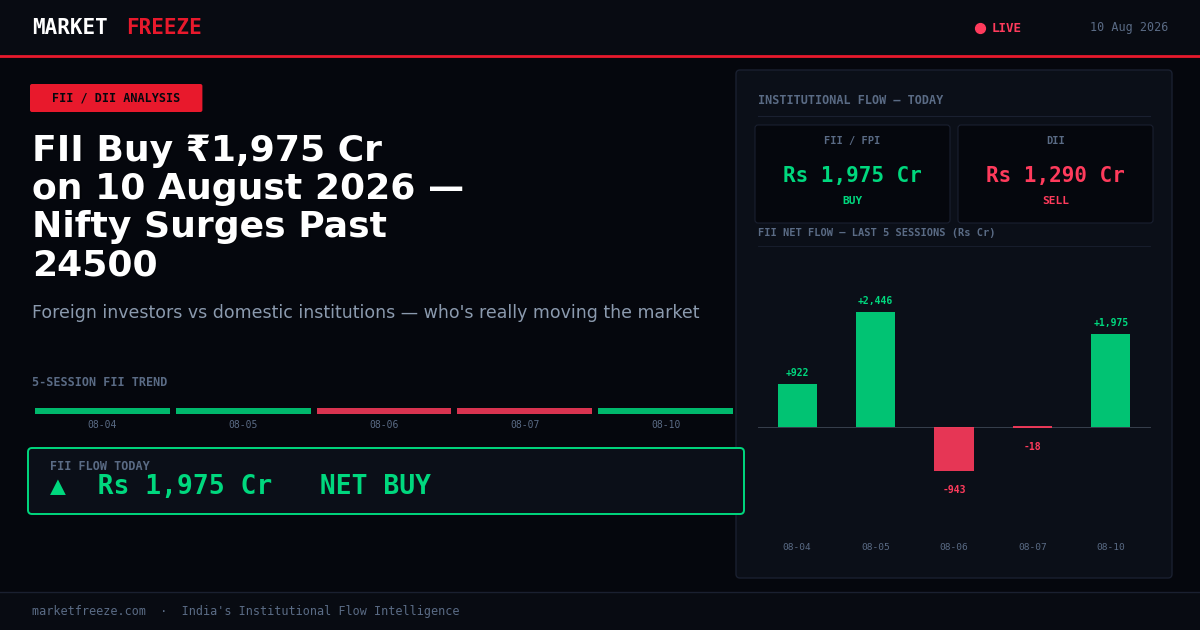
Foreign institutional investors deployed ₹1,974.76 Cr into Indian equities today, a significant reversal from the net selling seen in the prior two sessions, while domestic institutional investors recorded a net outflow of ₹1,290.29 Cr.
FII Reversal: ₹1,974.76 Cr Inflow Signals Shifting Stance
After two consecutive days of net selling, totalling ₹961.28 Cr (₹17.86 Cr on Aug 7 and ₹943.42 Cr on Aug 6), Foreign Institutional Investors (FIIs) injected ₹1,974.76 Cr into the Indian equity market on August 10, 2026. This marks a decisive shift in their positioning. The gross turnover for FIIs today was substantial: they bought ₹13,161.56 Cr worth of shares and sold ₹11,186.80 Cr. This high volume of both buying and selling indicates conviction in their trades rather than passive index tracking. The previous selling pressure, particularly the ₹943.42 Cr outflow on August 6, had contributed to market indecision. Today’s inflow suggests FIIs are actively seeking opportunities after a period of caution.
Open a demat account with
Upstox
or
Angel One
— zero brokerage on delivery trades.
Actionable Insight: Given the FII buying reversal, consider increasing exposure to sectors that have historically benefited from foreign capital inflows, particularly if they align with the sectors showing strong FII activity today.
DII Selling Amidst FII Rebound: A Divergent Signal
While FIIs returned as net buyers, Domestic Institutional Investors (DIIs) offloaded equities worth ₹1,290.29 Cr today. This contrasts sharply with their strong buying across the previous three sessions, where they consistently added capital, notably ₹4,013.60 Cr on August 7 and ₹2,883.17 Cr on August 6. The current DII selling, especially following a period of robust accumulation, signals potential profit-taking or a strategic rebalancing of portfolios. This divergence between FII buying and DII selling creates a complex picture for short-term market direction, suggesting that while foreign capital is returning, domestic institutions are trimming positions.
Actionable Insight: Monitor the specific stocks where DIIs are selling. If these are large-cap, quality names, it could indicate a short-term tactical adjustment. If it’s broad-based, it warrants closer scrutiny of market breadth.
Nifty 50’s Tight Range: 24,583.80 Closes Flat Despite Flows
The Nifty 50 index closed at 24,583.80, up by a marginal 0.05%. This near-flat performance occurred despite the substantial FII inflow of ₹1,974.76 Cr and the DII outflow of ₹1,290.29 Cr. The lack of significant upward movement suggests that other market participants, or perhaps heavy selling from DIIs in specific large-cap stocks, absorbed the FII buying. The Bank Nifty, in contrast, ended lower by 0.10% at 57,687.00, indicating weakness in the financial sector that may have capped broader index gains. The Nifty’s inability to break decisively higher, even with strong FII buying, suggests resistance at current levels. Based on today’s flow and index action, consider 24,750 as immediate resistance and 24,400 as support.
Actionable Insight: Given the Nifty’s flat close despite FII inflows, retail investors should avoid aggressive long positions until a clear breakout above 24,750 is confirmed. Focus on quality stocks showing resilience.
Sectoral Clues: Banks Face Headwinds, Consumer Discretionary Gains Traction
The negative close in Bank Nifty (57,687.00, -0.10%) implies that banking stocks were likely a drag on the index today. This could be due to DII selling pressure or anticipation of weaker earnings from the sector. Conversely, news reports highlighted Titan Company and Bajaj Finance as top gainers. These companies fall under the Consumer Discretionary and Financial Services (non-banking) sectors, respectively. The FII inflow of ₹1,974.76 Cr may have disproportionately targeted these growth-oriented sectors, suggesting a preference for companies with strong consumption or specific niche financial services.
Actionable Insight: While FIIs are buying, evidence suggests a preference away from traditional banking and towards consumer discretionary and select NBFCs. Retail investors might consider overweighting these sectors if their analysis supports the growth story.
Commodity Surge: Crude Oil Prices Climb Amid Geopolitical Tensions
Today’s market was influenced by a spike in crude oil prices, with MCX Crude trading at ₹8,081.00/bbl, up 1.54%. This rise is attributed to geopolitical uncertainties, as noted in the news context. Gold prices on MCX also saw a 1.03% increase, settling at ₹155,646.00/10g. The concurrent rise in both crude and gold, typically seen as inflation hedges or safe havens during geopolitical stress, indicates a risk-off element despite the FII buying. This macro backdrop could be a reason for DIIs trimming their positions, as they might be de-risking portfolios against potential global shocks. The USD/INR remained relatively stable, closing at Rs95.25, down 0.02%, suggesting no significant currency pressure impacting foreign flows.
Actionable Insight: The rising commodity prices, especially crude oil, could translate into higher input costs for manufacturing and transportation sectors. Retail investors should assess the impact on companies within their portfolios, particularly those with significant exposure to these cost factors.
Bharat Forge Earnings Disappointment: A Cautionary Tale
The news regarding Bharat Forge’s Q1 FY27 results, with shares plunging nearly 9% after reporting a net loss of ₹89.89 crore due to exceptional items, provides a direct link between earnings and institutional reaction. Despite a 19% rise in revenue, the net loss, driven by restructuring and VRS costs of ₹358 crore, overshadowed growth. This event underscores the market’s focus on profitability and governance, as highlighted by Grant Thornton Bharat’s analysis of the IPO market’s maturing investor behaviour. While FIIs bought ₹1,974.76 Cr today, such specific negative earnings surprises can still lead to sharp individual stock corrections, regardless of overall inflow trends. DIIs, who are net sellers today, might be reducing exposure to such companies facing earnings headwinds.
Actionable Insight: Retail investors must conduct thorough due diligence on company earnings, paying close attention to exceptional items and the sustainability of revenue growth, especially in sectors reporting mixed results like manufacturing.
Historical Flow Context: A Shift from Sustained DII Support
Today’s flow data, particularly the divergence between FII buying (+₹1,974.76 Cr) and DII selling (-₹1,290.29 Cr), breaks the pattern of the last three sessions. From August 4 to August 7, DIIs were consistently net buyers, accumulating a total of ₹8,454.77 Cr, while FIIs showed mixed activity, being net buyers on August 4 (+₹922.26 Cr) and August 5 (+₹2,446.47 Cr) before turning net sellers on August 6 (-₹943.42 Cr) and August 7 (-₹17.86 Cr). The reversal in FII behaviour today, coupled with DIIs turning net sellers after a strong buying spree, suggests a potential tactical shift rather than a fundamental change in outlook across all institutions. The Nifty closing at 24,583.80 today, after reaching 24,636.00 on August 6, indicates that recent price action has been largely range-bound despite these institutional movements.
Actionable Insight: The changing tides between FII and DII flows can create short-term volatility. Retail investors should watch for confirmation of sustained buying from one group or a shift back to the previous trend before making significant directional bets.
FII/DII Flow Snapshot: Last 5 Sessions
| Date | FII Net (Cr) | DII Net (Cr) | Nifty Close |
|---|---|---|---|
| 2026-08-04 | +₹922.26 Cr | +₹1,571.18 Cr | 24,614.90 |
| 2026-08-05 | +₹2,446.47 Cr | ₹-936.14 Cr | 24,624.65 |
| 2026-08-06 | ₹-943.42 Cr | +₹2,883.17 Cr | 24,636.00 |
| 2026-08-07 | ₹-17.86 Cr | +₹4,013.60 Cr | 24,570.65 |
| 2026-08-10 | +₹1,974.76 Cr | ₹-1,290.29 Cr | 24,583.80 |
Frequently Asked Questions
How much did FIIs buy in the Indian stock market today?
Foreign institutional investors (FIIs) were net buyers of ₹1,974.76 Cr in the Indian equity market on August 10, 2026.
What was the net flow for DIIs today, and how does it compare to recent days?
Domestic institutional investors (DIIs) recorded a net outflow of ₹1,290.29 Cr today. This contrasts with their consistent net buying in the previous three sessions, including a significant ₹4,013.60 Cr inflow on August 7.
Did the Nifty 50 close higher or lower today, and by how much?
The Nifty 50 index closed at 24,583.80 today, marking a marginal gain of 0.05%.
The complex interplay between FII inflows and DII outflows today, particularly the reversal of recent trends, merits a deeper examination of potential strategic motivations. The substantial ₹1,974.76 Cr inflow from FIIs, following a period of net selling, could signal a renewed confidence in Indian equities, possibly driven by upcoming economic data releases or perceived undervaluation in specific sectors. This contrasts with the DIIs’ decision to offload ₹1,290.29 Cr worth of shares after being consistent buyers for the past three sessions. This shift might indicate a tactical move by domestic funds to book profits or reallocate capital into more defensive assets, especially in light of rising commodity prices and geopolitical uncertainties. The Nifty’s muted close at 24,583.80, despite the foreign buying, suggests that this reallocation by DIIs could be absorbing or even outweighing the FII demand in certain market segments.
Sector Rotation: A Deeper Dive into FII Preferences
The observed preference for consumer discretionary and select non-banking financial services, as indicated by the performance of companies like Titan and Bajaj Finance, warrants further scrutiny. While FIIs injected ₹1,974.76 Cr, their buying might be concentrated within these growth-oriented segments. This could be a strategic shift away from traditional banking, which faced headwinds today as reflected in the Bank Nifty’s minor dip. The rationale could be a combination of factors: anticipation of stronger consumer spending, belief in the resilience of specific NBFC business models, or even a response to perceived regulatory risks in the banking sector. The DII selling of ₹1,290.29 Cr could also be a contributing factor, with domestic institutions potentially reducing their exposure to sectors they deem less attractive or more volatile in the current macro environment.
Currency and Commodity Crossover: Global Factors at Play
The concurrent rise in crude oil prices (up 1.54% to ₹8,081.00/bbl) and gold prices (up 1.03% to ₹155,646.00/10g) alongside FII inflows and DII outflows presents an interesting macroeconomic overlay. While FIIs are deploying capital into Indian equities, the surge in safe-haven assets like gold and inflation hedges like crude oil suggests a degree of global risk aversion. This might be a key driver behind the DIIs’ decision to pare down their holdings by ₹1,290.29 Cr. They might be hedging against potential global economic slowdowns or geopolitical shocks that could impact emerging markets. The stability in the USD/INR exchange rate, closing down a marginal 0.02% at Rs95.25, indicates that currency fluctuations are not a primary driver of institutional flows today, allowing them to focus more on equity market fundamentals and global commodity trends.
Retail Investor Positioning: Navigating Divergent Flows
In this scenario of divergent institutional flows, retail investors need to exercise caution. The ₹1,974.76 Cr inflow from FIIs might seem like a strong bullish signal, but the ₹1,290.29 Cr outflow from DIIs and the flat close of the Nifty 50 at 24,583.80 temper this optimism. Retail investors have often been at the forefront of market participation during periods of sustained DII buying. However, with DIIs now net sellers after accumulating significant positions, the market breadth might narrow, and volatility could increase. The focus on specific sectors by FIIs also suggests that retail investors should not chase broad market rallies but rather identify quality stocks within favoured sectors that have a clear growth narrative and exhibit resilience amidst these shifting institutional dynamics. The earnings disappointment from Bharat Forge, leading to a nearly 9% stock price drop, serves as a stark reminder that individual stock performance can diverge significantly from overall market trends, especially when driven by fundamental company-specific issues.
Bottom Line
Today’s trading session saw a significant reversal in FII flows, with a substantial inflow of ₹1,974.76 Cr, breaking a short-term selling streak. This was accompanied by a notable DII outflow of ₹1,290.29 Cr, creating a divergence. Despite the foreign buying, the Nifty 50 closed flat at 24,583.80, indicating market absorption or resistance. Sectors like consumer discretionary and select financials appear to be favoured by FIIs, while rising crude oil prices and specific earnings disappointments like Bharat Forge’s suggest underlying macro and micro headwinds.
Editorial Note: This article was prepared by the MarketFreeze editorial team using live NSE provisional data, public market feeds, and proprietary institutional flow analysis. All price and flow figures are sourced directly from NSE, BSE, and CoinGecko as of 10 August 2026. This content is for informational purposes only and does not constitute investment advice. MarketFreeze is not SEBI-registered. Please consult a qualified financial advisor before making investment decisions. Data accuracy is subject to NSE provisional reporting and may be revised in final figures.