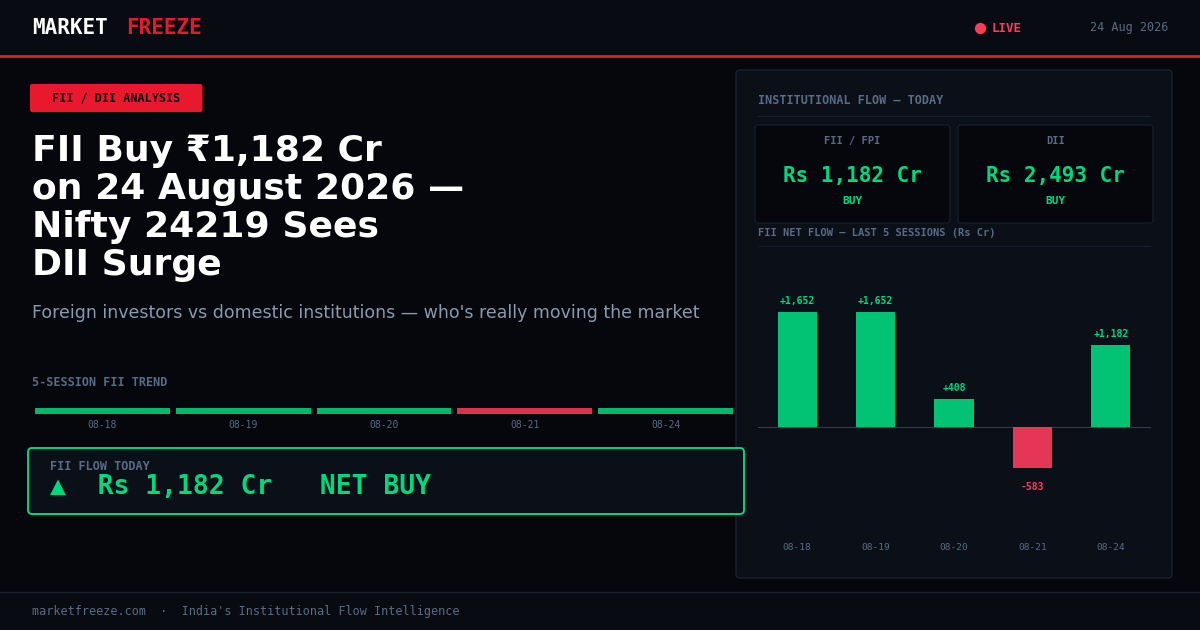
India’s equity markets absorbed ₹1,181.66 Cr of net FII buying and ₹2,493.41 Cr of net DII buying on August 24, 2026, a significant DII surge complementing a renewed FII inflow after two sessions of net selling.
Open a free demat account with
Upstox
or
Angel One
— zero brokerage on delivery trades.
FIIs Re-enter with ₹1,181.66 Cr Purchase
Foreign Institutional Investors (FIIs) reversed their recent selling trend, deploying ₹1,181.66 Cr into Indian equities on August 24. This marks a significant shift from the net selling of ₹583.36 Cr recorded on August 21. The total FII buy value for the day stood at a substantial ₹12,332.64 Cr, indicating a high volume of participation. The sell value was minimal, suggesting conviction in the selected long positions rather than broad-based liquidation.
This return of FII capital, especially after a period of net outflows, provides a positive underpinning for market direction. It suggests a renewed confidence in Indian asset valuations or a rebalancing of global portfolios. The scale of buying, when contrasted with the previous session’s selling, points towards a deliberate re-entry rather than a marginal shift.
Actionable Insight: Monitor the next 2-3 sessions to confirm if this FII inflow is sustained or a one-off event. A continuation would signal stronger upside potential for indices.
DIIs Continue Their Robust Buying Spree
Domestic Institutional Investors (DIIs) maintained their aggressive accumulation, posting a net buy of ₹2,493.41 Cr on August 24. This follows a massive ₹3,537.71 Cr net buy on August 21 and ₹3,973.72 Cr on August 20. DIIs have been the consistent buyers over the last three sessions, providing a crucial support buffer to the market.
Their sustained buying indicates a strong domestic conviction in the underlying Indian economy and corporate earnings. Unlike FIIs, DIIs often exhibit less sensitivity to short-term global macro events, focusing more on India-specific growth narratives. The sheer scale of their consistent buying suggests they are absorbing selling pressure and potentially positioning for medium-term gains.
Actionable Insight: Given DIIs’ persistent buying, focus on high-quality domestic cyclicals and defensives that they have historically favoured. Their continued presence reduces the immediate downside risk.
Nifty Erodes Early Gains, Closing at 24,219.05
The Nifty 50 index closed at 24,219.05, down 0.14% or 33 points for the day. This decline came after an initial rally, indicating profit-taking or selling pressure emerging in the latter part of the trading session. The Sensex mirrored this trend, ending down 0.22% at 77,369.00. The Bank Nifty underperformed, declining by 0.41% to 57,526.00.
The day’s price action suggests that while institutions like FIIs and DIIs were net buyers, broader market participants or specific large holders might have trimmed positions. This divergence between the net institutional flow and the index movement highlights that not all market participants were uniformly bullish. The failure to hold early gains, as mentioned in news reports, indicates a lack of sustained buying momentum across all segments.
Actionable Insight: With Nifty closing at 24,219.05, immediate support is now seen around 24,150. Resistance lies at the day’s high, around 24,300. A decisive break above 24,300, supported by continued institutional buying, would be required for further upside.
FII/DII Flow Table: Last 5 Sessions
| Date | FII Net (Cr) | DII Net (Cr) | Nifty Close |
|---|---|---|---|
| 2026-08-18 | +₹1,651.53 Cr | +₹2,579.31 Cr | 24,154.90 |
| 2026-08-19 | +₹1,651.53 Cr | +₹2,579.31 Cr | 24,078.30 |
| 2026-08-20 | +₹407.99 Cr | +₹3,973.72 Cr | 24,231.85 |
| 2026-08-21 | ₹-583.36 Cr | +₹3,537.71 Cr | 24,252.00 |
| 2026-08-24 | +₹1,181.66 Cr | +₹2,493.41 Cr | 24,219.05 |
Sectoral Implication: Metals Shine, Banks Face Pressure
The day’s trading activity, combined with institutional flows, provides clues on sector preferences. News reports highlighted metal stocks like Tata Steel and Hindalco as Nifty gainers, suggesting this sector is in favour. The FII buying, particularly if it targeted large-cap metals, would confirm this view. Conversely, the underperformance of the Bank Nifty, despite overall positive institutional net buys, points to potential FII or DII selling within the banking sector or profit-taking by other participants.
Bajaj Finance and SBI Life were cited as Nifty losers, indicating weakness in NBFCs and insurance. This could be a result of specific stock concerns or a broader rotation out of rate-sensitive sectors, especially if global bond yields are rising as suggested by global market commentary. The IT sector, typically an FII favourite, saw HCL Tech mentioned as a gainer, suggesting resilience or targeted buying within this segment.
Actionable Insight: Consider overweighting Metal and IT sectors based on recent outperformance and FII/DII flow indications. Reduce exposure to Banks and NBFCs until clearer buying emerges in these segments.
Global Headwinds Persist: Iran Sanctions and Inflation Concerns
Investor caution appears to be driven by external factors, including potential US economic sanctions on Iran and upcoming inflation updates, as reported. This geopolitical uncertainty and inflationary pressure contributed to a broader decline in Asian markets, with Tokyo’s Nikkei 225 falling 0.7%. Rising global bond yields also added to market pressures, making riskier assets like equities relatively less attractive in the short term.
The mention of Iran sanctions and inflation echoes themes seen in global markets, where AI stocks in Japan faced pressure ahead of Nvidia earnings due to similar concerns. This suggests that institutional money flow into India might also be influenced by these global macro trends, leading to selective buying rather than a broad rally. The strength in Gold MCX (up 1.92%) and Bitcoin (up 2.03%) further supports the narrative of investors seeking safe-haven or inflation-hedging assets amidst such uncertainties.
Actionable Insight: Given the global macro risks, expect choppier intraday moves. Prioritize large-cap stocks with strong balance sheets and pricing power that can withstand inflationary pressures and geopolitical shocks.
Indian Banks Tap International Markets for Growth Capital
In a parallel development, Indian lenders are actively raising capital offshore, with dollar debt sales exceeding $10 billion since the RBI window opened. ICICI Bank’s plan to raise $1 billion through five-year bonds is a prime example. This move by banks to secure USD funding is aimed at bolstering their lending and investment activities, potentially increasing their capacity to fund domestic growth.
While this is a positive for the banking sector’s long-term capacity, it’s important to distinguish this capital raising from FII/DII equity flows. Equity flows reflect direct investment in listed Indian companies, whereas debt issuance is about securing cheaper funding. However, a strong banking sector, well-capitalized through such measures, can indirectly support equity market performance by facilitating credit growth and economic expansion.
Actionable Insight: While banking stocks saw some pressure today, the fundamental capital raising by banks through dollar bonds is a long-term positive. Monitor specific bank results for loan growth and asset quality post these capital infusions.
Nifty Support at 24,150, Resistance at 24,300
Based on today’s trading range and the flow data, the Nifty 50 index (currently at 24,219.05) faces immediate support at approximately 24,150. This level is derived from the intraday low and the general trend of a modest pullback after early gains. Any further selling pressure could test this. Conversely, resistance is seen around the day’s high, near 24,300. A sustained move above this 24,300 mark, supported by robust FII/DII buying, would be necessary to signal a resumption of upward momentum.
The intraday trading range suggests a battle for control between buyers and sellers. The presence of net institutional buying indicates underlying demand, but the index closing lower points to selling pressure from other market participants or short-term traders. The absolute Nifty close of 24,219.05 positions it within a critical zone where both support and resistance are relatively close.
Actionable Insight: Retail traders should use 24,150 as a reference for potential buying opportunities if the index dips towards it with low volumes, and 24,300 as a trigger for caution or profit-taking on any short-term rallies.
FAQ
What was the net FII buying figure for August 24, 2026?
FIIs were net buyers of ₹1,181.66 Cr in Indian equities on August 24, 2026.
How much did DIIs buy on August 24, 2026?
DIIs bought a net amount of ₹2,493.41 Cr on August 24, 2026.
What was the Nifty 50 closing price on August 24, 2026?
The Nifty 50 closed at 24,219.05 on August 24, 2026.
The dichotomy between institutional inflows and the Nifty’s fractional decline warrants a closer look at potential sector rotation. The observed strength in metals, with names like Tata Steel and Hindalco leading the Nifty gainers, alongside IT counters such as HCL Tech, suggests a strategic reallocation of capital. If these are indeed FII-led plays, it implies a preference for cyclical recovery plays (metals) and resilient, globally competitive sectors (IT) over rate-sensitive financials. The underperformance of Bank Nifty, down 0.41%, coupled with specific banking stocks like SBI Life seeing losses, points towards profit-taking or a cautious stance by institutions on this segment, despite the overall positive net buy figures.
Historically, periods of global uncertainty, such as those potentially driven by geopolitical tensions related to Iran sanctions and rising inflation, often see a shift towards defensive sectors or commodities. The robust performance of Gold MCX, up 1.92%, and Bitcoin, up 2.03%, on the same day provides a compelling parallel. This suggests that while institutional money is flowing into Indian equities, a portion of investor capital is hedging against volatility by seeking alternative assets. This dual approach, investing in equities while hedging elsewhere, is a hallmark of sophisticated portfolio management in uncertain times. The fact that FIIs, often more sensitive to global macro trends, re-entered the market suggests they may be selectively betting on India’s growth story even amidst these headwinds, perhaps seeing current valuations as attractive entry points for the medium term.
Considering the broader market dynamics, the net positive flows of ₹1,181.66 Cr from FIIs and ₹2,493.41 Cr from DIIs on August 24 indicate that domestic players continue to be the primary anchors. DIIs have consistently bought over the last three sessions, absorbing selling pressure and providing a floor. Their sustained commitment, evidenced by their significant net buys on August 21 (₹3,537.71 Cr) and August 20 (₹3,973.72 Cr), highlights a deep-seated belief in India’s economic trajectory. This contrasts with FIIs, whose flows can be more volatile, as seen by their net selling of ₹583.36 Cr on August 21 before the latest inflow. This resilience from domestic institutions often acts as a buffer, preventing sharp corrections even when foreign sentiment wavers.
The performance of the Indian Rupee against the US Dollar, though not explicitly detailed for August 24, is a crucial underlying factor for FII flows. A strengthening rupee can make Indian equities more expensive for foreign investors, potentially dampening inflows. Conversely, a weakening rupee can attract FIIs if they anticipate currency gains on top of equity returns. The current context of global inflation and potential US interest rate hikes could lead to USD strength, which might put pressure on the INR. If the INR remains stable or depreciates slightly, it could further support the renewed FII buying trend seen on August 24.
Market Commentary: Sector Rotation and Global Influences
The sectoral performance on August 24, 2026, reveals a discernible shift. Metals, exemplified by Tata Steel and Hindalco, emerged as outperformers, suggesting a rotation towards cyclical plays. This is often seen when investors anticipate economic recovery or benefit from commodity price upswings. Concurrently, the IT sector, with HCL Tech showing strength, continues to be a favoured destination, likely due to its global appeal and consistent earnings potential, even amidst global uncertainties. The underperformance of the Bank Nifty, however, signals caution within the financial sector. This could be attributed to profit-taking after recent gains or concerns about rising interest rates impacting net interest margins, despite positive news regarding banks raising offshore capital.
The concurrent strength in Gold MCX (up 1.92%) and Bitcoin (up 2.03%) provides a critical lens through which to view the day’s equity market action. This surge in alternative, often considered “safe-haven” or inflation-hedging, assets indicates a prevalent investor sentiment of risk aversion driven by global factors like geopolitical tensions concerning Iran and inflation fears. While FIIs re-entered the equity market with a net inflow of ₹1,181.66 Cr, this occurred within a broader market environment where investors were actively seeking protection against volatility. This suggests that the equity inflows might be more tactical or selective, focusing on specific sectors or companies perceived as resilient, rather than a wholesale embrace of riskier assets.
The persistent buying by Domestic Institutional Investors (DIIs), who recorded a net purchase of ₹2,493.41 Cr, continues to provide a strong foundational support to the Indian market. Their consistent accumulation over multiple sessions, including the ₹3,537.71 Cr net buy on August 21, underscores a deep conviction in the domestic economic narrative. This steady demand from DIIs is crucial in absorbing any selling pressure, whether from profit-taking or from FIIs rebalancing portfolios, thus helping to stabilize indices like the Nifty 50 around the 24,200-24,300 levels.
Bottom Line
August 24, 2026, saw a significant return of FII buying (₹1,181.66 Cr) alongside continued robust DII accumulation (₹2,493.41 Cr), providing a net positive institutional flow despite a marginal dip in the Nifty 50 to 24,219.05. While metals and IT sectors appear favoured by this flow, banking and NBFCs showed weakness. Global geopolitical and inflation concerns are likely tempering broader market enthusiasm, as indicated by Gold and Bitcoin strength and mixed index performance. The key for tomorrow will be whether the FII inflow sustains and helps the Nifty break past the 24,300 resistance.
Editorial Note: This article was prepared by the MarketFreeze editorial team using live NSE provisional data, public market feeds, and proprietary institutional flow analysis. All price and flow figures are sourced directly from NSE, BSE, and CoinGecko as of 24 August 2026. This content is for informational purposes only and does not constitute investment advice. MarketFreeze is not SEBI-registered. Please consult a qualified financial advisor before making investment decisions. Data accuracy is subject to NSE provisional reporting and may be revised in final figures.