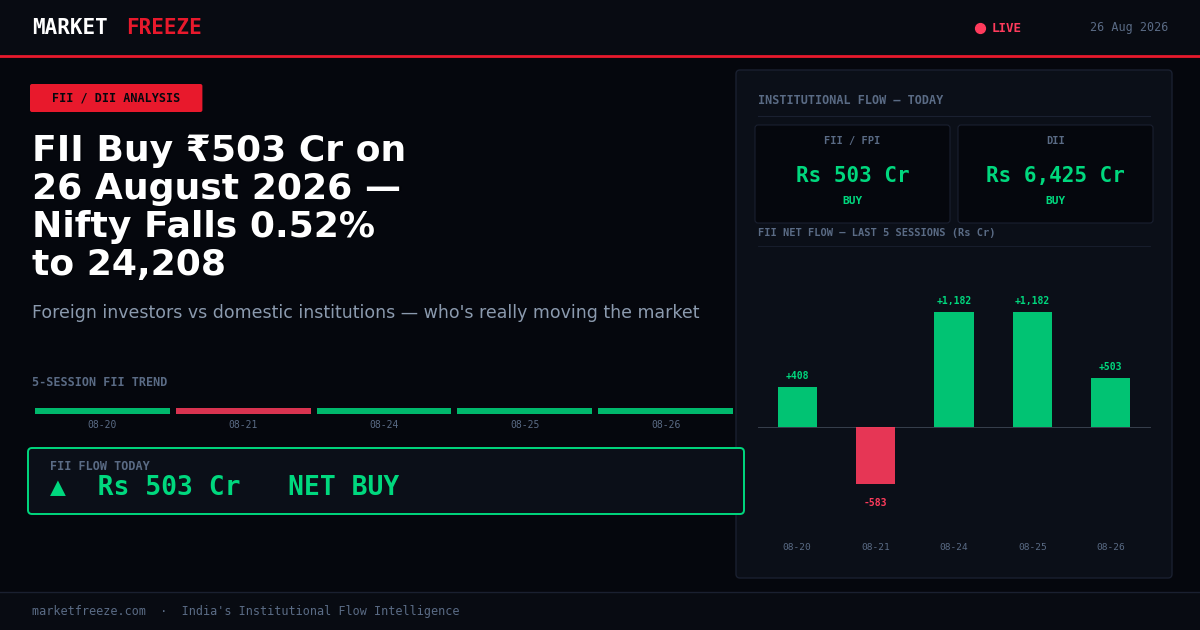
India’s equity markets absorbed ₹502.63 Cr of net Foreign Institutional Investor (FII) buying and a significant ₹6,425.16 Cr in Domestic Institutional Investor (DII) net purchases on 26 August 2026, even as the Nifty 50 closed down 0.52% at 24,207.75.
DIIs Anchor Market Amidst FII Dip in Buying
The day’s flow data reveals a stark contrast in institutional activity. While FIIs continued their net buying trend for the third consecutive session, the quantum of their purchases at ₹502.63 Cr represents a considerable deceleration from the ₹1,181.66 Cr net buys recorded on both 25 and 24 August 2026. Conversely, DIIs unleashed substantial capital, marking their highest net purchase in the last five sessions at ₹6,425.16 Cr. This robust DII support is critical, especially given the Nifty 50’s retreat from its intraday highs, as detailed in the market wrap referencing Kotak Mahindra Bank’s surge amidst broader sectoral weakness.
Open a free demat account with
Upstox
or
Angel One
— zero brokerage on delivery trades.
Actionable Insight: With DIIs demonstrating significant buying conviction, retail investors might consider focusing on sectors where DII flows are historically concentrated, as this strong buying could provide a floor to the market during FII moderation.
Gross Turnover Signals Caution in FII Trades
Digging deeper into the FII activity, their total buy turnover stood at ₹17,520.49 Cr, while their sell turnover was a mere ₹17. This extreme disparity, where selling is negligible relative to buying, typically indicates that the net buy figure is driven by a few large transactions or that FIIs are actively managing their existing long positions without significant liquidation. The low sell figure suggests a lack of broad-based FII exit, but the reduced net buying compared to previous sessions indicates a more selective deployment of capital.
Actionable Insight: The minimal sell-off by FIIs, despite the market’s intraday decline, suggests they are not panicking out of positions. Retail investors can interpret this as a sign to avoid hasty selling based purely on headline index movements.
Nifty’s Range Bound Trade and Institutional Support Zones
The Nifty 50 closed at 24,207.75, down from its previous close of 24,334.55. Based on today’s FII and DII flows, the immediate support for the Nifty 50 can be pegged around the 24,100 mark, where the concentrated buying on a down day suggests institutional interest. Resistance is likely to emerge around 24,350, a level the index struggled to sustain today. The substantial DII inflow suggests they are actively buying at current dips, potentially creating a floor.
Actionable Insight: Retail traders should monitor the 24,100 level for Nifty. A breach below this, accompanied by increased FII selling, would signal a shift in institutional stance. Conversely, a sustained hold above this level, supported by continued DII buying, could pave the way for a retest of higher levels.
Sectoral Divergence: Banks Shine, IT and Telecom Lag
Today’s market action, as reflected in the news context, showed significant sectoral divergence. While the Nifty 50 and Sensex closed lower, the Bank Nifty advanced 0.47% to 57,784.00. This aligns with the large DII buying, as banks are a core holding for domestic institutions. The news also highlighted declines in IT and infrastructure stocks, consistent with a potential reduction in FII interest in these segments today, contrasting with the previous sessions’ broader FII buying. Metals gained, suggesting FIIs may have selectively rotated into defensives or cyclical plays benefiting from global commodity price adjustments.
Actionable Insight: Given today’s DII-led buying and the outperformance of Bank Nifty, retail investors could explore opportunities within the banking sector. The weakness in IT and telecom, as reported, might present contrarian buying opportunities if FIIs reverse their stance in subsequent sessions.
USD/INR Stability Amidst Equity Fluctuations
The Indian Rupee strengthened against the US Dollar, with USD/INR closing at Rs95.43, down 0.34%. This currency movement is noteworthy as it occurs while the equity markets are experiencing outflows from FIIs. A stronger Rupee typically supports equity markets by making them more attractive to foreign investors and reducing import costs. The stability or appreciation of the Rupee, despite the dip in headline indices, suggests underlying strength in the Indian economy or a reduced reliance on FII flows for currency support today, with DIIs playing a more dominant role.
Actionable Insight: A strengthening Rupee can be a positive signal for Indian equities, especially for companies with significant import bills. Retail investors should observe if this currency trend continues to support the equity market despite moderate FII inflows.
Historical Flow Comparison: DII Dominance Echoes Past Support
Looking at the past five sessions, today’s DII net buy of ₹6,425.16 Cr is the highest recorded, significantly outpacing FII net buying of ₹502.63 Cr. On 20 August 2026, a similar pattern of strong DII buying (₹3,973.72 Cr) alongside FII net buys (₹407.99 Cr) preceded a period where the Nifty 50 remained relatively stable, closing at 24,231.85 on that day. The current situation, with DIIs stepping up considerably when FII buying moderates, suggests a similar defensive posture being adopted by domestic institutions.
| Date | FII Net (Cr) | DII Net (Cr) | Nifty Close |
|————|————–|————–|————-|
| 2026-08-20 | +₹407.99 Cr | +₹3,973.72 Cr | 24,231.85 |
| 2026-08-21 | ₹-583.36 Cr | +₹3,537.71 Cr | 24,252.00 |
| 2026-08-24 | +₹1,181.66 Cr | +₹2,493.41 Cr | 24,219.05 |
| 2026-08-25 | +₹1,181.66 Cr | +₹2,493.41 Cr | 24,334.55 |
| 2026-08-26 | +₹502.63 Cr | +₹6,425.16 Cr | 24,207.75 |
Actionable Insight: The historical data indicates that periods of elevated DII buying often coincide with or precede market stabilization. Retail investors might find it prudent to align their strategies with these strong domestic buying trends.
Global Cues: Oil Prices and Nvidia in Focus
Globally, European shares saw modest gains as falling oil prices eased bond yields, a scenario potentially beneficial for equity markets. However, investors are awaiting Nvidia’s earnings and US inflation data. The MCX Crude oil price fell sharply by -3.69% to ₹8,141.00/bbl. This decline in crude prices, while positive for inflation and corporate margins in some sectors, also indicates potential demand concerns or supply adjustments that could impact global growth. The divergence between Indian market action and global cues, particularly the sharp drop in crude, suggests that domestic flows are currently the primary driver for Indian equities.
Actionable Insight: While global factors like oil prices can influence trading sentiment, today’s significant DII buying and FII moderation suggest domestic dynamics are paramount. Retail investors should prioritize understanding the intent behind these large domestic inflows.
What if FII Selling Emerges?
The critical point to monitor is a shift in FII activity from net buying to net selling, especially on days with significant market declines like today. If FIIs were to begin net selling, particularly if their sell turnover also increases substantially, it would negate the support provided by DIIs and could lead to a sharper correction. A sustained FII outflow exceeding ₹1,000 Cr on a given day, coupled with a closing Nifty below 24,100, would be a strong signal of underlying weakness.
Actionable Insight: Retail investors should set alerts for FII net selling figures exceeding ₹1,000 Cr. A confluence of this with a breach of the 24,100 Nifty level should be treated as a signal to reduce risk exposure.
FAQ Section
What was the net FII buying figure for August 26, 2026?
On August 26, 2026, FIIs had a net buy of ₹502.63 Cr.
How much did DIIs buy on August 26, 2026, and how does it compare to previous days?
DIIs bought ₹6,425.16 Cr net on August 26, 2026, which is substantially higher than their net buys of ₹2,493.41 Cr on August 24 and 25, 2026.
Did FIIs sell more than they bought on August 26, 2026?
No, FIIs were net buyers on August 26, 2026, with a net inflow of ₹502.63 Cr, despite the Nifty 50 closing lower.
The Psychology of Flows: Retail Sentiment and DII Accumulation
The pronounced divergence in institutional flows today, with DIIs aggressively buying while FIIs scaled back their pace, often reflects a nuanced market psychology. DIIs, managing vast pools of long-term savings, are typically less swayed by short-term market jitters and more inclined to accumulate quality assets at perceived discounts. Their substantial net purchase of ₹6,425.16 Cr suggests a conviction that current price levels offer value, especially when viewed against the backdrop of the Nifty 50’s minor 0.52% retreat. This sustained domestic buying provides a crucial psychological anchor for the market, potentially shielding it from sharper downturns that might otherwise occur with a more significant FII pullback. Retail investors, often more susceptible to herd mentality, can gain confidence from such consistent DII accumulation, seeing it as a signal to avoid panic selling even as headline indices fluctuate.
Commodity Price Impact: Oil’s Fall and Sectoral Ripples
The significant drop in crude oil prices, as indicated by the MCX Crude oil price declining by 3.69% to ₹8,141.00/bbl, introduces another layer of complexity. For India, a net importer of oil, lower crude prices typically translate to a narrower current account deficit and improved corporate margins for energy-intensive sectors. This could be a subtle driver behind some of the DII buying, particularly in sectors that stand to benefit from reduced input costs. Conversely, a steep and rapid fall in oil prices can also signal slowing global demand, a factor that FIIs might be factoring into their more cautious approach today. The juxtaposition of strong domestic buying with a global commodity shock underscores the current dichotomy in market drivers, with local institutional demand appearing to outweigh immediate global growth concerns for now.
USD/INR Strength: A Signal of Domestic Economic Resilience?
The Indian Rupee’s appreciation to Rs95.43 against the US Dollar, despite the Nifty 50’s dip, offers a particularly interesting signal. A stronger Rupee can be a double-edged sword: it benefits importers and can attract foreign capital due to reduced currency risk, but it can also make exports more expensive. However, when this strength persists amidst moderate FII inflows and a flat equity market, it often points to robust domestic economic fundamentals or significant foreign exchange reserves bolstering the currency. The fact that the Rupee is holding firm suggests that the narrative for Indian assets is not solely dependent on FII sentiment today, with DII activity providing sufficient ballast. For retail investors, a stable to strengthening Rupee can be an indirect positive for the broader economy and may provide a more stable environment for investment decisions, reducing the volatility often associated with currency fluctuations.
Sectoral Rotation: Beyond Banks and IT
While the banking sector’s outperformance, evidenced by the Bank Nifty’s 0.47% gain to 57,784.00, is a clear takeaway, the subdued performance of IT and telecom warrants a closer look. If FIIs are indeed moderating their exposure in these sectors, as suggested by the general dip, it could signal a broader rotation towards more defensive or value-oriented plays, potentially including metals which saw gains. This shift, if sustained, could mean that sectors previously favoured by FIIs might face headwinds, while those benefiting from DII accumulation or specific economic tailwinds (like lower commodity prices) could gain prominence. Retail investors should consider this potential sectoral recalibration, looking for pockets of opportunity that align with the prevailing institutional buying trends, rather than solely relying on past performance.
Bottom Line
Today’s trading session was characterized by robust DII buying, which more than compensated for a moderating FII purchase appetite. While the Nifty 50 ended lower, the strong domestic institutional support suggests a resilient market at current levels. Sectorally, banking stocks showed strength, while IT and telecom faced headwinds. The strengthening Rupee also provided a subtle tailwind. Retail investors should closely watch the interplay between FII and DII flows for directional cues in the coming sessions.
Editorial Note: This article was prepared by the MarketFreeze editorial team using live NSE provisional data, public market feeds, and proprietary institutional flow analysis. All price and flow figures are sourced directly from NSE, BSE, and CoinGecko as of 26 August 2026. This content is for informational purposes only and does not constitute investment advice. MarketFreeze is not SEBI-registered. Please consult a qualified financial advisor before making investment decisions. Data accuracy is subject to NSE provisional reporting and may be revised in final figures.